Cardano Consolidates Near the Key $0.50 Level as Midnight Token Stages a Strong Rebound and Draws Attention

Last Updated 2026-03-26 11:02:16
Reading Time: 1m
Cardano’s price is consolidating near the crucial $0.50 resistance level, holding steady without a breakout, while Midnight (NIGHT) token maintains its upward momentum and trading volume soars. This article offers a comprehensive analysis of recent price action and explores potential future trends.

1. Cardano Price Consolidates Near Key Resistance
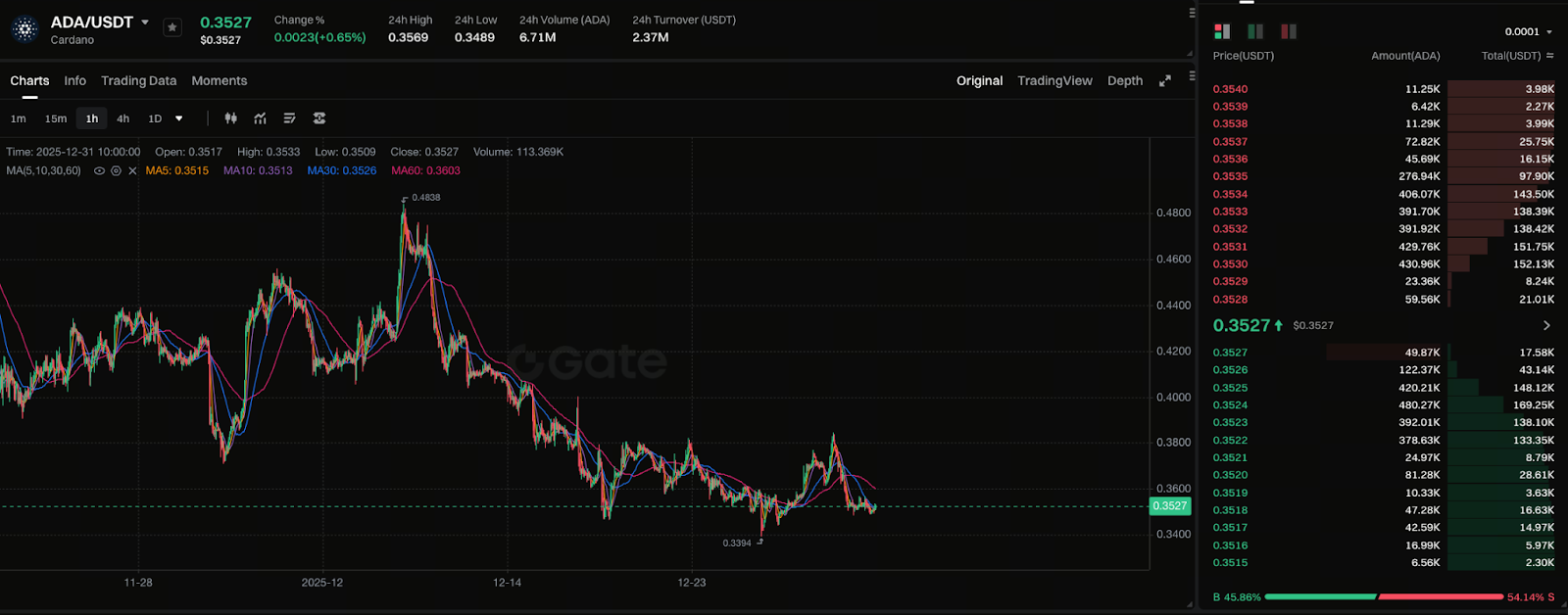

Chart: https://www.gate.com/trade/ADA_USDT

Recent data indicates that Cardano (ADA) is consolidating near the critical resistance level of $0.50. Market data shows ADA has hovered around its 50-day simple moving average, a sign of strong supply and demand dynamics at this price. A breakout above this resistance zone would be a key signal for bulls to initiate a new rally.

This consolidation suggests that buying and selling forces are nearly balanced, and the market is awaiting fresh momentum or fundamental catalysts to determine its next move. If ADA successfully breaks through $0.50, the next target may shift to a higher resistance level.

2. Midnight Token’s Sustained Rally Draws Attention
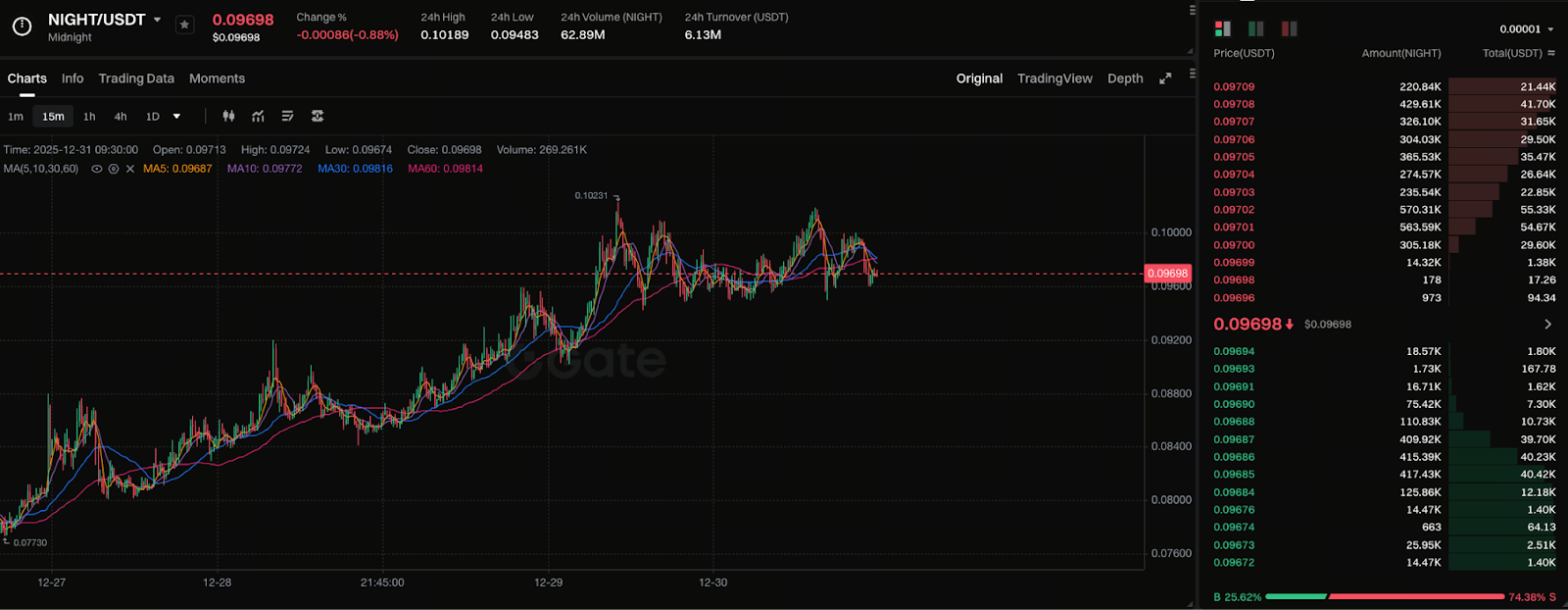

Chart: https://www.gate.com/trade/NIGHT_USDT

As Cardano consolidates, another emerging asset on CoinMarket—Midnight Token (symbol: NIGHT)—has caught the market’s attention with a standout performance. Multiple data sources report that NIGHT Token saw a sharp price surge in a short window, posting weekly gains of about 43% alongside a significant increase in trading volume.

Midnight Token’s breakout was further fueled by a social media mention from Cardano founder Charles Hoskinson, sparking a wave of trading activity. While some data points to a recent decline in trading volume (with the holiday period dampening overall market activity), analysts highlight that Midnight’s price remains elevated, reflecting sustained market interest in the asset.

3. Market Sentiment and Technical Analysis: A Dual Perspective

Market Sentiment

The current market sentiment is cautious. ADA’s consolidation near the $0.50 resistance underscores a clear divide among investors at higher price levels. Bulls are eager for a breakout to start a new uptrend, while bears test market resilience with selling pressure at the top.

Technical Indicators

  • Resistance at $0.50: This level has been tested several times without a breakout and remains a focal point for market participants.
  • Volume Indicators: Although trading activity has picked up due to the surge in NIGHT Token, ADA’s individual trading volume remains subdued.

4. Bull vs. Bear Dynamics: Resistance and Support Analysis

In the ongoing tug-of-war between bulls and bears, the most critical short-term support lies near $0.35. If ADA drops below this level, selling pressure could intensify and drive prices lower. Conversely, holding above $0.50 may attract new buyers and confirm a technical breakout.

Additionally, the strong momentum in NIGHT Token could create a spillover effect for ADA. As the Midnight ecosystem gains traction, it may enhance the perceived value of the Cardano network, indirectly supporting ADA’s price.

5. Medium- and Long-Term Outlook and Risk Considerations

Looking ahead, if Cardano breaks through its key resistance zone, bulls could regain the upper hand and kick off a new upward phase. If consolidation persists, market participants should monitor trading volume and other technical indicators closely.

Meanwhile, as a trending asset, Midnight Token remains highly volatile. Investors should be mindful of short-term trading risks and keep an eye on fundamental developments and ecosystem growth.

Conclusion

Cardano’s consolidation near $0.50 and Midnight Token’s strong rally are at the center of current market focus. Both technical and sentiment factors show a convergence of bullish and bearish forces. Investors should incorporate dynamic technical indicators and fundamental analysis into their trading strategies to better evaluate market opportunities and risks from a comprehensive perspective.

Author: Max
Disclaimer
* The information is not intended to be and does not constitute financial advice or any other recommendation of any sort offered or endorsed by Gate.
* This article may not be reproduced, transmitted or copied without referencing Gate. Contravention is an infringement of Copyright Act and may be subject to legal action.

Related Articles

What is Fartcoin? All You Need to Know About FARTCOIN
Intermediate

What is Fartcoin? All You Need to Know About FARTCOIN

Fartcoin (FARTCOIN) is a representative meme coin within the Solana ecosystem based on an AI-driven narrative. Its core concept originated from an experiment aimed at exploring the "boundaries between AI Agents and humor." More than just a digital asset with social attributes, the project deeply couples absurd humor culture with on-chain financial logic by integrating autonomous AI interaction models.
2026-04-04 22:01:19
Gold Price Forecast for the Next Five Years: 2026–2030 Trend Outlook and Investment Implications, Could It Reach $6,000?
Beginner

Gold Price Forecast for the Next Five Years: 2026–2030 Trend Outlook and Investment Implications, Could It Reach $6,000?

Analyze current gold price trends alongside authoritative five-year forecasts, integrating an evaluation of market risks and opportunities. This gives investors insight into the potential trajectory of gold prices and the main drivers expected to shape the market over the next five years.
2026-03-25 18:13:30
Aster vs Hyperliquid: Which Perp DEX Will Prevail?
Beginner

Aster vs Hyperliquid: Which Perp DEX Will Prevail?

Aster and Hyperliquid are the two representative protocols of the "purpose-built L1 path" within the current decentralized perpetual exchange (Perp DEX) sector. As a pioneer in the field, Hyperliquid has built a deep liquidity moat through its highly mature order book architecture and strong community consensus. Conversely, Aster, as a rising challenger, seeks to leapfrog the competition in high-performance trading through more aggressive multi-chain aggregation logic, private transaction modules, and an underlying execution environment optimized for 2026 market demands.
2026-03-24 11:58:33
AI-Native Settlement Layers: How United Stables Is Building the Next Financial Rail
Beginner

AI-Native Settlement Layers: How United Stables Is Building the Next Financial Rail

Stablecoins were originally designed as dollar substitutes within exchanges, primarily used for asset pricing and trade settlement. As on-chain financial ecosystems have matured, their role has expanded beyond simple payments to include collateral assets, cross-chain liquidity mediums, and unified settlement units. In particular, as AI systems and automated agents begin to participate directly in economic activity, demand has risen sharply for programmable value units capable of instant settlement. This shift is pushing stablecoins toward the role of foundational financial infrastructure.
2026-03-25 03:16:17
Aerodrome Tokenomics: How ve(3,3) Powers Base's Most Profitable DEX
Beginner

Aerodrome Tokenomics: How ve(3,3) Powers Base's Most Profitable DEX

AERO is the native token of Aerodrome Finance, a core decentralized exchange and liquidity protocol in the Base ecosystem. It is primarily used for liquidity incentives and ecosystem operations. veAERO is a governance NFT that users receive by locking AERO, representing both voting power and the right to share protocol revenue. Through a dual track structure of AERO as a utility token and veAERO as a governance credential, Aerodrome separates liquidity usage value from long term governance power, allowing participants to act as liquidity providers, governance decision makers, and revenue sharers within the same system.
2026-03-25 06:40:31
Hybrid Collateral Stablecoins: Inside United Stables' Stability and Yield Architecture
Beginner

Hybrid Collateral Stablecoins: Inside United Stables' Stability and Yield Architecture

In the early stages of the crypto market, traditional stablecoins mainly relied on single-reserve or single-collateral models. Their primary focus was price stability and payment convenience, which allowed them to become foundational tools for on-chain trading and capital flows. As the market has entered a more mature financial phase, however, this structure has begun to reveal limitations, including high concentration risk and the difficulty of balancing liquidity with yield. These constraints have driven the evolution toward multi-layer collateral and portfolio-based designs, such as the dual-layer hybrid collateral architecture proposed by United Stables, which seeks to redefine the underlying logic of stable assets.
2026-03-25 03:17:39