Decentralized finance (DeFi) initially developed around crypto-native assets, with lending, trading, and yield mechanisms primarily based on assets like ETH and stablecoins. While this model improves capital efficiency, it also has clear limitations, including a narrow range of assets and reliance on a single source of yield. Because most returns are driven by on-chain trading activity and market volatility, DeFi has historically struggled to establish a direct connection with the real economy.
The introduction of real-world assets (RWA) changes this dynamic. By mapping real-world debt-based assets onto blockchain networks, DeFi capital can participate in real economic activity and generate returns from actual cash flows.
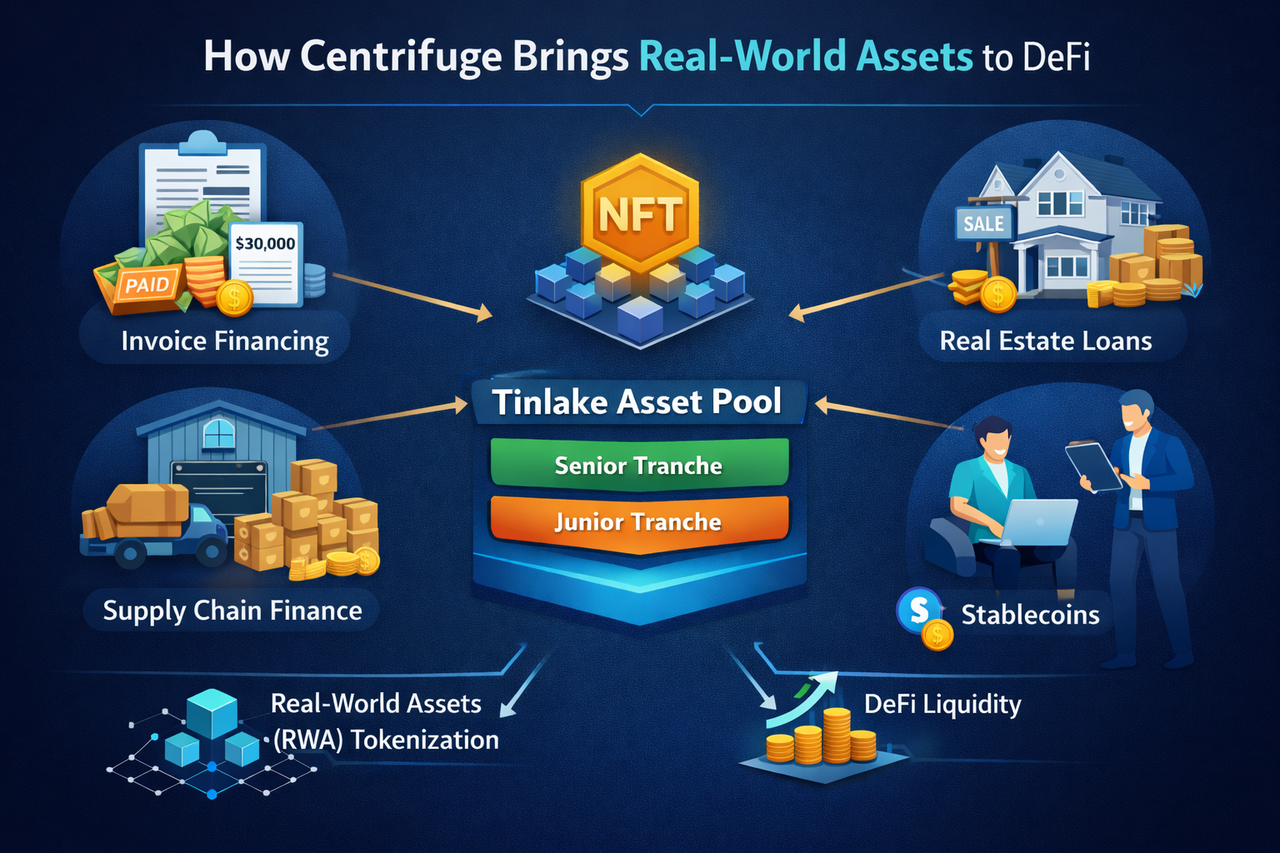
As a protocol focused on RWA financing, Centrifuge plays a central role in transforming traditional financial assets into on-chain financing instruments. Through asset pools and smart contract infrastructure, Centrifuge enables businesses to convert invoices, loan receivables, and other debt assets into on-chain financing opportunities while accessing on-chain liquidity. This creates a closed loop between real-world financing demand and blockchain-based capital, positioning Centrifuge as a key driver of RWA adoption in DeFi.
What Are Centrifuge’s Core Use Cases?
Centrifuge’s primary use cases focus on financing debt-based assets in the real world, including invoice financing, receivables financing, real estate loans, and private credit. These assets typically have predictable cash flows but are often illiquid and difficult to finance efficiently within traditional systems.
By tokenizing these assets and integrating them into on-chain asset pools, Centrifuge improves liquidity and enables them to enter decentralized financial markets. For asset holders, this means faster and more efficient access to capital. For investors, it opens exposure to yield streams derived from real economic activity.
How Does Invoice Financing Work on Centrifuge?
Invoice financing is one of the most prominent use cases of Centrifuge.
In traditional business operations, companies often wait for customers to settle invoices before receiving cash flow, which can slow down operations. With Centrifuge, businesses can bring unpaid invoices on-chain as financing assets and access liquidity provided by investors.
This allows companies to receive funds before invoice maturity, improving cash flow efficiency. At the same time, investors earn returns by funding these invoice-backed assets, creating a complete on-chain financing cycle.
How Does Supply Chain Finance Enter On-Chain Markets Through Centrifuge?
In supply chain finance, businesses often hold large volumes of receivables that tie up working capital. Traditional financing typically relies on bank credit and lengthy approval processes.
Centrifuge addresses this by converting supply chain receivables into on-chain financing assets that can be funded through DeFi liquidity pools. Businesses gain faster access to capital, while investors earn returns by supporting these financing needs.
This model reduces reliance on traditional intermediaries and enables more efficient capital flow within supply chain ecosystems through blockchain-based infrastructure.
Real estate loans represent another important application supported by Centrifuge.
In traditional finance, these assets are typically held and financed through institutional channels. With Centrifuge, real estate loan receivables can be tokenized and introduced into asset pools, allowing them to access on-chain liquidity.
This approach enhances liquidity for real estate-backed assets while offering investors exposure to returns linked to property markets, integrating real estate finance into the broader DeFi ecosystem.
How Does Centrifuge Unlock Liquidity for Private Credit?
Private credit refers to non-public loan assets issued by businesses or financial institutions, which are often illiquid and have limited financing options.
Through Centrifuge, these assets can be brought into on-chain pools and financed by DeFi capital. Asset holders gain liquidity, while investors participate in the yield generated by private credit assets.
This expands the range of assets supported in DeFi and enables private credit markets to connect with blockchain-based capital flows.
How Does Centrifuge Enable RWA to Enter On-Chain Financial Markets?
Centrifuge enables real-world assets to enter DeFi through a combination of tokenization and asset pool financing mechanisms.
First, real-world assets are represented as on-chain tokens. These tokens are then placed into financing pools, where investors supply stablecoins to fund them. Smart contracts manage capital deployment and return distribution, automating the financing lifecycle.
This structure allows real-world assets to access blockchain liquidity while enabling on-chain capital to participate in real economic activity, effectively integrating traditional finance with decentralized systems.
What Are the Advantages and Challenges of Centrifuge’s Use Cases?
The main advantage of Centrifuge’s use cases lies in improving financing efficiency for real-world assets while introducing diversified, real-economy-backed yield sources into DeFi. The on-chain asset pool model enhances transparency, increases liquidity, and reduces reliance on intermediaries.
However, challenges remain. These include verifying the authenticity of underlying assets, managing default risk, and navigating legal and regulatory requirements. Because these assets originate off-chain, the system still depends on legal frameworks and asset management practices outside the blockchain.
As a result, while Centrifuge expands the scope of RWA applications, it must balance on-chain efficiency with off-chain risk management.
Conclusion
Centrifuge’s use cases span invoice financing, supply chain finance, real estate loans, and private credit. Through asset tokenization and on-chain financing pools, these real-world assets can enter decentralized financial markets.
This model improves financing efficiency and introduces new sources of yield into DeFi, bridging the gap between traditional finance and blockchain-based systems. As RWA continues to gain importance in on-chain finance, Centrifuge is emerging as a critical infrastructure layer enabling this transition.
FAQs
What are Centrifuge’s main use cases?
They include invoice financing, supply chain finance, real estate loans, and private credit, all centered on real-world asset financing.
Why is invoice financing suitable for Centrifuge?
Because invoices have predictable cash flows, they can be tokenized and financed through on-chain pools, improving business cash flow efficiency.
How does Centrifuge support supply chain finance?
By tokenizing receivables and integrating them into asset pools, providing businesses with on-chain financing options.
How do real estate loans enter on-chain financial markets?
Loan receivables are tokenized and placed into asset pools, allowing them to access DeFi liquidity.
What is Centrifuge’s core value?
Its core value lies in enabling real-world assets to enter on-chain financial markets while connecting financing demand with DeFi liquidity.







