Why Do Blockchains Need Enterprise Privacy?
While most people view blockchains as transparent, this very feature can present challenges for enterprises.
For instance, making the following information fully public could introduce significant risks:
- Employee compensation
- Company fund allocation
- Business transaction details
Traditional public blockchains use addresses to mask identities, but transactions remain traceable and analyzable, which falls short of enterprise security needs. Conversely, fully closed private chains provide privacy but lack interoperability with other systems and may suffer from limited liquidity.
What Are Zones?
 (Source: tempo)
Zones, as proposed by Tempo, are a design that bridges public and private blockchains. The core idea is to create multiple semi-enclosed operational spaces on a single mainnet.
Key characteristics of these Zones include:
-
Independent operating environments
Each Zone functions as a parallel, self-contained blockchain with its own transaction processing mechanism.
-
Private transaction details
Transactions within a Zone are hidden from external view and accessible only to relevant participants.
-
Connectivity with the mainnet
While data remains private, assets can move freely between the mainnet and other Zones.
How Zones Work
Each Zone is operated by a designated entity, such as a financial institution or infrastructure service provider. Operators are responsible for transaction processing, maintaining system stability, and setting access permissions. Importantly, these operators have visibility into all transaction data within their respective Zones.
This structure is intentional—not a flaw—as it enables regulatory compliance, including:
- Regulatory reporting
- Anti-money laundering (AML)
- Audit requirements
Balancing Privacy and Trust
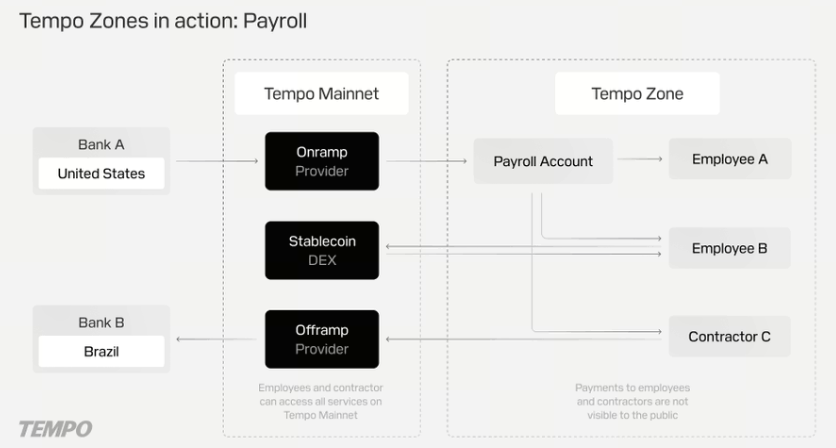
Tempo defines varying levels of visibility for different roles:
- Users: can only view their own assets and transactions
- Zone operators: have access to all activities within their Zone
- External parties: see only cryptographic verification results, not transaction details
(Source: tempo)
This approach addresses the core challenge of finding a practical balance between privacy and transparency.
Asset Security
Although Zones are managed by specific entities, operators cannot control user assets—a critical safeguard. All funds remain locked in Smart Contracts on the mainnet, and only asset holders can withdraw their assets.
Additionally, Tempo assets feature enhanced control mechanisms, including:
- Whitelisting
- Asset freezing
These controls can be consistently enforced across different Zones, strengthening overall compliance.
Tempo: A Blockchain Purpose-Built for Payments and Institutions
Tempo is a Layer 1 blockchain co-developed by Stripe and Paradigm, with design goals distinct from traditional public blockchains.
Its core positioning features:
-
High-performance transactions
Supports extremely high throughput for large transaction volumes, with near-instant confirmation times
-
Stablecoin-first approach
Optimized specifically for stablecoin transfers and settlements
-
Enterprise-focused architecture
Enables payment, clearing, and fund management use cases
Expanding from Payments to the AI Economy
Beyond Zones, Tempo has introduced the Machine Payments Protocol to support future AI-driven automated transactions. This paves the way for payments not just between people, but directly between AIs—a new paradigm in digital commerce.
Ecosystem Growth: Institutional and Service Provider Participation
Since the Tempo mainnet launch, leading enterprises and service providers—including Visa, Shopify, and OpenAI—have joined the ecosystem. Several major financial institutions have also become validator nodes, signaling Tempo’s evolution toward an institutional-grade blockchain.
Conclusion
Tempo’s introduction of Zones marks a pivotal shift in blockchain technology, moving beyond the binary of fully public or fully private systems toward adaptable privacy layers. For enterprises, this approach better aligns with real-world needs—protecting sensitive data while preserving the liquidity and interoperability that blockchain enables. Whether this model becomes mainstream will depend on enterprise adoption and the evolving regulatory landscape.







