I. Event Overview and Market Context
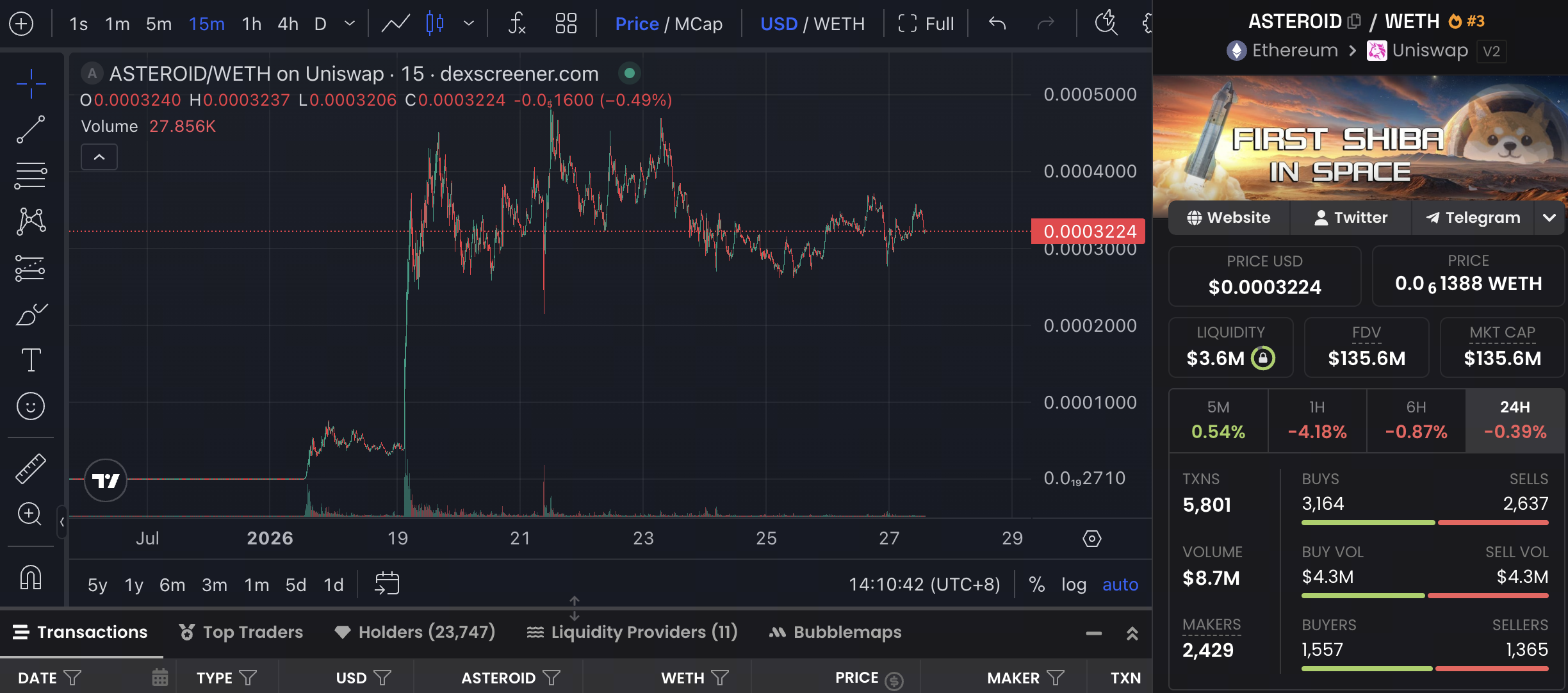
Image credit: Dexscreener
In April 2026, Ethereum on-chain meme tokens once again took center stage in the market. Multiple new projects rapidly moved from zero liquidity to multi-million dollar market caps, with some tokens posting gains of dozens or even hundreds of times. This surge was accompanied by a spike in on-chain trading activity and Gas consumption.
It's important to note that this boom does not signal the start of a full-blown bull run. Instead, it reflects "marginal asset expansion amid a rebound in risk appetite." The meme zone typically emerges in the early or middle stages of a cycle, serving to amplify liquidity and sentiment rather than drive overall market trends.
Historically, heightened meme activity often signals three things:
- Capital begins to flow from mainstream assets into high-volatility tokens
- Mainstream assets (such as ETH) enter a relatively stable phase
- The share of short-term traders rises significantly
Thus, the current ETH meme wave is fundamentally the result of structural shifts, not an isolated event.
II. Data and Timeline: Structural Shifts Behind the Activity
On-chain data reveals this cycle is characterized by "high activity and rapid elimination." Trading volumes have soared, but project survival rates are extremely low, highlighting a market preference for short-term speculation over long-term development.
The current structure can be understood across three dimensions:
Trading Layer: Explosive Volume, Limited Sustainability
- Single-day meme token trading volume has reached the billion-dollar level
- Trading peaks within the first 12–24 hours after a new token launch
Supply Layer: Explosive Growth in Issuance
- The number of new meme tokens issued daily has surged
- The vast majority of projects lack ongoing liquidity support
Lifecycle: Drastically Shortened
- Most projects lose trading activity within 24–72 hours
- Only a select few are able to sustain their narrative
This structure points to the emergence of a "high-frequency filtering mechanism": a wave of projects are rapidly created, traded, and eliminated, with only a handful of assets surviving.
This is a sharp departure from the "gradual diffusion" logic of traditional bull markets, resembling instead a high-turnover, speculative arena.
III. Driving Mechanisms: Liquidity, Narrative, and Trading Logic
The ETH meme wave is driven by multiple overlapping structural factors—not just a single cause.
Liquidity is the first driver. Ethereum remains one of the most concentrated networks for stablecoins and mainstream capital. When risk appetite returns, funds flow easily into the ETH ecosystem for high-frequency trading. Mature DEX infrastructure and Wallet tools have further lowered the entry barrier for meme trading.
The second driver is narrative. Meme tokens are fundamentally "propagation assets," with prices driven by consensus and virality, not underlying value. This cycle's narrative has notably evolved:
- From single animal memes to AI, politics, and trending themes
- From organic community growth to KOL and capital-driven promotion
- From cultural symbols to financial trading instruments
Finally, trading logic has shifted. The market now demonstrates a clear trend toward strategic approaches, including:
- Wallet Address tracking and Smart Money monitoring
- Automated Copy Trading and Bots
- Liquidity sniping and launch-phase trading strategies
These behaviors are transforming the meme market from one driven by retail sentiment to a semi-professionalized contest.
IV. ETH and Meme: The Feedback Loop
ETH and meme tokens are interconnected through a pronounced two-way feedback mechanism.
In a positive cycle:
- ETH price stability → creates a low-volatility environment
- Meme activity increases → draws in on-chain trading
- Trading surges → Gas consumption rises
- Network demand increases → supports ETH price
In a negative cycle:
- Meme market drawdown
- Liquidity exits rapidly
- On-chain activity falls
- ETH faces short-term selling pressure
This mechanism makes memes an "amplifier" for ETH in the current cycle. Memes don't dictate the trend, but they accelerate its formation or reversal.
V. Evolution of Market Behavior: Strategic Trading Emerges
Compared to the last cycle, participation in the meme market has changed significantly. Previously, the norm was indiscriminate chasing of gains; now, structure and signals take center stage. Traders are paying attention to:
- Initial liquidity size and lock-up status
- Concentration of holdings by Wallet Address
- Community growth rates and dissemination paths
These shifts can be summarized as:
- From "sentiment-driven" → "signal-driven"
- From "long-term fantasy" → "short-term realization"
- From "retail-dominated" → "strategist participation increases"
It's important to stress that this evolution hasn't reduced risk; instead, it has made the competitive landscape more complex. The market remains highly competitive and essentially zero-sum.
VI. Risk Structure: Extreme Asymmetry in Return and Risk
The defining feature of the ETH meme market is the extreme asymmetry between returns and risk. A few early participants can capture extraordinary gains, while the majority face losses or total wipeout.
Key risks include:
- Manipulation Risk
- Project teams or large investors control liquidity
- Artificial price surges created through fake filled amounts
- Liquidity Risk
- High trading volume doesn't guarantee real capital
- Liquidity can vanish in a short period
- Zeroing Risk
- Project lifecycles are extremely short
- Rug pulls and project abandonment are common
- Concentration Risk
- Holdings concentrated in a few addresses
- Prone to coordinated price control and sell-offs
This means the market isn't simply "high risk, high reward." Instead, a tiny minority earn outsized returns while the majority absorb systemic losses.
VII. Narrative Upgrade: The "Financialization" of Memes
One of the most significant changes in this ETH meme wave is the clear upgrade in narrative.
Early memes were extensions of internet culture; now, they're increasingly connected to real-world trends and display stronger capital characteristics. For example:
- Linked to AI technology trends
- Associated with celebrities or political events
- Leveraging trending topics as gateways for traffic
The impact of this shift includes:
- Memes are no longer just community phenomena—they're tools for capital operations
- Narrative cycles are shorter but more explosive
- Information asymmetry has intensified
In short, memes are evolving from "cultural assets" to "trading tools," with financial attributes becoming much more pronounced.
VIII. ETH Meme Wave: Potential Development Paths
Given the current structure, the ETH meme wave could evolve along three paths:
Scenario 1: Continued Expansion (Bullish)
If liquidity keeps flowing in and ETH price remains stable, memes may continue to serve as a gateway for on-chain traffic, driving higher activity and broader wealth effects.
Scenario 2: High-Frequency Volatility (Neutral)
If incremental capital is lacking, memes will remain active but rotate in short cycles, making it difficult to sustain trends. Trading opportunities will hinge more on timing than direction.
Scenario 3: Rapid Retreat (Bearish)
If macro or market risks rise, funds could quickly exit high-risk assets, draining meme market liquidity and sending many projects to zero.
Conclusion
The ETH meme wave is not an isolated phenomenon, but the product of liquidity, sentiment, and trading structure acting in concert. It reflects a rebound in risk appetite but also exposes a highly unstable capital structure.
For participants, the key isn't whether to participate, but whether you understand the underlying logic:
- Memes are driven by sentiment, not fundamentals
- Returns depend on timing, not value accumulation
- Risks stem from market structure, not isolated incidents
At this stage, ETH memes are best viewed as a high-frequency contest—rather than an investment track with long-term certainty.