Ethereum is navigating a paradox: it aims to ossify its base protocol—locking in core rules, halting changes, and ensuring predictability—while simultaneously driving the system at an unprecedented pace. Layer 2 solutions are scaling up, Fusaka is paving the way for a tenfold increase in data capacity, the Ethereum Virtual Machine (EVM) is being reengineered, and validators are actively adjusting gas limits. Every component is in motion.
The ossification thesis suggests Layer 1 can be frozen so that innovation happens on higher layers. But is this really true? Or is Ethereum simply rebranding ongoing changes as “minimalism” because it sounds more responsible?
Let’s look at what the Fusaka upgrade actually delivers. Fusaka introduces the PeerDAS mechanism, fundamentally changing how validators verify data. Validators are no longer required to download full rollup data blocks; instead, they randomly sample portions of data and use erasure codes to reconstruct the complete dataset. This marks a major architectural shift for the network and is being rolled out as part of the “Surge” scaling phase.
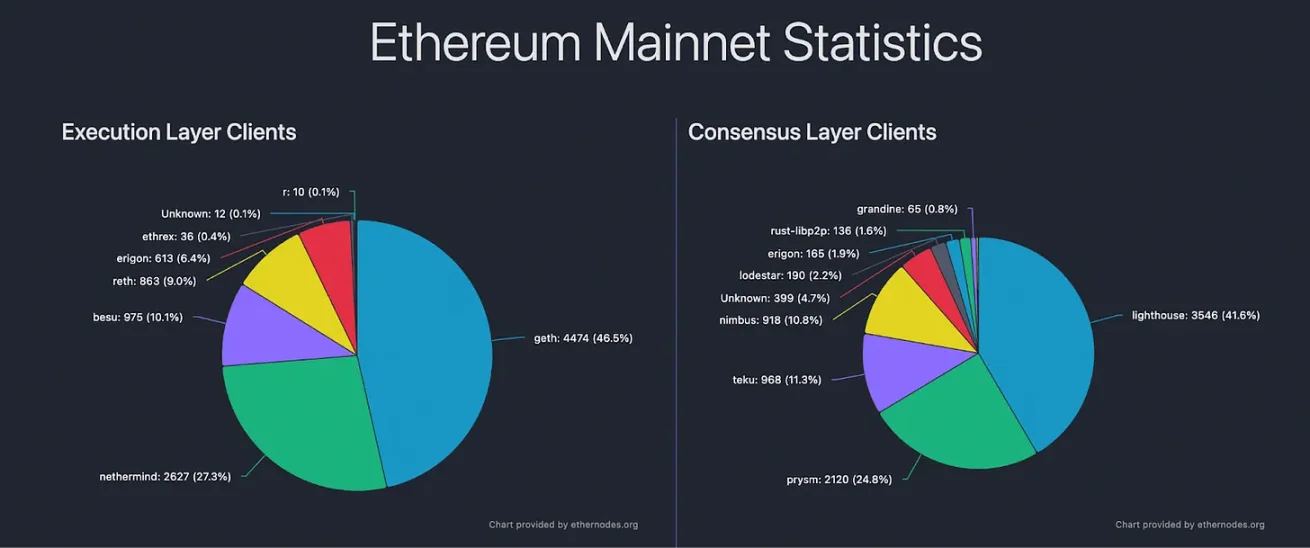
There are also forks that adjust only blob parameters. These smaller hard forks are designed to incrementally increase data capacity. Fusaka launched on December 3. The first BPO fork will go live on December 17, raising the blob target from 6 to 10; the second fork on January 7 will push it to 14. The end goal is for each block to support 64 blobs—an eightfold increase over current capacity.
Is this ossification? Clearly not. These are iterative, scheduled capacity expansions with rules still changing—just in smaller, more predictable increments.
Consider EIP-7918, which sets a minimum reserve price for blob gas fees. In effect, Ethereum controls the data availability market and now charges a floor fee even when demand is low.
This demonstrates Ethereum’s pricing power and its strategy for value capture as the foundational data layer for Layer 2 solutions. While this may be a smart business move, it is not ossification; quite the opposite, it’s the base network actively managing its relationship with Layer 2s to maximize value.
So, what does ossification mean here?
It means the protocol wants to stop changing its core rules, but will continue to fine-tune parameters:
- Freeze the consensus mechanism (maintain proof-of-stake, PoS)
- Freeze monetary policy (keep the EIP-1559 burn mechanism)
- Freeze core opcodes (smart contracts from 2020 still run smoothly)
But throughput, data capacity, gas limits, and fee structures? These remain in flux.
It’s like claiming the Constitution is “frozen” because amendments are rare, even though the Supreme Court reinterprets it every decade. Technically accurate, but in reality, it’s always evolving.
The Ingenuity of the Ethereum Interoperability Layer (EIL)
If Ethereum wants to present itself as a single chain while actually comprising dozens of Layer 2s, it needs a unifying layer. That’s the role of the Ethereum Interoperability Layer (EIL).
EIL is designed to give users a seamless “single Ethereum” experience across independent Layer 2s, without introducing new trust assumptions. Technically, users sign a single Merkle root to authorize synchronized operations across multiple chains. Cross-chain liquidity providers (XLPs) use atomic swap processes backed by base layer staking to front the necessary gas fees and funds for each chain.
The critical detail is that XLPs must lock collateral on Ethereum’s base layer and set an 8-day unlock delay. This is longer than the 7-day fraud proof window for Optimistic Rollups. If an XLP tries to cheat, the fraud proof mechanism has enough time to penalize their staked assets before funds are withdrawn.
This design is clever, but it introduces a new layer of abstraction: users no longer manually bridge assets between Layer 2s—they rely on XLPs to handle transfers. The system’s effectiveness depends on whether XLPs are reliable and competitive; otherwise, fragmentation will reappear in a new form.
EIL’s success also depends on adoption by wallets and Layer 2s. The Ethereum Foundation can build the protocol, but if major Layer 2s keep users locked in their own ecosystems, EIL will be purely cosmetic. This is the “HTTP dilemma”: even the perfect standard can’t prevent fragmentation if platforms refuse to implement it.
BlackRock and the “Comfort Cage”
Meanwhile, Ethereum is attracting significant institutional capital. BlackRock launched the iShares Ethereum Trust ETF in July 2024. By mid-2025, inflows exceeded $13 billion, and BlackRock subsequently filed for a staked Ethereum ETF. Institutions want more than exposure—they want yield.
BlackRock is also leveraging Ethereum as infrastructure: its BUIDL fund tokenizes US Treasuries and money market instruments, deploying them on Ethereum and expanding to Layer 2s such as Arbitrum and Optimism. Ethereum, in BlackRock’s view, is a neutral settlement layer, much like the internet’s TCP/IP protocol.
This is both validation and control. When BlackRock designates Ethereum as the infrastructure layer for tokenized assets, it’s a vote of confidence—but it also means Ethereum starts optimizing itself for BlackRock’s requirements: predictability, stability, compliance-friendly features, and the reliable, if unexciting, attributes of foundational infrastructure.
Vitalik has warned about this risk. At DevConnect, he noted that if base layer decisions cater primarily to Wall Street’s “comfort,” it can cause problems: if the protocol leans toward institutions, the decentralized community will gradually disappear; if it favors the cypherpunks, institutions will pull out. Ethereum is trying to straddle both worlds, and the tension is intensifying.
There’s also the speed issue: some proposals advocate shrinking block times to 150 milliseconds, which favors high-frequency trading and arbitrage bots but makes it impossible for regular users to participate in governance or build social consensus at such speeds. If the network runs too fast, it becomes a “machine-to-machine” tool, eroding the political legitimacy that gives Ethereum its value.
Quantum Computing and the Coming Demise of Elliptic Curves
Quantum computing is another looming threat. At DevConnect, Vitalik declared, “Elliptic curves will eventually die.” He was referring to elliptic curve cryptography (ECC), which secures user signatures and validator consensus. Quantum computers running Shor’s algorithm can derive private keys from public keys, breaking ECC’s security.
Timeline? Possibly before the next US presidential election in 2028. That gives Ethereum roughly 3 to 4 years to migrate the entire network to quantum-resistant cryptography.
In this context, ossification becomes irrelevant.
If quantum attacks materialize, Ethereum would need disruptive, large-scale hard forks to survive. Regardless of how stable the protocol is, if its cryptographic foundation collapses, everything is lost.
Ethereum is better positioned than Bitcoin:
- Public keys are concealed by address hashes and only exposed during transfers
- Validator withdrawal keys are similarly hidden
- The roadmap already includes quantum-resistant alternatives to ECDSA, such as lattice-based cryptography and hash-based signatures
However, executing this migration poses massive coordination challenges: how do you convert millions of users’ keys without jeopardizing their funds? How do you set deadlines for wallet upgrades? What happens to legacy accounts that don’t migrate? These are not just technical problems—they raise social and political questions about who decides the network’s future.
The quantum threat illustrates a fundamental truth: ossification is a choice, not a law of nature. Ethereum’s “skeleton” can remain frozen only as long as the environment allows; when conditions change, the network must adapt or die.
Additionally, Vitalik donated $760,000 to encrypted messaging apps Session and SimpleX, stating that privacy “is critical for protecting digital privacy,” and set the next goal as permissionless account creation and metadata privacy.
The Ethereum Foundation has launched a privacy task force to make privacy a default feature, not an afterthought. Projects like the Kohaku wallet are building user-friendly privacy tools that don’t require users to understand complex cryptography.
The core idea is “privacy as hygiene”—as routine as washing your hands. People shouldn’t need a special reason to seek financial privacy; it should be the default.
This stands in contrast to regulatory demands for transparency and traceability. Stablecoins, tokenized Treasuries, and BlackRock’s BUIDL fund—all carry compliance expectations. Ethereum cannot serve as Wall Street’s infrastructure layer and simultaneously fulfill the cypherpunk dream of “privacy first.” There may be a way to reconcile both, but it will require exceptionally sophisticated design.
The Shark That Wants to Freeze
Can Ethereum strike this balance?
- Freeze the base layer while letting Layer 2s innovate?
- Appease both BlackRock and the cypherpunks?
- Complete cryptographic upgrades before quantum computers arrive?
- Maintain default privacy without alienating institutions?
It might be possible. The modular architecture is clever: the base layer handles security and settlement, Layer 2s handle execution and experimentation. This separation could work. But it requires EIL to unify the Layer 2 experience and institutions to trust that the base layer won’t change in ways that break their expectations.
It also means the Ethereum community must accept that ossification comes at the cost of some control. If the protocol is frozen, the community can’t fork to fix issues or add features. It’s a trade-off: stability means sacrificing flexibility.
Sergey argues that Ethereum needs to keep evolving, and he’s right; but Vitalik insists the protocol can’t change forever, which is also valid. The key is to let innovation flourish at the edges while keeping the core stable.
The shark claims it wants to freeze, cryptographers say the bones need replacing, Wall Street wants a compliant tool, and cypherpunks want wild freedom.
Ethereum is trying to be all these things at once, and blocks keep rolling out. That’s Ethereum: cold bones, a moving shark.
Statement:
- This article is republished from [Foresight News], with copyright belonging to the original author [Thejaswini MA]. If you have any concerns regarding this republication, please contact the Gate Learn team, and we will address your request promptly according to our procedures.
- Disclaimer: The views and opinions expressed in this article are solely those of the author and do not constitute investment advice.
- Other language versions of this article are translated by the Gate Learn team. Do not copy, distribute, or plagiarize the translated article without crediting Gate.







