With the official launch of the Ethereum Interoperability Layer (EIL), over 60 major Rollups—including Arbitrum, Optimism, and Base—now support second-level asset transfers and state synchronization. Currently, the Total Value Locked (TVL) of the L2 ecosystem accounts for more than 75% of the total Ethereum network.
From the macro perspective of modular blockchains, the significance of Layer 2 lies in reshaping Ethereum from a “monolithic processor” into a “universal base asset” for global digital finance. This not only resolves the performance anxiety caused by the explosive growth of the application layer but also provides flexibility for vertical industries through customized AppChains.
Why Does Ethereum Need Scaling Solutions?
As a decentralized global computer, Ethereum relies on a strict consensus mechanism on its mainnet, also known as Layer 1. As a result, it can process only about 15 transactions per second. When the network becomes congested, Gas fees can surge to levels that are unaffordable for ordinary users.
Because Layer 1 upgrades such as sharding have progressed slowly and cannot meet short term demand, Ethereum has adopted a Rollup centric development roadmap. The core idea is to move most computation off chain while keeping critical transaction data on chain. This approach significantly increases throughput while preserving security.
What Is Layer 2?
Layer 2 is a secondary network architecture built on top of Layer 1. It processes most transaction computations off chain and submits only compressed data or cryptographic proofs to the mainnet. By inheriting the security and decentralization of the mainnet while reducing fees and latency, Layer 2 makes large scale usage more practical. Common types include sidechains, state channels, and Rollups.
If we compare the Ethereum mainnet to a busy court responsible for final judgments and security, Layer 2 functions like regional mediation centers that handle everyday cases. After processing thousands of cases, these centers submit a summarized report to the court, dramatically reducing the court’s workload.
The key characteristics of Layer 2 include:
- Transaction computation occurs on the second layer.
- Final state settlement is secured by the main chain.
- User assets ultimately rely on mainnet security.
Layer 2 is not an independent blockchain. It is tightly coupled with the main chain. The main chain provides consensus and finality, while Layer 2 handles high frequency execution.
The Core Idea Behind Rollups
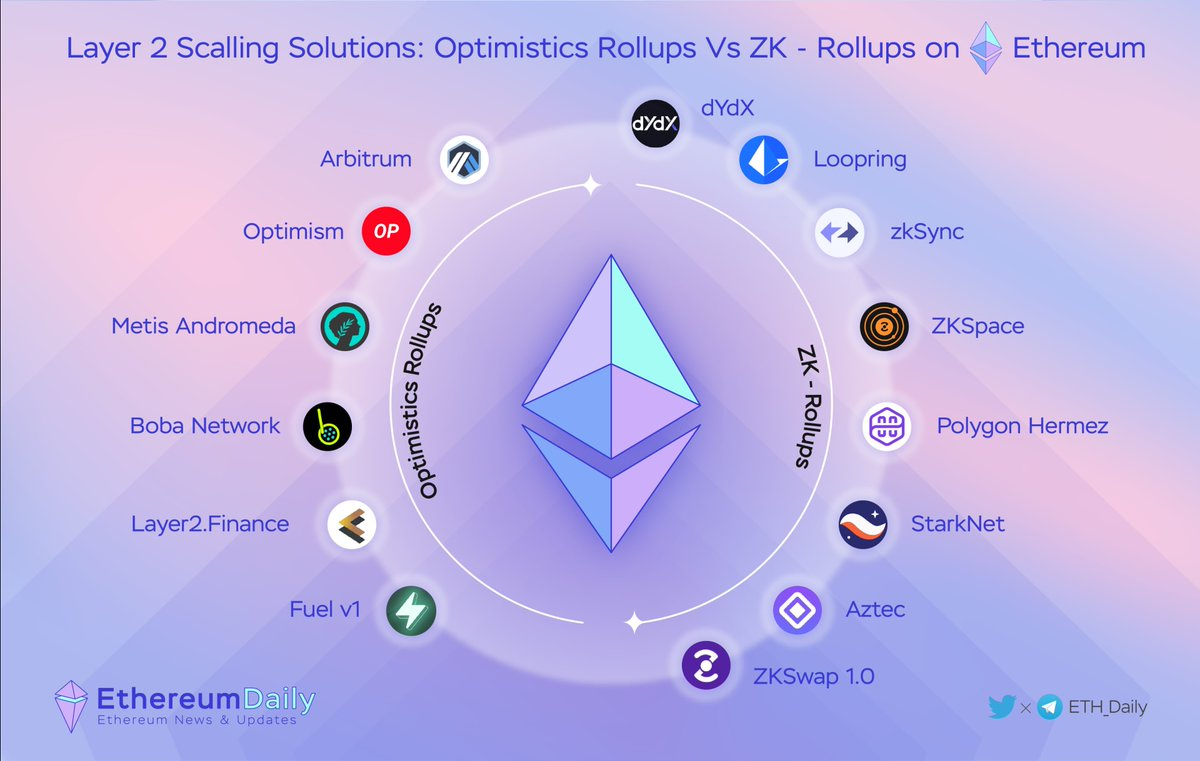
Rollups are currently the most widely adopted Layer 2 scaling technology. The term “roll up” refers to bundling and compressing large numbers of transactions before submitting them to the main chain. Rollups generally fall into two categories: Optimistic Rollups and ZK Rollups.
The fundamental idea is to aggregate many transactions into a single batch, store only the necessary data and verification information on chain, and thereby dramatically increase throughput while inheriting the security of the mainnet.
Their operation can be summarized in three stages:
- Off chain execution: Transactions are executed quickly by Layer 2 nodes, producing updated state results.
- Batch aggregation: Hundreds or thousands of transactions are compressed into a data batch, and a corresponding state root is computed.
- State submission: The batch data and its validity information, such as fraud proofs or zero knowledge proofs, are submitted to the main chain for final confirmation and settlement.
Through this architecture, which shifts “computation off chain while anchoring results on-chain”, Rollups strike a balance between performance and inherited security. The main chain focuses on consensus and data availability, while high frequency computational activity takes place on Layer 2. This design has become central to Ethereum’s scaling roadmap.
How Optimistic Rollups Work
Optimistic Rollups assume that all transactions are valid by default. A Sequencer collects user transactions, executes them, and submits the new state root along with compressed transaction batches to the mainnet. During a challenge window, typically 7 days, anyone can submit a Fraud Proof. If fraud is proven, the invalid state is rolled back; otherwise, the state becomes final. Representative projects include Optimism and Arbitrum.
The process unfolds as follows:
- Trigger: A user initiates a transaction, and the Sequencer receives and orders it.
- Default assumption: The system presumes all submitted data is valid and does not verify it in real time.
- Challenge mechanism: A challenge period, usually seven days, is established. During this window, any validator who detects fraud may submit a Fraud Proof.
- Outcome: If no challenge succeeds within the window, the transaction state is finalized. If a challenge succeeds, the malicious party is penalized and the incorrect data is reverted.
How ZK Rollups Work
ZK Rollups rely on validity proofs based on zero knowledge cryptography. The Sequencer executes transactions off chain, generates a new state root, and submits it to the mainnet along with a ZK proof. Validators on the mainnet verify the proof immediately. Because the proof is mathematically sound, it cannot be forged, and no challenge period is required. This enables near instant confirmation. Representative projects include zkSync and Starknet. While highly performant, generating proofs is computationally intensive.
The logic is as follows:
- Mathematical verification: Each batch of transactions is accompanied by a zero knowledge proof, such as a SNARK or STARK.
- Immediate settlement: A smart contract on Ethereum verifies the validity of the proof.
- Security: Because the mathematical proof cannot be falsified, ZK Rollups do not require a challenge period. Withdrawals are faster and security is strong.
Security Model and Data Availability
The core of Layer 2 security lies in data availability. This means that even if all Layer 2 nodes stop operating, users can still reconstruct their balances using the compressed data published on the Ethereum mainnet and safely withdraw their funds. This is why Rollups are considered to “inherit the security of the main chain”.
In terms of computational correctness, the two Rollup approaches differ. Optimistic Rollups rely on fraud proofs, while ZK Rollups depend on validity proofs. Both methods ensure that state updates remain verifiable.
In addition, Layer 2 systems must satisfy several essential security properties:
- Asset ownership: Users retain ultimate control over their assets. Layer 2 operators cannot unilaterally freeze or misappropriate funds.
- Censorship resistance: If a Layer 2 node refuses to process a transaction, users can typically rely on a forced exit mechanism on the mainnet to protect their assets.
Risks and Challenges Facing Layer 2
Although Layer 2 solutions have accelerated Ethereum scaling, several issues have emerged in recent years, including recurring security vulnerabilities, liquidity fragmentation, and limited value capture for the main chain.
Multiple Optimistic Rollup bridge attacks have resulted in losses exceeding one billion US dollars. Users often rely on centralized Sequencers, creating single points of failure. Liquidity fragmentation has further worsened the user experience. Large amounts of capital are spread across dozens of Layer 2 networks, cross chain bridge fees remain high, and more than fifty billion US dollars in Ethereum DeFi total value locked is concentrated on Layer 2, providing limited economic feedback to the mainnet.
In February 2026, Vitalik Buterin suggested that Layer 2 projects should move beyond marketing themselves solely as scaling solutions. Instead, they should focus on functional value that Layer 1 cannot deliver in the short term, such as privacy transactions enabled by zero knowledge proofs, gaming, social applications, AI specific optimizations, millisecond level confirmations, and non-financial use cases. This signals a shift in Layer 2’s role from a simple scaling substitute toward broader functionality.
Conclusion: The Role of Layer 2 in Ethereum’s Architecture
Layer 2 is a crucial component of Ethereum’s scaling strategy. Its goal is to increase network throughput and lower costs without compromising decentralization or security. Through batch processing and data compression, Rollups move large amounts of computation off chain while relying on the main chain for final settlement.
Optimistic Rollups and ZK Rollups differ in their verification models and finality assumptions, but both embody the same architectural principle: shifting computation off chain while inheriting mainnet security.
Overall, Layer 2 represents a key step in Ethereum’s path toward mainstream adoption. By outsourcing complex computation to Rollups, the Ethereum mainnet can concentrate on secure and decentralized consensus. At the same time, the past few years have exposed challenges such as liquidity fragmentation, security vulnerabilities, and limited value return to the main chain. In the future, Layer 2 may evolve from a pure scaling solution into a more diversified layer focused on functional innovation.
FAQs
Is Layer 2 an independent blockchain?
No. Layer 2 relies on the main chain for settlement and security.
Do Rollups operate entirely independently from the main chain?
No. Final state updates must still be submitted to the main chain for confirmation.
Which is more secure, Optimistic Rollups or ZK Rollups?
Their security models differ, but both depend on the main chain. ZK Rollups use mathematical proofs for immediate verification, while Optimistic Rollups rely on a challenge period to ensure correctness.
Does using Layer 2 completely eliminate Gas fees?
No. Fees cannot be entirely avoided, but they are typically much lower than on the main chain.
Has Layer 2 solved all of Ethereum’s scalability challenges?
Layer 2 improves transaction efficiency, but long term scalability will still require protocol upgrades and architectural optimization.