Meme tokens originated from internet culture and Group-driven momentum, establishing a distinct asset class in the crypto Marketplace. Dogecoin was an early pioneer, introducing Meme culture to blockchain, while Shiba Inu and Floki gradually extended their community-driven foundations toward broader ecosystem applications.
As the blockchain industry matured, Meme tokens evolved from digital assets reliant solely on Group consensus into on-chain ecosystem projects featuring diverse functional modules. Floki, Dogecoin, and Shiba Inu each chart unique paths for Meme assets across payments, DeFi, and multi-chain applications.
Dogecoin vs Shiba Inu vs Floki: Introduction and Positioning Differences
Dogecoin, one of the earliest Meme crypto assets, emerged during the internet culture boom. Designed to showcase the open nature of digital currency with humor and ease, Dogecoin operates on its own blockchain network and is primarily positioned as a peer-to-peer value transfer tool.
Dogecoin maintains a straightforward functional profile, focusing on payment and transfer use cases. Its design prioritizes serving as a transaction medium, resulting in limited ecosystem expansion and a strong community-driven payment asset orientation.
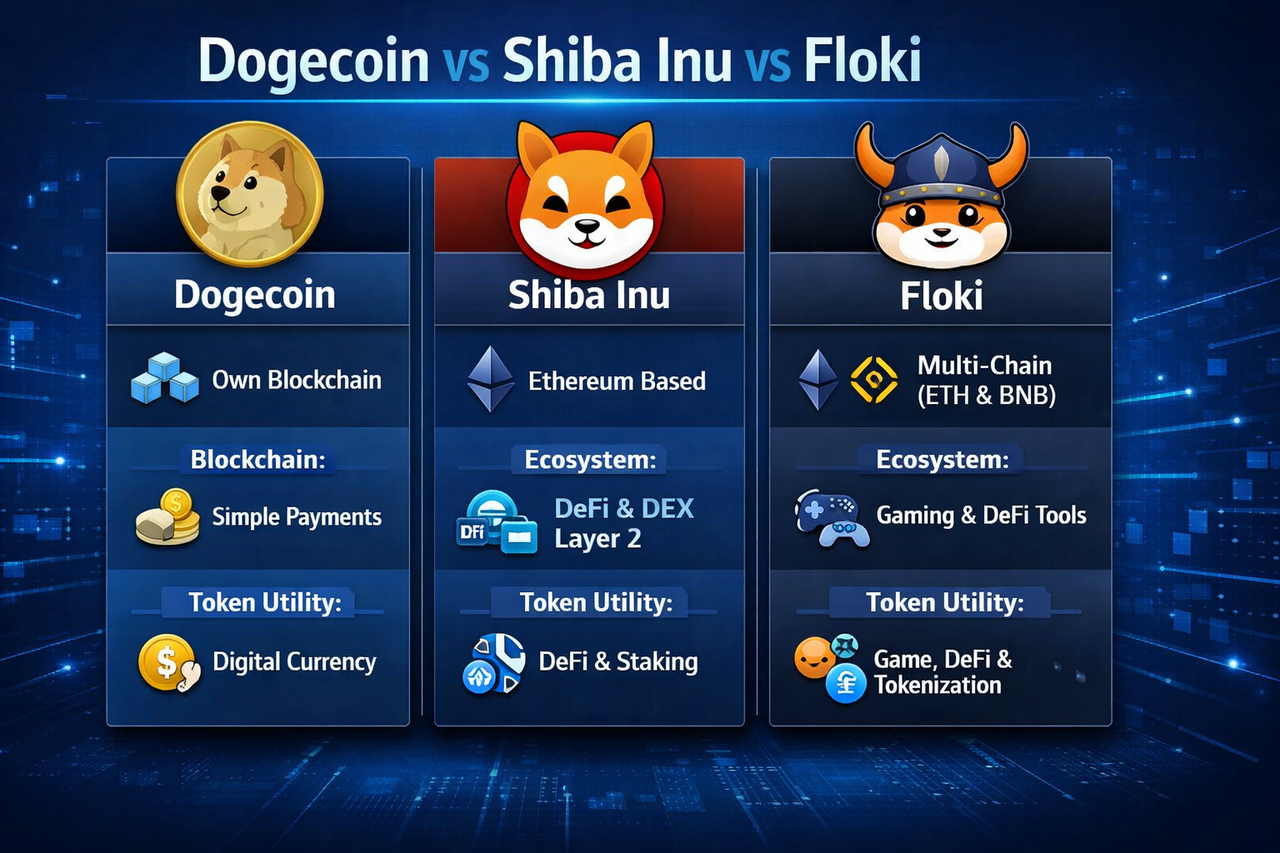
Shiba Inu, a Meme token built on the Ethereum network, was initially rooted in community culture but later expanded to include decentralized trading, NFT, and Layer2 ecosystem modules.
Compared to Dogecoin, Shiba Inu places greater emphasis on ecosystem development. By introducing multiple functional tokens and infrastructure modules, it has evolved from a single Meme asset into a complex on-chain application ecosystem with enhanced functional scalability.
Floki, a multi-chain Meme asset deployed on Ethereum and BNB Chain, builds ecosystem modules—including blockchain gaming, DeFi tools, and tokenization platforms—on a Group-driven foundation. Compared to Dogecoin and Shiba Inu, Floki’s design highlights the dual focus of “community dissemination + application ecosystem.” Through modules like Valhalla, FlokiFi, and TokenFi, FLOKI establishes functional scenarios and a distinct ecosystem synergy.
Core Differences Among the Three Meme Projects
| Comparison Dimension |
Dogecoin |
Shiba Inu |
Floki |
| Underlying Architecture |
Independent blockchain |
Ethereum |
Ethereum + BNB Chain |
| Core Positioning |
Payment token |
Meme + DeFi |
Meme + multi-scenario ecosystem |
| Ecosystem Modules |
Limited |
DEX, Layer2 |
Gaming, DeFi, tokenization |
| Expansion Capability |
Medium |
High |
High |
| Token Function |
Payment |
Payment + DeFi |
Ecosystem utility |
Structurally, Dogecoin retains its payment focus, Shiba Inu leans toward DeFi ecosystem expansion, while Floki emphasizes multi-chain and multi-module synergy.
How Do Floki, Dogecoin, and Shiba Inu Differ in Underlying Architecture?
Dogecoin operates on an independent main chain, relying on its own network consensus mechanism. Shiba Inu is issued on the Ethereum network, leveraging the Ethereum ecosystem for foundational support. Floki utilizes a dual-chain deployment on Ethereum and BNB Chain to enhance cross-ecosystem compatibility.
These architectural differences shape their respective capabilities in expansion and ecosystem compatibility. Dogecoin’s independent chain structure supports autonomy, while Shiba Inu and Floki benefit from mature public chain infrastructures, making ecosystem expansion more accessible.
How Do Floki, Dogecoin, and Shiba Inu Differ in Ecosystem Development?
Dogecoin’s ecosystem functionality is relatively limited, with primary use cases centered on payments and community tipping. Shiba Inu builds on this foundation with decentralized trading platforms and Layer2 solutions, creating a multi-layered ecosystem.
Floki further develops ecosystem modules around blockchain gaming, DeFi tools, and asset tokenization, resulting in greater functional diversity. Unlike Dogecoin’s payment orientation and Shiba Inu’s DeFi focus, Floki’s ecosystem strategy emphasizes multi-scenario synergy.
How Do Floki, Dogecoin, and Shiba Inu Differ in Token Utility?
Dogecoin’s primary utility is as a payment medium for on-chain transfers and value transmission. Shiba Inu, beyond payment, supports DeFi and ecosystem interaction. Floki primarily functions as a utility token within its ecosystem, enabling gaming, tools, and service modules.
These differences in token utility reflect the projects’ design directions: Dogecoin prioritizes value transfer, Shiba Inu focuses on ecosystem financial interaction, and Floki excels at connecting functional scenarios.
Summary
Floki, Dogecoin, and Shiba Inu are all Meme tokens, yet they differ significantly in underlying architecture, ecosystem modules, and token utility. Dogecoin exemplifies the payment-focused Meme asset model, Shiba Inu illustrates the expansion of Meme projects into DeFi ecosystems, and Floki demonstrates the evolution of Meme projects toward multi-chain functional ecosystems.
FAQs
Are Floki, Dogecoin, and Shiba Inu All Meme Coins?
Yes, all three are Meme Coins, but they differ substantially in ecosystem development and functional expansion.
What Is the Key Difference Between Dogecoin and Shiba Inu?
Dogecoin is primarily used for payments, while Shiba Inu has developed an ecosystem that includes DEX and Layer2.
How Is Floki Different from Shiba Inu?
Shiba Inu emphasizes DeFi ecosystem expansion, whereas Floki focuses on blockchain gaming, DeFi tools, and multi-chain application scenarios.
Why Does Floki Use a Multi-Chain Architecture?
Multi-chain architecture improves asset compatibility and supports the expansion of functional modules across various blockchain ecosystems.
Which Meme Project Has the Most Complex Ecosystem?
In terms of module diversity, both Shiba Inu and Floki have complex ecosystem structures, but their focus differs: Shiba Inu emphasizes DeFi, while Floki centers on multi-scenario ecosystems.
Why Is Dogecoin’s Ecosystem Expansion Limited?
Dogecoin’s primary design goal is to serve as a payment-oriented digital asset, so its ecosystem functionality remains relatively limited.