AI Is Entering the Physical World Era
Since the rise of ChatGPT, the marketplace has largely viewed AI through the lens of "cognitive capabilities," such as text generation, code writing, and logical reasoning. This phase centers on enabling machines to better comprehend and produce information—essentially optimizing processes within the digital realm. However, Andreessen Horowitz's research suggests AI is moving into a new era: transitioning from "understanding the world" to "impacting the world."
This shift can be summarized with a clear three-stage progression:
- Past: AI delivers information (answers questions)
- Present: AI supports decision-making (Agent)
- Future: AI executes directly (Physical AI)
In short, AI's ultimate goal is no longer to be "smarter," but to be "more useful"—capable of performing tasks and generating outcomes in the real world.
Three Core Systems: Robotics, Auto Science, and Next-Generation Interfaces
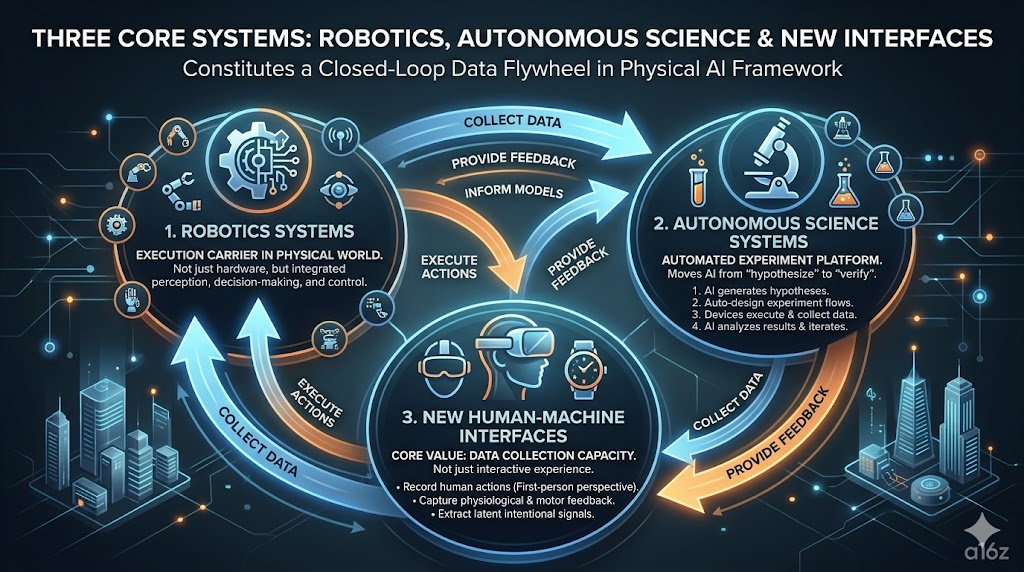
Within the Physical AI framework, a16z breaks the ecosystem into three core systems, which together create a closed-loop data flywheel rather than operating in isolation.
-
Robotics system: the execution vehicle for AI in the physical world. Robots are evolving beyond mechanical devices into integrated systems that combine perception, decision-making, and control. For example, Tesla's humanoid robot initiative isn't just about hardware innovation—it's about building AI systems that can reliably carry out tasks in complex environments.
-
Autonomous science system: automated experimentation platforms. These extend AI's role from "hypothesis generation" to "hypothesis validation." The process can be broken down as follows:
- AI formulates research hypotheses
- Systems auto-design experimental procedures
- Experimental devices execute and collect data
- AI analyzes results and iteratively improves
This closed-loop approach automates knowledge production and generates large volumes of high-quality, causally linked data.
- Next-generation human-machine interfaces: including AR, wearable devices, and brain-computer interfaces (such as Neuralink). The core value of these devices lies not in the user experience, but in their data collection capabilities. Their main functions include:
- Recording human actions from a first-person perspective
- Capturing physiological and movement feedback
- Extracting latent intent signals
These advances enable AI to receive more authentic and continuous data inputs.
Data Paradigm Shift: From Internet Data to Real-World Data
AI development is now facing a hidden bottleneck: the diminishing returns of internet data. While text and code datasets are vast, their marginal value is declining. Physical AI introduces new data sources—real-world interaction data.
Consider the contrast between two data paradigms:
-
Internet Data
- Features: High volume, easy access
- Limitations: Correlation-based, high noise
-
Physical World Data
- Features: Scarce, costly to obtain
- Advantages: Causal relationships, verifiable
This shift will redefine the path for AI capability upgrades:
- From "prediction systems" to "control systems"
- From "answer generation" to "result optimization"
- From "offline training" to "real-time feedback"
Foundational Infrastructure for Physical AI
From a technical standpoint, the competitive core of Physical AI lies not in applications, but in infrastructure. Key components can be summarized as follows:
- Simulation systems: Data generation engines that train AI in virtual environments, significantly reducing real-world trial-and-error costs. NVIDIA's Omniverse, for instance, is bridging the digital and physical worlds.
- World models: Systems that interpret the physical environment—object motion, environmental changes, and more—providing the foundation for accurate AI decision-making.
- Action models: Converting decisions into precise actions, enabling AI to transition from "thinking" to "executing."
- Advanced sensors: Delivering multidimensional inputs (vision, touch, biosignals) so AI can perceive the world comprehensively.
Value Realignment: Who Will Capture the Next Wave
As technology evolves, the value landscape is shifting. Value previously concentrated at the application layer is shrinking, while the importance of the system and infrastructure layers is rising.
Key points of this shift:
- Application layer homogenization: Low barriers to entry, fierce competition
- System layer value growth: Robotics and automation systems become central
- Data as a barrier: Real-world data is hard to replicate and holds enduring value
Most notably, Physical AI transforms data from an "infinitely replicable resource" into an "asset that requires long-term accumulation."
Investment and Industry Dynamics: Opportunities and Constraints
From an investment perspective, this phase introduces distinct structural features.
First, capital intensity is rising—Physical AI aligns more closely with industries such as:
- Semiconductors
- New energy
- Aerospace
This entails:
- Greater investment
- Longer return cycles
- Higher technical barriers
Second, the industry chain breaks down into three tiers:
- Upstream: Hashrate and simulation platforms
- Midstream: Model and system integration
- Downstream: Application deployment and real-world scenarios
Finally, the development rhythm can be viewed as a three-stage model:
- Short term: Agent expands within the digital world
- Mid term: Human-machine collaboration systems mature
- Long term: Physical AI achieves scalable adoption
The Road Ahead: From Agent to Physical AI
Over the long term, AI's evolution can be abstracted into three stages:
- Cognitive AI (exemplified by ChatGPT): Addresses understanding and generation
- Agent AI: Executes tasks in digital environments
- Physical AI: Performs tasks in the real world
This progression highlights a core trend: AI is shifting from an "information processing tool" to a "real-world execution system."
Conclusion: The Endgame for AI
To summarize, a16z's core insights are:
- AI will enter the physical world
- Data sources will fundamentally change
- System capabilities will surpass single-point model capabilities
Ultimately, AI's endgame isn't just a deeper understanding of the world, but the ability to act and deliver results in real environments. As this capability matures, AI will evolve from a tool to foundational infrastructure—reshaping industry structures and capital flows on a profound scale.