As autonomous AI agents become more capable, they are increasingly expected to interact with digital services, make purchases, and execute tasks on behalf of users. These agents can already search for information, call APIs, run workflows, and manage digital tools. The next stage in their development is the ability to participate in economic transactions.
However, the existing internet payment infrastructure was built primarily for human users. Most payment systems rely on manual authorization, graphical interfaces, and direct human interaction. This structure is not suitable for AI agents that operate programmatically and must complete transactions automatically during task execution.
Gate Pay for AI addresses this limitation by introducing a payment infrastructure specifically designed for autonomous AI systems. By embedding payment capabilities directly into agent workflows, the system enables AI agents to interact with paid services and complete transactions without requiring human intervention.
As part of the broader Gate for AI ecosystem, Gate Pay for AI functions as the financial layer that enables AI agents to participate in digital commerce environments.
What Is Gate Pay for AI
AI agents face a key limitation when participating in digital services: existing payment systems are designed for humans and require manual authorization; Gate Pay for AI addresses this problem by providing payment infrastructure that enables autonomous AI agents to perform economic transactions. It allows AI systems to initiate payments, settle transactions, convert assets, and access paid services as part of automated workflows.
The system supports both cryptocurrency and fiat-based settlement, allowing agents to interact with a wide range of digital and real-world services.
Gate Pay for AI integrates directly with AI agent frameworks through standardized components such as:
Through these integrations, AI agents can automatically detect payment requirements, authorize transactions, and complete payments as part of their normal task execution process.
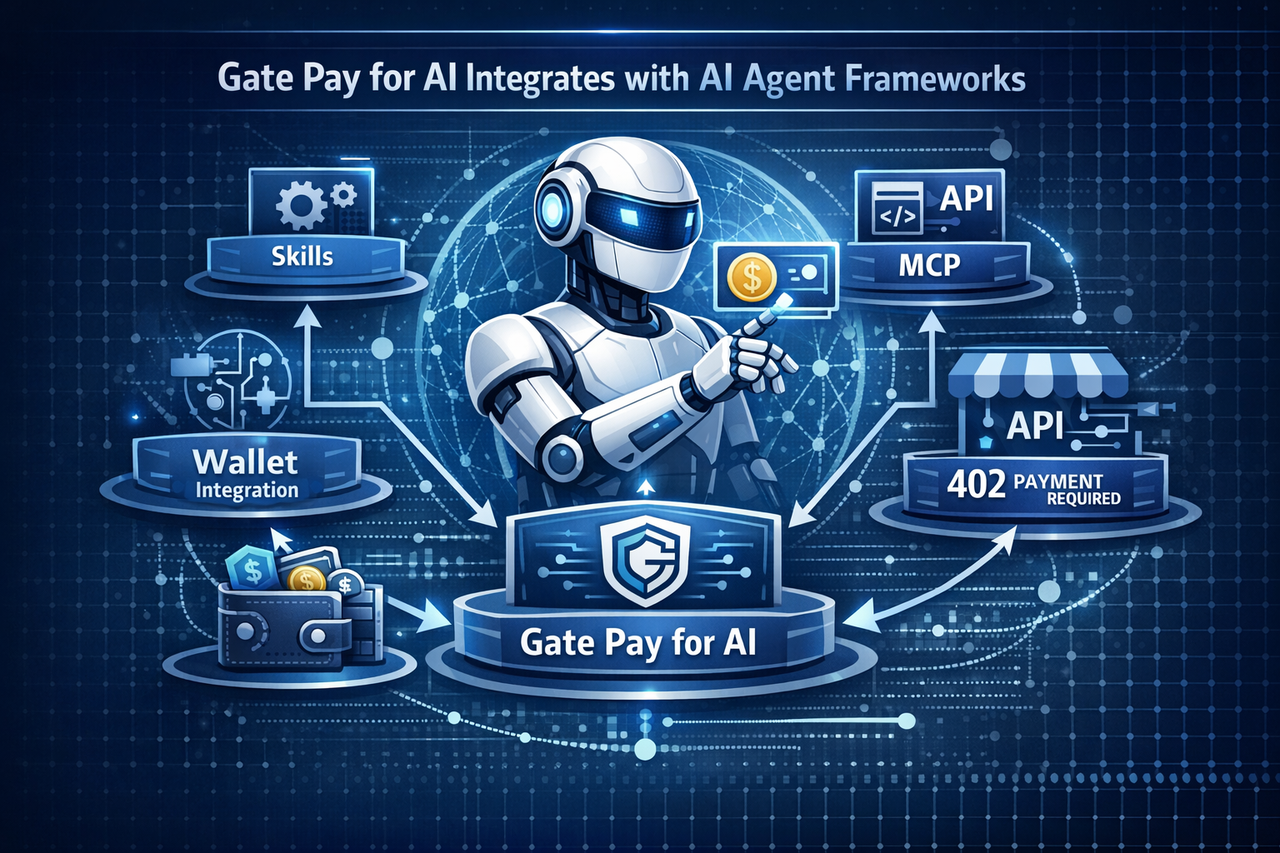
Gate Pay for AI Positioning in Gate for AI Architecture
Within the Gate for AI architecture, Gate Pay for AI serves as the payment infrastructure layer that enables economic interactions between AI agents and service providers.
AI agents operating within the ecosystem can use Gate Pay for AI to perform transactions when interacting with external services.
The system integrates with several core infrastructure components:
-
Router modules, which help agents discover services
-
Skills modules, which provide executable capabilities
-
MCP interfaces, which standardize tool access for agents
-
Wallet infrastructure, which manages digital assets
Together, these components allow agents to discover services, request tasks, receive price quotations, and complete payments automatically.
Product Structure of Gate Pay for AI
Gate Pay for AI is designed to support two primary user groups:
-
C-end users, who operate AI agents
-
B-end merchants, who provide services
These two sides form the core economic interaction layer of the system.
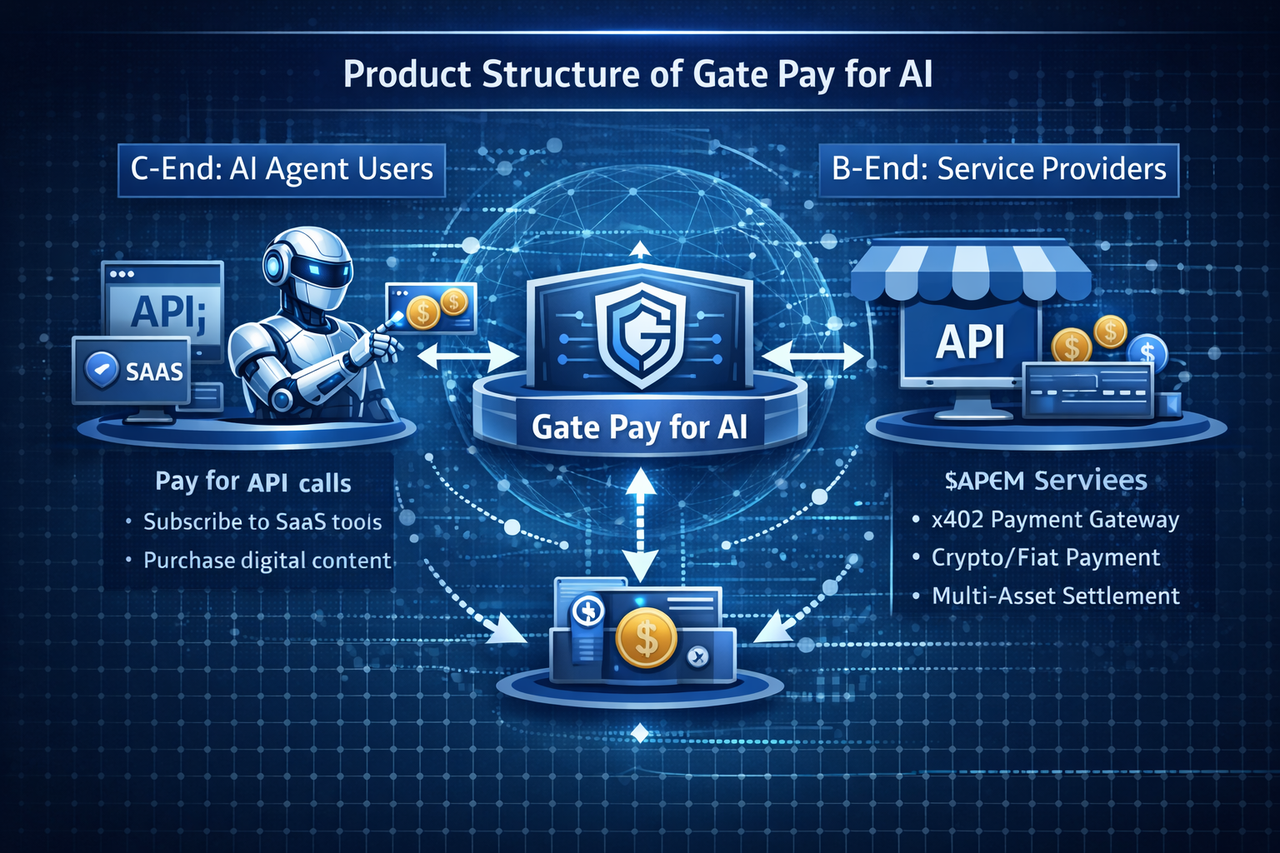
C-End: AI Agent Users
On the user side, the goal is to allow AI agents to perform payments directly while executing tasks.
The agent acts as a proxy for the user and interacts with services that require payment. Instead of asking the user to manually authorize each transaction, the agent can complete the payment workflow automatically.
Typical use cases include:
-
Paying for API calls
-
Subscribing to SaaS tools
-
Purchasing digital content
-
Executing paid automated workflows
-
Acting as a transaction proxy for users
Gate Pay for AI enables several capabilities within the agent environment:
These functions allow agents to complete transactions seamlessly during task execution.
B-End: Service Providers
On the merchant side, Gate Pay for AI enables service providers to receive payments from AI agents.
Merchants can integrate with Gate Pay for AI payment gateway and expose their services to agent-based systems through standardized interfaces.
Merchant capabilities include:
-
x402-based payment gateway integration
-
Cryptocurrency payment acceptance
-
Fiat payment acceptance
-
Automatic asset conversion
-
Multi-currency payment support
Once integrated, merchants can allow AI agents to invoke their services and automatically settle payments during the request process.
x402 Protocol Role in Gate Pay for AI
The x402 protocol plays a central role in enabling automated payments between AI agents and services.
It introduces a request-based payment model, where services can signal that a payment is required before a request can be completed.
The protocol is based on the HTTP 402 status code, traditionally reserved for payment-required responses.
When an AI agent sends a request to a service:
-
The service may return an x402 payment requirement
-
The agent detects the payment condition
-
The agent initiates a payment transaction
-
Once payment is confirmed, the service executes the request
Key characteristics of the x402 protocol include:
This approach enables AI agents to interact with commercial services in a standardized and programmable way.
Payment Capabilities within Gate Pay for AI
Gate Pay for AI supports multiple payment modes so that agents can transact with different types of services.
Cryptocurrency Payments
The system supports digital asset payments across multiple networks.
Supported assets include:
Payments can occur through x402 request-based workflows or direct on-chain transactions.
Fiat Payments
Gate Pay for AI also supports settlement in traditional fiat currencies.
Capabilities include:
This enables AI agents to interact with services that only accept traditional currencies.
Automatic Currency Conversion
In many transactions, the agent and the merchant may use different assets.
For example:
In this situation, Gate Pay for AI can automatically perform an asset swap before completing the payment.
This process occurs automatically and does not require manual user input.
Cryptocurrency to Fiat Conversion
Some services only accept fiat currency payments. In these cases, Gate Pay for AI can convert cryptocurrency assets into fiat before settlement.
Examples include:
-
Flight bookings
-
Hotel reservations
-
SaaS subscriptions
-
Web2 API services
This capability allows AI agents that primarily hold digital assets to interact with traditional service providers.
Use Cases of Gate Pay for AI
Gate Pay for AI supports a wide range of emerging AI-driven economic activities.
Representative use cases include:
| Use Case |
Description |
| Agentic Commerce |
AI agents can autonomously purchase services, digital products, or subscriptions on behalf of users. |
| API-Based Billing |
Agents can pay for API usage in real time, supporting pay-per-request business models. |
| Automated Task Execution |
Agents can complete tasks that require payment, such as booking services or accessing paid data sources. |
| AI Service Procurement |
Organizations can deploy agents that automatically purchase tools, computing resources, or software services when needed. |
| Multi-Agent Collaboration |
In complex systems involving multiple agents, economic interactions may occur between agents that provide and consume services. |
Advantages of AI-Native Payment Infrastructure
Gate Pay for AI introduces several benefits compared to traditional payment models.
-
Automation: Payments can be completed automatically as part of AI workflows.
-
Programmability: Payment logic can be integrated directly into agent decision-making systems.
-
Multi-Asset Support: Agents can transact using different cryptocurrencies and fiat currencies.
-
Scalability: The system supports large numbers of automated microtransactions across services.
-
Interoperability: Through MCP interfaces and standardized protocols, different agent frameworks can access the same payment infrastructure.
Risks and Considerations
Although AI-native payment systems offer significant advantages, several considerations remain.
-
Security Risks Autonomous agents performing financial transactions must be protected from malicious services and unauthorized requests.
-
Authorization Controls Users must define clear spending limits and policies to prevent unwanted transactions.
-
Regulatory Compliance Fiat settlements and cross-border transactions may require compliance with financial regulations.
-
Agent Reliability Errors in agent decision-making could potentially lead to unintended payments or service requests.
Designing safeguards, monitoring mechanisms, and policy controls will be essential for safe deployment.
The Future of AI Agent Payments
As AI agents become more capable, their ability to participate in economic systems will continue to expand.
Future developments may include:
-
AI-Native Marketplaces for Services Platforms where AI agents can discover, compare, and purchase digital services directly from providers without human involvement.
-
Fully Autonomous Economic Agents AI systems that can independently make financial decisions, purchase resources, and manage transactions to accomplish tasks.
-
Decentralized Agent Networks Distributed ecosystems where multiple AI agents interact, collaborate, and exchange services across decentralized infrastructure.
-
Large-Scale Agent-to-Agent Commerce Economic systems where AI agents continuously buy and sell services from other agents, creating automated digital marketplaces.
Payment infrastructure designed specifically for AI agents will play a critical role in enabling these ecosystems.
Gate Pay for AI represents an early step toward building the financial layer required for agent-driven digital economies.
Summary
Gate Pay for AI is a payment infrastructure module designed to enable autonomous AI agents to perform economic transactions.
By supporting both cryptocurrency and fiat payments, integrating with agent frameworks through Skills and MCP interfaces, and implementing the x402 request-based payment protocol, the system allows agents to discover services, request tasks, and complete payments automatically.
Within the Gate for AI ecosystem, Gate Pay for AI functions as the payment layer that enables commercial interactions between agents and service providers.
As AI agents continue to evolve, infrastructure systems like Gate Pay for AI will be essential for enabling automated commerce and agent-based economic activity.
FAQs
What is Gate Pay for AI?
Gate Pay for AI is a payment infrastructure module that allows AI agents to perform transactions automatically when interacting with services.
What types of payments does Gate Pay for AI support?
The system supports both cryptocurrency payments and fiat currency settlements, including automatic asset conversion.
What is the x402 protocol?
The x402 protocol is a request-based payment protocol built around the HTTP 402 status code. It allows services to signal that payment is required before fulfilling a request.
Can AI agents pay for APIs using Gate Pay for AI?
Yes. AI agents can automatically pay for API usage through x402-based workflows or direct payment transactions.
Does the system support automatic currency conversion?
Yes. If the asset held by the agent differs from the merchant’s required payment currency, the system can automatically convert the asset before settlement.