Summary
- Bitcoin’s short-term trend remains bearish, and Ethereum continues to trade within a downward channel, reflecting ongoing uncertainty in market direction.
- Bitcoin options with a notional value of approximately USD 23.4 billion are set to expire, marking the largest options expiry in history.
- NVIDIA has acquired AI chip startup Groq for approximately USD 20 billion in cash, marking its largest acquisition to date.
- Polymarket stated that recent user account compromises were caused by a third-party vulnerability, which has now been fixed.
- DJT transferred approximately USD 174 million worth of Bitcoin, indicating active management of its crypto asset positions.
- HYPE, SUI, and SVL will unlock approximately USD 246 million, USD 61.61 million, and USD 12.67 million worth of tokens respectively over the next 7 days.
Market Overview
Market Commentary
- BTC Market Update — Bitcoin’s short-term trend remains bearish, with prices continuing to consolidate below key resistance zones and overall volatility gradually contracting. The current major support lies near USD 84,000, while resistance is concentrated around the USD 93,400 level. On the 4-hour timeframe, as long as price remains below the descending trendline, any upward movement is more likely to be viewed as a technical rebound rather than a trend reversal. Only a sustained and effective breakout above the USD 90,000 level would meaningfully undermine the existing bearish structure and open room for a broader recovery.From a daily perspective, Bitcoin has gradually moved out of its medium- to long-term descending channel since December, with the downward slope clearly flattening, indicating a marginal easing of selling pressure. Price action is currently oscillating between descending trend resistance and a strong support zone. To truly reverse market momentum and rebuild bullish expectations, Bitcoin must close decisively above the descending trendline, around the USD 93,000 area.
- ETH Market Update — Ethereum remains in a downward channel. In the short term, overall trading volume continues to shrink, Bollinger Bands are contracting significantly, and the MA5, MA10, and MA30 are tightly converged, reflecting a lack of directional momentum and a consolidation phase. On the 4-hour chart, ETH failed to hold its lower trendline and broke below the previous ascending channel, further weakening its technical structure. After an unsuccessful rebound attempt near USD 3,100, price made a new local low, indicating a clear loss of bullish momentum. Currently, price is hovering above the USD 2,800 support level, which is temporarily holding, but there are no clear signs of sustained buying interest or proactive capital inflows. Meanwhile, the RSI has begun to decline, signaling weakening intraday momentum. If the USD 2,800 support level fails, price may quickly fall toward the USD 2,600 region.
- Altcoins — Over the past 24 hours, the Fear & Greed Index stood at 28, while the Altcoin Season Index was at 17, indicating persistently low risk appetite. Altcoins remain clearly differentiated, with capital largely staying defensive. Major altcoins such as SOL and XRP saw modest pullbacks, and the broader market continues to trade in a range-bound structure.
- Stablecoins — The total market capitalization of stablecoins currently stands at USD 308.6 billion, down USD 734 million over the past week, representing a decline of 0.34%.
- Gas Fees — Ethereum network gas fees have generally remained below 1 Gwei over the past week, with the highest single-hour peak at 0.147 Gwei. As of December 25, the daily average gas fee stood at 0.036 Gwei.
Trending Tokens
Over the past 24 hours, the market showed clear divergence: BTC posted a slight gain, while ETH declined modestly, reflecting a cautious and defensive stance among major capital flows with no clear directional conviction. Major altcoins such as SOL and XRP also experienced mild pullbacks, underscoring ongoing market caution. Despite broader pressure, a few tokens managed to move strongly against the trend, attracting short-term capital attention. Below is a breakdown of these assets.ZBT ZEROBASE(+35.50%,Market Cap: $22.53M)
According to Gate market data, ZBT is currently priced at USD 0.10476, up 35.50% over the past 24 hours. ZEROBASE is a decentralized crypto infrastructure network that leverages zero-knowledge proofs (ZKP) and trusted execution environments (TEE) to enable verifiable off-chain computation. It supports products such as zkStaking, zkLogin, and ProofYield, bridging institutional DeFi, user privacy, and real-world asset strategies. ZEROBASE offers programmable, compliant staking and transparent cryptographic guarantees without exposing sensitive data.
The recent rebound in ZBT primarily reflects a strategic technical upgrade by ZEROBASE. On December 8, ZEROBASE deployed geographically distributed hub nodes in Tokyo, Singapore, Paris, and Virginia, increasing network throughput to over 7,000 TPS. This upgrade provides foundational support for high-concurrency applications such as ZK staking and verifiable on-chain vaults, significantly alleviating scalability bottlenecks and strengthening ZEROBASE’s competitiveness in privacy-focused DeFi.
At the same time, the team actively participated in events such as Blockchain Week at major exchanges and the BNB Chain Hackathon in Abu Dhabi from December 3–6, further enhancing ecosystem exposure and developer engagement, signaling strong long-term commitment.
BEEFI Beefy.Finance(+31.72%,Market Cap: $12.07m)
According to Gate data, BEEFI is currently priced at USD 152.18, up 31.72% over the past 24 hours. Beefy is a “custodial-style” yield farming platform that supports efficient background operations without interfering with users’ daily activities. It is designed for users seeking passive yield strategies with minimal time commitment, enabling continuous asset compounding through simple interactions.
BEEFI’s rally is primarily driven by technical momentum. Price successfully broke above the 200-day exponential moving average (EMA, approximately USD 156.9), while trading volume expanded to nearly three times its previous level, signaling a clear bullish structural shift. Technically, RSI(7) rose to 80.39, and the MACD histogram formed a bullish crossover (+3.11), indicating strong short-term momentum, though also suggesting the asset has entered an overbought zone with potential pullback risk.
BANANA Banana Gun(+29.46%,Market Cap: $31.26m)
According to Gate data, BANANA is currently priced at USD 7.79, up 29.46% in the past 24 hours. Banana Gun is a Telegram-based trading bot that allows users to buy and snipe new tokens on networks such as Ethereum. It is known for its fast execution, intuitive user interface, and incentive-based fee structure that helps users gain early access to new token launches.
On December 18, Banana Gun officially announced that Banana Pro now supports the Base network, marking a major expansion from the Solana ecosystem into the EVM ecosystem. This upgrade introduced core features such as swaps, limit orders, DCA, and wallet tracking on Base, while also unifying asset views and trading interfaces across Solana and Base. This significantly improves cross-chain trading efficiency and user experience. The announcement signaled Banana Gun’s accelerated expansion into the EVM ecosystem and broader user base, serving as a key catalyst for the recent price surge.
Key Market Data Highlights
Bitcoin Set for Largest Options Expiry in History This Friday, Potentially Driving Price Higher
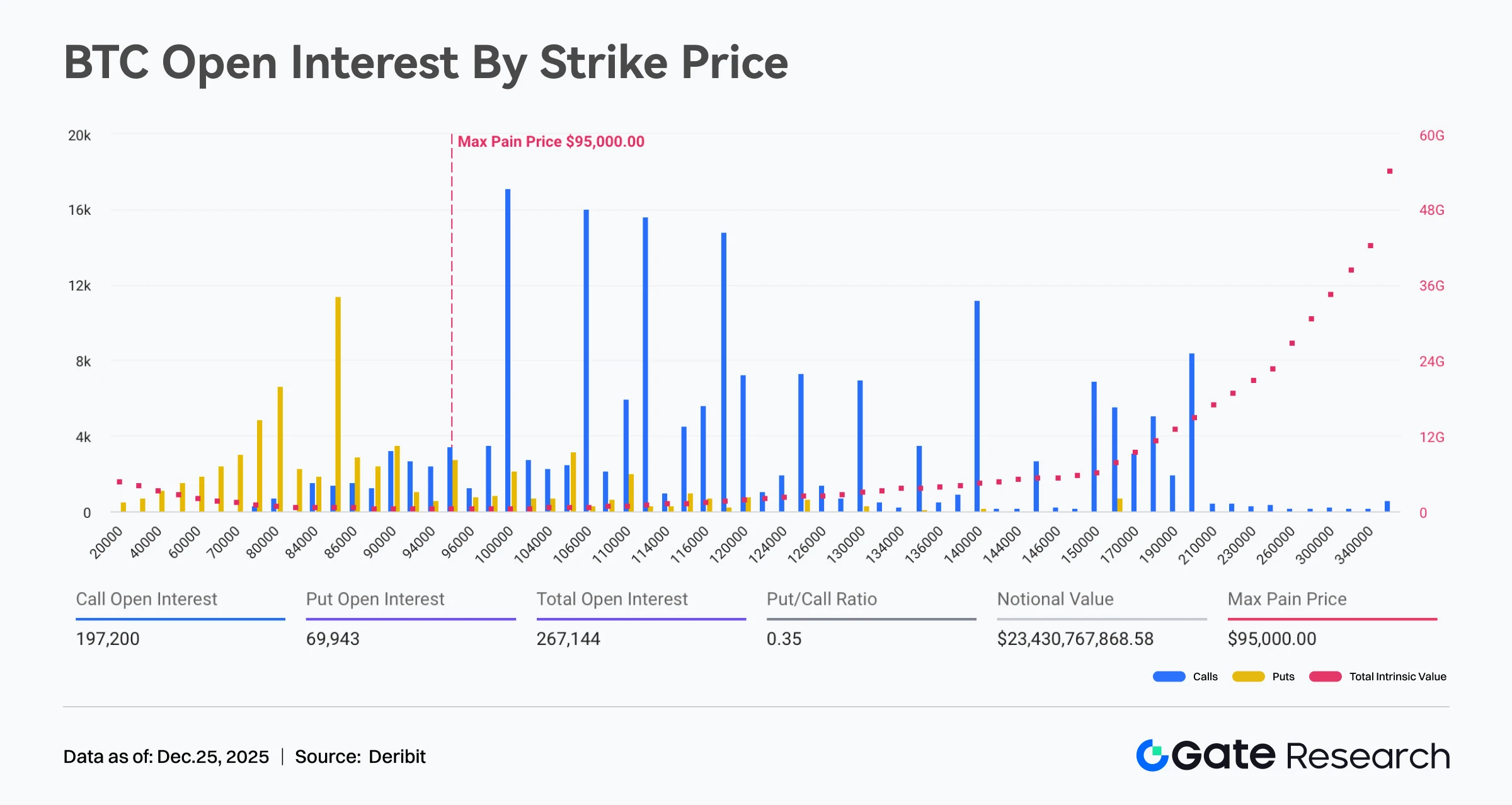
On December 26 (this Friday), Bitcoin options with a notional value of approximately USD 23.4 billion are set to expire, marking the largest expiry event in the history of the Bitcoin options market. Market analysis suggests that the structure of this expiry is moderately bullish, with the max pain point near USD 95,000, potentially exerting short-term upward pressure on price.
When open interest is heavily concentrated at specific strike prices, market makers often hedge delta exposure through spot or perpetual futures trading, which can temporarily influence spot prices. The max pain level, representing the price point of maximum loss for option buyers, is often viewed as an important reference level, and markets sometimes gravitate toward it. However, it is important not to overinterpret this relationship as causal. Options expiry primarily represents a liquidity release and risk rebalancing event rather than a fundamental driver of long-term trends. Bitcoin’s medium- to long-term direction remains primarily determined by macroeconomic conditions, monetary policy expectations, institutional capital flows, adoption cycles, and on-chain fundamentals.
NVIDIA Acquires AI Chip Startup Groq for Approximately USD 20 Billion
On December 25, Disruptive CEO Davis, the lead investor in Groq’s latest funding round, revealed that NVIDIA has agreed to acquire Groq for approximately USD 20 billion in cash. If finalized, this would become NVIDIA’s largest acquisition to date, surpassing its nearly USD 7 billion acquisition of Mellanox in 2019.
From a technical perspective, Groq’s core strength lies in its high-performance AI inference architecture, which delivers ultra-low latency and high throughput in large language model inference scenarios. This complements NVIDIA’s GPU-dominated AI training business. Through this acquisition, NVIDIA aims to establish a fully integrated pipeline from model training to inference deployment, further reinforcing its dominance in AI infrastructure.
From an industry standpoint, demand for AI inference chips is rapidly accelerating, particularly across edge computing, real-time AI, and enterprise inference use cases. Groq’s architectural advantages could help NVIDIA capture incremental market share in these emerging segments. This acquisition not only strengthens NVIDIA’s technological moat but also signals a broader shift in AI competition from training-centric to inference-driven optimization.
Maple Finance Issues Its Largest Loan Ever, Outstanding Borrowings Reach Record High
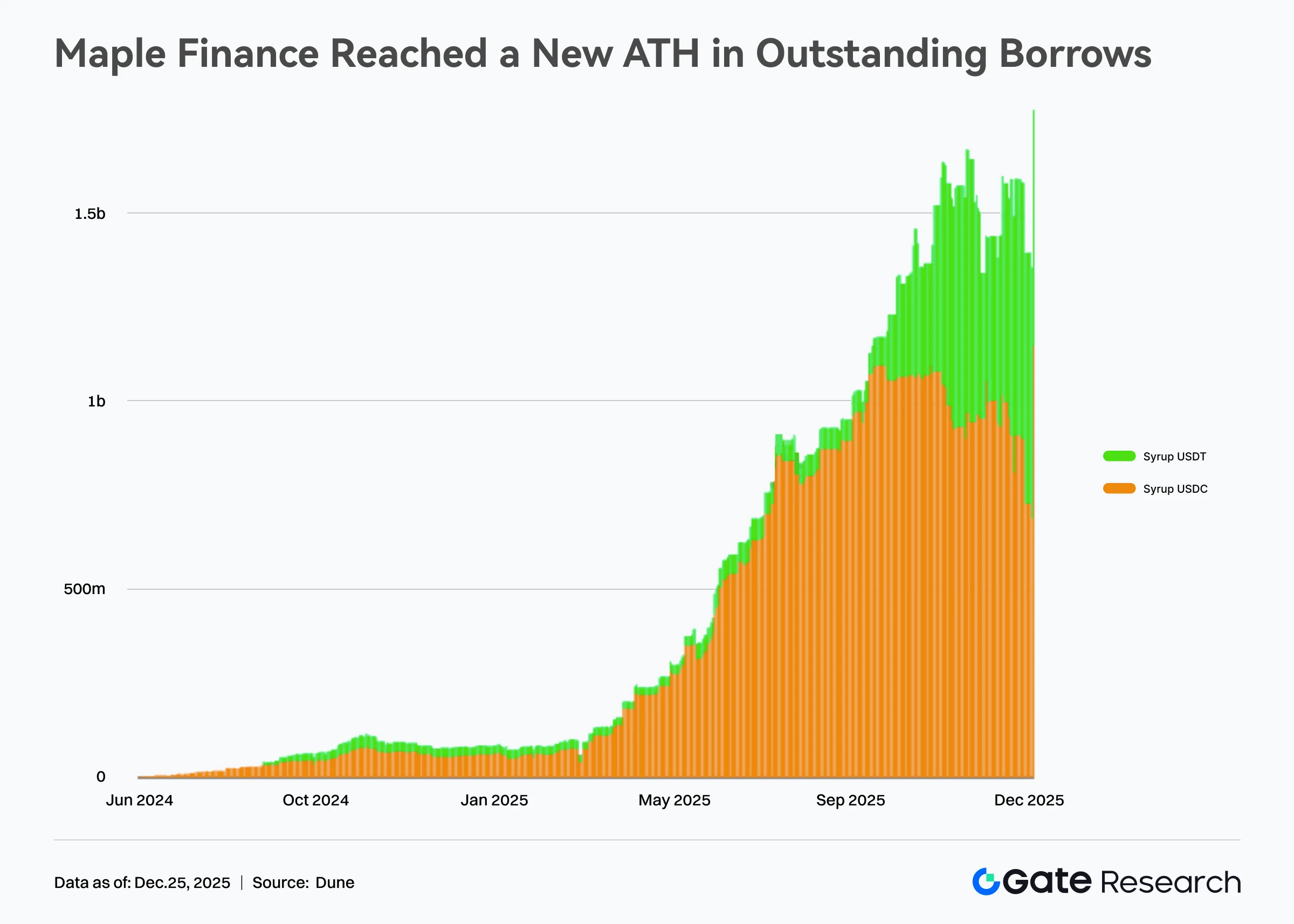
On December 25, Relayer Capital founder Austin Barack announced that Maple Finance completed its largest single loan to date, totaling USD 500 million. At the same time, its outstanding borrowings reached an all-time high, marking a symbolic milestone heading into 2025 and positioning Maple as a leading example of institutional growth in DeFi. Relayer Capital views Maple’s native token SYRUP as one of its highest-conviction core holdings.
This milestone reflects the growing maturity of institutional DeFi lending in both scale and risk management, and signals that the real-world asset (RWA) narrative is transitioning from concept to tangible execution. Since the beginning of 2025, multiple major exchanges have listed SYRUP, further reinforcing market confidence in Maple’s business model and long-term value. Relayer Capital’s significant allocation underscores institutional belief in Maple’s sustainable growth potential. From a broader industry perspective, this development highlights DeFi’s evolution from retail-driven speculation toward institutionally driven financial infrastructure.
Focus of the Week
Tom Lee’s BitMine Increases ETH Holdings by Approximately USD 88 Million
BitMine, the Ethereum treasury company led by Fundstrat co-founder Tom Lee, has further expanded its crypto reserves by acquiring approximately USD 88 million worth of ETH through BitGo and Kraken. On-chain data shows that the transaction involved approximately 29,462 ETH. BitMine disclosed that its total ETH holdings have now reached 4,066,062 ETH, with an average acquisition price of approximately USD 2,991. At current prices, the total value of its ETH holdings is around USD 12 billion, further solidifying its position as the world’s largest corporate holder of Ethereum.
This accumulation continues BitMine’s aggressive asset allocation strategy. The company has stated its long-term goal is to control 5% of Ethereum’s circulating supply and views ETH as a foundational infrastructure for reshaping the global financial system. Chairman Tom Lee noted that large-scale holdings generate significant synergies, positioning BitMine as a key bridge between Wall Street capital and the blockchain ecosystem. Despite recent market weakness, BitMine continues to accumulate aggressively. Its stock, BMNR, closed at USD 31.09, down 0.86% on the day, while ETH declined approximately 2.48% over the past 24 hours to USD 2,951.
Polymarket Confirms User Account Breaches Were Caused by Third-Party Vulnerability
Polymarket recently confirmed that a series of user account breaches and fund losses were not caused by vulnerabilities within its own systems, but rather by a security flaw introduced by a third-party authentication provider. The issue was first reported on social platforms such as X and Reddit, where users stated that their accounts experienced unauthorized login attempts and forced liquidations despite not clicking suspicious links and having two-factor authentication enabled.
According to user reports, the issue primarily affected accounts registered and logged in via Magic Labs, a provider offering email-based non-custodial Ethereum wallets commonly used by crypto newcomers. Polymarket later acknowledged in its official Discord channel that the vulnerability originated from the third-party authentication provider and affected only a limited number of users. The issue has since been resolved, and there is no ongoing risk. The platform stated it would proactively contact affected users but has not disclosed the number of impacted accounts or the total losses.
This incident once again highlights Polymarket’s ongoing challenges related to third-party security dependencies. In September 2024, users reported wallet compromises after logging in via Google accounts, and just last month, a phishing incident in comment sections resulted in losses exceeding USD 500,000. As prediction market activity continues to grow, these recurring security issues may intensify scrutiny around platform architecture and user protection mechanisms.
TMTG Transfers Approximately USD 174 Million in Bitcoin, Signaling Active Asset Management
Following its recent increase in Bitcoin holdings, TMTG was observed transferring approximately 2,000 BTC, valued at around USD 174 million at the time. On-chain data shows that these funds were moved across multiple related wallets, with roughly USD 12 million transferred to Coinbase Prime Custody, while the remainder remained within wallets linked to the same entity. The transfers occurred one day after the company’s Bitcoin holdings rose to 11,542 BTC, indicating active portfolio management.
Market participants generally believe these transfers reflect reserve restructuring or custody adjustments rather than outright selling. Coinbase Prime Custody primarily serves institutional clients, and such movements are commonly associated with cold storage reorganization, wallet consolidation, or internal risk management. Notably, the transfers occurred shortly after blockchain analysts reported TMTG’s acquisition of an additional 451 BTC, reinforcing the view that the company is actively managing rather than liquidating its Bitcoin position. Despite broader market weakness, Bitcoin prices remained relatively stable between USD 86,000 and USD 87,000, showing no significant reaction to the large on-chain movements.
Funding Weekly Recap
According to RootData, between December 19 and December 25, 2025, a total of nine crypto and related projects announced funding rounds or acquisitions, spanning infrastructure, payments, DeFi, and other sectors. Below are the largest funding rounds of the week:
Architect
Announced a USD 35 million funding round on December 24, led by CMT Digital.
Architect is a scalable trading infrastructure designed for institutional traders, aiming to bridge centralized and decentralized markets while providing secure, high-performance, and compliant global digital asset access. The funding will be used to accelerate development of its institutional trading platform, including improvements to its core matching engine, infrastructure performance, compliance and risk management systems, and clearing and settlement capabilities. It will also expand support for perpetual contracts and multi-asset derivatives. Through these investments, Architect aims to significantly improve institutional market access efficiency and deepen the integration between traditional finance and crypto markets.
Coinbax
Announced a USD 4.2 million funding round on December 22, led by Paxos.
Coinbax is a stablecoin payments infrastructure that introduces programmable control mechanisms and automated settlement logic to provide secure and reliable stablecoin and tokenized deposit rails for banks, fintech firms, and enterprise payment use cases. The funding will support the expansion of its institutional payment network, including compliance and risk management systems, custody and settlement infrastructure, cross-border payment capabilities, and programmable payment modules for banks and enterprises. Coinbax aims to accelerate the adoption of stablecoins and tokenized deposits in real-world financial applications, enhancing efficiency, transparency, and security across global payment systems.
Easy.fun
Announced a USD 2 million funding round on December 24, led by Mirana Ventures.
Easy.fun is an open on-chain trading arena that combines high-performance decentralized trading with gamified competition, allowing users to compete in real time based on rankings, achievements, and rewards. The funding will be used to enhance core platform functionality and ecosystem development, including improving on-chain trading performance, refining leaderboard and competition mechanics, introducing additional trading instruments and formats, and strengthening community incentives and user growth systems. Easy.fun aims to build a trading ecosystem that blends professional-grade execution with engaging, game-like participation, driving higher activity and interaction across decentralized markets.
Next Week to Watch
Token Unlocks
According to Tokenomist data, several major token unlocks are scheduled over the next 7 days (2025.12.26 – 2026.01.01). The top three are as follows:
- HYPE will unlock approximately USD 246 million worth of tokens, representing 4.1% of its circulating supply.
- SUI will unlock approximately USD 61.61 million worth of tokens, representing 1.2% of its circulating supply.
- SVL will unlock approximately USD 12.67 million worth of tokens, representing 17.1% of its circulating supply.
References:
- Gate, https://www.gate.com/trade/BTC_USDT
- Farside Investors, https://farside.co.uk/btc/
- Gate, https://www.gate.com/trade/ETH_USDT
- Gate, https://www.gate.com/crypto-market-data
- DeFiLlama, https://defillama.com/stablecoins
- Etherscan, https://etherscan.io/gastracker
- Coingecoko, https://www.coingecko.com/en/cryptocurrency-heatmap
- The Block, https://www.theblock.co/post/383595/tom-lees-bitmine-88-million-eth
- The Block, https://www.theblock.co/post/383711/polymarket-third-party-vulnerability-hack
- Coindesk, https://www.coindesk.com/business/2025/12/24/trump-media-shuffles-2-000-btc-after-fresh-bitcoin-inflows
- Rootdata, https://www.rootdata.com/Fundraising
- Tokenomist, https://tokenomist.ai/
- Deribit, https://www.deribit.com/statistics/BTC/metrics/options
- X, https://x.com/AustinBarack/status/2003902632973275405?s=20
- CNBC, https://www.cnbc.com/2025/12/24/nvidia-buying-ai-chip-startup-groq-for-about-20-billion-biggest-deal.html
Gate Research is a comprehensive blockchain and cryptocurrency research platform that provides deep content for readers, including technical analysis, market insights, industry research, trend forecasting, and macroeconomic policy analysis.
Disclaimer
Investing in cryptocurrency markets involves high risk. Users are advised to conduct their own research and fully understand the nature of the assets and products before making any investment decisions. Gate is not responsible for any losses or damages arising from such decisions.