The big thing people miss when talking about bitcoin.
A financial advisor asked me the other day:
Matt, do you really think each bitcoin could be worth $1 million? That’s a crazy number.
I understand his view. $1 million sounds crazy. It implies bitcoin will rise 14x from today’s price.
When I joined crypto full-time in 2018, I used to hear people say that and laugh. At the time, bitcoin was around $4,000, and $1 million sounded absurd—even to me.
I no longer see it that way. As I’ve spent more time studying the asset, I’ve realized that I—like my advisor friend—was making a pretty basic mistake in analyzing bitcoin’s opportunity.
In this week’s memo, I want to explain that mistake and show how a set of reasonably conservative assumptions can get bitcoin to $1 million.¹
How To Calculate Bitcoin’s Value
I think of bitcoin as an emerging store-of-value asset. It serves a purpose similar to gold—allowing people to hold wealth outside the traditional fiat and banking system—but in a digital form. It is more volatile and less established than gold, but it is increasingly competing for the same market.
With that framing in mind, the basic math for estimating its value is straightforward: Estimate the size of the store-of-value market, estimate bitcoin’s share of that market, and divide by 21 million (the maximum total supply of bitcoin). That gives you an implied price.
Today, the store-of-value market is just under $38 trillion: $36 trillion for gold and $1.4 trillion for bitcoin. On that basis, bitcoin currently represents just a bit under 4% of the market.²
This is why $1 million per bitcoin sounds unreasonable to many, and why I dismissed it for years. Given the current market size, bitcoin would need to capture more than 50% of the store-of-value market to reach $1 million. That is a very high bar.
But here’s the point most people miss: The store-of-value market is not static. In fact, it has expanded dramatically over the past two decades. And as concerns about fiat currency debasement spread, I suspect that will continue.
A Short History of Gold
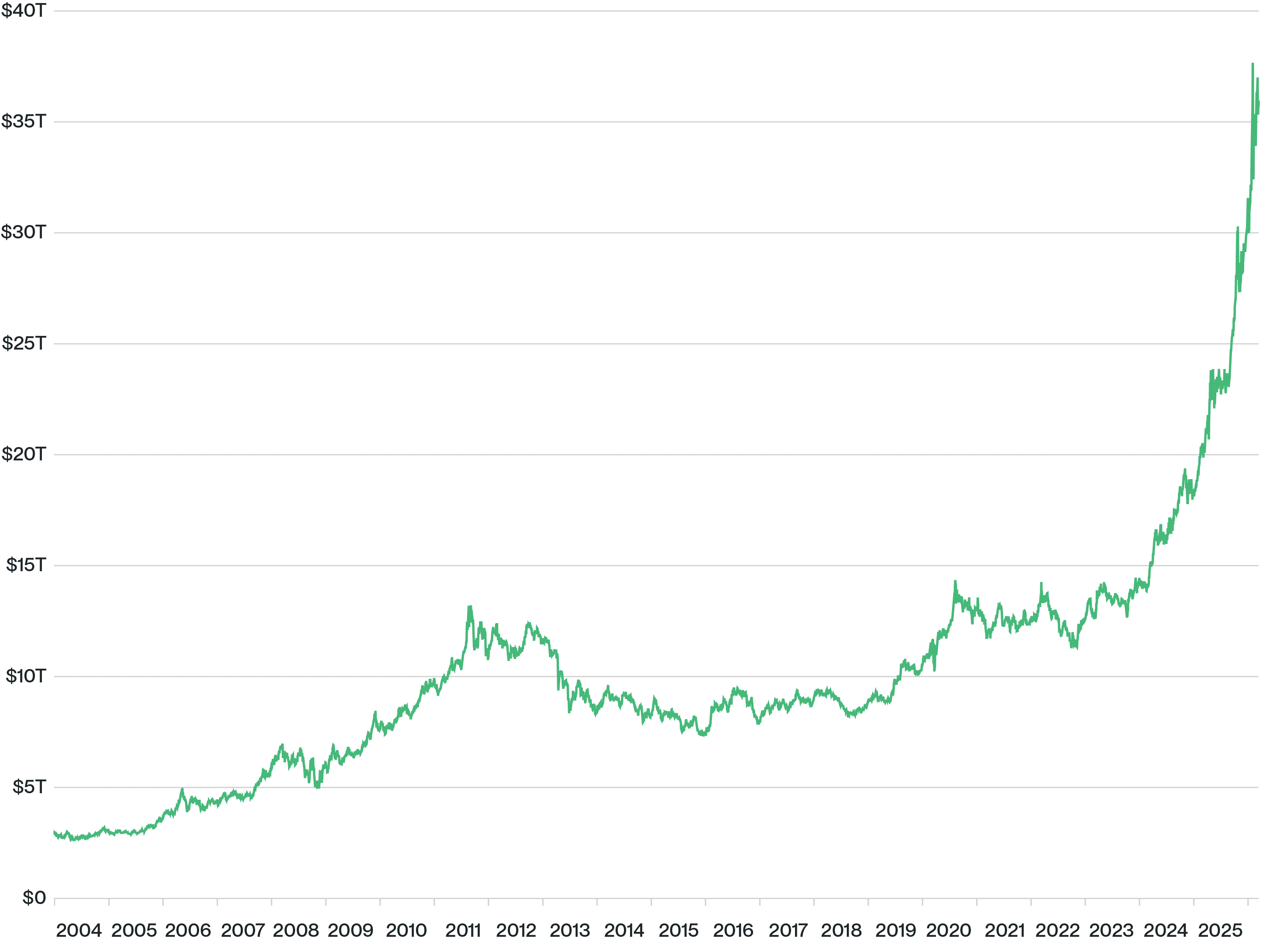
I first started paying significant attention to gold when the first gold ETF launched in the U.S. in 2004. At the time, the entire gold market was worth about $2.5 trillion. (Not that much more than the bitcoin market today!)
It’s grown to almost $40 trillion over the years—a compound annual growth rate of 13% per year—thanks to rising concerns about government debt, geopolitical uncertainty, easy monetary policy, and other factors.
Gold’s Market Cap, 2004-Present
Source: Bitwise Asset Management with data from World Gold Council and Bloomberg.
The mistake people make when evaluating bitcoin’s potential is ignoring this growth. If this growth rate continues, the global “store of value” market will be ~$121 trillion in 10 years. At that level, bitcoin only needs to take 17% of the market to be worth $1 million a coin.
That’s still a lot of growth—from ~4% to ~17%—but it feels well within reach when you reflect on all the progress bitcoin has made recently.
A few years ago, there were no U.S. bitcoin ETFs and few institutional holders, and bitcoin was considered too volatile to warrant anything above a 1% allocation. Now, bitcoin ETFs have proven to be the fastest-growing ETFs of all time, bitcoin is owned by everyone from the Harvard endowment to the Abu Dhabi sovereign wealth fund, and bitcoin’s long-term volatility has declined to the point that many professional investors are considering 5% allocations.
There are still miles to go, but with these undercurrents, capturing one-sixth of the store-of-value market in 10 years doesn’t seem extreme. It seems more like a continuation of recent trends.
What Could Go Wrong?
Of course, you need to look at both sides of the equation.
It’s possible that the global store-of-value market will not continue to grow as it has for the past 20 years. The past two decades have featured a global financial crisis, the invention of quantitative easing, and an extended period of low interest rates. Those trends may not repeat in the future, and we could see a pullback in gold prices. Another risk is that bitcoin could simply fail to gain market share.
But I think there’s equal risk that these projections are too conservative—that the store-of-value market will grow faster in the future, as concerns about government debt reach crisis levels, and that bitcoin will end up taking much more than 17% of the store-of-value market in ten years.
As I see it, the base case—that the store-of-value market will continue to grow as it has, and bitcoin will continue to gain market share as it has—leads you to much, much higher prices than we have today.
Notes
(1) Long-time readers may remember that I wrote about a similar topic in 2023. Since then my views on it have sharpened.
(2) It’s worth noting that the store-of-value market is larger than gold and bitcoin when you consider other assets like silver, platinum, and palladium, but for ease of comparison we’re confining this analysis to gold and bitcoin.
No Advice on Investment; Risk of Loss: Prior to making any investment decision, each investor must undertake its own independent examination and investigation, including the merits and risks involved in an investment, and must base its investment decision—including a determination whether the investment would be a suitable investment for the investor—on such examination and investigation.
Crypto assets are digital representations of value that function as a medium of exchange, a unit of account, or a store of value, but they do not have legal tender status. Crypto assets are sometimes exchanged for U.S. dollars or other currencies around the world, but they are not currently backed nor supported by any government or central bank. Their value is completely derived by market forces of supply and demand, and they are more volatile than traditional currencies, stocks, or bonds.
Trading in crypto assets comes with significant risks, including volatile market price swings or flash crashes, market manipulation, and cybersecurity risks and risk of losing principal or all of your investment. In addition, crypto asset markets and exchanges are not regulated with the same controls or customer protections available in equity, option, futures, or foreign exchange investing.
Crypto asset trading requires knowledge of crypto asset markets. In attempting to profit through crypto asset trading, you must compete with traders worldwide. You should have appropriate knowledge and experience before engaging in substantial crypto asset trading. Crypto asset trading can lead to large and immediate financial losses. Under certain market conditions, you may find it difficult or impossible to liquidate a position quickly at a reasonable price.
The opinions expressed represent an assessment of the market environment at a specific time and are not intended to be a forecast of future events, or a guarantee of future results, and are subject to further discussion, completion and amendment. The information herein is not intended to provide, and should not be relied upon for, accounting, legal or tax advice, or investment recommendations. You should consult your accounting, legal, tax or other advisors about the matters discussed herein.
Disclaimer:
- This article is reprinted from [Matt Hougan]. All copyrights belong to the original author [Matt Hougan]. If there are objections to this reprint, please contact the Gate Learn team, and they will handle it promptly.
- Liability Disclaimer: The views and opinions expressed in this article are solely those of the author and do not constitute any investment advice.
- Translations of the article into other languages are done by the Gate Learn team. Unless mentioned, copying, distributing, or plagiarizing the translated articles is prohibited.