When users engage with RWA projects, their primary concerns are how assets are brought on-chain, how those assets are managed, and how transactions are executed. These issues directly affect asset security, operational pathways, and overall system usability.
This process typically spans multiple layers, including user onboarding, asset management, transaction execution, and governance. Collectively, these modules create a comprehensive on-chain asset management framework.
How Users Access the MANTRA RWA Ecosystem
Users join the MANTRA ecosystem by connecting their wallets and preparing their assets. With a wallet compatible with BNB Chain or similar networks, users can access the system and interact with the protocol.
From a technical perspective, users must complete identity and asset setup steps, which may involve generating an on-chain address and connecting to external asset systems. In RWA scenarios, some processes may also include off-chain verification to confirm asset provenance and regulatory compliance.
Structurally, user onboarding is divided into on-chain access points and off-chain interfaces. On-chain access handles interactions and transactions, while off-chain interfaces connect real-world asset information to the system. This dual-layer architecture bridges traditional finance with blockchain environments.
This onboarding mechanism provides a unified access path for users, enabling different asset types to enter and be processed within a single system.
How MANTRA Manages On-Chain RWA Assets
Asset management is central to MANTRA's ecosystem, aiming to ensure a one-to-one correspondence between blockchain assets and real-world assets.
On the technical side, assets are tokenized on-chain, with each token representing a proportional share of real-world asset rights. The platform uses smart contracts to record ownership and enforce transfer rules.
Structurally, asset management is organized into three layers: asset mapping, contract management, and data verification. The mapping layer establishes on-chain representations, the contract layer enforces operational rules, and the verification layer upholds data integrity.
This structure ensures that assets not only exist on-chain but also maintain a verifiable link to real-world assets, improving both trust and utility.
What Happens During a MANTRA Asset Operation
A MANTRA asset operation is much more than a simple transfer or purchase. It is a standardized process involving collaboration among multiple on-chain and protocol modules.
Every user action becomes an on-chain transaction, passing through steps such as network validation, contract execution, and state updates. Understanding this process clarifies how user-initiated RWA asset operations are processed by the protocol and result in verifiable outcomes on the blockchain.
The flowchart below outlines the full lifecycle, from initiation to confirmation:
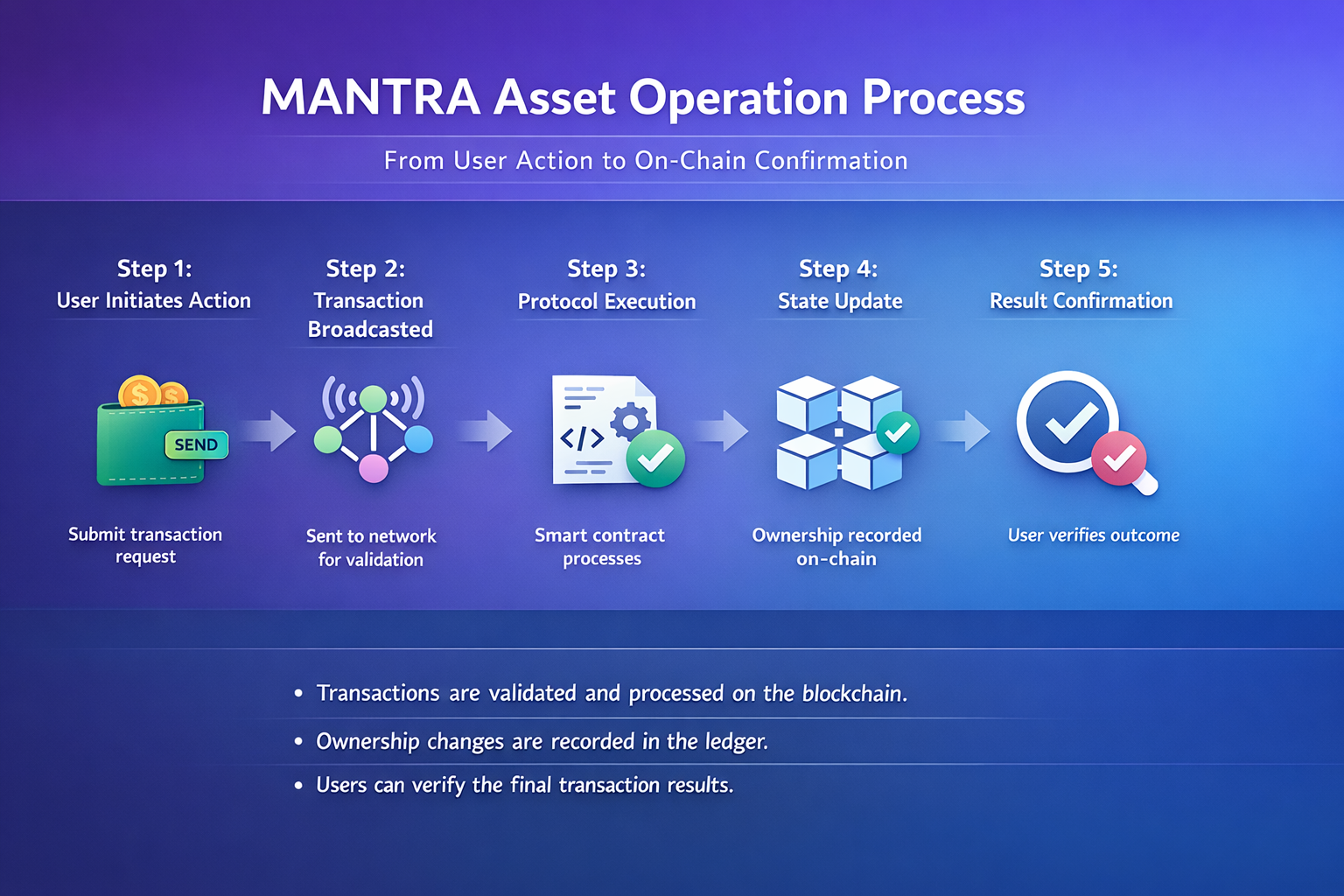
This process is validated and recorded through blockchain consensus. Each stage is managed by specialized modules, ensuring clear roles and responsibilities.
The result: user operations are transformed into auditable on-chain events, enhancing transparency and reliability.
How the MANTRA Protocol Handles Transaction Processing and Execution Logic
Transaction processing is driven by the interplay between smart contracts and consensus mechanisms. Smart contracts define the rules of execution, while consensus ensures transaction ordering and validity.
Technically, after a transaction is submitted, network nodes verify its legitimacy—including signature and balance checks—then execute the relevant contract logic, such as asset transfers or state updates.
Structurally, transaction processing is segmented into input validation, logic execution, and result recording. This modular approach streamlines system scalability and maintenance.
This mechanism guarantees that all transactions follow unified rules, preventing conflicts and errors.
How Governance Mechanisms Influence MANTRA's Operations
Governance mechanisms determine how system rules are amended and enforced.
Users holding designated tokens or participating in governance can vote on system parameters such as fee structures and asset management rules.
The governance module is separated from the execution module, enabling system adjustments without impacting core operations.
This design allows the system to remain stable while adapting to new requirements, supporting long-term usability.
How the MANTRA Network Maintains System Stability
System stability is ensured through consensus mechanisms, distributed node architecture, and robust risk management strategies.
Consensus protocols guarantee transaction order, node distribution increases fault tolerance, and risk controls detect and prevent abnormal activity.
These components comprise the network layer, supporting reliable operations under various conditions.
Key stability factors are summarized below:
| Module |
Function |
Role |
| Consensus Mechanism |
Transaction Validation |
Ensures Data Consistency |
| Node Network |
Distributed Operation |
Enhances Fault Tolerance |
| Risk Control System |
Anomaly Detection |
Reduces System Risk |
| Contract Logic |
Rule Execution |
Ensures Operational Accuracy |
| Data Layer |
State Recording |
Provides Traceability |
Together, these factors keep the system reliable in complex environments and support continuous asset flow.
Summary
Through integrated user onboarding, asset management, transaction execution, and governance, MANTRA delivers a complete framework for mapping, managing, and circulating real-world assets on-chain.
FAQ
What are the key steps in MANTRA’s core operational process?
User onboarding, asset mapping, transaction execution, and state confirmation.
How are RWA assets managed on-chain?
Through tokenization and smart contracts that record ownership.
Who executes transactions?
Network nodes validate and execute via smart contracts.
How do governance mechanisms influence the system?
System parameters and rules are adjusted through voting.
How does the system maintain operational stability?
By leveraging consensus protocols, a distributed node network, and risk management systems.







