If you only judge by market hype, AI + Crypto appears to have already succeeded; but when you examine real revenue and user retention, it’s still only halfway there. This is exactly where the greatest research value lies today: the narrative is crowded, yet true PMF remains rare.
Many projects label AI as a feature and Crypto as a fundraising structure, resulting in combinations that are “technologically advanced but weak in demand.” For researchers, the biggest risk is confusing “demonstrable” with “sustainable,” or mistaking “short-term trading volume” for “long-term user value.” So, the first step in evaluating AI + Crypto isn’t whether it can tell a good story, but whether it can generate irreplaceable on-chain demand.
Why the Market Keeps Asking About PMF
In traditional internet, PMF is typically reflected in a flattening retention curve, improved organic growth, and better unit economics. For AI + Crypto, these standards still apply—but there’s an added question: is the on-chain layer essential, or just optional?
If removing the on-chain module leaves user experience, cost, or credibility nearly unchanged, the product is closer to “AI + tokenized marketing” than true AI + Crypto. Conversely, PMF is only achieved when on-chain mechanisms markedly improve transaction efficiency, trusted settlement, permission collaboration, or incentive alignment.
Without “irreplaceable on-chain value,” there’s no long-term valuation anchor for AI + Crypto.
How to Redefine PMF in AI + Crypto
In this sector, PMF must satisfy at least three layers:
-
Demand Layer PMF: Users genuinely have high-frequency, essential tasks to accomplish.
-
Product Layer PMF: The product delivers those tasks with less friction and a better experience.
-
Mechanism Layer PMF: On-chain settlement, incentives, and governance make the system superior to Web2 solutions, not more complicated.
The third layer is often overlooked. Many projects seem to check the first two boxes, but their mechanism layer actually detracts: increased Gas costs, settlement delays, unclear compliance, and high user learning curves. Growth then relies on subsidies, which fade when the subsidies stop.
Four Common Pitfalls of Pure Concept Projects
-
Narrative substitutes for demand: The roadmap is ambitious, but user profiles are vague and core use cases unclear.
-
Subsidies substitute for value: Short-term activity is driven by airdrops and high APY, but there’s no genuine willingness to pay.
-
On-chain fails to replace off-chain: Forcing unnecessary data and processes onto the blockchain actually reduces efficiency.
-
Tokens substitute for business models: The income model doesn’t hold up, relying entirely on secondary market sentiment to keep the project running.
All four pitfalls share a common trait: they can create short-term metric booms, but cannot survive a full market cycle.
Five-Dimensional Framework for Assessing “Irreplaceable On-Chain Demand”

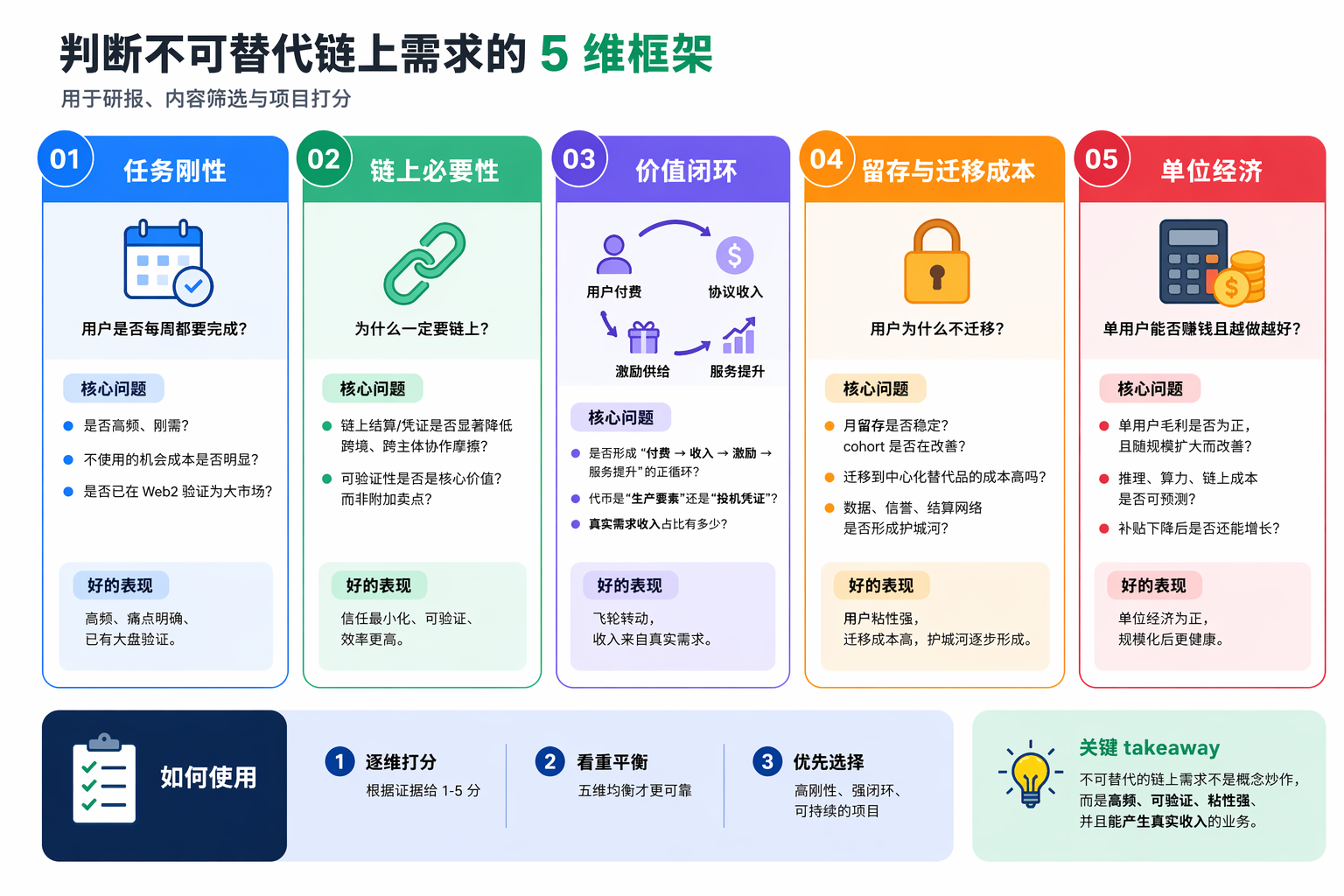
This framework is ideal for research reports, content filtering, and project scoring.
1. Problem Severity
-
Do users need to complete this task every week?
-
Is the opportunity cost of not using the product significant?
-
Has this problem been validated as a large market in Web2?
2. On-chain Necessity
-
Why is on-chain settlement or credentialing required?
-
Does decentralized settlement significantly reduce cross-border or cross-entity friction?
-
Is verifiability a core value, not just a bonus feature?
3. Value Capture Loop
-
Does a positive cycle form: user payment -> protocol revenue -> supply-side incentives -> improved service quality?
-
Is the token a “productive factor” or just a “speculative instrument” in the cycle?
-
How much protocol revenue is driven by genuine demand versus internal circular trading?
4. Retention & Switching Cost
-
Is monthly retention stable, and are cohorts improving?
-
Why don’t users migrate to centralized alternatives?
-
Do data, reputation, and settlement networks create an accumulable moat?
5. Unit Economics
-
Is per-user gross profit positive and improving with scale?
-
Are inference, hash rate, and on-chain costs predictable?
-
Can growth continue after subsidies decrease?
Which Directions Are Closer to PMF, and Which Are Still High Risk
Three directions closer to PMF:
-
Decentralized compute and inference marketplace: When demand requires flexible hash power and supply has idle GPUs, and on-chain enables verifiable settlement, blockchain mechanisms can deliver real efficiency.
-
Verifiable data and model provenance networks: When collaboration needs clear data origins, permissioning, and revenue sharing, on-chain recording and automated distribution have clear advantages.
-
On-chain payment and collaboration protocols for AI Agents: When Agents need machine-to-machine micropayments, cross-platform settlement, and permission control, Crypto’s programmable payments are valuable.
Two high-risk directions:
-
“AI concept + Meme issuance”: High traffic, short lifespan, usually lacking sustainable revenue and product repeat purchases.
-
“Full-stack, all-in-one platform” early narrative: Attempting to tackle model, data, hash rate, applications, and blockchain all at once consumes vast resources, creates organizational complexity, and has a high early failure rate.
From “Correct Opinion” to “Sufficient Evidence”: AI + Crypto’s Validation Path
AI + Crypto is best approached with a dynamic “hypothesis - validation - review” research method, rather than one-off scoring. The sector is so variable that static conclusions quickly become outdated. Valuable analysis doesn’t just label projects—it continually updates the evidence chain.
Recommended research sequence:
-
Write the core hypothesis: e.g., the project solves a high-frequency need, and the on-chain mechanism is essential, not optional.
-
Define observable signals: Turn abstract judgments into trackable metrics, such as repeat visits, feature usage depth, percentage of real revenue, and retention after incentives are reduced.
-
Compare over time: Focus on 3–6 months of continuous change, not single-day peaks. Short-term spikes may be driven by sentiment; sustained improvement likely comes from the product.
-
Compare horizontally with peers: Benchmark user structure, iteration speed, and narrative stability against similar projects to spot “lookalikes with major differences.”
-
Regularly review and update conclusions: Every 2–4 weeks, re-examine which evidence strengthens or overturns the original hypothesis—avoid preconceptions.
Key execution points to observe:
-
Will users keep using core features without subsidies?
-
Does on-chain interaction serve real business, not just generate active data?
-
Is the team consistently optimizing the main product, rather than chasing every new narrative?
-
Can income and usage data corroborate each other, rather than tell separate stories?
-
When market sentiment weakens, do product metrics remain resilient?
Conclusion: Demand First, Then Tokens, Finally Narrative
AI + Crypto’s PMF won’t materialize just by saying “the future is here.” It must be proven by data: users consistently use the product, are willing to pay, on-chain mechanisms deliver irreplaceable advantages, and the system remains functional after subsidies end.
Projects worth tracking long-term aren’t necessarily the best storytellers—they’re the ones that connect “demand - product - mechanism - revenue” into a closed loop.
For investors, researchers, and content creators, the most effective approach isn’t chasing trends but building a stable evaluation system. If you consistently use the same five-dimensional framework to assess projects, market noise will fade and your win rate will rise.







