JPMorgan Reaffirms $170,000 Bitcoin Target—Is the Market Really Undervaluing It?
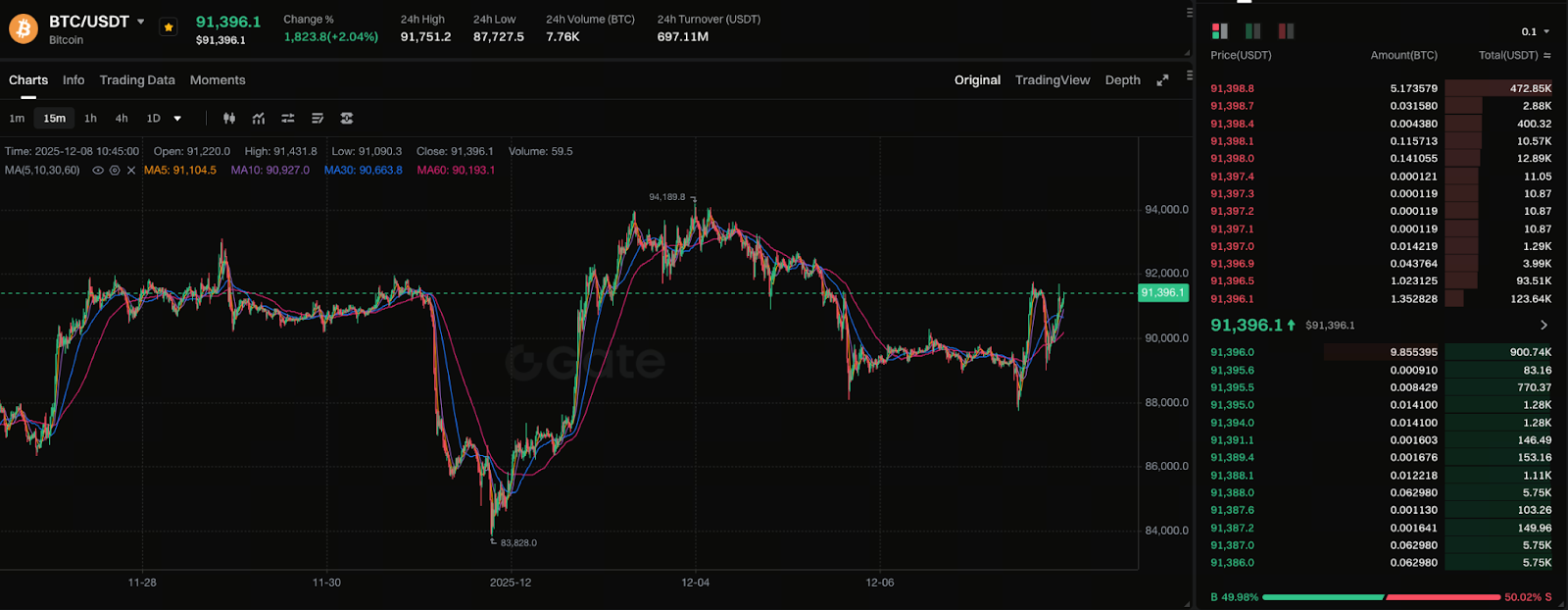
Image: https://www.gate.com/trade/BTC_USDT
In recent years, Bitcoin has seen intense price swings. Earlier this year, it surged to a record high above $126,000, then entered a sustained correction and now trades primarily in the $90,000–$100,000 range. As market sentiment grows more cautious, Wall Street giant JPMorgan released its latest research report at the end of 2025, delivering another strong bullish signal for Bitcoin and reaffirming its view that the cryptocurrency could reach $170,000 in the next 6–12 months.
This forecast quickly ignited debate across the market. After a deep round of deleveraging, is Bitcoin truly on the verge of a new value re-rating?
Why Is JPMorgan Reaffirming the $170,000 Target?
JPMorgan analysts argue that the market is clearly undervaluing Bitcoin at present. In the previous sharp correction, a wave of highly leveraged, short-term speculative capital was systematically cleared out. This has left the market with a “cleaner capital structure,” laying a more solid foundation for the next long-term rally.
More crucially, JPMorgan has doubled down on a core thesis: Institutions are increasingly treating Bitcoin as “digital gold.” Its value is no longer confined to being a volatile risk asset; instead, it is steadily evolving into a long-term store of value.
Applying a gold-like valuation model, adjusted for volatility, JPMorgan concludes that Bitcoin’s “theoretical fair value” should be close to $170,000.
The “Gold Benchmark Model”: Bitcoin’s New Valuation Anchor Takes Shape
JPMorgan’s framework highlights growing comparability between Bitcoin and gold:
- Both serve as hedges against inflation
- Both act as safe-haven assets and long-term stores of value
- Institutional participation is rising, and market liquidity continues to improve
The report notes that as the Bitcoin market matures, its volatility is gradually decreasing, and investors are increasingly viewing its “value anchor” in line with gold. When the market stops pricing Bitcoin solely as a “high-risk speculative asset” and begins to value it as “digital gold,” its price baseline will rise accordingly.
In short, once leveraged bubbles have been fully cleared and the market structure stabilizes, Bitcoin’s long-term value proposition is more likely to gain broad recognition from capital.
Current Market Environment: Mining Costs, Institutional Holdings, and Liquidity Dynamics
On the supply side, Bitcoin miners are under significant pressure. Global hash rates and mining difficulty have declined, and higher electricity and operational costs have forced some high-cost miners out of the market. JPMorgan has lowered its estimate of Bitcoin’s “production cost” to around $90,000. If prices remain below this level for long, some miners may sell their reserves to ease operational stress, adding temporary selling pressure.
However, JPMorgan believes that large institutional holders, not miners, are the true drivers of market direction.
The key institutional bellwether is Strategy (formerly MicroStrategy). As long as its market net asset value multiple (mNAV) stays above 1.0, it does not need to sell Bitcoin to meet debt or financial obligations. The metric is currently around 1.1, and if it remains stable, it will provide critical support for Bitcoin’s price.
Three Key Variables for Investors to Watch
Even with JPMorgan’s clear price target, the bank does not ignore potential risks. These variables will directly determine whether the $170,000 target is achievable:
First, whether Strategy is forced to reduce its Bitcoin holdings.
If market swings, index rebalancing, or financial pressures compel Strategy to sell, market sentiment could take a significant hit.
Second, macroeconomic trends and interest rates.
If global liquidity tightens and the US dollar strengthens, Bitcoin’s appeal as “digital gold” may temporarily weaken.
Third, regulatory environment and market risk appetite.
If major economies tighten crypto regulations or global risk appetite wanes, Bitcoin could remain volatile at elevated levels or face another correction.
Only if the “digital gold” thesis is repriced by the market, institutional holdings remain stable, and macro liquidity stays supportive does the $170,000 target have a realistic chance of being realized.
Conclusion: The Start of a New Bull Market, or a High-Risk Wager?
JPMorgan’s $170,000 Bitcoin forecast gives the market a compelling “bull market script.” Examined through the lenses of capital structure, valuation logic, and institutional participation, this price target is grounded in a clear financial framework—not just market hype.
Yet, mining costs, institutional holding stability, macro liquidity, and the regulatory environment all represent real uncertainties.
For investors, it’s more rational to focus on three main themes than to obsess over a specific price point:
- Are core institutions like Strategy maintaining stable positions?
- Is global macro liquidity becoming more accommodative?
- Is the market truly revaluing Bitcoin as “digital gold”?
This could be the beginning of a new long-term value cycle;
Or it may simply be the prelude to another round of high-volatility, high-risk capital speculation.







