In blockchain networks, native tokens typically serve multiple roles such as payment, incentives, and governance, making them a core component of system operation. A token model not only influences network security and participation, but also reflects its intended use cases and architectural design.
For the Keeta network, KTA is more than just a unit for transaction fees. It is deeply embedded in both the validation mechanism and governance structure. Given Keeta’s positioning toward real-world financial systems, its tokenomics model places greater emphasis on stability, scalability, and long-term sustainability in high-frequency usage scenarios.
The Role and Positioning of KTA in the Keeta Network
As the native utility token of the Keeta network, KTA primarily supports network operations and participation mechanisms.
Within the overall architecture, KTA serves three core roles:
First, as a medium for paying transaction fees.
Second, as an incentive tool for validators and participants.
Third, as a carrier of governance weight.
Unlike many tokens that only serve on-chain activities, KTA is designed in close alignment with Keeta’s focus on real-world financial applications. Its goal is to support high-frequency transactions, compliant execution, and large-scale system operations.
Core Use Cases of KTA
KTA’s primary use cases revolve around fundamental network functions.
First, users must pay transaction fees denominated in KTA when submitting transactions or executing on-chain operations. These fees compensate for network resource consumption and help maintain system operations.
Second, under Keeta’s Delegated Proof of Stake (DPoS) mechanism, validator nodes earn KTA rewards by processing transactions and maintaining the network, while regular users can participate through delegation.
In addition, KTA is used in network governance, such as voting on protocol upgrades or parameter adjustments. In certain scenarios, it can also work alongside a KYC certification system to support identity verification processes.
KTA Supply Mechanism: Issuance and Distribution Structure
KTA adopts a fixed supply model with a total cap of 1 billion tokens, a design that helps establish long-term scarcity expectations.
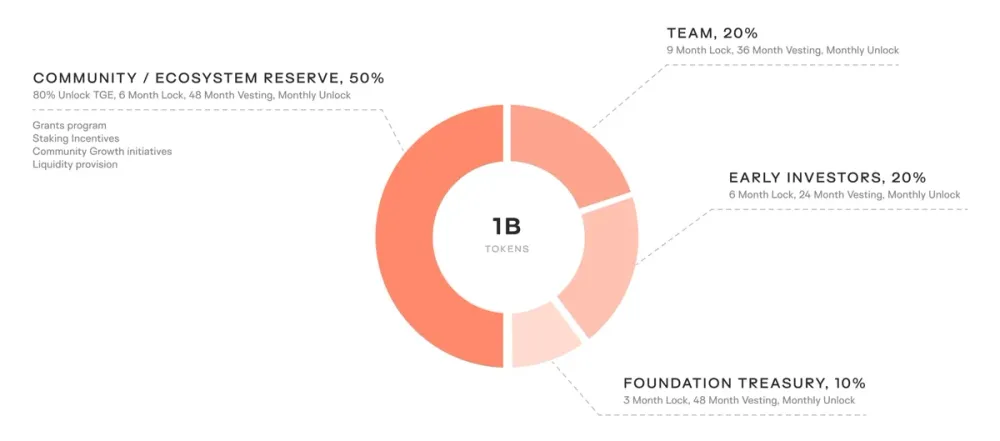
Its supply is primarily distributed through an initial allocation, combined with subsequent incentive releases to support network operations. The overall structure balances ecosystem development, participation incentives, and long-term growth needs.
KTA is allocated across several key stakeholder groups to support both early-stage development and long-term expansion:
| Allocation Category |
Percentage |
Purpose |
| Community & Ecosystem |
50% |
Developer incentives, ecosystem subsidies, liquidity support |
| Team & Advisors |
20% |
Core development and long-term building (with vesting mechanisms) |
| Early Investors |
20% |
Initial funding and network launch |
| Foundation |
10% |
Long-term research, partnerships, and infrastructure development |
Incentive Mechanism Design: Driving Network Participation
Keeta adopts a DPoS mechanism, with KTA forming the foundation of both incentives and security.
Validator nodes must hold or receive delegated KTA to participate in consensus and earn rewards by processing transactions. This encourages nodes to maintain high availability and stable performance.
Regular users can delegate their KTA to participate indirectly and share in the rewards, thereby increasing overall participation.
In addition, KTA is used for developer grants, ecosystem incentives, liquidity support, and community rewards. This multi-layered incentive structure helps drive long-term network growth.
Functions and Use Cases of KTA in the Network
KTA’s role in the Keeta network extends beyond basic fee payments and includes:
-
Paying transaction and execution fees
-
Supporting high-frequency payment and settlement scenarios
-
Participating in validator delegation and reward distribution
-
Enabling governance and protocol upgrades
In practice, KTA acts as the core medium connecting user actions with network execution. For example, when users transfer assets, interact with protocols, or perform wallet operations, KTA is typically involved as both a fee and incentive mechanism. This “usage-driven demand” model creates a linkage between token value and network activity.
Key Features of the KTA Tokenomics Model
KTA’s economic model has several notable characteristics.
First, it emphasizes low fees and high efficiency to support large-scale transaction processing. Second, it uses the DPoS mechanism to distribute incentives, balancing network security and participation. In addition, KTA’s use cases align with Keeta’s positioning as financial infrastructure, enabling it to support not only on-chain activity but also interactions with real-world financial systems.
Potential Challenges and Limitations
Despite its advantages, KTA’s design also faces potential challenges.
For example, in high-performance networks, low transaction fees may weaken long-term incentive strength. At the same time, the DPoS model can, in some cases, lead to concerns about power concentration.
As the network scales, maintaining a balance between performance, decentralization, and compliance will remain an ongoing challenge for the tokenomics model.
Conclusion
As a core component of the Keeta network, KTA’s tokenomics model revolves around payment, incentives, and governance, closely aligned with the network’s focus on high performance and financial applications.
Through the coordinated design of its supply mechanism, distribution model, and incentive system, KTA supports both secure network operations and ecosystem expansion. It also reflects the broader trend of blockchain infrastructure extending into real-world financial systems.
FAQs
What are the main uses of KTA?
KTA is primarily used for paying transaction fees, participating in validator incentives, and network governance.
How does KTA support network security?
Through the DPoS mechanism, validator nodes must hold or receive delegated KTA to participate in consensus, strengthening network security.
How can users participate in the KTA ecosystem?
Users can use KTA to pay fees or delegate it to validator nodes to earn rewards.
Does KTA have an inflation mechanism?
It typically includes issuance mechanisms for incentives, though the exact structure depends on network design.
How is KTA different from other blockchain tokens?
Its design places greater emphasis on supporting high-performance financial applications and large-scale transaction scenarios.







