New York Fed Purchases $6.8 Billion in Treasury Bills to Boost Year-End Liquidity: Market Impact and Price Trend Analysis

2025-12-24 03:36:23
Beginner
Quick Reads
In 2025, the New York Federal Reserve announced it would purchase $680 million in U.S. Treasury securities to boost year-end liquidity. This article delivers a comprehensive analysis of the measure's effects, market response, and price movements, providing investors with in-depth insights and expert interpretation.

Analysis of the New York Fed’s $6.8 Billion Treasury Purchase

In mid-December 2025, the Federal Reserve Bank of New York announced it would inject approximately $6.8 billion in short-term liquidity into the financial system via repurchase agreements (repos). This move aimed to ease potential year-end funding market stress. Market participants viewed this as the most notable temporary liquidity intervention by the Fed in the repo market since 2020.

It’s important to note that these actions are technical liquidity management tools, not a policy shift. The primary objective is to stabilize short-term funding markets and prevent abnormal interest rate swings due to liquidity mismatches—not to signal a long-term easing stance.

How Repurchase Agreements Work and Their Policy Nature

A repurchase agreement involves the central bank providing short-term funds to financial institutions in exchange for high-quality collateral—usually U.S. Treasuries or Treasury bills—and reversing the transaction on a set date. This mechanism is fundamentally a short-term funding adjustment tool with the following characteristics:

  • Fixed term, making the liquidity injection temporary;
  • Does not permanently expand the central bank’s balance sheet;
  • Fundamentally distinct from Quantitative Easing (QE) in policy terms.

As a result, while markets are highly sensitive to Fed liquidity injections, repo operations primarily serve as “technical maintenance” of the funding market, not a redefinition of monetary policy direction.

Why Does Year-End Liquidity Stress Keep Reappearing?

At year-end, banks and financial institutions typically face multiple funding constraints:

  • Regulatory ratio and capital adequacy assessments;
  • Tax settlements and year-end balance sheet adjustments;
  • Balance sheet management and risk exposure reduction.

These factors combine to drive up short-term funding demand, increasing volatility in repo rates and short-term funding costs. Without timely intervention, this can trigger abnormal spikes in short-term rates and threaten overall financial market stability.

In this context, the Fed’s repo operations act as a liquidity backstop—a routine response to seasonal pressures, not a direct economic outlook signal.

The Fed’s Toolkit: Treasuries and Repo Operations

For this round of liquidity management, the Fed primarily used:

  • Repurchase Agreements (Repo): Providing cash to the market and temporarily receiving collateral;
  • Treasury Bill Operations: Using short-term government securities to optimize the system’s cash supply structure.

The December 2025 operation stood out due to its relatively large scale, highlighting the Fed’s focus on the year-end liquidity gap and ongoing pressure in the short-term funding market.

Market Reactions and Price Dynamics

Market feedback showed that this liquidity injection had varied effects across asset classes:

Bond Market: Short-term interest rates and repo rates declined, reflecting eased funding stress and increased downward pressure on short-term yields.

Risk Assets: Some risk assets saw modest sentiment improvements, but gains were limited. The reaction was mostly short-term, driven by better funding conditions rather than a change in trend.

Crypto Market: Opinions were split. Improved liquidity benefits volatile assets, but a one-off, temporary operation isn’t enough to change the medium- or long-term price structure of crypto assets. Traders remained cautious overall.

In sum, the price impact of such operations is mostly short-term and structural. The durability of these effects remains to be seen.

Implications for Crypto Assets and Risk Markets
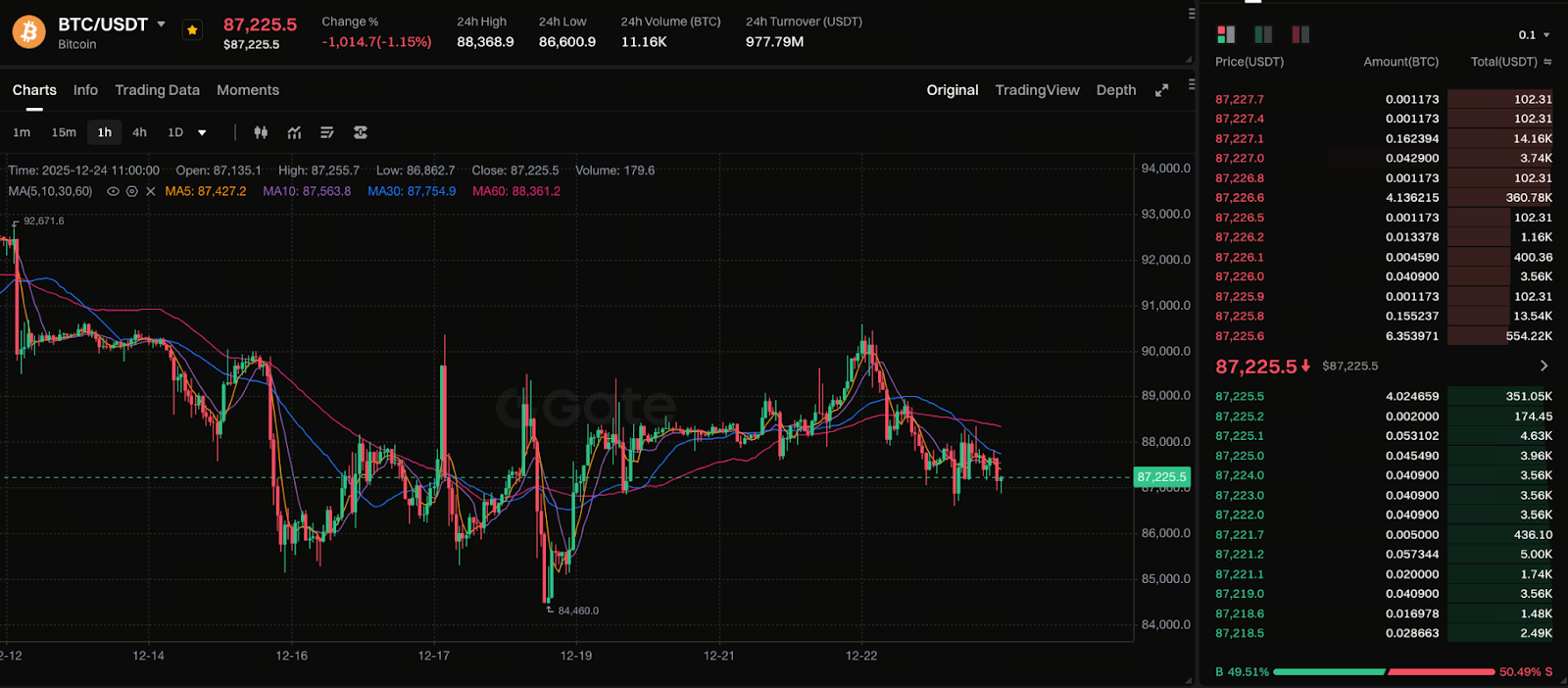

Chart: https://www.gate.com/trade/BTC_USDT

Some market participants see the Fed’s liquidity operation as a “leading indicator” for a rebound in risk assets, especially as macro risk sentiment eases. However, a more cautious view holds that:

  • Repo operations address technical imbalances in funding markets;
  • They are clearly distinct from broad-based monetary easing;
  • Support for risk assets is typically limited and short-lived.

Even so, this move sends a clear message: short-term funding conditions are under active management, which helps contain the spread of extreme risk aversion.

Key Takeaways for Investors

When interpreting liquidity events like this, investors should maintain a structural perspective and focus on:

  • Changes in repo rates and short-term funding costs as liquidity indicators;
  • Whether operations are ongoing or increasing in scale;
  • The distinction between technical liquidity management and policy-driven easing;
  • Shifts in macro data, inflation trends, and future interest rate expectations.

It’s crucial for risk management not to overinterpret a single liquidity operation as a long-term asset allocation signal.

Conclusion

The New York Fed’s $6.8 billion Treasury purchase and year-end liquidity support via repo agreements represent a highly targeted technical funding operation. In the short term, this helps relieve funding market stress and stabilize interest rates, but it does not indicate a change in monetary policy direction.

For investors, this event is best used as a reference for marginal changes in funding conditions—not as a standalone basis for long-term investment decisions. Ultimately, market trends will continue to be shaped by the broader evolution of macro fundamentals, policy expectations, and risk appetite.

Author: Max
Disclaimer
* The information is not intended to be and does not constitute financial advice or any other recommendation of any sort offered or endorsed by Gate.
* This article may not be reproduced, transmitted or copied without referencing Gate. Contravention is an infringement of Copyright Act and may be subject to legal action.

Share

Crypto Calendar
OM Token Göçü Sona Erdi
MANTRA Chain, kullanıcıları OM token'larını 15 Ocak'tan önce MANTRA Chain ana ağına taşımaları için bir hatırlatma yayınladı. Taşıma işlemi, $OM'nin yerel zincirine geçişi sırasında ekosistemdeki katılıma devam edilmesini sağlar.
OM
-4.32%
2026-01-14
CSM Fiyat Değişikliği
Hedera, Ocak 2026'dan itibaren KonsensüsSubmitMessage hizmeti için sabit USD ücretinin $0.0001'den $0.0008'e yükseleceğini duyurdu.
HBAR
-2.94%
2026-01-27
Vesting Kilidi Gecikti
Router Protocol, ROUTE tokeninin Hakediş kilidinin 6 aylık bir gecikme ile açılacağını duyurdu. Ekip, projenin Open Graph Architecture (OGA) ile stratejik uyum sağlamak ve uzun vadeli ivmeyi koruma hedefini gecikmenin başlıca nedenleri olarak belirtiyor. Bu süre zarfında yeni kilit açılımları gerçekleşmeyecek.
ROUTE
-1.03%
2026-01-28
Tokenların Kilidini Aç
Berachain BERA, 6 Şubat'ta yaklaşık 63,750,000 BERA tokenini serbest bırakacak ve bu, mevcut dolaşımdaki arzın yaklaşık %59.03'ünü oluşturacaktır.
BERA
-2.76%
2026-02-05
Tokenların Kilidini Aç
Wormhole, 3 Nisan'da 1.280.000.000 W token açacak ve bu, mevcut dolaşımdaki arzın yaklaşık %28,39'unu oluşturacak.
W
-7.32%
2026-04-02
sign up guide logosign up guide logo
sign up guide content imgsign up guide content img
Sign Up

Related Articles

2025 BTC Price Prediction: BTC Trend Forecast Based on Technical and Macroeconomic Data
Beginner

2025 BTC Price Prediction: BTC Trend Forecast Based on Technical and Macroeconomic Data

This article will provide a systematic interpretation of the Bitcoin price trend in 2025 from the perspectives of technical analysis, on-chain data, and macroeconomic factors, combining the latest trends and data, and supplemented with example charts to help investors form a comprehensive judgment.
2025-07-11 10:42:17
Flare Crypto Explained: What Is Flare Network and Why It Matters in 2025
Beginner

Flare Crypto Explained: What Is Flare Network and Why It Matters in 2025

Discover what Flare Crypto is, how it works, its use cases, tokenomics, and why it's gaining traction in the blockchain space in 2025.
2025-04-15 01:21:45
Pi Coin Transaction Guide: How to Transfer to Gate.com
Beginner

Pi Coin Transaction Guide: How to Transfer to Gate.com

Pi Network is a decentralized cryptocurrency network for the general public, using the Stellar Consensus Protocol (SCP) consensus mechanism, which allows users to easily mine Pi tokens from their mobile devices and use them for payments and transactions. With the official opening of the mainnet on February 20, 2025, investors can deposit and trade $PI on exchanges such as Gate.com. This article details how to securely transfer Pi Coins to Gate.com, including obtaining a deposit address, completing the transfer using the Pi Network mainnet wallet, and the exchange's arrival confirmation process. In addition, we have analysed $PI investment risks, including market volatility, compliance and potential fraud risks, to remind investors to take risk management before trading.
2025-02-25 08:21:43
How to Use a Crypto Whale Tracker: Top Tool Recommendation for 2025 to Follow Whale Moves
Beginner

How to Use a Crypto Whale Tracker: Top Tool Recommendation for 2025 to Follow Whale Moves

This article will take you through what is a crypto whale tracker and why it has become the "must-have weapon" for encryption investors. We will recommend seven mainstream Whale tracking tools, and combined with usage scenarios, teach you how to efficiently use these tools to obtain first-hand signals from the market. Of course, Whale behavior may also be a "lure," so while using these tools, you also need to have a certain level of judgment and data interpretation ability. This article is suitable for beginners to quickly get started, as well as for experienced players to optimize strategies.
2025-04-14 06:57:17
What is N2: An AI-Driven Layer 2 Solution
Beginner

What is N2: An AI-Driven Layer 2 Solution

This article introduces N2 (Niggachain AI Layer 2), the world's first AI-driven Layer 2 blockchain solution. N2 combines AI technology and quantum computing resistance to address the limitations of traditional blockchains in scalability, transaction speed, and cost. Its core technologies include '0-second block time', AI-driven network optimization, and quantum-resistant security protection, aiming to improve transaction efficiency and ensure system stability.
2024-12-23 07:21:00
Understand Baby doge coin in one article
Beginner

Understand Baby doge coin in one article

Baby Doge Coin, also known as "Baby Dog Token", is a meme token derived from the Dogecoin community, which gained popularity through Elon Musk's tweets and enhanced token utility through mechanisms such as deflation, payment integration, and NFT ecosystem. This article comprehensively analyzes the project background, token information, application scenarios, and market performance of Baby Doge, helping investors quickly understand its potential and risks.
2025-02-14 16:53:03





