From a market evolution standpoint, competition among token models has shifted from “storytelling” to a focus on “conversion.” Token systems that address genuine real-world needs are generally more sustainable than assets driven solely by sentiment. Recently, RAVE has secured additional liquidity entry points in both mainstream spot and derivatives markets, with a notable surge in trading activity. This has brought increased scrutiny to the robustness of its tokenomics.
Within the blockchain and digital asset framework, research on RAVE should move beyond the price curve and return to the fundamentals of supply and demand: Is usage demand authentic? Is the issuance schedule manageable? Is governance participation effective? Does the incentive structure generate long-term positive feedback? The following analysis addresses these dimensions in sequence: function, allocation, governance, value, risk, and conclusions.
Core Functions and Use Cases of the RAVE Token
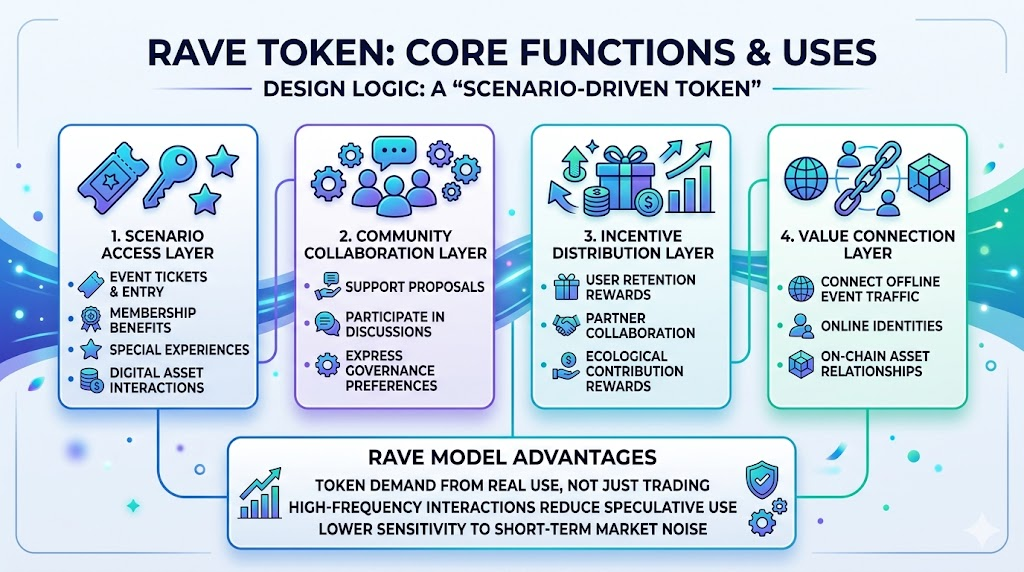
RAVE is designed as a scenario-driven token, with four primary layers of utility:
- Scenario Access: For event tickets, membership equity, exclusive experiences, and digital asset interactions
- Community Collaboration: For proposal support, governance discussions, and expressing governance preferences
- Incentive Distribution: For rewarding user retention, partner collaboration, and ecosystem contributions
- Value Connection: For integrating offline event traffic, online identities, and on-chain asset relationships
The strength of this model lies in token demand coming from actual use cases, not just trading. If events and the community sustain high-frequency engagement, RAVE’s share of non-speculative usage can increase, potentially reducing price sensitivity to short-term market noise.
Recent public data shows that RAVE’s volume and price elasticity have expanded significantly in a short time, reflecting rapid growth in market attention. For researchers, the focus should be on tracking the ratio shift between “trading demand” and “usage demand,” rather than just daily price changes.
Token Issuance, Allocation, and Incentive Mechanisms
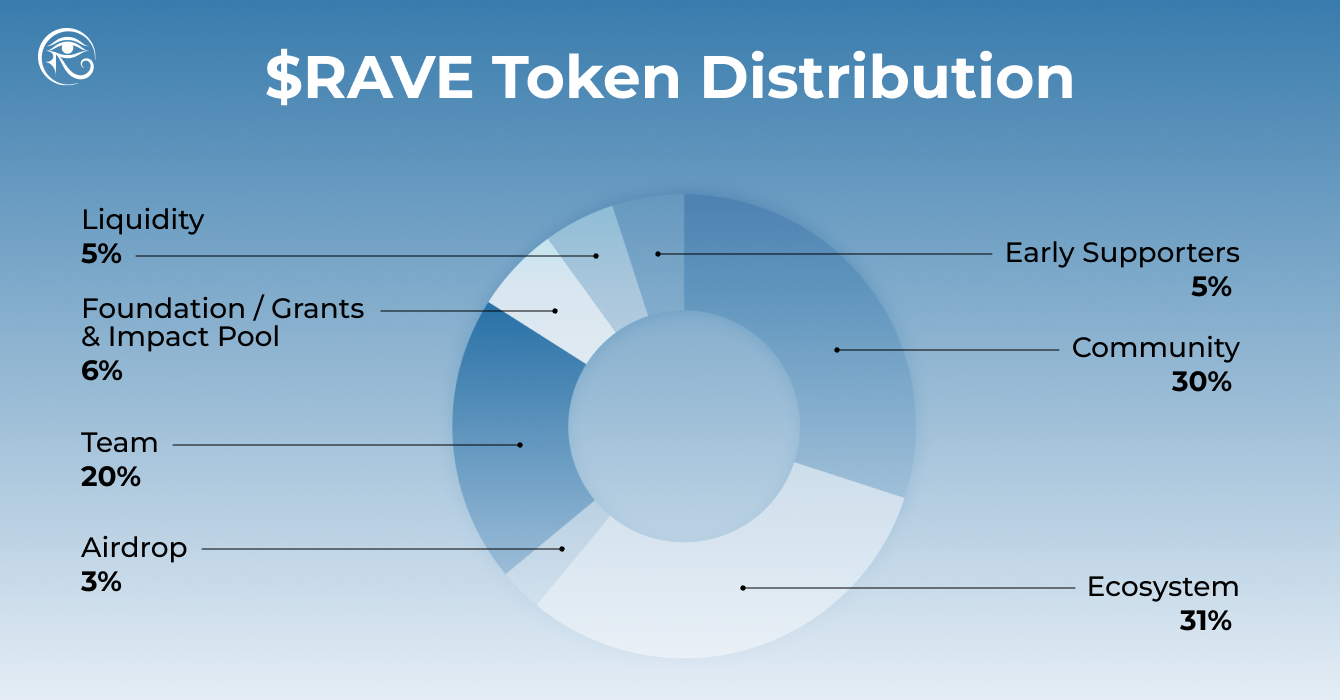
According to the official white paper, RAVE has a fixed maximum supply of 1 billion tokens. The current discussion centers on the pace of circulation and allocation structure, not the total supply itself. Public disclosures indicate about 23.03% entered circulation at TGE, with the remainder subject to a 12-month cliff and 36-month linear vesting.
Primary allocation categories include:
- Community and ecosystem incentives
- Team and co-builders
- Initial airdrop and liquidity provisions
- Foundation or influence pool
- Early supporters and strategic partners
This structure has dual implications during early growth:
- Positive: Aligns long-term incentives and avoids systemic imbalance from one-off releases
- Negative: If new circulating supply outpaces real demand growth, price stability can come under pressure
The effectiveness of the incentive mechanism hinges on whether tokens drive long-term engagement rather than just short-term trading. Key metrics to monitor include:
- Alignment between new circulating supply and trading depth
- Changes in the percentage of addresses with non-trading usage
- Retention periods post-reward distribution
- Whether ecosystem partnerships foster ongoing collaboration or are limited to one-off campaigns
Participating in Decentralized Governance with RAVE
The governance value of RAVE is rooted in the “quality of participation,” not merely the number of votes. According to the public framework, holders can engage in ecosystem direction discussions, propose collaborative initiatives, and advise on resource allocation through community mechanisms.
A mature governance system typically exhibits three traits:
- Transparency: Proposals, voting results, and execution status are all trackable
- Executability: Governance outcomes are actionable and can be implemented in products or operations
- Reviewability: Post-execution data feedback enables iterative optimization
The practical participation process is as follows:
- Hold and manage RAVE assets
- Access the governance platform or official governance channel
- Discuss and vote on proposals
- Monitor execution and review outcomes
Note that governance participation does not equate to protocol control. Professional analysis should distinguish among “community advisory rights,” “operational coordination rights,” and “protocol parameter rights,” avoiding the conflation of marketing narratives with governance reality.
Market Value and Long-Term Potential of RAVE
RAVE’s value should be assessed through a threefold lens: “business fundamentals + market structure + token supply,” rather than projecting long-term outcomes from short-term trends.
Recently, RAVE has exhibited high volatility and turnover, with sharp price increases, heightened trading activity, and expanded derivatives access. Such conditions typically widen valuation discrepancies.
Long-term potential depends on three core variables:
- Demand: Whether event participation consistently translates to on-chain activity and repeat engagement
- Supply: Whether token unlocks are synchronized with ecosystem growth
- Structure: The health of trading depth, holding distribution, and governance participation
Recommended tracking framework:
- Weekly: Monitor
MC / FDV and changes in circulating percentage
- Monthly: Review event execution, user retention, and on-chain engagement
- Quarterly: Evaluate incentive distribution efficiency and community governance conversion rates
If RAVE succeeds in boosting non-trading use cases and converting community engagement into stable retention, its valuation logic will increasingly resemble that of a platform asset; otherwise, pricing will likely remain sentiment-driven.
RAVE Investment: Risk and Return Analysis
RAVE’s high elasticity makes proactive risk management essential. The main risks at this stage fall into five categories:
- Volatility: Significant short-term price and volume swings, with high costs for momentum trading
- Circulation: Future unlock events may alter supply dynamics and market expectations
- Liquidity: Shallow depth can lead to slippage and cascading volatility in large trades
- Execution: Event-driven ecosystems depend on team performance, partnership stability, and operational efficiency
- Compliance: Regulatory or platform rule changes across jurisdictions may impact accessibility
Potential returns are driven by:
- User growth and increased demand from real-world use case expansion
- Enhanced network effects from community governance and brand partnerships
- Valuation re-rating as supply unlocks align with demand growth
A prudent approach is to treat RAVE as a “high-volatility growth asset,” employing phased validation rather than all-in bets:
- Validate demand before increasing exposure
- Observe unlocks before judging trends
- Control drawdowns before pursuing returns
Conclusion
The essence of RAVE’s tokenomics is not to spark short-term trading frenzy, but to connect offline entertainment, on-chain identity, and community collaboration into a sustainable growth engine. Recent market trends show rising attention and liquidity for RAVE, but also increased volatility and structural uncertainty.
From a long-term perspective, RAVE’s ability to endure market cycles ultimately hinges on three questions:
- Can genuine usage demand keep growing?
- Can governance participation translate into effective execution?
- Can token supply pacing match platform expansion?
Only when these three pillars form positive feedback loops can RAVE evolve from an “event-driven asset” to an “ecosystem-driven asset.” For investors and researchers, the most valuable approach is not to predict single market moves, but to continuously track data, test hypotheses, and dynamically refine judgments.







