In the multi-chain era, user assets are no longer limited to single-chain transfers—they are now actively involved in Swap, Bridge, Staking, DApp interactions, and real-world payment scenarios, significantly expanding the attack surface. Wallet security has evolved from simply "protecting Private Keys from theft" to a comprehensive, system-level approach that includes "preventing transaction hijacking, Approval abuse, cross-chain risks, and endpoint environment compromise."
A thorough technical evaluation of SafePal requires analyzing the storage layer, signature layer, transmission layer, on-chain verification layer, and operational upgrade layer. This article is structured around these five layers, focusing on how SafePal reduces asset risk in practical scenarios and detailing the security responsibilities users must still shoulder.
SafePal's Digital Asset Storage and Management Technology
SafePal is built on the principle that "the platform does not custody Private Keys—users retain full asset sovereignty." Private Keys and seed phrases are never held by centralized servers; instead, asset control is directly tied to the user’s local key material. This design minimizes platform-level custody risk but also places the burden of backup and recovery squarely on the user.
In terms of asset management, SafePal supports a unified multi-chain view, covering major public chains and a wide range of Token assets. The value of multi-chain aggregation is not just "seeing more Coins," but also reducing operational errors caused by switching wallets—such as address copy mistakes, incorrect network selection, and Approval target misjudgments.
From an engineering standpoint, SafePal emphasizes a clear separation between the account layer and the interaction layer:
- The account layer handles key derivation, address management, and Signature confirmation.
- The interaction layer manages DApp connections, market data, Trade routing, and cross-chain operations.
- Sensitive actions always require user confirmation and Signature—they are never executed automatically by the frontend.
This layered architecture helps isolate malicious DApps or phishing pages from directly accessing core keys. Even if the interaction layer is compromised, attackers cannot easily bypass the signature layer to obtain the Private Key itself.
Security of Decentralized and Hardware Wallets
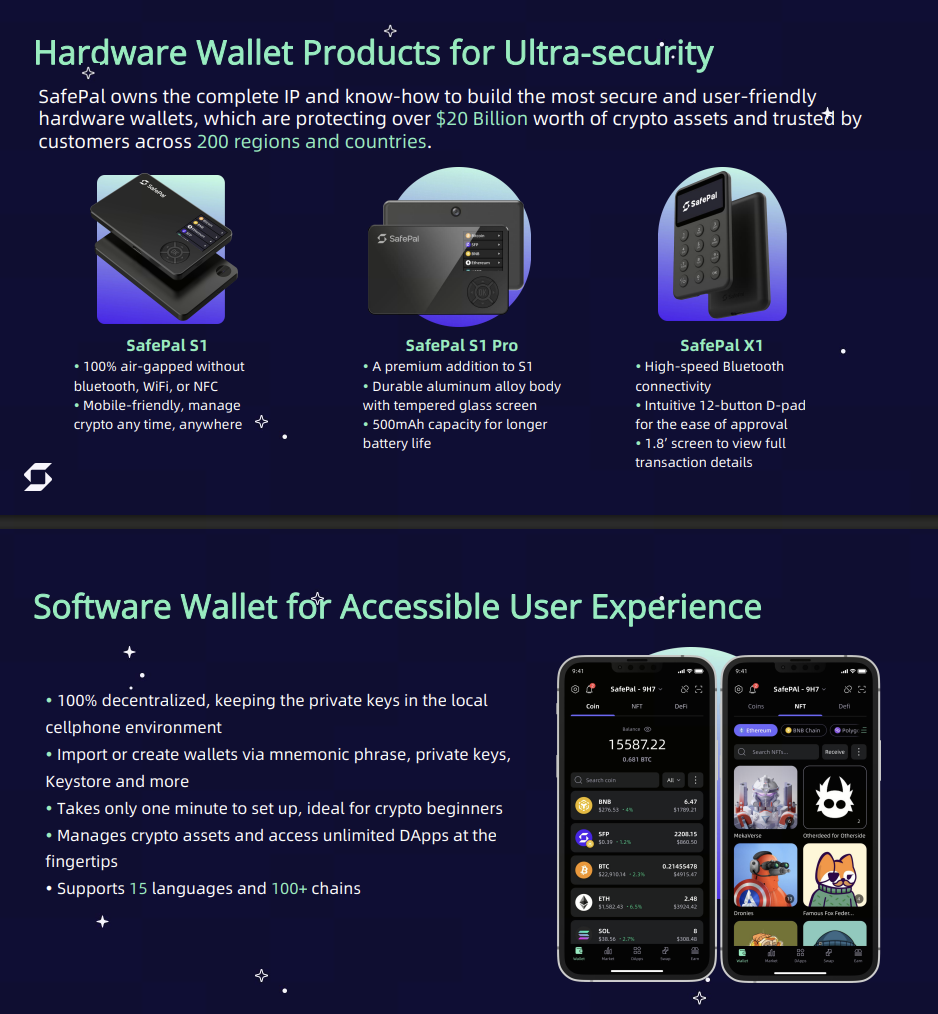
Image source: SafePal White Paper
SafePal’s security model uses a dual-track approach: "hot-end availability + cold-end isolation." The Software Wallet is designed for High Frequency transactions, while the Hardware Wallet is intended for long-term, high-value asset isolation. These two solutions complement each other—they are not substitutes.
A major hardware security upgrade for SafePal is the move from CC EAL 5+ to CC EAL 6+ secure chips (as announced for 2025). This upgrade means:
- Greater resistance to physical tampering and fault injection.
- Stronger defenses against sophisticated threats like side-channel attacks.
- Increased hardware trust for offline Signature devices.
A core feature of SafePal hardware is the offline Signature process. Using QR Codes to transfer Trading Data minimizes attack vectors from USB, Bluetooth, or direct network connections. Transactions are initiated online, reviewed and signed offline, and then broadcast on-chain—significantly lowering the risk of "remote malicious Signature injection."
A critical point for decentralized Wallets is that "security is not automatic." Even with advanced hardware, poor seed phrase storage, downloading apps from fake sites, or ignoring contract Approval ranges can still lead to asset loss. Technical architecture sets the upper limit, but real security depends on user behavior.
Blockchain Technology in SafePal
SafePal’s blockchain strategy is "multi-chain compatibility + unified interaction layer," not building a proprietary chain. The main goal is to enable users to manage assets and applications across multiple chains from a single interface, reducing the friction of ecosystem migration.
According to 2025–2026 updates, SafePal is expanding chain support and ecosystem integration—adding networks like Hedera, World Chain, Lemon Chain, and new DApp scenarios such as prediction markets. These expansions introduce technical challenges:
- Variations in address formats, Signature standards, and transaction models across chains.
- Additional trust assumptions in Bridge and routing processes.
- Compatibility and Risk Control issues with new, less stable chain infrastructure.
SafePal addresses these with a "unified experience layer + native network adaptation layer"—the frontend experience remains consistent, while the backend handles chain-specific Signature, Gas, and broadcast logic. For users, this means a lower learning curve; for security teams, it requires ongoing updates to Risk Control rules to detect abnormal contracts, fake Tokens, and high-risk Approval requests.
Ultimately, the value of blockchain technology in SafePal is not just supporting more chains, but enabling secure, sustainable multi-chain asset management. Only by balancing usability and security can a wallet platform achieve long-term adoption.
SafePal's Multi-Signature and Encryption Protection
SafePal’s approach to Multi-Signature distinguishes between the Wallet’s internal Signature process and on-chain account-level Multi-Sig mechanisms. SafePal natively focuses on "local key Signature and device confirmation," while account-level Multi-Signature is achieved via integration with on-chain protocols that support Multi-Sig.
In practice, SafePal serves as a Signature terminal in Multi-Signature workflows—for team treasuries, DAOs, or project fund custody:
- Transactions are initiated in the Multi-Sig account.
- Each signer confirms via their own device.
- Execution occurs only after the required threshold is met.
This mechanism transforms "single-point leakage risk" into "threshold collaboration risk," significantly improving organizational fund security.
SafePal’s encryption protection is fourfold:
- Key layer encryption: Private Keys are locally protected by secure chips or enclaves, never exposed in plaintext.
- Transmission layer isolation: Hardware Signatures are transmitted via offline QR codes, mitigating online hijack risks.
- Application layer protection: Passwords, biometrics, and operation confirmations block unauthorized actions.
- Policy layer defense: Risk Reminders, Approval reviews, and abnormal transaction interception reduce high-risk interactions.
Encryption does not guarantee "absolute security." Phishing attacks often bypass technical defenses and exploit human nature to trick users into signing. The most effective defense is a combination of "encryption architecture, risk awareness, and disciplined operation."
Future Directions for SafePal Technology
SafePal’s technology is expected to evolve along five main lines:
- Strengthening hardware trusted computing. EAL 6+ is a milestone; next steps include firmware verifiability, supply chain transparency, and device consistency audits, further reducing trust costs.
- Optimizing account abstraction and smart Signature experiences. As Account Abstraction becomes mainstream, wallets can offer more flexible permissions, social recovery, and batch transactions—without sacrificing self-custody.
- Upgrading cross-chain security middleware. More frequent multi-chain operations will require better transaction simulation, Approval visualization, and Bridge path scoring to help users assess risks before signing.
- Expanding institutional and team-level security solutions. Enhanced Multi-Sig, permission layers, audit logs, and approval workflows will broaden SafePal’s organizational capabilities.
- Productizing security education. Security should be integral to the user experience—risk grading Reminders, Approval expiry suggestions, suspicious contract alerts, and recovery drill guidance.
The goal of technical optimization is not feature bloat, but making "safe actions" easier than "risky ones." This is often the key to a wallet platform’s long-term viability.
Summary
SafePal’s core technology and security architecture form a layered defense system: self-custody keys as the foundation, hardware isolation and offline Signature as critical barriers, and multi-chain adaptation with policy-based Risk Control for High Frequency scenarios. The upgrade pace in 2025–2026 shows a shift from "single-device security" to comprehensive, end-to-end protection.
For individual users, SafePal offers robust technical safeguards; for teams and institutions, Multi-Signature and permission governance are crucial enhancements. Digital asset security is an ongoing process—driven by technology, product design, and user habits working together. Only with continuous improvement in all three can wallets become truly reliable Web3 infrastructure gateways.