Recently, a post by Farcaster co-founder Dan Romero on Farcaster’s shift from “social-first” to “wallet-first” has drawn significant attention and sparked widespread debate. For active Farcaster users, this isn’t news: since the Farcaster App rolled out its built-in wallet in February, support for more chains and richer wallet features has become the norm. Dan’s statement simply reiterates what’s been clear all year and serves as a summary of the team’s ongoing direction. Yet for those less familiar with Farcaster, the announcement seemed unexpected. Many reacted with surprise, lamenting that the “last hope of crypto social” or “SocialFi’s final stand” had “declared failure,” “abandoned social,” or “lost its way.” Some expressed disappointment that the “social track has been disproven,” or that “Web3 social is a dead end,” worrying that the community would turn into a “casino” and that the team was “racing in the wrong direction.”
These differing reactions stem from varying interpretations of what the Farcaster wallet actually represents. In reality, the built-in wallet added to Farcaster this year wasn’t a sudden strategic pivot—it was a natural upgrade from the previous need to connect an external wallet for on-chain actions. As Frames evolved into richer, more interactive Mini Apps, user demand for seamless on-chain interaction grew. The built-in wallet’s launch was fundamentally about enabling these new scenarios and strengthening the network’s core capabilities atop the social layer—not about abandoning the social network itself.
The wallet is an addition, not a replacement; it drives, not overtakes, social;
It extends, not abandons, social; it follows the trend, not a forced pivot.
The underlying open social protocol remains as robust as ever, and the diverse client ecosystem is thriving. You can still experience pure social by switching clients. The official Farcaster App retains all its original social features; the built-in wallet is simply an extension, enabling seamless Mini Apps integration, deep identity graph connectivity, and smooth interaction with the social feed.
The team has merely shifted its product focus, exploring new growth paths for the network. They’ve stopped spending time onboarding users from every industry for the sake of diversity, and are no longer optimizing the underperforming Channels feature. After building a “cozy corner” for a niche but engaged user base, the “social-first” strategy failed to achieve strong product-market fit—daily active users remain relatively few. So the team pragmatically returned to crypto’s core principle: serving value transfer.
On this foundation, the wallet-social combination creates stronger differentiation, a more realistic growth path, and a closer fit with crypto social’s product-market fit. Farcaster’s shift this year mirrors the broader trend: “walletizing social, socializing wallets” is the natural direction for consumer crypto apps. Nearly every product with any social component now includes wallet features, while wallets are adding social elements. Some products have even positioned themselves as “social + wallet” from the outset.
Walletizing Social Applications
To stand out, every crypto app must answer how it differs from traditional off-chain alternatives—and crypto social apps must clarify what sets them apart from mainstream social networks. Product manager Yu Jun famously proposed a formula for evaluating new products’ appeal:
Product Value = (New Experience − Old Experience) − Migration Cost
Some new products have very low migration costs. Threads, backed by Instagram’s massive social graph, reached 100 million users in just five days. Sometimes, luck brings a wave of users seeking change for its own sake—Bluesky, for example, capitalized on the “uncensored Twitter” narrative and attracted a flood of Twitter refugees.
But most crypto apps lack that kind of foundation or luck. To get users to even glance at a new product—when mainstream social apps are larger and more mature—crypto social must focus on delivering a distinctly new experience. Initially, crypto social was all about technical integration with blockchains for decentralization. But for most users, these underlying cryptographic features are invisible and don’t deliver a new experience. Instead, they often add friction to onboarding and fail to differentiate from traditional social apps. For example, both Farcaster and Lens use blockchain at their core—Farcaster stores identity data on the OP Chain, Lens stores identity and social graphs on the Lens Chain—ensuring “not your private key, not your social account.” But most users don’t care about the underlying tech; they care about what’s new and interesting at the product level.
The Farcaster team recognized this early. Their philosophy is “product-led protocol development,” aiming to drive network growth with a flagship app. Had they stopped at building a social protocol, their mission would have been complete: they’d implemented decentralization theory, built a protocol focused on openness, programmability, and composability, and enabled developers to build all kinds of apps atop the social graph. But if, like Nostr, ActivityPub, or Lens, they’d left the ecosystem to grow unchecked, users wouldn’t switch just for different back-end tech, and unchecked growth would only increase noise and degrade user experience. Ultimately, users wouldn’t come—or wouldn’t stay. By launching their own client, the Farcaster team aimed to attract users through product quality.
High-quality social circles are a new experience. Unique alpha information is a new experience. The fusion of crypto and social is a new experience. Farcaster achieved the first by onboarding high-quality users, creating a rare moat—but growth was limited, and it struggled to attract the “profit-seeking” majority of crypto users. Ironically, Farcaster was once criticized for being too “clean”—for a long time, discussing tokens was frowned upon and confined to the /DEGEN Channel, which limited engagement. It wasn’t until early 2024, with the launch of Frames (a crypto-native feature that set Farcaster apart from traditional social apps) and the community-driven $DEGEN creator economy project, that Farcaster’s daily active users surged tenfold from about 2,000 at the end of January 2024. This was driven by both product innovation and the community’s ability to incubate new projects on an open social network.
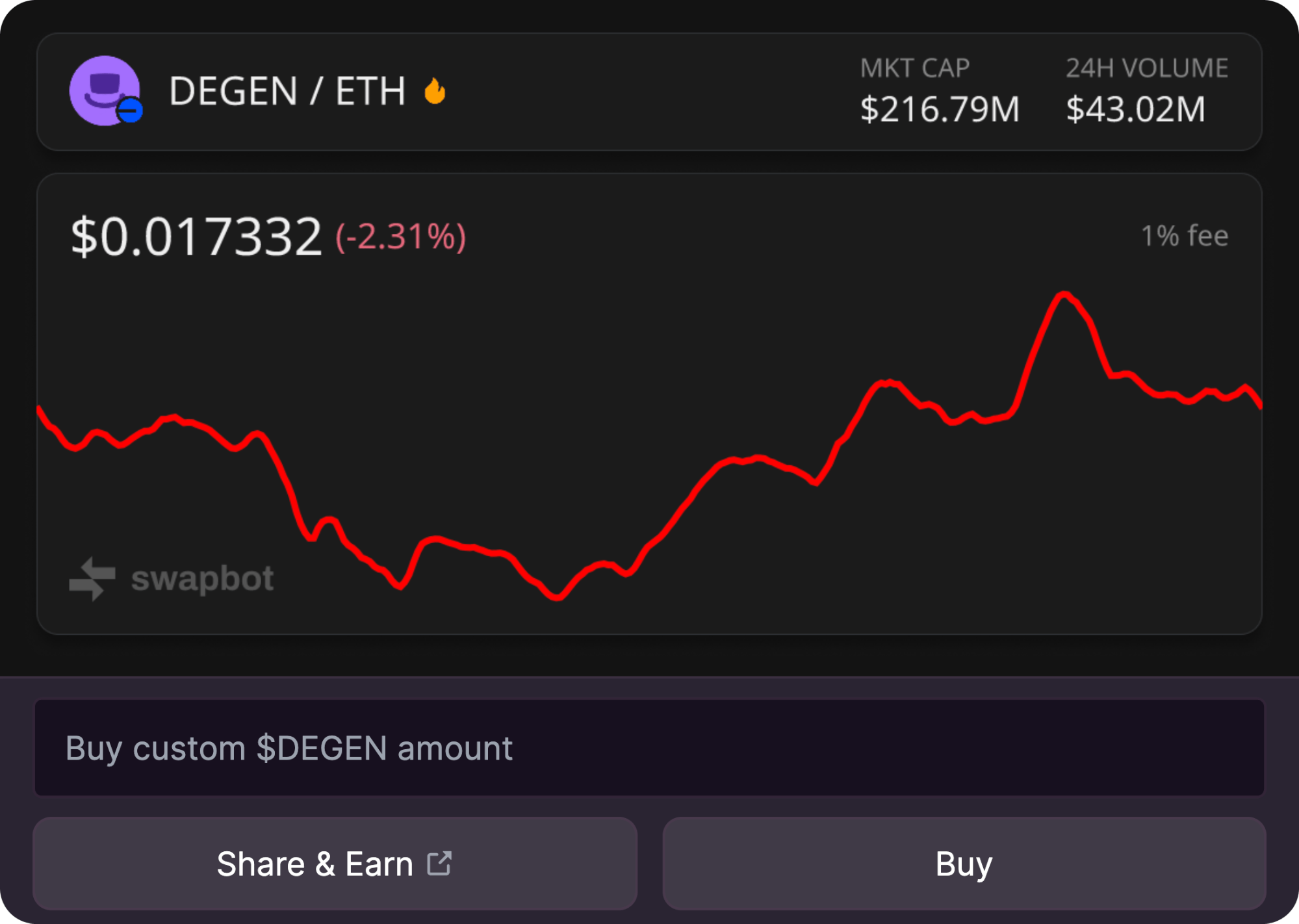
Early Farcaster mini app: a trading Frame https://0x.org/post/power-up-farcaster-frames-with-0x-token-swaps
At that point, Farcaster had already evolved from the “agricultural era” of pure social networking to the “craft era” of crypto integration: social graph + Frames + external wallet, connecting social content and on-chain actions for the first time. Solana later tried to use its Actions protocol and browser plugins to enable wallet and crypto mini-app interactions within Twitter’s feed. Social × crypto apps × wallet interaction is a widespread area of exploration. With Frames, users could mint NFTs or trade directly in the social feed—a genuinely new experience—but with just four action buttons, slide transitions like a PowerPoint, and limited functionality and performance. Any wallet authorization required switching to an external wallet, leading to a fragmented and clunky experience. From day one, the community called for full wallet functionality, but it took a year to arrive.
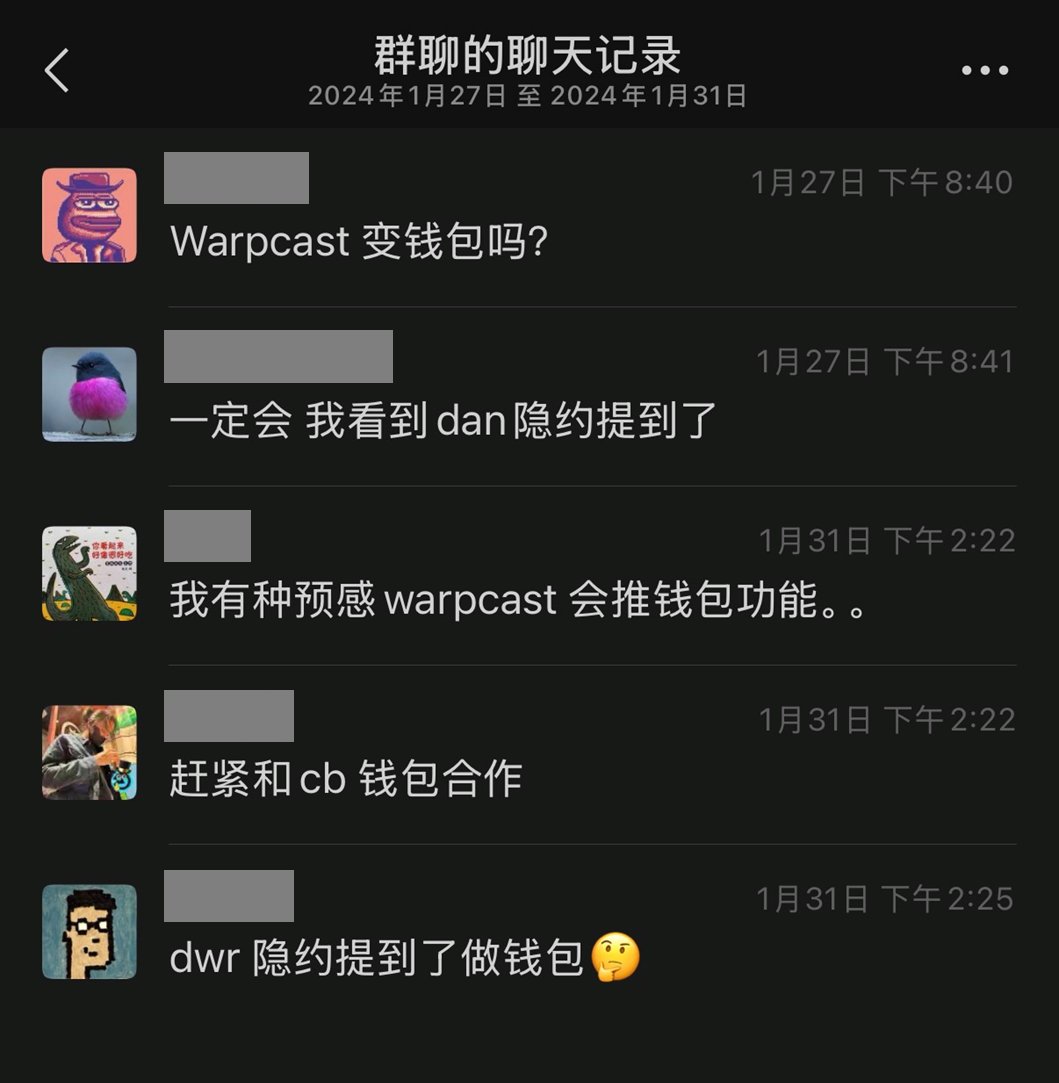
In the Farcaster Chinese community WeChat group, users were already excitedly discussing wallet features as soon as Frames launched in early 2024
Later last year, with the memecoin supercycle—from PumpFun’s rise to the Farcaster-native Clanker—more asset launches drove more trading needs, making the path from discovery to trading increasingly critical. The wallet naturally became the key entry point.
So, to enable users to interact with crypto apps more naturally within a social media platform, you need:
- A more flexible, higher-performance framework to support powerful mini-apps
- A shift from external wallet connections to a built-in wallet for truly seamless on-chain interaction
This trend has also been validated by Telegram, whose Mini Apps ecosystem and built-in TON wallet created a wave of excitement. Farcaster’s upgrade this year followed naturally:
- Frames → Mini Apps
- External wallet → Built-in wallet
Whatever a web page can do, Mini Apps can do—anyone can build them permissionlessly, and they work across clients, massively expanding the functional boundaries of social apps. With a built-in wallet, there’s no need to switch to an external wallet. This marks the transition from the “craft era” of basic crypto features to the “industrial era” of richer functionality. This isn’t a detour—it’s a natural extension of the trend, an inevitable evolution driven by market demand.
Integrating a built-in wallet isn’t the death knell for crypto social—it’s the industrial revolution.
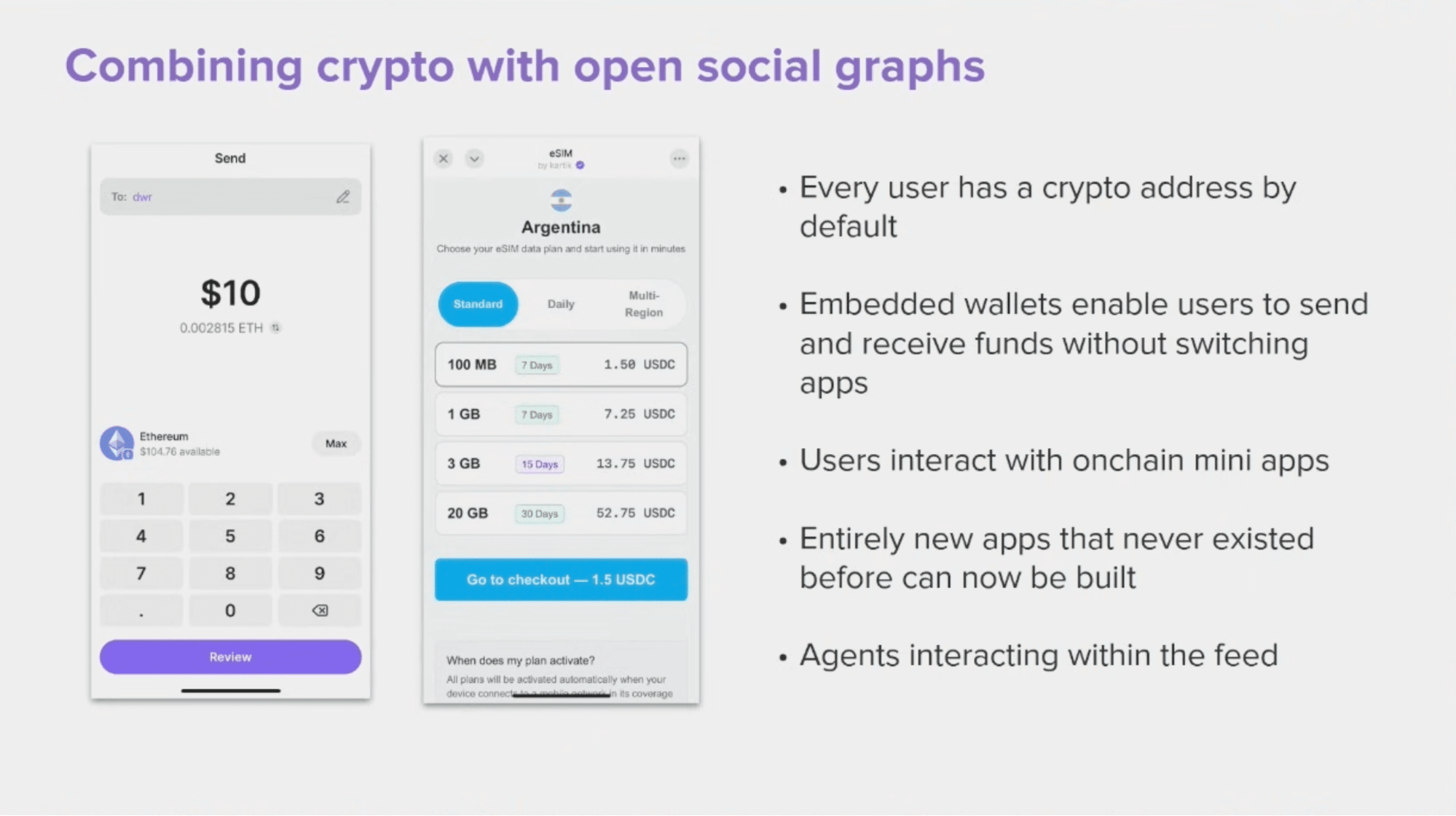
Crypto Apps and Decentralized Social by Linda Xie https://www.youtube.com/watch?v=4vl8eZEOwqk
With a built-in wallet, transaction signals based on the social graph emerge naturally. Asset issuance, distribution, discovery, trading, and community-building can all happen within a single app, and interaction with Mini Apps is seamless, enabling nearly every crypto use case: gaming, video, livestreaming, voice spaces, podcasts, prediction markets, DeFi, and more. The thriving Mini Apps ecosystem and built-in wallet work in tandem, weaving on-chain interaction into daily social behavior. Apps like Noice, Bracky, QR, and Harmonybot have all leveraged the social graph + Mini Apps + built-in wallet to create new crypto social scenarios, each enjoying their own moment in the spotlight. Against this backdrop, Farcaster’s daily active users hit new highs at the end of October.
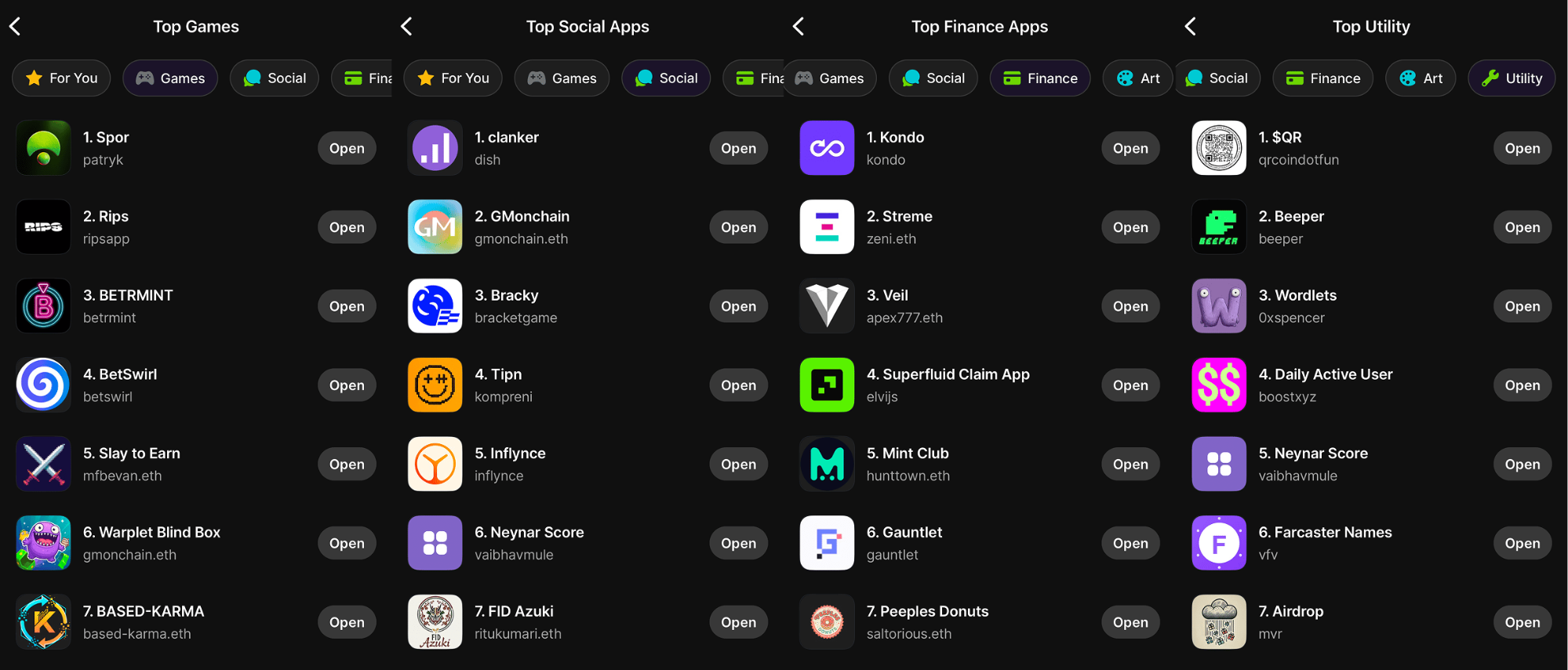
Trending Mini Apps by Category
These are tangible, usable, scenario-unlocking experiences for users—and they’re what truly set crypto social apart from traditional social apps. Even if users are initially drawn by a wallet’s convenience, low fees, or frictionless cross-chain experience, they may “come for the tool, stay for the network.” This is a step beyond simply vying for attention with Twitter through social networking alone.
Similarly, some chat apps are adding wallet features atop social. For example, Farcaster ecosystem chat app frens and DeBox let users initiate trades directly in group chats using the built-in wallet. More developers now recognize: mainstream crypto users shouldn’t be avoided. The essence of crypto social isn’t to distance from wallets, but to embrace them. The value layer shouldn’t be isolated, but integrated. Crypto social without a built-in wallet is “taking the long way around.”
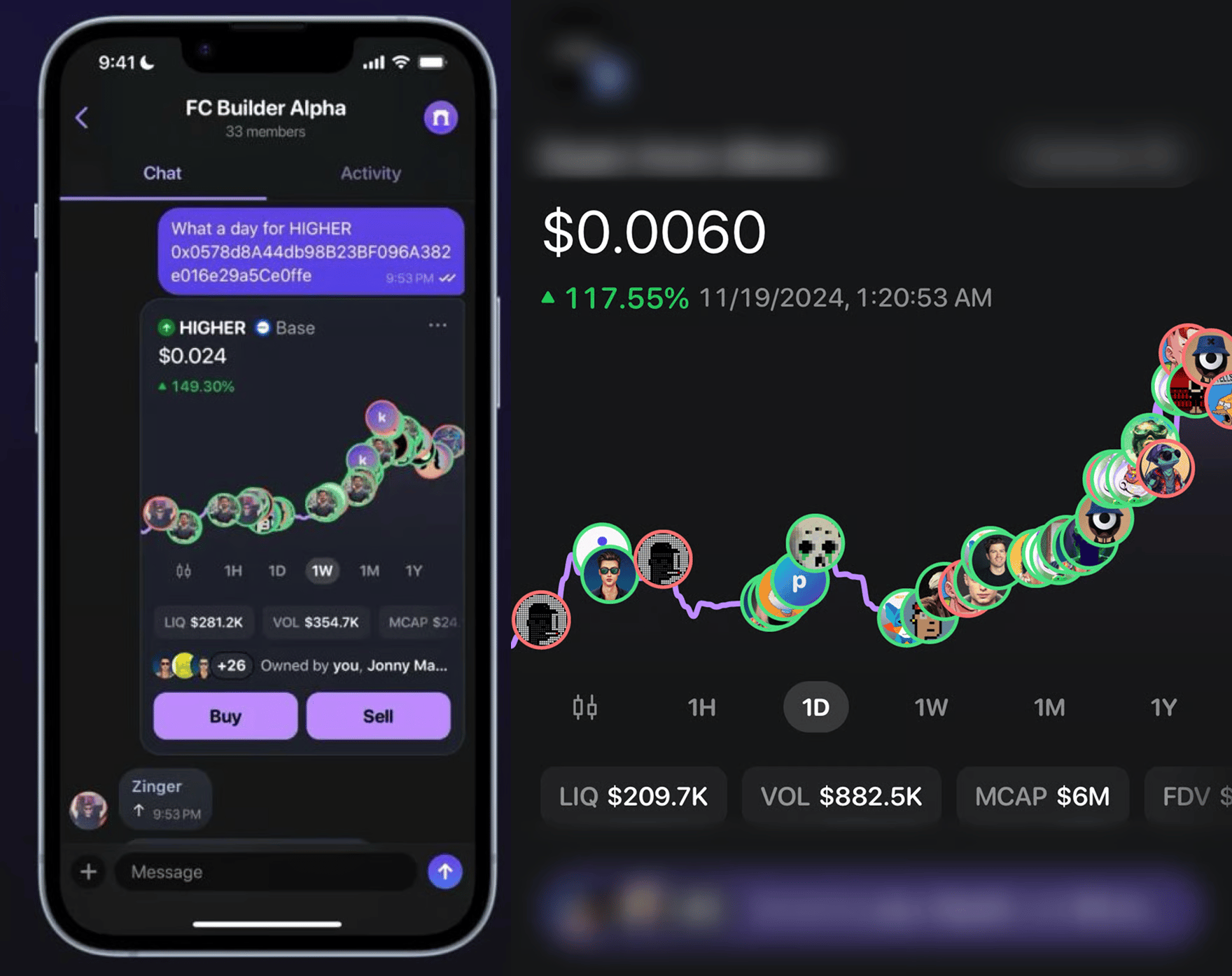
frens screenshots https://farcaster.xyz/div/0x7fd92c7bhttps://farcaster.xyz/jpren.eth/0x98150327
Socializing Wallet Applications
At the same time, crypto wallets are adding social features. Evolving from simple asset containers and trading gateways, wallets now seek to incorporate social signals and interactions based on social graphs as user needs and on-chain behaviors diversify.
Zapper and Base App—originally wallet apps—now integrate Farcaster’s social protocol and graph, essentially acting as Farcaster clients. This highlights Farcaster’s value as an open, programmable, composable social protocol. With open interfaces, developers can freely build clients or applications on Farcaster. Any wallet or app can permissionlessly plug Farcaster’s social layer into their product.
Zapper now features Farcaster content and trading signals based on the Farcaster social graph, allowing users to spot opportunities from the on-chain actions of those they follow and trade with a single tap.
Base App has integrated Farcaster as a social feed, Zora as a tool for content assetization, and XMTP as the protocol for instant messaging and community chat. Within Base App, users can create content, issue assets, discover social connections, trade tokens, interact with apps, chat in communities, and interact with agents—creating a closed loop of content, relationships, and value.
Zerion has also integrated social graphs for discovery. Building on its robust wallet-following feature, it now incorporates Twitter, Farcaster, and Lens identities, making it easier to find interesting users and top traders’ signals.
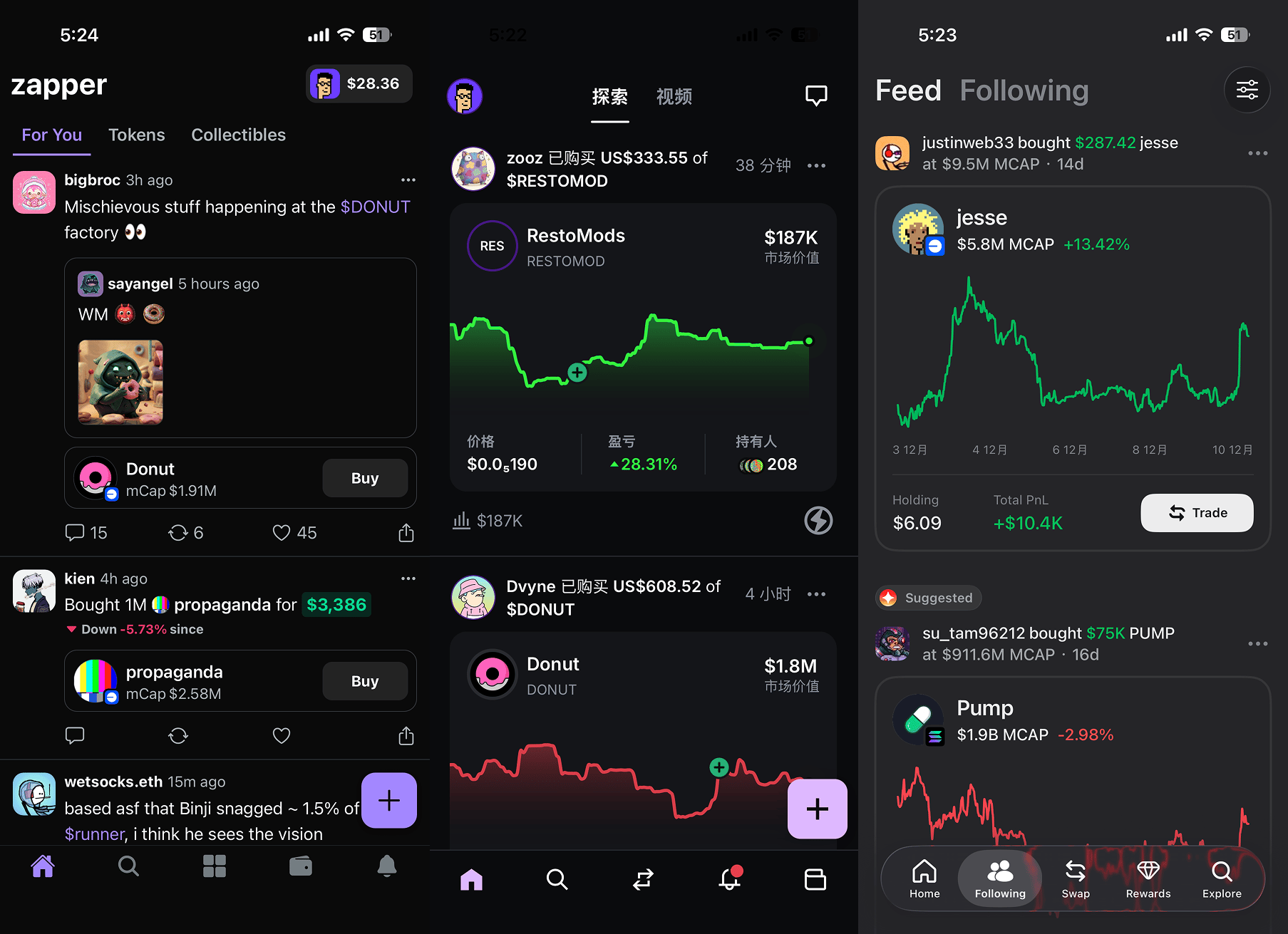
Zapper, Base App, Zerion
Centralized exchanges are wallets too, and they’re actively exploring social integration. Since 2022, Binance has launched Binance Feed, which was upgraded to Binance Square in 2023. Leveraging the world’s largest crypto trading gateway, Binance has built a comprehensive community platform centered on trading, where users can follow traders, access in-depth content, exchange strategies, and join voice or live social events—all within one app, increasing user retention.
Similarly, Robinhood—a centralized exchange now covering crypto and prediction markets—recently announced social features, letting users share strategies, discover signals, and copy trades on the platform.
However, centralized exchanges’ social features are typically closed ecosystems. Like traditional social platforms, user relationships, content, and identities remain controlled by the platform. Developers can’t freely build new apps on these social graphs; all features depend on the exchange team’s iterations. Still, users don’t care about this—they only care if your product is useful and easy to use.
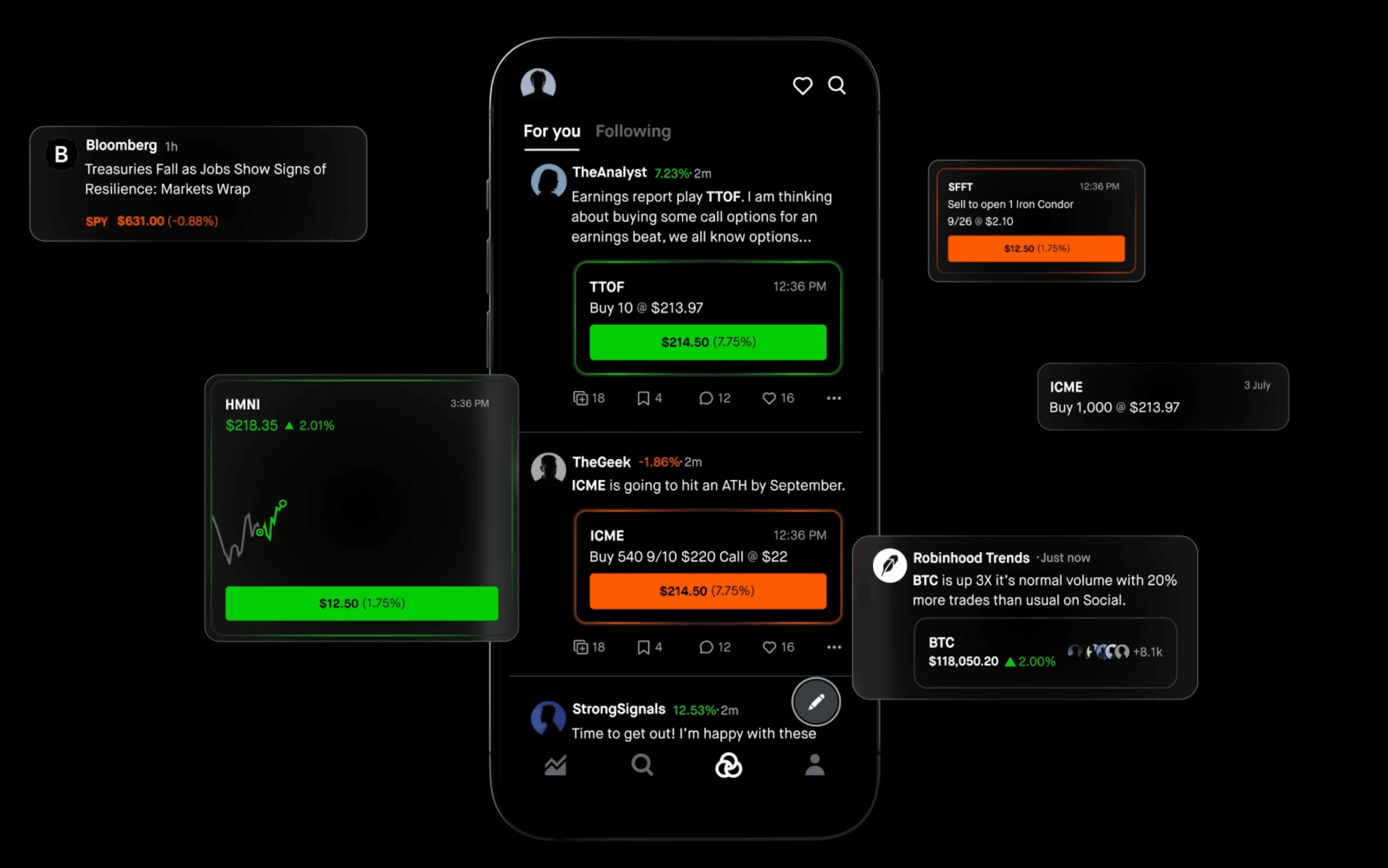
Robinhood is exploring social https://robinhood.com/us/en/social/
For wallets, social isn’t just an add-on—it’s the key step in evolving from a “tool” to a “network.” Social features give asset activity context, provide sources for trading decisions, and create new channels for content distribution. Adding social gives wallets stronger network effects, transforming them from tools into ecosystems.
Social + Wallet: Discovery, Trading, Creation
Social apps are becoming walletized, wallets are becoming socialized, and the two are increasingly intertwined. This is the natural direction for consumer crypto apps. For crypto social, not integrating a wallet is a passive choice that alienates mainstream crypto users—fail to do it, and you’ll fall behind and be replaced by more complete products. Social apps need wallets to complete the on-chain interaction puzzle. Core capabilities like app ecosystems and the creator economy—the heart of differentiated crypto social—depend on robust wallet functionality. Layering value atop social gives networks new growth levers.
For wallets, adding social is the icing on the cake. Users no longer “use and leave”—they stay for relationships, content, and community. Wallets evolve from tools to networks, from entry points to experiences, from asset managers to interactive spaces, naturally expanding use cases and network effects.
Some apps have targeted the “social + wallet” route from day one, recognizing the natural synergy and closed loop of content, relationships, and assets.
- interface.social: Discover trending tokens, track on-chain activity, copy trades, and share trading opinions (Takes).
- 0xppl.com: Discover trending tokens, track multi-chain wallet activity, copy trades, and monitor profits.
- Firefly.social: An aggregator client for X, Farcaster, Lens, and Bluesky; supports cross-platform posting and aggregates friends’ trading activity to surface trading opportunities in social data.
- fomo.family: Real-time tracking of friends’ and top traders’ on-chain trades, with built-in trade analysis and P&L tracking for rapid asset discovery.
- Share.xyz: Share any trade, follow any wallet, receive real-time trade notifications, copy trades, and share revenue with copied traders.
- gmgn.ai: Quickly discover trending assets, track smart money and followed users’ positions and trades, execute trades instantly, and access integrated copy trading, risk checks, and real-time alerts for on-chain intelligence and trading.
- Vector.fun: Track on-chain user activity and asset discovery. (Acquired by Coinbase; currently suspended.)
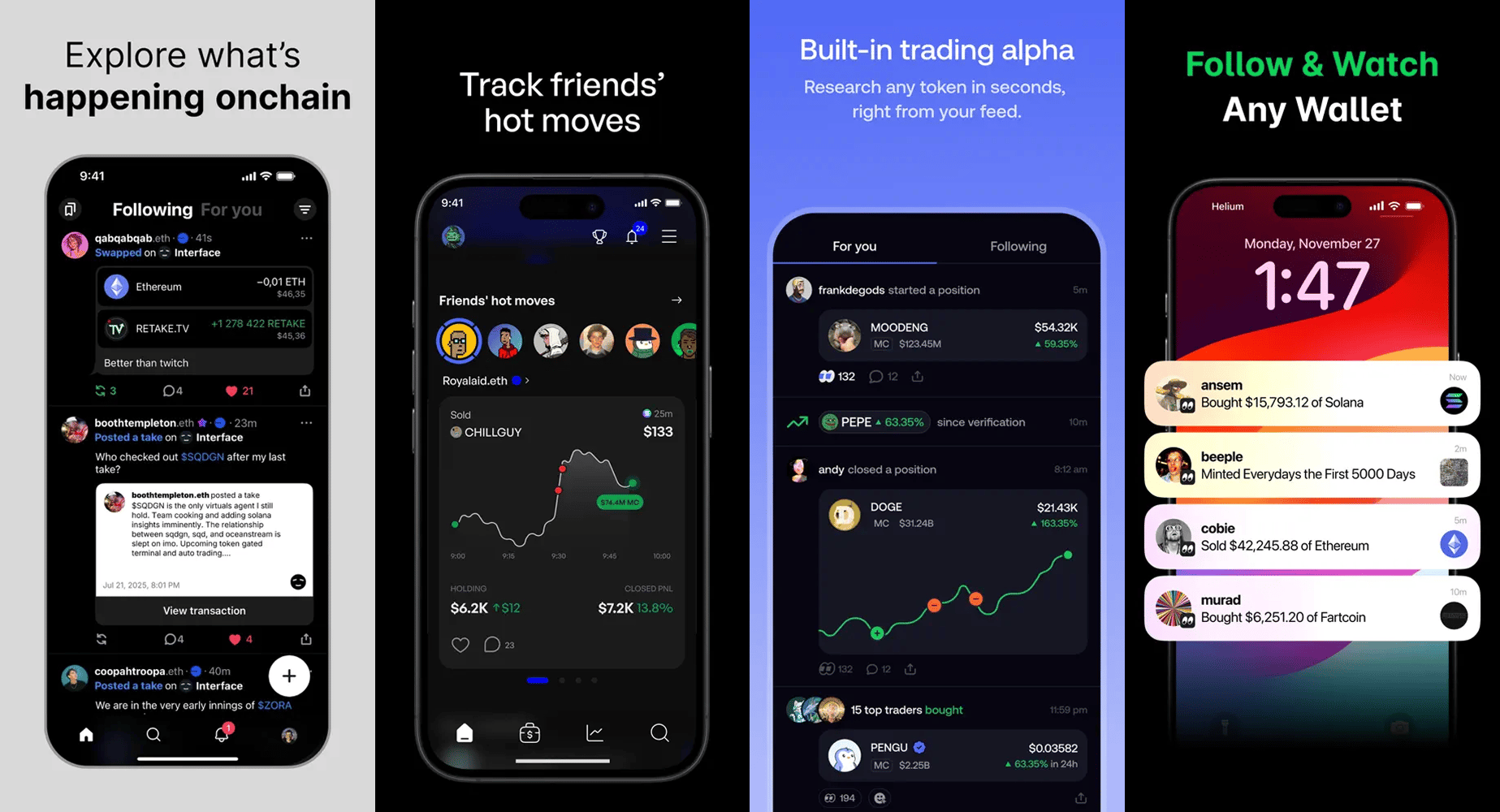
Interface, 0xppl, fomo, Share
Across the board, you’ll notice similar features and interfaces. “Discovery, Trading, Creation” is Farcaster’s new slogan—and it fits other “social + wallet” apps too: discover trading signals, copy trades quickly, and share strategies.
The main differences lie in each product’s focus. Some apps emphasize content creation, letting users explain “what to buy and why”; others focus almost entirely on trade execution, data insights, and copy trading efficiency. These choices define product strengths and user experience.
Who will stand out? Likely, whoever does one thing deeply and professionally.
For example, 0xPPL excels at on-chain graph analysis and connects to many social graphs, making it a powerful tool for identifying wallet addresses during new token launches. GMGN has optimized the entire trading process, from discovery to analysis to execution. Zapper and Zerion, as professional wallets, support a wide range of chains. For cross-chain experience, Farcaster Wallet is exceptionally smooth with minimal friction.
Interface, fomo, and Share differentiate with “Takes,” “Comment,” or “Share” features, encouraging users to document their trading logic and build content. However, centralized content has limited network effects. Other apps can simply integrate the Farcaster protocol for content creation, allowing their content to spread across a larger social network.
Additionally, apps built on Farcaster can leverage hundreds of Mini Apps with diverse features, embedding them directly into the social feed to easily expand functionality—no need to reinvent the wheel.
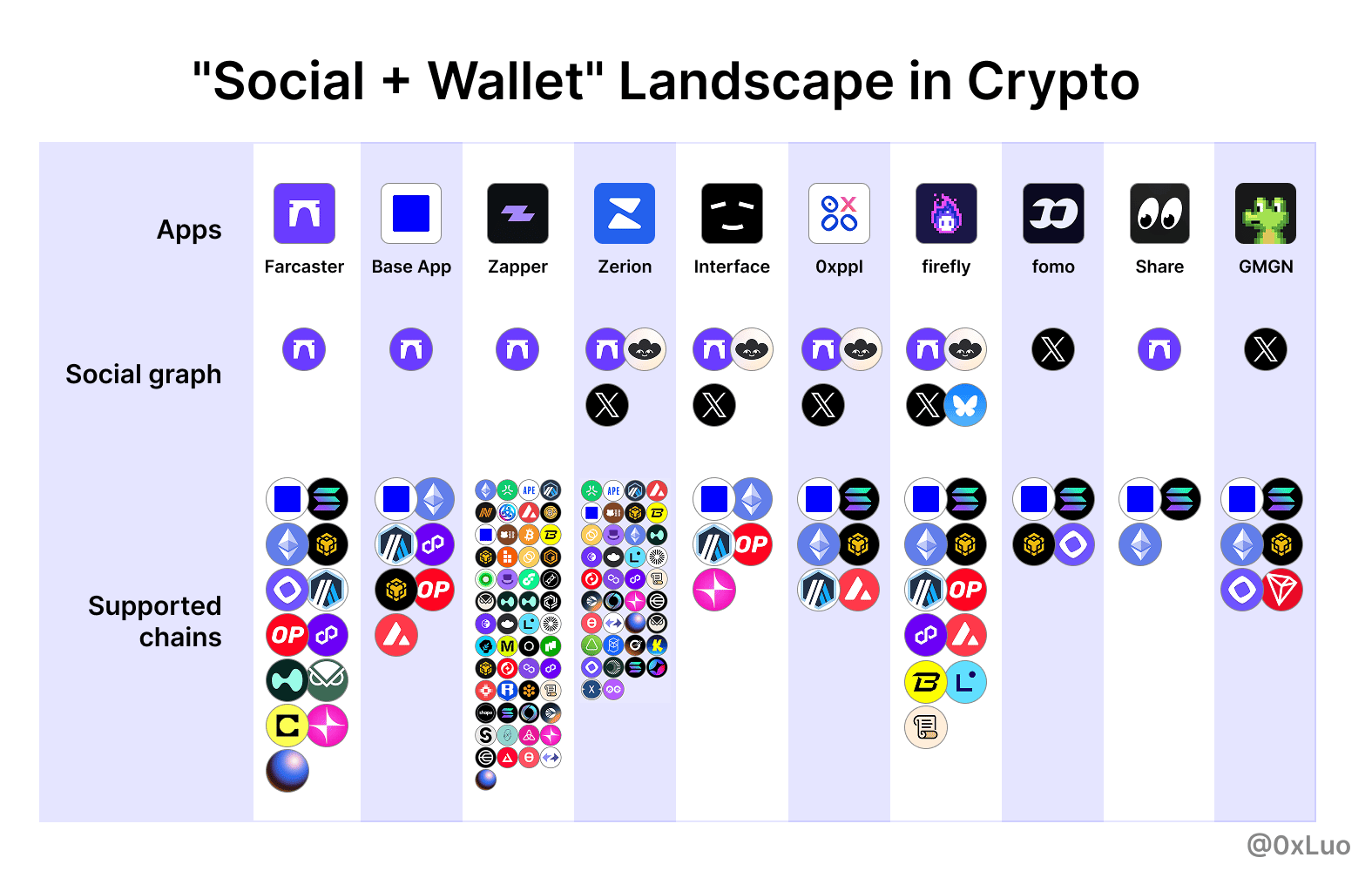
“Social + Wallet” Crypto App Landscape
Dan Romero once said, “It’s much easier to add a wallet to a social network than to add a social network to a wallet.” Expanding wallet capabilities atop an existing social network is arguably easier from a product perspective. Still, other apps can integrate existing social networks—unless they’re confident in their own user base.
Looking at the “social + wallet” crypto app landscape, Farcaster and X are the most frequently chosen social graphs. The difference is openness: integrating X typically just links wallet addresses to X accounts, while integrating Farcaster allows not only identity association but also easy import of users’ existing relationships and content—providing a ready-made social network without starting from scratch.
As more apps adopt Farcaster as social infrastructure, the network’s value is amplified, strengthening the protocol’s network effects. Over the past four years, the Farcaster team has built a “small but refined” social graph through a measured approach. While growth has been limited, the accumulated relationships, content, and culture are becoming the foundation for an open crypto social ecosystem. This network will continue to grow, diversify, and be adopted.
Conclusion
Farcaster isn’t dead. Crypto social isn’t dead. And Farcaster, as a crypto social platform, is very much alive. True crypto social isn’t just a social network—it’s about fusing social with value transfer. This year, Farcaster App’s leap from clunky external wallet connections to a full-featured built-in wallet finally filled a long-missing foundational gap. This isn’t abandoning social—it’s powering it, giving social a new engine for growth.
The recent “mockery” Farcaster has faced only highlights that its social graph and daily active users are still limited, leading to information gaps and misinterpretations from outside observers. Amid the trend of “walletizing social, socializing wallets,” Farcaster still faces intense competition—these are real challenges. Continued growth will require both a product-side “wallet-first” strategy and ongoing Mini Apps innovation, with value transfer capabilities complementing the protocol’s composable ecosystem.
What’s next? No one can say for sure. But perhaps, by building wallet features atop existing social media, crypto social can truly begin—allowing value to flow and making crypto social networks more vibrant than ever.
Disclaimer:
- This article is republished from [paragraph], copyright belongs to the original author [0xLuo]. If you have any concerns about this republication, please contact the Gate Learn team, and we will handle it promptly according to our procedures.
- Disclaimer: The views and opinions expressed in this article are solely those of the author and do not constitute investment advice.
- Other language versions of this article are translated by the Gate Learn team. Unless Gate is explicitly mentioned, reproduction, distribution, or plagiarism of translated articles is prohibited.







