Spot Bitcoin ETF Inflows of $1.42 Billion Drive BTC Price Momentum

Last Updated 2026-03-25 18:09:53
Reading Time: 1m
Although Bitcoin (BTC) has climbed 21% since November 2025, market research indicates that this move is more akin to the "bear market rebound" pattern seen in 2022. This report analyzes critical technical indicators and assesses potential future price risks.

Spot Bitcoin ETF Inflows Rebound Sharply

In the trading week of mid-January 2026, the US spot Bitcoin ETF market saw net inflows of approximately $1.42 billion—the largest weekly increase in nearly three months. This marks a clear reversal from the previous period of outflows and highlights that institutional investors are reassessing BTC’s risk–return profile.

At the market level, ETF inflows are typically strong indicators of underlying trends. They often reflect shifts in medium- and long-term allocation strategies, rather than short-term trading behavior.

ETF Fund Structure: IBIT Takes the Lead

In terms of product distribution, this wave of inflows was highly concentrated in BlackRock’s iShares Bitcoin Trust (IBIT):

  • IBIT attracted about $1.03 billion in new capital
  • Representing roughly 73% of all ETF net inflows for the week

This structural dynamic underscores the dominance of large asset managers in the crypto ETF space. Institutional capital tends to favor ETFs that offer greater scale, deeper liquidity, and higher compliance standards over smaller or less liquid products.

IBIT’s continued strong inflows show that traditional finance is entering the Bitcoin market using familiar instruments, rather than directly managing on-chain or custody complexities.

Bitcoin Price Performance and Capital Flow Dynamics
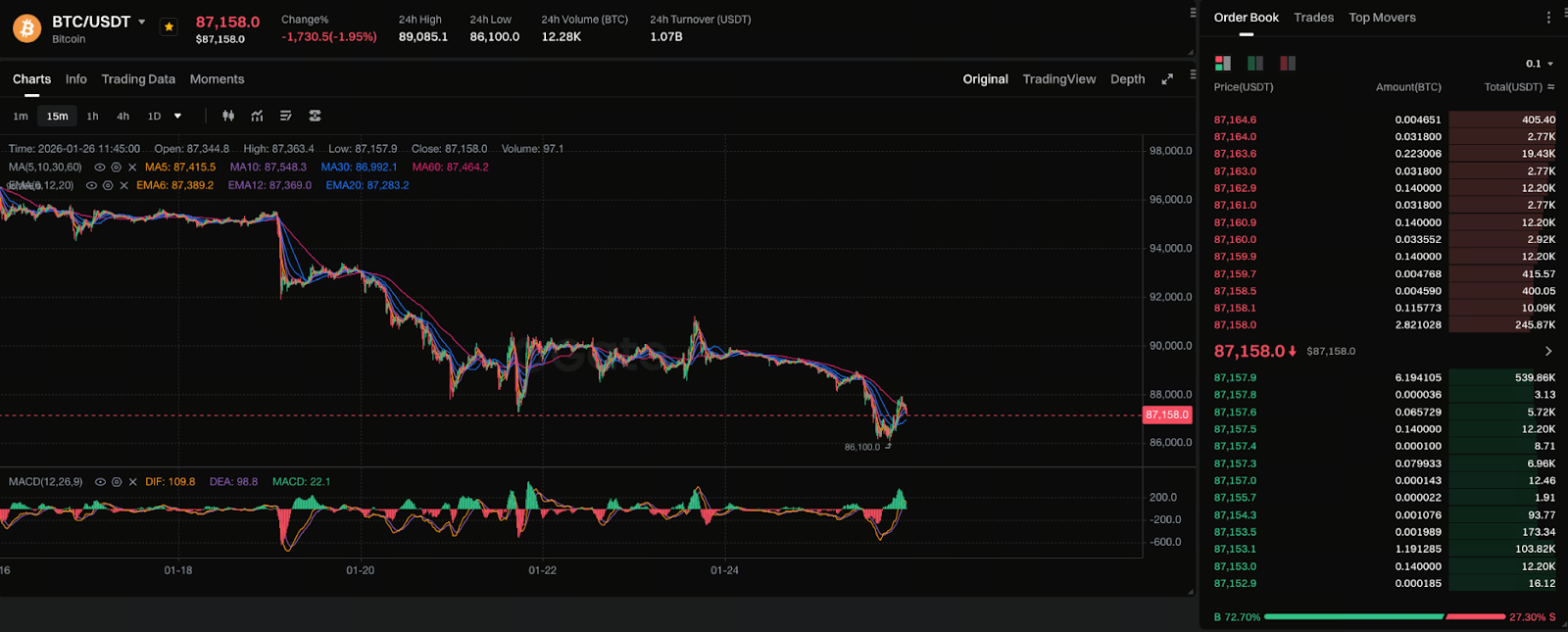

Chart: https://www.gate.com/trade/BTC_USDT

With support from ETF inflows, Bitcoin traded mostly around the $90,000 mark in early 2026. Intraweek data shows BTC briefly tested $95,000 but encountered resistance at that level.

This price range developed amid strong net inflows, indicating that ETF capital is providing meaningful support for market sentiment and price floors. However, it also reveals that, at higher price levels, there is still profit-taking and a wait-and-see attitude among market participants.

Structurally, the current market resembles a “capital-backed floor and price digestion” phase rather than a rapid, one-sided rally.

Strategy (Formerly MicroStrategy) Makes Another Major Bitcoin Purchase

Beyond ETF inflows, ongoing large-scale buying by corporations has also become a focal point. Strategy (formerly MicroStrategy) disclosed a new round of substantial accumulation in mid-January:

  • Period: January 12–19
  • New BTC acquired: approximately 22,305
  • Capital deployed: about $2.13 billion
  • Total BTC holdings: approximately 709,715

This move demonstrates that the company continued to add to its holdings even as prices remained elevated but sentiment stabilized, reinforcing its long-term strategy of positioning Bitcoin as a core asset.

While Strategy’s stock price faced short-term pressure, its holdings have established it as one of the world’s most influential institutional Bitcoin holders, and its actions send a clear signal to the market.

Risks and Uncertainties in the Institutional Capital Landscape

ETF inflows and corporate buying have fueled market enthusiasm, but also bring structural risks:

  • Volatility remains high: Even with net inflows, BTC continues to see significant daily and weekly price swings.
  • Institutional strategies have constraints: ETF capital is usually tied to longer allocation cycles, while corporate buying (such as by Strategy) is closely linked to financing costs and balance sheet health.
  • Potential impact of high leverage: If funding conditions tighten, some institutions may face challenges in maintaining their accumulation strategies.

As a result, institutional buying should not be viewed as a “risk-free bottom.”

Key Takeaways for Investors

The significant return of US spot Bitcoin ETF capital and renewed accumulation by Strategy send a clear message: structural interest from traditional finance and corporate capital in Bitcoin persists.

However, the mismatch between short-term price action and capital allocation cycles means that investment strategies must focus more on:

  • Position management
  • Volatility tolerance
  • Risk control across multiple timeframes

At this stage, Bitcoin is increasingly being repriced as an institutional-grade asset, rather than merely a vehicle for sentiment-driven trading.

Author: Max
Disclaimer
* The information is not intended to be and does not constitute financial advice or any other recommendation of any sort offered or endorsed by Gate.
* This article may not be reproduced, transmitted or copied without referencing Gate. Contravention is an infringement of Copyright Act and may be subject to legal action.

Related Articles

What is Fartcoin? All You Need to Know About FARTCOIN
Intermediate

What is Fartcoin? All You Need to Know About FARTCOIN

Fartcoin (FARTCOIN) is a representative meme coin within the Solana ecosystem based on an AI-driven narrative. Its core concept originated from an experiment aimed at exploring the "boundaries between AI Agents and humor." More than just a digital asset with social attributes, the project deeply couples absurd humor culture with on-chain financial logic by integrating autonomous AI interaction models.
2026-04-04 22:01:19
Gold Price Forecast for the Next Five Years: 2026–2030 Trend Outlook and Investment Implications, Could It Reach $6,000?
Beginner

Gold Price Forecast for the Next Five Years: 2026–2030 Trend Outlook and Investment Implications, Could It Reach $6,000?

Analyze current gold price trends alongside authoritative five-year forecasts, integrating an evaluation of market risks and opportunities. This gives investors insight into the potential trajectory of gold prices and the main drivers expected to shape the market over the next five years.
2026-03-25 18:13:30
Aster vs Hyperliquid: Which Perp DEX Will Prevail?
Beginner

Aster vs Hyperliquid: Which Perp DEX Will Prevail?

Aster and Hyperliquid are the two representative protocols of the "purpose-built L1 path" within the current decentralized perpetual exchange (Perp DEX) sector. As a pioneer in the field, Hyperliquid has built a deep liquidity moat through its highly mature order book architecture and strong community consensus. Conversely, Aster, as a rising challenger, seeks to leapfrog the competition in high-performance trading through more aggressive multi-chain aggregation logic, private transaction modules, and an underlying execution environment optimized for 2026 market demands.
2026-03-24 11:58:33
AI-Native Settlement Layers: How United Stables Is Building the Next Financial Rail
Beginner

AI-Native Settlement Layers: How United Stables Is Building the Next Financial Rail

Stablecoins were originally designed as dollar substitutes within exchanges, primarily used for asset pricing and trade settlement. As on-chain financial ecosystems have matured, their role has expanded beyond simple payments to include collateral assets, cross-chain liquidity mediums, and unified settlement units. In particular, as AI systems and automated agents begin to participate directly in economic activity, demand has risen sharply for programmable value units capable of instant settlement. This shift is pushing stablecoins toward the role of foundational financial infrastructure.
2026-03-25 03:16:17
2026 Silver Price Forecast: Bull Market Continuation or High-Level Pullback? In-Depth Analysis of Silver Candlestick Chart
Beginner

2026 Silver Price Forecast: Bull Market Continuation or High-Level Pullback? In-Depth Analysis of Silver Candlestick Chart

2026 Silver Price Forecast: Latest Outlook This article integrates current market trends, silver candlestick chart analysis, and momentum factors to assess the potential key support and resistance levels, upside targets, and pullback risks for silver prices. The goal is to help investors make informed, rational decisions.
2026-03-25 16:08:59
ASTER Tokenomics: Buybacks, Burns, and Staking as the Value Foundation of ASTER in 2026
Beginner

ASTER Tokenomics: Buybacks, Burns, and Staking as the Value Foundation of ASTER in 2026

ASTER is the native equity and governance token of the Aster ecosystem, with its core value built upon a radical "Deflationary Engine." Beyond serving as a governance tool, ASTER integrates multiple utilities including staking rewards, trading fee discounts, and liquidity incentives. Through its deep integration with the upcoming dedicated Layer 1 mainnet, it enables direct value capture from protocol cash flow to token holders.
2026-03-25 07:38:07