The Core Shift in Enterprise AI: From "Can It Be Used?" to "Is It Worth Buying?"
Over the past two years, the main concern for enterprise AI was validating capabilities—can the model get the job done?
By 2026, this question will have yielded to more practical considerations:
- Will the enterprise sign an annual contract?
- Can pilot projects convert to official procurement?
- After rollout, will the number of seats and budget increase?
This marks the entrance into the "pay-for-validation" phase. At this stage, the market will reward not just technical advancement, but product systems that are deliverable, scalable, and encourage repeat purchases.
In this light, recent debates on enterprise adoption rates are critical. Regardless of the specific metrics used, the core takeaway is clear: enterprises are buying, and the adoption pace is faster than early SaaS cycles.
Why Coding, Customer Support, and Search Were First to Close the Commercial Loop
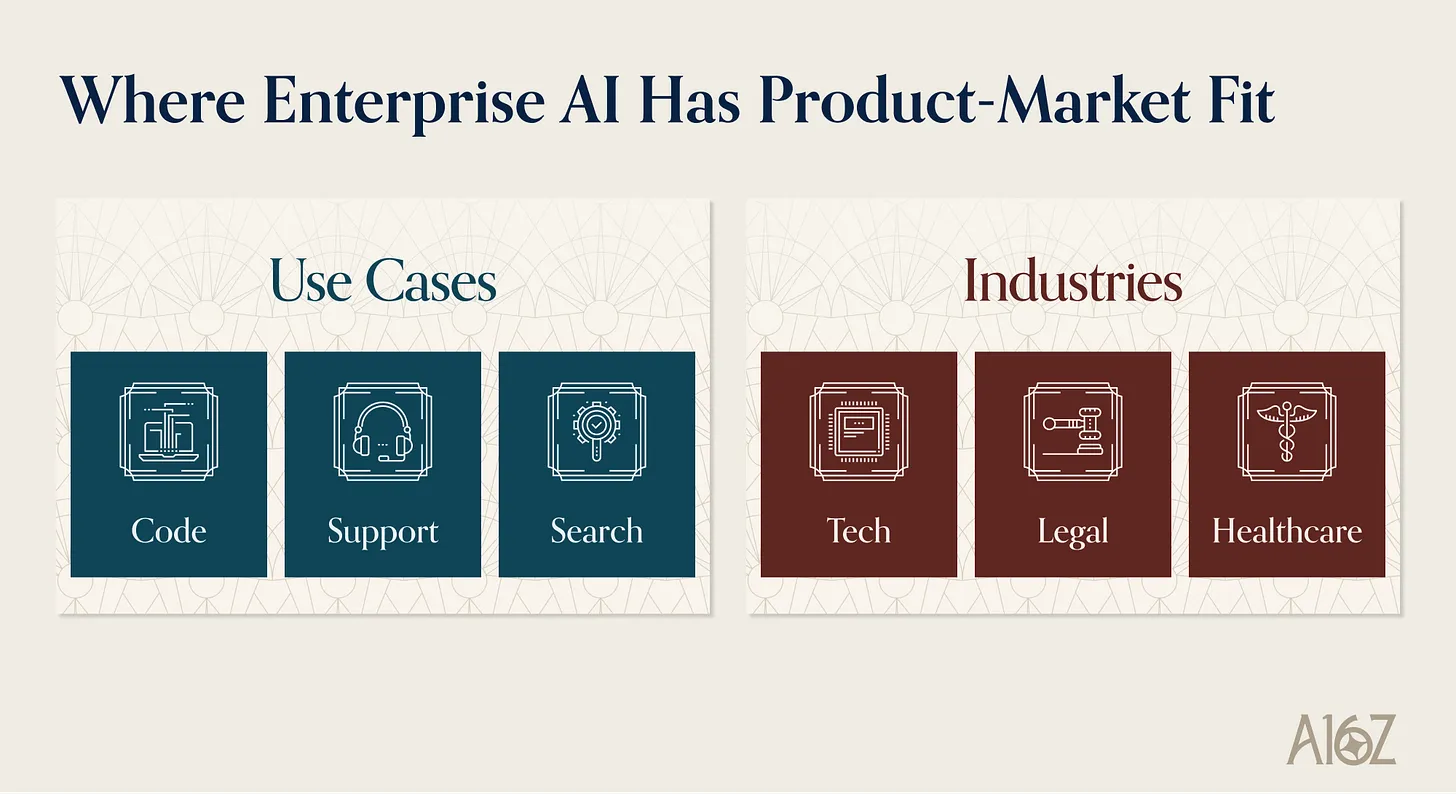
Many chalk up the leadership of these three sectors to models being "naturally good at text," but that's only the surface. The deeper reason is they meet four hard requirements for enterprise spending:
- Task definition: clear input and output boundaries for easy standardization.
- Outcome verification: code runs, tickets close, search results line up.
- Value measurement: saves man-hours, improves conversions, cuts outsourcing costs.
- Incremental deployment: start with Copilot, then automate workflows—no need for an all-at-once overhaul.
Why Coding Is the First Major Use Case
Coding commercializes efficiently thanks to its combination of high-paying roles, frequent tasks, and measurable productivity gains.
When enterprises see core engineering teams' productivity improve meaningfully, purchasing decisions speed up.
Plus, code fits naturally with a "human review + model generation" collaboration, lowering the psychological barrier for management to launch.
Why Customer Support Is the Second Large-Scale Scenario
Customer support is highly templated, with built-in SOPs and mature KPI systems (response time, resolution rate, satisfaction).
AI can quickly run A/B tests and generate financial metrics, making it easier for CFOs to sign off.
Why Search Is an Unassuming but Highly Valuable Long-Term Bet
Enterprise search may look like a simple efficiency tool, but it's actually the backbone for organizational knowledge flow.
Better search drives collaboration among R&D, legal, sales, and operations. The long-term compounding benefits are substantial.
Tech Giants and Startups: Rethinking Roles Across the Model, Application, and Process Layers
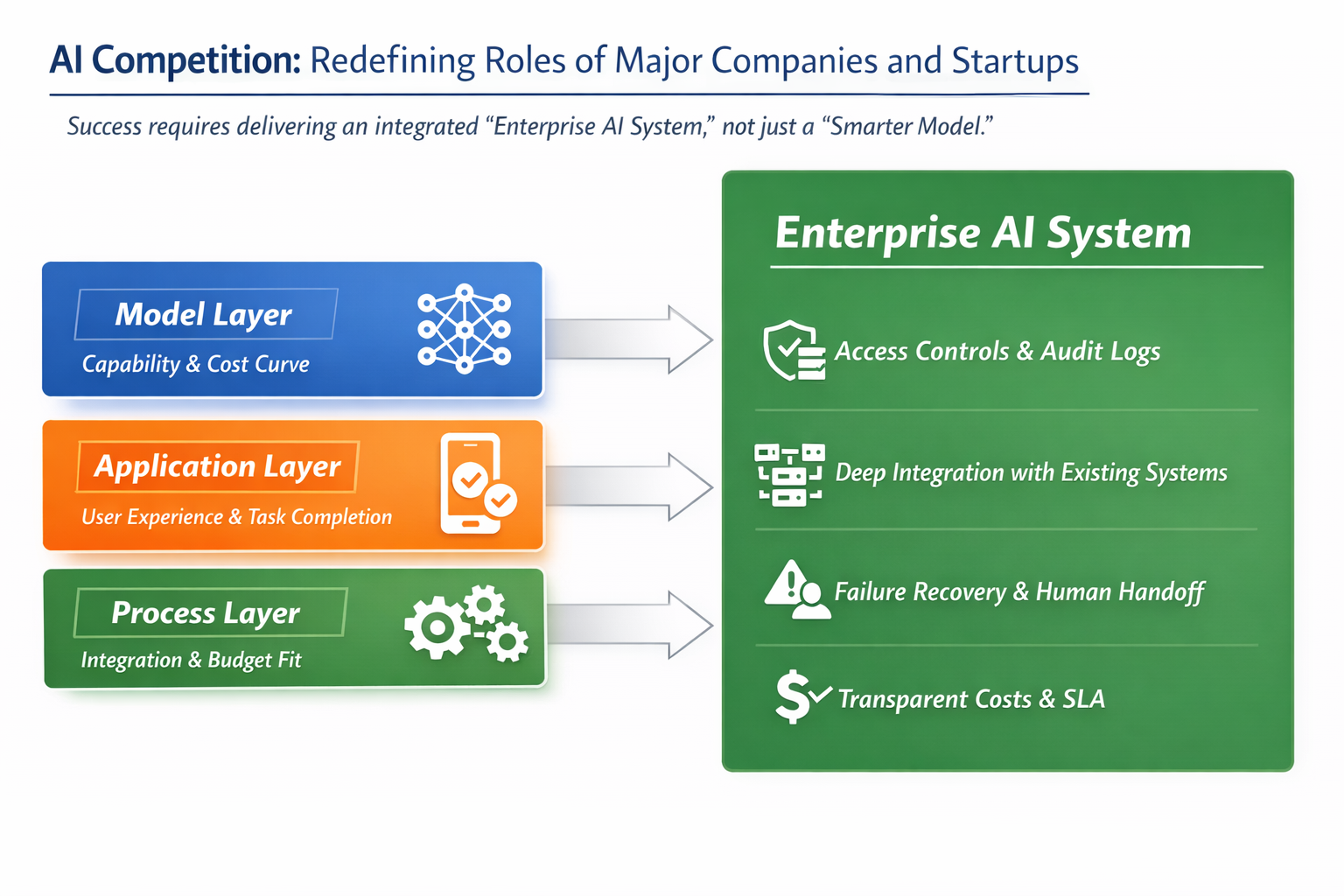
Enterprise AI competition isn't a one-layer game—it's about synergy across three layers:
- Model layer: sets the ceiling for capability and cost curves.
- Application layer: drives user experience and task completion rates.
- Process layer: determines whether the system truly integrates into enterprise workflows and budgets.
Too much of the current conversation fixates on the model layer, overlooking process.
In practice, enterprises aren't buying "smarter models," they're buying workable production systems.
Whoever delivers packaged solutions with:
- Permission systems and audit logs,
- Deep integration with enterprise systems,
- Failover and human-intervention mechanisms,
- Transparent cost structures and SLAs,
will have the edge in securing long-term contracts.
High-Probability Enterprise AI Use Cases for 2026–2027
The next wave won't be every industry taking off at once—it will be phased and layered.
High-probability directions include:
- Financial and compliance support: invoice matching, contract review, expense auditing.
- Medical and legal document flows: text-heavy, rule-driven, high-value per unit.
- Sales ops automation: lead qualification, proposal drafts, follow-up optimization.
- Cross-system long-task agents: moving from Q&A to multi-step execution.
But keep in mind: before these can scale, they must clear one shared hurdle—the organizational transformation cost from demo to production.
Enterprise Buying Logic: Budget Sources, Procurement Processes, and Organizational Resistance
Whether an enterprise adopts AI isn't about the tech team's enthusiasm—it's about whether the budget can be justified.
The common path:
- Start with a pilot from the innovation budget.
- Prove ROI with quantifiable metrics.
- Move to annual contracts and scaled deployment.
Resistance is real:
- Data permissions and compliance worries,
- Conflicts over roles and incentive structures,
- High integration costs for legacy systems,
- Management concerns about "short-term efficiency, long-term governance risks."
That's why many products "wow" on first try but underperform on revenue. The real barrier in enterprise AI isn't the demo—it's managing organizational friction.
Key Takeaways for Investors and Founders: Metrics That Matter More Than "Model Scores"
In enterprise AI, these metrics often trump benchmark scores:
- Net Revenue Retention (NRR): can you keep expanding seats and modules?
- Pilot-to-paid conversion: is sales truly repeatable?
- Deployment cycle length: is delivery efficient?
- Unit economics: are gross margins and inference costs sustainable?
- Human-AI collaboration depth: is this embedded in core workflows?
For founders: focus first on high-value, narrow use cases, not building a one-size-fits-all platform.
Nail one paid use case, then expand modules. That's usually more reliable than attacking the whole enterprise with a generic assistant from day one.
Conclusion: Enterprise AI Is in the "Paid Deep Water"—Winning Comes Down to Execution Density
The biggest change for enterprise AI in 2026 isn't smarter models—it's more pragmatic customers. The market is shifting from "possibilities" to "retention rates."
To sum up: the first half of enterprise AI was about showcasing capabilities; the second half is about sustained delivery.
So, whether you're writing, investing, or making product decisions, focus on three things:
- Is there ongoing payment?
- Is deployment expanding?
- Has the product become organizationally indispensable?
Those who win on these fronts will secure a lasting position in the next era of enterprise AI.