The Quiet Fade-Out of DOGE: A High-Profile Reform Agency Dissolved Mid-Term

Beginner
Quick Reads
Last Updated 2026-03-27 12:30:24
Reading Time: 1m
At the start of the year, the new US administration founded the Department of Government Efficiency (DOGE) to cut costs and improve administrative performance. Seen as the central driver of reform for the coming years, this high-profile initiative launched with great fanfare. Yet, before its term ended, DOGE was discreetly disbanded, with its responsibilities redistributed across other government agencies.

A Bold Start, a Quiet Exit
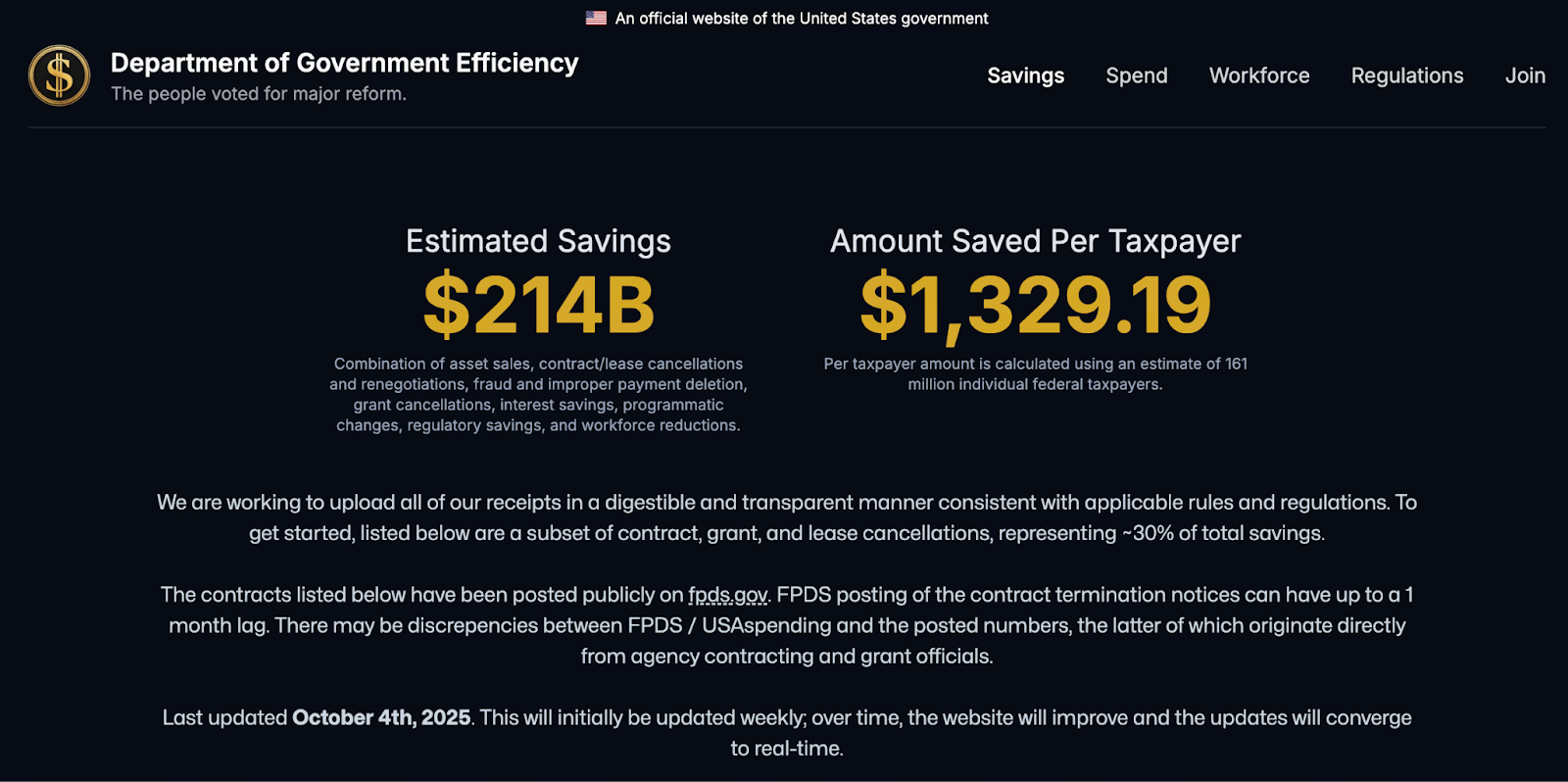

(Source: Department of Government Efficiency)

Earlier this year, the United States welcomed a new administration that prioritized streamlining government agencies and boosting administrative efficiency. The new administration established the Department of Government Efficiency (DOGE) as part of its core strategy. This department was widely seen as a cornerstone of administrative reform during Trump’s second term, with expectations for its long-term operation, potentially through 2026. However, recent reports reveal that this much-anticipated reform initiative quietly exited well before the midpoint of the term.

Office of Personnel Management Confirms DOGE Has Ceased Operations

When questioned by the media about DOGE’s status, Scott Kupor, Director of the U.S. Office of Personnel Management (OPM), gave a direct response: The Department of Government Efficiency is no longer active and is not recognized as an independent, centralized administrative entity. Its duties and authorities have been fully transferred to other government agencies, completing DOGE’s streamlining and reorganization. Leaked documents further show that the Office of Personnel Management has taken over DOGE’s core functions and is now the primary agency responsible for these responsibilities.

DOGE’s Personnel Reshuffle

In its early stage, DOGE drew considerable attention by assembling prominent leaders from the tech industry, including Elon Musk and several members of his core team. As DOGE’s influence faded, many of these key figures transitioned to a newly established government entity—the National Design Studio.

This organization, led by Airbnb co-founder Joe Gebbia and founded through an executive order in August, now leads efforts to revamp and modernize U.S. government websites and digital services. The contrast in reform direction is clear: the focus has shifted from aggressive cost-cutting and consolidation to enhancing user experience and rebranding government services.

Transparency Shortfalls Become DOGE’s Greatest Controversy

During its launch, DOGE repeatedly claimed to have cut hundreds of billions in expenses, but those figures were never publicly verified. The lack of transparency prevented outside financial analysts from assessing the actual impact of these reforms. Without oversight or financial reporting, doubts grew about DOGE’s effectiveness and undermined its credibility as a reform leader. Ultimately, the department’s failure to institutionalize public disclosure led to its rapid decline and demonstrated the difficulties of matching ambitious goals with established government structures.

If you want to explore more Web3 content, click here to register: https://www.gate.com/

Conclusion

The creation of the Department of Government Efficiency symbolized the new administration’s drive for systemic innovation. Its swift dissolution exposed the complex realities of government reform. While DOGE itself quietly faded, some of its responsibilities continue through other agencies in new forms. The reform approach has moved from drastic streamlining to visible optimization and redesign. The short existence of DOGE serves as a notable example in the administration’s reform process. It began with high expectations and ended quietly, prompting renewed reflection on the pace and direction of U.S. government transformation.

Disclaimer
* The information is not intended to be and does not constitute financial advice or any other recommendation of any sort offered or endorsed by Gate.
* This article may not be reproduced, transmitted or copied without referencing Gate. Contravention is an infringement of Copyright Act and may be subject to legal action.

Related Articles

What is Fartcoin? All You Need to Know About FARTCOIN
Intermediate

What is Fartcoin? All You Need to Know About FARTCOIN

Fartcoin (FARTCOIN) is a representative meme coin within the Solana ecosystem based on an AI-driven narrative. Its core concept originated from an experiment aimed at exploring the "boundaries between AI Agents and humor." More than just a digital asset with social attributes, the project deeply couples absurd humor culture with on-chain financial logic by integrating autonomous AI interaction models.
2026-04-04 22:01:19
Gold Price Forecast for the Next Five Years: 2026–2030 Trend Outlook and Investment Implications, Could It Reach $6,000?
Beginner

Gold Price Forecast for the Next Five Years: 2026–2030 Trend Outlook and Investment Implications, Could It Reach $6,000?

Analyze current gold price trends alongside authoritative five-year forecasts, integrating an evaluation of market risks and opportunities. This gives investors insight into the potential trajectory of gold prices and the main drivers expected to shape the market over the next five years.
2026-03-25 18:13:30
Aster vs Hyperliquid: Which Perp DEX Will Prevail?
Beginner

Aster vs Hyperliquid: Which Perp DEX Will Prevail?

Aster and Hyperliquid are the two representative protocols of the "purpose-built L1 path" within the current decentralized perpetual exchange (Perp DEX) sector. As a pioneer in the field, Hyperliquid has built a deep liquidity moat through its highly mature order book architecture and strong community consensus. Conversely, Aster, as a rising challenger, seeks to leapfrog the competition in high-performance trading through more aggressive multi-chain aggregation logic, private transaction modules, and an underlying execution environment optimized for 2026 market demands.
2026-03-24 11:58:33
AI-Native Settlement Layers: How United Stables Is Building the Next Financial Rail
Beginner

AI-Native Settlement Layers: How United Stables Is Building the Next Financial Rail

Stablecoins were originally designed as dollar substitutes within exchanges, primarily used for asset pricing and trade settlement. As on-chain financial ecosystems have matured, their role has expanded beyond simple payments to include collateral assets, cross-chain liquidity mediums, and unified settlement units. In particular, as AI systems and automated agents begin to participate directly in economic activity, demand has risen sharply for programmable value units capable of instant settlement. This shift is pushing stablecoins toward the role of foundational financial infrastructure.
2026-03-25 03:16:17
Aerodrome Tokenomics: How ve(3,3) Powers Base's Most Profitable DEX
Beginner

Aerodrome Tokenomics: How ve(3,3) Powers Base's Most Profitable DEX

AERO is the native token of Aerodrome Finance, a core decentralized exchange and liquidity protocol in the Base ecosystem. It is primarily used for liquidity incentives and ecosystem operations. veAERO is a governance NFT that users receive by locking AERO, representing both voting power and the right to share protocol revenue. Through a dual track structure of AERO as a utility token and veAERO as a governance credential, Aerodrome separates liquidity usage value from long term governance power, allowing participants to act as liquidity providers, governance decision makers, and revenue sharers within the same system.
2026-03-25 06:40:31
Hybrid Collateral Stablecoins: Inside United Stables' Stability and Yield Architecture
Beginner

Hybrid Collateral Stablecoins: Inside United Stables' Stability and Yield Architecture

In the early stages of the crypto market, traditional stablecoins mainly relied on single-reserve or single-collateral models. Their primary focus was price stability and payment convenience, which allowed them to become foundational tools for on-chain trading and capital flows. As the market has entered a more mature financial phase, however, this structure has begun to reveal limitations, including high concentration risk and the difficulty of balancing liquidity with yield. These constraints have driven the evolution toward multi-layer collateral and portfolio-based designs, such as the dual-layer hybrid collateral architecture proposed by United Stables, which seeks to redefine the underlying logic of stable assets.
2026-03-25 03:17:39





