What Are Gate ETF Leveraged Tokens?
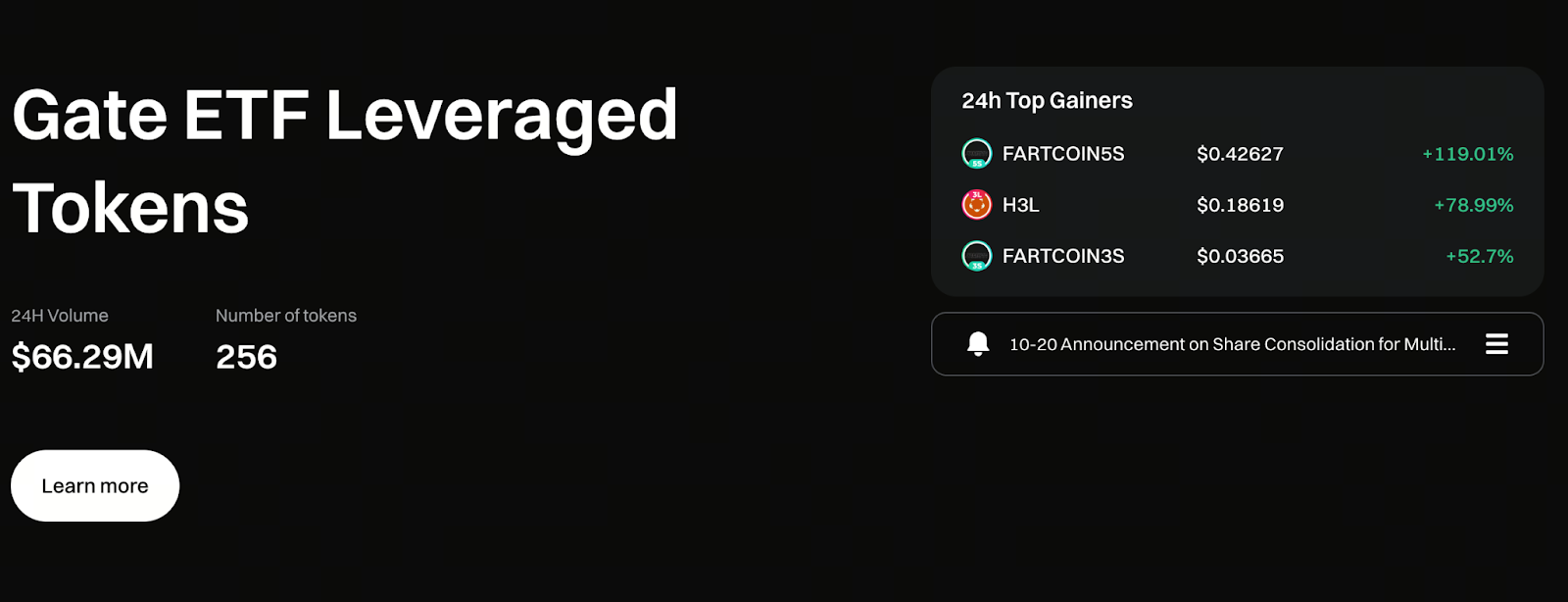
Image: https://www.gate.com/leveraged-etf
Gate ETF Leveraged Tokens are tokenized products backed by crypto assets with an embedded leverage mechanism. They are purpose-built to let users capture leveraged price movements—without using derivatives or facing liquidation risk.
Like traditional ETFs, leveraged ETF tokens have their own independent net asset value (NAV) system. Unlike crypto contracts, they do not require margin, have no forced liquidation thresholds, and are not subject to instant liquidation during short-term volatility.
For users, these tokens trade just like any regular coin. Examples include:
How Do Gate ETF Leveraged Tokens Deliver Leverage?
Gate ETF Leveraged Tokens are powered by a system-managed basket of perpetual contract positions.
The platform uses algorithmic strategies to dynamically adjust contract positions, maintaining the token’s target leverage ratio (such as 3×). When the market rises or falls, the token’s NAV is amplified accordingly.
The key benefits:
- No need for users to understand contract operations
- No manual rebalancing required
- No risk of margin calls
All complex risk management and position control are handled automatically by the system in the background.
Why Don’t Gate ETF Leveraged Tokens Get Liquidated?
This is the most common misconception about leveraged ETF tokens. The absence of liquidation does not mean there is “no risk.”
The real distinction is:
- Contract trading: When the price hits the liquidation line → the position is liquidated
- ETF leveraged tokens: Risk exposure is reduced through automatic deleveraging and rebalancing
In extreme market conditions, the NAV of leveraged ETF tokens can experience sharp drawdowns, but unlike contracts, it will not instantly drop to zero.
This makes them more suitable for users who:
- Lack familiarity with contract mechanics
- Prefer not to monitor the market constantly
- Want to control exposure to extreme risks
The Compounding Effect of ETF Leveraged Tokens in Trending Markets
The standout feature of Gate ETF Leveraged Tokens is their potential for significant compounding effects during sustained market trends.
When the market moves up or down consecutively:
- Each NAV change compounds on a new base value
- Leverage returns accumulate over time
This is why leveraged ETF tokens are often called “trend amplifiers.”
However, this advantage only applies in clearly trending markets.
What Risks Should You Watch for in Sideways Markets?
ETF leveraged tokens are not suitable for all market conditions.
In sideways or choppy markets, the automatic rebalancing mechanism can cause “decay” in NAV. Even if the price returns to its starting point, the NAV of a leveraged ETF token may end up lower than where it began.
This means:
- ETF leveraged tokens are not designed for long-term holding
- They are better for short-term trend opportunities
- They are not suitable for “buy and forget” strategies
Understanding this is essential before using Gate ETF Leveraged Tokens.
Which Trading Strategies Work Best for Gate ETF Leveraged Tokens?
In practice, ETF leveraged tokens are most commonly used in the following scenarios:
- Breakout markets with clear direction
- News-driven short-term trends
- Swing trading
- Hedging spot position risk
For example, if you hold a large spot position but worry about short-term downside, you can use ETF leveraged tokens for directional hedging—no need to manage complex contract positions.
ETF Leveraged Tokens vs. Contract Trading: Key Differences
Gate ETF Leveraged Tokens are not a replacement for contracts—they are designed for a different purpose.
Contracts are better suited for:
- High-frequency trading
- Granular position management
- Professional traders
ETF leveraged tokens are ideal for:
- Simplified trading operations
- Quick participation in trends
- Reduced psychological stress from liquidation risk
The choice depends on your trading experience and risk appetite.
The Role of Gate ETF Leveraged Tokens Amid the Crypto ETF Boom
As crypto ETFs become mainstream, more users are learning about ETF structures and index investing logic.
Gate ETF Leveraged Tokens build on this foundation:
- They retain the “NAV + automated management” features of ETFs
- They introduce the higher-volatility leverage mechanisms of the crypto market
They function more as “trading-oriented ETF tools” than as traditional long-term investment products.
Conclusion
Gate ETF Leveraged Tokens are not “guaranteed profit products.” However, in trending markets, they offer a simpler and more intuitive way to participate with leverage.