The core function of a DEX Aggregator is to combine liquidity from multiple decentralized exchanges and automatically identify the best trading path using algorithmic routing. Instead of comparing prices across different DEX platforms manually, users can simply initiate a trade through the aggregator interface. The system calculates and executes the optimal route automatically. This approach improves trading efficiency while also reducing slippage and transaction costs.
Today, aggregators have become an important part of the DeFi trading experience. For example, 1inch in the Ethereum ecosystem and Jupiter in the Solana ecosystem are well known representatives. As the DeFi landscape grows more complex, aggregators are evolving beyond simple price comparison tools into trading infrastructure that supports cross pool routing, liquidity splitting, and integration across multiple protocols.
Why DeFi Needs Trading Aggregators
In the early stages of DeFi, users typically executed trades directly on a single decentralized exchange such as Uniswap, SushiSwap, or Curve. As the number of DEX platforms increased, however, liquidity became distributed across multiple protocols and liquidity pools. This phenomenon, often referred to as "liquidity fragmentation", makes it difficult for users to obtain the best price on any single platform.
When trade sizes increase, insufficient liquidity can also lead to higher slippage. For instance, one DEX may have limited liquidity for a trading pair, while another may offer a better price. If a user trades only on a single platform, they may end up paying a higher cost. DEX aggregators emerged in response to this challenge, with the goal of automatically combining different sources of liquidity.
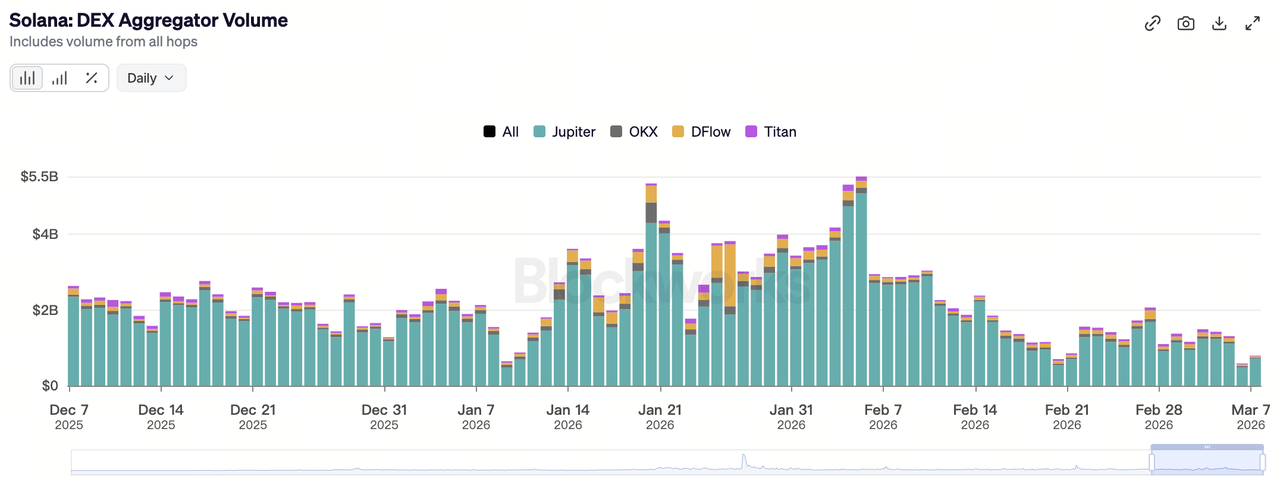 Screenshot source: Blockworks
By algorithmically scanning prices and liquidity across multiple DEX platforms, aggregators can determine the most efficient trading route. In some cases, a transaction may be divided into multiple parts and executed across different DEXs to achieve the best overall price. This mechanism significantly improves capital efficiency.
Without aggregators, users would have to open multiple DEX interfaces, compare quotes from different pools, analyze fees and expected slippage, and react quickly to price changes. This process is time consuming, error prone, and difficult to manage in real time.
DEX aggregators automate this comparison and routing process with algorithms, delivering a "globally optimal" or near optimal execution plan with a single click. As a result, they lower the knowledge and operational barriers for ordinary users participating in DeFi.
Core Functions of a DEX Aggregator: Routing, Splitting, and Integration
The key technology behind a DEX aggregator is the routing algorithm. This algorithm continuously analyzes liquidity pools, prices, and fees across multiple DEX platforms in order to compute the most efficient trading path.
Aggregators typically provide three essential capabilities.
Smart Routing
At the heart of the aggregator lies the path searching and routing algorithm, which evaluates multiple potential swap routes and selects the best path or combination of paths for the given trade size.
During routing, the system considers several factors. These include which intermediary tokens can be used to reach the target token through multi hop paths, the liquidity depth of pools along each route, pricing curves, recent trading activity, and the cost of on chain execution. In effect, the system performs a combined shortest path and lowest cost optimization across multiple markets.
Order Splitting
Many aggregators divide a single trade across multiple DEX platforms or liquidity pools. For example, 40 percent of an order might execute in one AMM pool such as Radium or Orca, 30% in another AMM, and the remaining 30% through RFQ market makers. This distribution reduces price impact and slippage along any single route.
This mechanism is particularly useful for large trades or situations where a single liquidity pool does not have sufficient depth. By splitting execution across several venues, the final execution price is often better than completing the entire order on a single DEX.
Liquidity and Interface Integration
From a technical perspective, DEX aggregators interact with DEX protocols through smart contracts. They may also obtain quotes from professional market makers through APIs or RFQ interfaces. This design allows users to access multiple liquidity sources from a single frontend.
From the user’s perspective, the aggregator provides a unified interface. The user only needs to choose the blockchain, the tokens involved, and the trade direction. Decisions such as "where the swap occurs", "how the order is split", and "how the execution proceeds" are handled automatically by backend logic.
The Difference Between DEX Aggregators and Traditional DEXs
Although both aggregators and traditional DEX platforms allow users to trade tokens, their positioning and technical architecture differ significantly.
| Dimension |
DEX Aggregator Characteristics |
Traditional DEX Characteristics |
| Liquidity Source |
Aggregates liquidity from multiple DEX platforms and market makers, providing unified access. |
Uses only the liquidity available within its own protocol and pools. |
| Pricing and Slippage Control |
Reduces slippage by distributing price impact across multiple pools through routing and order splitting. |
Prices are determined entirely by the curve and depth of a single pool, so large trades can cause significant slippage. |
| Cost Structure |
Considers both price and gas fees, sometimes selecting a route with a slightly higher quoted price but lower total cost. |
Primarily reflects the pool price plus on chain gas fees; users must manually compare alternatives. |
| User Experience |
A single interface provides access to multiple protocols, with one click price comparison and routing, reducing decision complexity. |
Each DEX has its own interface, and users must manually choose the platform and liquidity pool. |
| Protocol Role |
Functions more like an on chain intelligent order routing layer and may not hold significant liquidity itself. |
Acts directly as a market making or matching venue, tied to specific liquidity pools or order books. |
In terms of usage scenarios, a standard DEX serves as a fundamental liquidity building block within the DeFi ecosystem. A DEX aggregator, by contrast, focuses on integrating these building blocks from a user perspective and optimizing trade execution across them.
In practice, many users interact with an aggregator on the frontend while their trades are actually executed on underlying DEX protocols. The two systems therefore complement each other rather than replace one another.
The Technical Evolution of Aggregators: From 1inch to Jupiter
Early Example: 1inch Pathfinding and Order Splitting
1inch was one of the earliest projects dedicated to DEX aggregation. Its Pathfinder routing algorithm can split a single trade across multiple DEX platforms and even across multiple pools within the same DEX, aiming to identify the theoretically optimal price combination.
At the execution layer, the 1inch aggregation protocol performs atomic execution of multi hop paths and multi pool splits within on chain contracts. The routing decision also incorporates gas fees, preventing scenarios where a route offers a better quoted price but incurs extremely high gas costs.
Next Generation Example: Jupiter on Solana
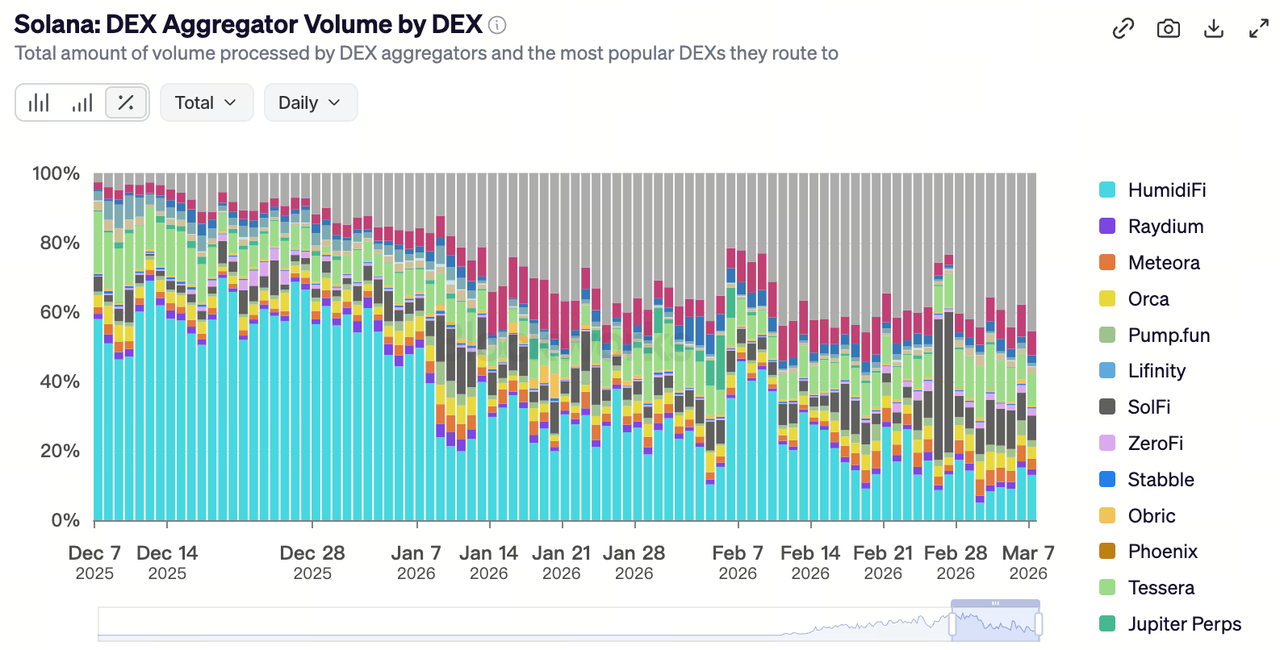
In high performance blockchain environments, Jupiter represents a new generation of DEX aggregators. It integrates liquidity from both AMMs and order book based DEX platforms across the Solana ecosystem, using routing algorithms to find the best swap path across multiple pools.
Thanks to Solana’s high throughput and low transaction costs, Jupiter can more aggressively use multi hop and multi pool routing strategies. Even with these more complex routes, transaction costs remain extremely low, sometimes below $0.01, while slippage is reduced and execution quality for large orders improves.
Shared Trends in Technical Evolution
Looking at the evolution from 1inch to Jupiter, several common trends emerge in the development of DEX aggregators. These include more sophisticated pathfinding algorithms, broader integration of cross protocol and cross chain liquidity, and more advanced user features such as stablecoin routing and multi asset batch swaps.
As the number of DeFi protocols grows and cross chain interoperability improves, aggregators may evolve from single chain comparison tools into unified trading entry layers that support multiple chains and asset types. This shift could further reduce the complexity of navigating the Web3 ecosystem.
Advantages and Limitations of Aggregated Trading
Key Advantages
-
Better prices and lower slippage: Through multi path routing and order splitting, aggregators often deliver prices closer to the global market optimum than a single DEX can offer for the same trade size. This advantage becomes especially noticeable in large trades.
-
Convenient one stop experience: Users do not need to understand the detailed mechanics of each AMM or order book system, nor switch between multiple interfaces to compare prices. This lowers the barrier to entry and suits both beginners and high frequency traders.
-
Amplifying overall DeFi liquidity: At the logical level, aggregators combine liquidity that is scattered across different protocols and pools. This improves market price continuity and capital efficiency, helping reduce trading friction for long tail assets.
Practical Limitations and Risks
-
Additional protocol and contract risk: Using an aggregator introduces an extra layer of smart contract logic. If vulnerabilities exist in the aggregator’s contracts or routing mechanisms, users could face risks such as abnormal transactions or potential asset loss. This represents an additional risk source compared with using a single DEX directly.
-
Tradeoff between routing complexity and gas cost: In high gas environments, overly complex routes that involve many pools or hops may appear cheaper in quoted price but become less favorable after gas costs are added. Routing design must therefore balance execution quality and cost efficiency.
-
Execution uncertainty across multiple protocols: Since aggregators rely on underlying DEX platforms, sudden price movements or liquidity changes before execution can cause parts of a planned route to fail. Aggregators must therefore implement fallback mechanisms, such as canceling part of a route and returning unfilled assets.
Summary
Overall, a DEX Aggregator is a type of DeFi infrastructure that combines liquidity from multiple decentralized exchanges and automatically identifies the most efficient trading route through algorithmic routing. Its main value lies in reducing liquidity fragmentation, improving execution quality for larger trades, and simplifying the trading process for users.
From an industry perspective, aggregators are unlikely to replace DEX platforms. Instead, they function as a trading routing layer built on top of them. As the DeFi ecosystem expands and the demand for cross chain trading and multi protocol integration grows, the role of DEX aggregators may become even more significant.
In the future, aggregators may continue evolving toward more advanced capabilities, including cross chain routing, MEV optimization, and automated trading strategies. These developments could further strengthen their role in DeFi trading infrastructure.
FAQs
Do DEX Aggregators hold user assets?
Most aggregators do not custody user assets. Trades are still executed on chain through smart contracts.
Are DEX Aggregators always cheaper than trading directly on a DEX?
Not necessarily. Aggregators often find better prices or lower slippage in many situations. However, for small trades, high gas environments, or pairs with extremely deep liquidity on a single DEX, the difference may be minimal. In some cases, after accounting for gas costs, the aggregated route may even be slightly less favorable.
Will aggregators replace DEX platforms?
No. DEX platforms provide the underlying liquidity, while aggregators integrate and route trades across them.
How does a DEX Aggregator differ from order book depth aggregation on centralized exchanges?
On centralized exchanges, depth aggregation typically occurs within a centralized matching system where both orders and funds are settled inside exchange accounts. By contrast, a DEX aggregator operates through on chain smart contracts, routing trades across decentralized protocols while user funds remain in blockchain addresses. This process is more transparent but also constrained by blockchain performance and gas costs.
Why do many Solana users use Jupiter instead of trading on a single DEX directly?
Within the Solana ecosystem, liquidity is also distributed across multiple AMM and order book based DEX platforms. Jupiter scans these pools simultaneously and uses multi hop routes and order splitting to find better swap prices. Combined with Solana’s low transaction costs, this makes Jupiter a preferred trading entry point for many users.
How can developers integrate a DEX Aggregator?
Developers can integrate aggregators through the APIs or smart contract interfaces they provide. This allows wallets, asset management tools, or strategy platforms to embed routing capabilities and offer one click optimal swaps for users without maintaining their own connections to multiple DEX platforms or implementing custom routing algorithms.







