During the process of bringing real-world assets on-chain, price volatility directly impacts transaction efficiency and asset valuation. Because of this, users are often concerned about whether the system provides stable pricing tools. In this context, stablecoins play a pivotal role by minimizing the uncertainty associated with volatility.
This challenge typically centers on three aspects: the pegging mechanism, collateral structure, and transactional application. Together, these elements define the reliability and adoption scope of stablecoins.
What Is mantraUSD? Its Role Within the MANTRA Ecosystem
mantraUSD functions as the settlement-layer asset in the MANTRA ecosystem, serving as the standard for transaction pricing and value transfer.
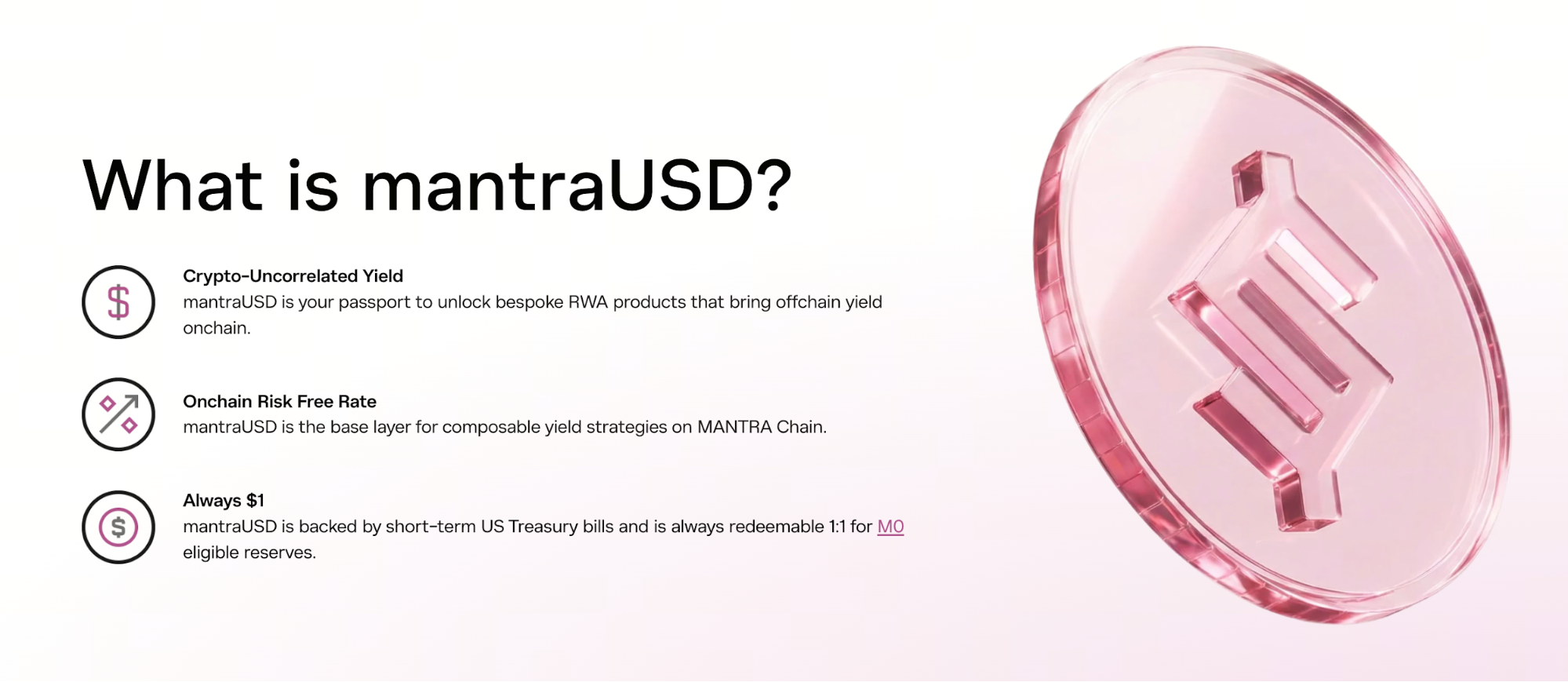
Mechanically, this stablecoin is pegged to fiat currency, enabling on-chain assets to be exchanged using a stable unit and insulating transactions from the impact of price fluctuations.
Structurally, the MANTRA ecosystem comprises an asset layer and a settlement layer. RWA assets reside on the asset layer, while mantraUSD operates on the settlement layer. These layers are linked through the trading system, allowing assets to circulate based on a stable price.
This structure provides a unified value standard for complex RWA assets, significantly enhancing overall system efficiency.
How Does mantraUSD Maintain Its USD Peg?
A stablecoin’s core function is to sustain its value relative to the U.S. dollar. mantraUSD accomplishes this through collateralization and a robust reserve mechanism.
The protocol maintains reserves matching the volume of tokens issued, underpinning each token’s value. These reserves are generally held in low-volatility assets to limit price deviations.
The peg mechanism is structured through three modules: issuance, reserves, and market stabilization. The issuance module manages supply, the reserve module guarantees value support, and the market mechanism maintains price stability through trading activities.
This architecture allows the stablecoin to remain relatively stable during market swings, making it a dependable medium of exchange.
How Are Collateral Assets and Reserve Structures Designed?
mantraUSD’s stability is rooted in its reserve setup. The system supports issuance by collateralizing assets.
Each stablecoin unit is backed by a proportional share of reserve assets, which may include real-world financial instruments or other low-risk vehicles.
The reserve framework consists of an asset pool, a management module, and an auditing mechanism. The asset pool holds collateral, the management module oversees adjustments, and the audit mechanism verifies authenticity.
This transparent approach boosts user trust in the stablecoin and helps reduce systemic risk.
What Is mantraUSD’s Role in RWA Transactions?
Within RWA trading, mantraUSD is primarily used for pricing and settlement.
Users can buy or sell on-chain assets using this stablecoin, which facilitates value exchange. Its price stability shields both parties from additional volatility risk.
Structurally, mantraUSD sits at the heart of the transaction flow, bridging asset buyers and sellers. This mirrors the settlement currency function in traditional financial systems.
This role standardizes complex asset trading, increasing both liquidity and overall market efficiency.
How Does mantraUSD Differ from USDT, USDC, and Other Stablecoins?
mantraUSD’s main differences from leading stablecoins lie in its use case and structural design.
| Dimension |
mantraUSD |
USDT / USDC |
| Use Case |
RWA Transactions |
General Payments |
| Structural Focus |
Asset Settlement |
Liquidity |
| Collateral Source |
RWA-Linked Assets |
Fiat Reserves |
| Ecosystem Role |
Specialized Stablecoin |
General Stablecoin |
| System Relationship |
Internal Settlement |
Cross-Platform Use |
As shown, mantraUSD is specialized, while USDT and USDC are designed for universal use. This determines both their application scope and design priorities.
How Does the Revenue Distribution Mechanism Impact Ecosystem Participants?
Certain stablecoin designs incorporate revenue distribution mechanisms.
The system can share some value—sourced from asset yields or fees—with participants. This is typically tied to asset pools or protocol-generated revenue.
Revenue distribution is structured around asset origination, allocation rules, and participant roles. Together, these define how returns circulate within the system.
This approach drives user engagement and strengthens the system’s long-term resilience.
Comparative Summary Table
| Module |
mantraUSD |
General Stablecoin |
| Design Goal |
RWA Settlement |
Multi-Scenario Use |
| Value Support |
Asset Collateral |
Fiat Reserves |
| Usage Path |
Internal Transactions |
Multi-Platform Circulation |
| Risk Structure |
Asset-Linked |
Reserve-Linked |
| Ecosystem Role |
Settlement Layer |
General Layer |
This comparison highlights that mantraUSD is optimized for internal system functions rather than broad ecosystem interoperability, giving it a distinct advantage in its targeted scenarios.
Conclusion
mantraUSD delivers stable value through its collateralization and pegging mechanisms, serving as a settlement asset within the MANTRA ecosystem and enabling RWA assets to be traded with a unified standard.
FAQ
What is the main function of mantraUSD?
It serves as the unit of account and settlement for RWA assets.
How does it remain stable?
By anchoring value to reserves and managing issuance.
How is it different from USDT?
The key differences are in its use case and structural design.
Can it be used for ordinary transactions?
It is primarily intended for transactions within the MANTRA ecosystem.
Why are stablecoins important?
They reduce price volatility and enhance transaction efficiency.