What Is Stock Tokenization? Ushering in a New Era of Traditional Finance and Blockchain Integration

Beginner
Quick Reads
Last Updated 2026-03-30 04:15:23
Reading Time: 1m
Stock tokenization is a new trend that issues traditional stocks in the form of blockchain tokens, providing global investors with a more convenient, transparent, and programmable way to participate in assets.

The basic concept of stock tokenization

Tokenized Stocks refer to the mapping of the value of traditional company stocks to blockchain tokens, allowing them to be traded as on-chain assets in the crypto market. These tokens are typically built on standards such as ERC-20 or Solana SPL, enabling free transfers, trading, and even participation in on-chain contracts and derivatives operations.

These tokens are usually backed by professional institutions that custody real stock shares, or track the corresponding stocks’ market performance through compliant structured agreements.

Why is stock tokenization on the rise?

The traditional stock market has some inherent barriers, such as:

  • Regional and time limitations: Different countries have different trading market opening hours.
  • High threshold and cumbersome procedures: the account opening process is complicated, and funds come in and out slowly.
  • Asset fragmentation and difficulty in integration: high cross-platform management costs.

Tokenization of stocks provides a more flexible, cross-market alternative:

  • 24-hour on-chain trading
  • Global users can easily access
  • No need to rely on TradFi brokerage systems.

This trend is attracting attention from multiple platforms and users worldwide.

The advantages and application scenarios of stock tokenization

  1. Low barrier to entry: Users only need to have a wallet address and stablecoins (such as USDT) to buy and sell stock tokens, without the need for a traditional brokerage account.
  2. High liquidity: Stock tokens can be freely traded on multiple crypto trading platforms, enhancing asset liquidity.
  3. Supports fragmented holdings: No need to purchase whole shares anymore, you can buy any quantity of tokens as needed (e.g. 0.01 shares), making it more suitable for novice investors.
  4. Stronger asset integration capabilities: Users can manage multiple tokenized assets, including stocks, bonds, real estate, etc., under a unified account on a single blockchain.
  5. Strong scalability: Stock tokens can be integrated into DeFi applications to achieve staking, lending, derivatives, and other secondary financial instruments.

Current market stock tokenization products
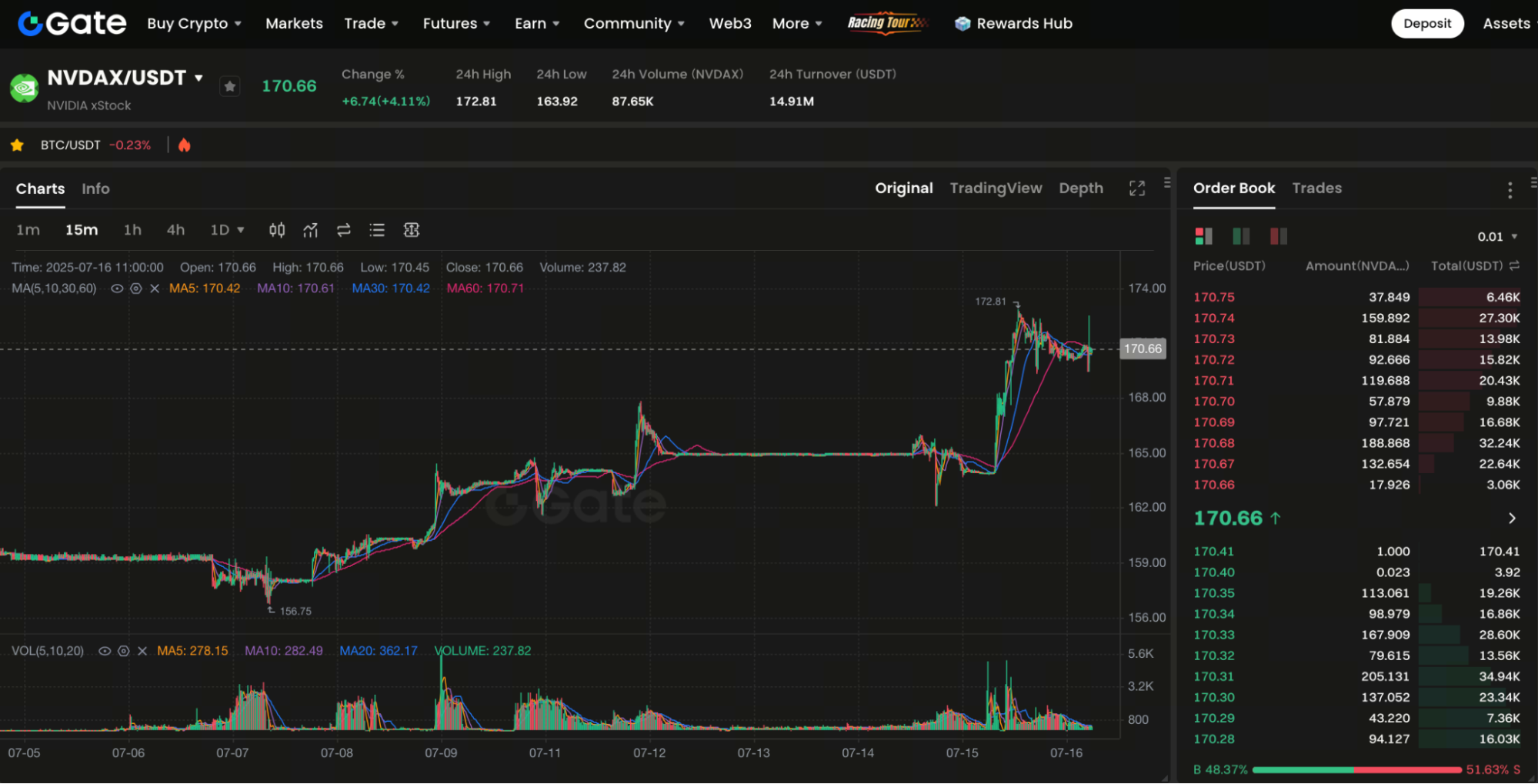

Figure:https://www.gate.com/trade/NVDAX_USDT

Currently, multiple platforms have launched stock tokenization services, with common representatives including:

  • Gate xStocks Zone: Launching multiple stock tokens such as GOOGLX, TSLAX, AAPLX, supporting contract trading and leverage operations.
  • Backed Protocol: Focused on compliant token issuance in the European market.
  • Synthetix, Mirror Protocol (no longer updated): Early exploration of synthetic asset forms of stock prices.

These platforms differ in terms of compliance, issuance structure, and tracking mechanisms, but collectively drive the development of this market.

What should investors pay attention to?

Although stock tokenization brings convenience and innovation, investors should still pay attention to the following points:

  • Price tracking mechanism: Different platforms may use different indices or quotation sources, and the price may deviate slightly from the original stock.
  • Liquidity risk: The trading volume of tokens may be insufficient, leading to slippage in buying and selling.
  • Platform security and compliance: Prioritize products with transparent issuers, on-chain proof, and strong platform backing.
  • Tax and legal issues: There are differences in the recognition of tokenized assets across different regions, and local regulations should be followed.

Conclusion: The future asset trading model is changing.

Stock tokenization is an important application of blockchain technology in the real financial sector. It provides more users with flexible, secure, and transparent channels for asset participation. With the gradual improvement of the regulatory system and the continuous optimization of platform products, stock tokenization is expected to become an important component of mainstream investment methods.

For users who wish to participate in global quality assets but are constrained by traditional processes, stock tokenization is undoubtedly a new window worth paying attention to.

Author: Max
Disclaimer
* The information is not intended to be and does not constitute financial advice or any other recommendation of any sort offered or endorsed by Gate.
* This article may not be reproduced, transmitted or copied without referencing Gate. Contravention is an infringement of Copyright Act and may be subject to legal action.

Related Articles

What is Fartcoin? All You Need to Know About FARTCOIN
Intermediate

What is Fartcoin? All You Need to Know About FARTCOIN

Fartcoin (FARTCOIN) is a representative meme coin within the Solana ecosystem based on an AI-driven narrative. Its core concept originated from an experiment aimed at exploring the "boundaries between AI Agents and humor." More than just a digital asset with social attributes, the project deeply couples absurd humor culture with on-chain financial logic by integrating autonomous AI interaction models.
2026-04-04 22:01:19
Gold Price Forecast for the Next Five Years: 2026–2030 Trend Outlook and Investment Implications, Could It Reach $6,000?
Beginner

Gold Price Forecast for the Next Five Years: 2026–2030 Trend Outlook and Investment Implications, Could It Reach $6,000?

Analyze current gold price trends alongside authoritative five-year forecasts, integrating an evaluation of market risks and opportunities. This gives investors insight into the potential trajectory of gold prices and the main drivers expected to shape the market over the next five years.
2026-03-25 18:13:30
Aster vs Hyperliquid: Which Perp DEX Will Prevail?
Beginner

Aster vs Hyperliquid: Which Perp DEX Will Prevail?

Aster and Hyperliquid are the two representative protocols of the "purpose-built L1 path" within the current decentralized perpetual exchange (Perp DEX) sector. As a pioneer in the field, Hyperliquid has built a deep liquidity moat through its highly mature order book architecture and strong community consensus. Conversely, Aster, as a rising challenger, seeks to leapfrog the competition in high-performance trading through more aggressive multi-chain aggregation logic, private transaction modules, and an underlying execution environment optimized for 2026 market demands.
2026-03-24 11:58:33
AI-Native Settlement Layers: How United Stables Is Building the Next Financial Rail
Beginner

AI-Native Settlement Layers: How United Stables Is Building the Next Financial Rail

Stablecoins were originally designed as dollar substitutes within exchanges, primarily used for asset pricing and trade settlement. As on-chain financial ecosystems have matured, their role has expanded beyond simple payments to include collateral assets, cross-chain liquidity mediums, and unified settlement units. In particular, as AI systems and automated agents begin to participate directly in economic activity, demand has risen sharply for programmable value units capable of instant settlement. This shift is pushing stablecoins toward the role of foundational financial infrastructure.
2026-03-25 03:16:17
ASTER Tokenomics: Buybacks, Burns, and Staking as the Value Foundation of ASTER in 2026
Beginner

ASTER Tokenomics: Buybacks, Burns, and Staking as the Value Foundation of ASTER in 2026

ASTER is the native equity and governance token of the Aster ecosystem, with its core value built upon a radical "Deflationary Engine." Beyond serving as a governance tool, ASTER integrates multiple utilities including staking rewards, trading fee discounts, and liquidity incentives. Through its deep integration with the upcoming dedicated Layer 1 mainnet, it enables direct value capture from protocol cash flow to token holders.
2026-03-25 07:38:07
2026 Silver Price Forecast: Bull Market Continuation or High-Level Pullback? In-Depth Analysis of Silver Candlestick Chart
Beginner

2026 Silver Price Forecast: Bull Market Continuation or High-Level Pullback? In-Depth Analysis of Silver Candlestick Chart

2026 Silver Price Forecast: Latest Outlook This article integrates current market trends, silver candlestick chart analysis, and momentum factors to assess the potential key support and resistance levels, upside targets, and pullback risks for silver prices. The goal is to help investors make informed, rational decisions.
2026-03-25 16:08:59