XRP Exchange Rate in Euro: Understanding the Latest XRP to EUR Trends

Beginner
Quick Reads
Last Updated 2026-03-29 08:53:36
Reading Time: 1m
XRP’s exchange rate against the euro reflects market supply and demand for XRP. It is also shaped by global cryptocurrency market trends, eurozone economic conditions, and updates from Ripple Labs.

What is XRP?

XRP is a cryptocurrency developed by Ripple Labs, primarily designed for cross-border payments and fund settlements. Key features include:

  • Fast transactions: Transaction confirmations take only seconds—much faster than Bitcoin or Ethereum.
  • Low transaction fees: Each transaction incurs a minimal fee, making XRP well-suited for high-value international transfers.
  • Bridge asset: XRP functions as a bridge between different fiat currencies, facilitating efficient capital flows.

With these advantages, XRP is not just an investment asset—banks and payment platforms also use XRP as a settlement tool.

XRP to Euro Exchange Rate Snapshot

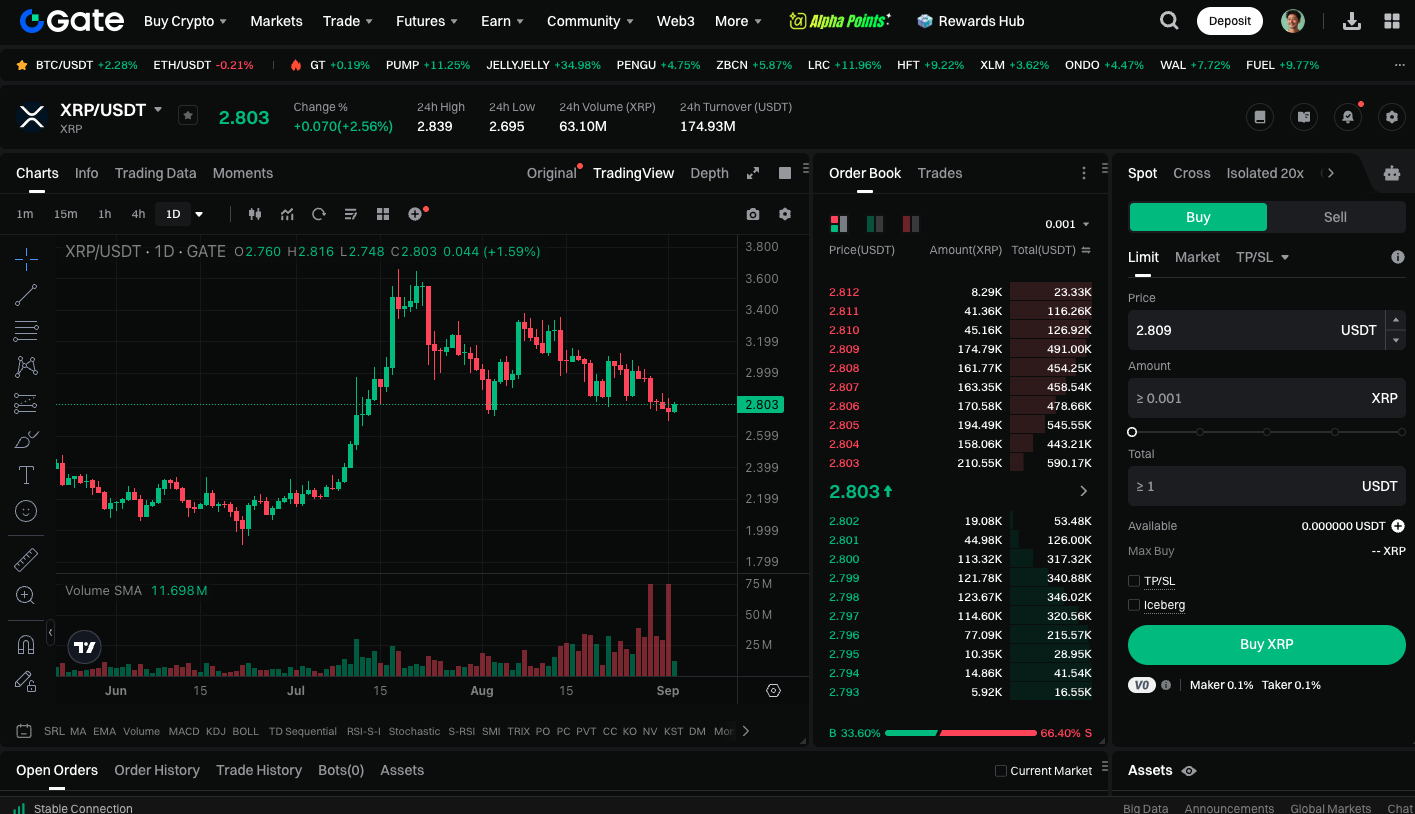
As of this report, the latest exchange rate is: 1 XRP ≈ 2.4 EUR. Trends in the global crypto market, Eurozone economic factors, and developments at Ripple Labs impact this figure, which reflects the interplay of supply and demand for XRP. Key features of the exchange rate:

  • High volatility: XRP’s price movement is closely tied to overall crypto market swings, which can lead to sharp short-term fluctuations.
  • Market depth: High-liquidity exchanges (such as Binance and Gate) provide support and stability for the EUR/XRP rate.
  • Trading hours: European trading sessions have a significant impact on exchange rate movements.

Investors should monitor real-time rates to identify optimal entry and exit points when trading.

Factors Influencing the XRP to Euro Rate

XRP’s exchange rate is driven by a range of factors, including:

  1. Market supply and demand

When demand rises or supply contracts, XRP’s price increases. This pushes the exchange rate higher.

  1. Global crypto market trends

Overall market sentiment, shaped by fluctuations in Bitcoin and Ethereum prices, can indirectly affect the XRP/EUR rate.

  1. Eurozone economic indicators

European Central Bank policy, inflation, and interest rate changes all influence the value of the EUR. These factors, in turn, impact the XRP/EUR rate.

  1. Ripple Labs developments

Partnerships, litigation developments, or tech upgrades at Ripple can trigger XRP price swings.

  1. Regulatory environment

Shifts in Europe’s crypto regulatory policy also affect market confidence and demand.

Together, these factors create significant complexity and volatility in the XRP/EUR exchange rate.

Outlook

With global demand for cross-border payments on the rise and deeper collaboration between Ripple and banks, the outlook for XRP’s role in the Euro market is increasingly promising.

  • Cross-border payments bridge: XRP will continue to serve as a bridge asset, connecting Europe to global markets.
  • Clearer regulation: If Europe provides greater regulatory clarity, this would strengthen investor confidence and stabilize the exchange rate.
  • Ecosystem expansion: Growth and broader adoption within the Ripple ecosystem could drive real demand and support XRP’s price.

While the XRP/EUR rate remains subject to volatility, it has medium- to long-term upside potential. This makes it an important trading pair for investors to watch.

Start trading XRP spot market now: https://www.gate.com/trade/XRP_USDT
Summary

The XRP to Euro (XRP/EUR) exchange rate is a key metric for European investors and crypto enthusiasts. As of the latest market data, 1 XRP is approximately 2.4 EUR. Investors can trade XRP spot or derivatives on exchanges. For those looking to invest in XRP within the Web3 ecosystem, staying informed about exchange rate movements and underlying market dynamics is essential for managing risk and assets. Understanding how the XRP/EUR rate fluctuates and structuring trading strategies accordingly can help investors achieve superior returns in a rapidly evolving market.

Author: Allen
Disclaimer
* The information is not intended to be and does not constitute financial advice or any other recommendation of any sort offered or endorsed by Gate.
* This article may not be reproduced, transmitted or copied without referencing Gate. Contravention is an infringement of Copyright Act and may be subject to legal action.

Related Articles

What is Fartcoin? All You Need to Know About FARTCOIN
Intermediate

What is Fartcoin? All You Need to Know About FARTCOIN

Fartcoin (FARTCOIN) is a representative meme coin within the Solana ecosystem based on an AI-driven narrative. Its core concept originated from an experiment aimed at exploring the "boundaries between AI Agents and humor." More than just a digital asset with social attributes, the project deeply couples absurd humor culture with on-chain financial logic by integrating autonomous AI interaction models.
2026-04-04 22:01:19
Gold Price Forecast for the Next Five Years: 2026–2030 Trend Outlook and Investment Implications, Could It Reach $6,000?
Beginner

Gold Price Forecast for the Next Five Years: 2026–2030 Trend Outlook and Investment Implications, Could It Reach $6,000?

Analyze current gold price trends alongside authoritative five-year forecasts, integrating an evaluation of market risks and opportunities. This gives investors insight into the potential trajectory of gold prices and the main drivers expected to shape the market over the next five years.
2026-03-25 18:13:30
Aster vs Hyperliquid: Which Perp DEX Will Prevail?
Beginner

Aster vs Hyperliquid: Which Perp DEX Will Prevail?

Aster and Hyperliquid are the two representative protocols of the "purpose-built L1 path" within the current decentralized perpetual exchange (Perp DEX) sector. As a pioneer in the field, Hyperliquid has built a deep liquidity moat through its highly mature order book architecture and strong community consensus. Conversely, Aster, as a rising challenger, seeks to leapfrog the competition in high-performance trading through more aggressive multi-chain aggregation logic, private transaction modules, and an underlying execution environment optimized for 2026 market demands.
2026-03-24 11:58:33
AI-Native Settlement Layers: How United Stables Is Building the Next Financial Rail
Beginner

AI-Native Settlement Layers: How United Stables Is Building the Next Financial Rail

Stablecoins were originally designed as dollar substitutes within exchanges, primarily used for asset pricing and trade settlement. As on-chain financial ecosystems have matured, their role has expanded beyond simple payments to include collateral assets, cross-chain liquidity mediums, and unified settlement units. In particular, as AI systems and automated agents begin to participate directly in economic activity, demand has risen sharply for programmable value units capable of instant settlement. This shift is pushing stablecoins toward the role of foundational financial infrastructure.
2026-03-25 03:16:17
ASTER Tokenomics: Buybacks, Burns, and Staking as the Value Foundation of ASTER in 2026
Beginner

ASTER Tokenomics: Buybacks, Burns, and Staking as the Value Foundation of ASTER in 2026

ASTER is the native equity and governance token of the Aster ecosystem, with its core value built upon a radical "Deflationary Engine." Beyond serving as a governance tool, ASTER integrates multiple utilities including staking rewards, trading fee discounts, and liquidity incentives. Through its deep integration with the upcoming dedicated Layer 1 mainnet, it enables direct value capture from protocol cash flow to token holders.
2026-03-25 07:38:07
Hybrid Collateral Stablecoins: Inside United Stables' Stability and Yield Architecture
Beginner

Hybrid Collateral Stablecoins: Inside United Stables' Stability and Yield Architecture

In the early stages of the crypto market, traditional stablecoins mainly relied on single-reserve or single-collateral models. Their primary focus was price stability and payment convenience, which allowed them to become foundational tools for on-chain trading and capital flows. As the market has entered a more mature financial phase, however, this structure has begun to reveal limitations, including high concentration risk and the difficulty of balancing liquidity with yield. These constraints have driven the evolution toward multi-layer collateral and portfolio-based designs, such as the dual-layer hybrid collateral architecture proposed by United Stables, which seeks to redefine the underlying logic of stable assets.
2026-03-25 03:17:39