Event Recap: SEC Officially Ends Zcash Investigation
The U.S. Securities and Exchange Commission (SEC) has officially closed its two-year investigation into the Zcash Foundation and confirmed it will take no enforcement action. In its statement, the Zcash Foundation emphasized that this result reflects recognition from regulators for its approach to information disclosure, governance structure, and its understanding and cooperation with regulatory requirements.
This investigation began in 2023, when the SEC issued a subpoena to the Zcash Foundation to assess whether Zcash and its privacy technology might present compliance risks under U.S. securities law. The probe extended beyond the token’s attributes to include potential risks associated with privacy coins in anti-money laundering (AML) and investor protection.
With privacy coins long under heightened regulatory scrutiny, the conclusion of this investigation is symbolically significant. It not only removes years of policy uncertainty for Zcash, but also provides a practical example of how privacy technology can align with compliance pathways.
Zcash Price Action: Regulatory Clarity Drives Swift Recovery
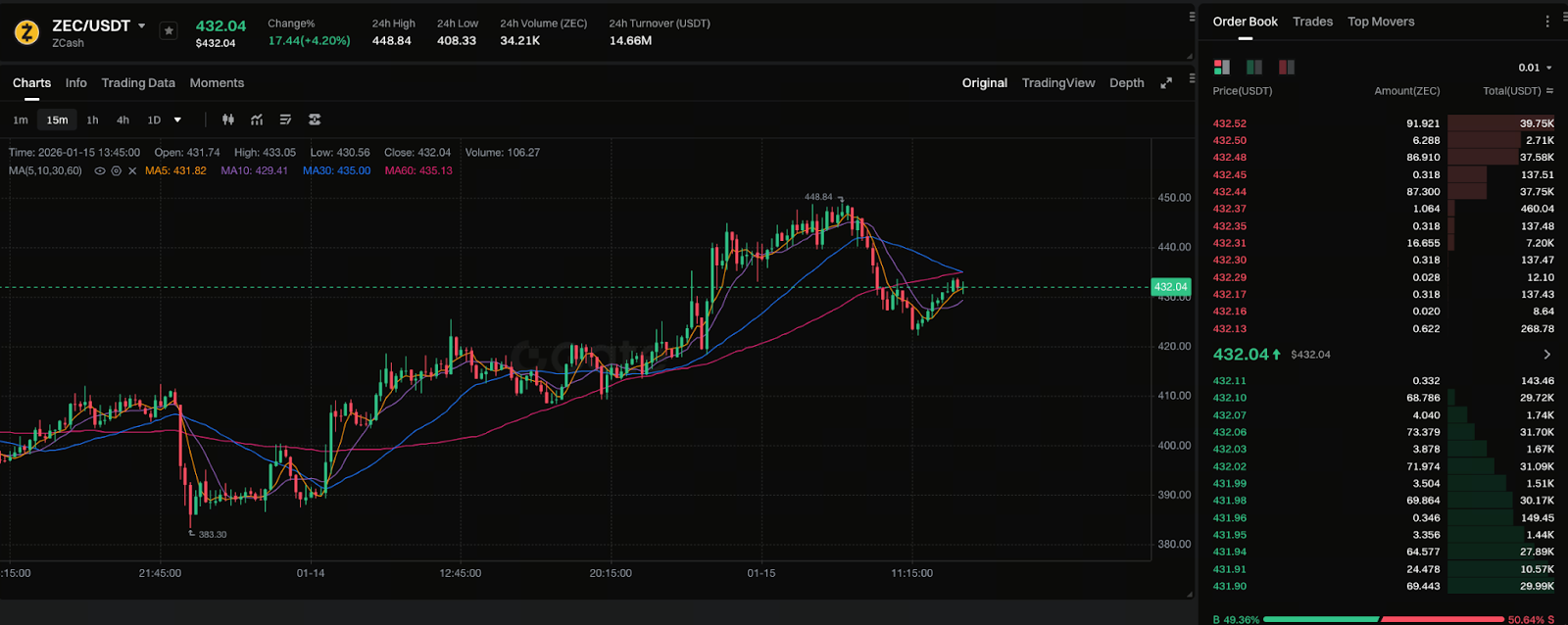
Chart: https://www.gate.com/trade/PEPE_USDT
Clear regulatory messaging quickly translated into market movement. After the announcement on January 14, 2026, ZEC saw a sharp price rally. Market data shows ZEC jumped over 6% in a single trading day, briefly reaching $445, with a 24-hour peak gain close to 14%.
Structurally, this rebound appears to be driven by sentiment and expectations. In recent weeks, ZEC’s price was pressured by several negative factors, including:
- Management and governance team changes: The entire Electric Coin Company (ECC) development team resigned in early January due to disputes with the Bootstrap Foundation, causing an initial price drop.
- Community disagreements: Conflicts over the development fund and employment terms created a “leadership vacuum” narrative.
- Weak sentiment across the sector: Privacy coins had faced delistings and scrutiny throughout 2024 and 2025.
These issues led to a notable correction in ZEC. The current recovery to the $420–$450 range suggests the market is now reassessing its regulatory risk premium rather than simply engaging in short-term speculation.
Sector-Wide Impact: Spillover Effects of Regulatory Easing in Privacy Coins
Zcash’s regulatory “green light” has implications beyond just one project. Privacy coins have long been considered the most regulatory-challenged crypto assets, with the market pricing in higher uncertainty for the sector.
This event sends a clear signal: privacy technology itself is not inherently illegal or non-compliant.
As global data privacy awareness grows and on-chain autonomy becomes more valued, some investors are rethinking the long-term value of privacy coins. The sector has shown periods of activity, indicating that demand for privacy remains—though it is strongly shaped by policy and trading conditions.
The Zcash case could prompt increased market interest in “compliant privacy” pathways, rather than excluding privacy coins from mainstream portfolios.
Risks and Controversies Persist: Zcash’s Structural Challenges Remain
While regulatory uncertainty has eased, Zcash still faces several long-term challenges that will determine whether its price rebound can be sustained.
1. Governance and Strategic Uncertainty
Recently, the Zcash community has debated governance models and fund allocation. The departure of key members from the ECC has impacted market confidence. These issues may not be immediately reflected in price, but they continue to shape medium- and long-term expectations for the Zcash roadmap.
2. Non-Default Privacy Functionality
Unlike some privacy coins like Monero, Zcash does not enable privacy transactions by default. While this “optional privacy” aided in its SEC clearance, the actual usage rate of shielded addresses remains a point of debate. Some argue this weakens the purity of its narrative and may affect its core competitiveness in the privacy sector.
3. Market Structure Limitations
ZEC’s price action remains closely tied to overall crypto market risk appetite. Analysis suggests recent rallies were driven largely by futures speculation rather than spot buying, which could lead to volatility if sentiment shifts.
Outlook: Key Variables and Market Focus
In the coming weeks, Zcash’s market performance may hinge on several core factors:
- Price: Can the $400–$450 range become firm support?
- Trading Structure: Will rising prices be supported by improved volume and position structure?
- Sector Linkage: Will privacy coins spark broader sentiment across the market?
- Policy Expectations: Will regulators further clarify their stance on privacy technology?
If ZEC consolidates in the current range and overall market risk appetite improves, the rebound could continue.
Over the longer term, the compliance pathway for privacy coins, pace of technological innovation, and expansion of real-world use cases will be key to whether Zcash can truly break out of its cyclical lows.
Conclusion: A Major Regulatory Signal
The SEC’s decision to end its investigation of Zcash is a rare, clear policy boost for privacy coins in the crypto market. It has lifted ZEC’s price in the short term and reduced a longstanding regulatory risk premium.
However, this event signals “no longer being denied,” not “full acceptance.” Zcash and the broader privacy coin sector still need to find a sustainable balance between technology, governance, and compliance.
For market participants, this event offers short-term trading opportunities and may also shape the policy pricing logic for privacy assets over longer timeframes.