The Kobeissi Letter recent news highlights a notable signal on the geopolitical chessboard. Recently, U.S. President Donald Trump posted on Truth Social that Washington demands Iran to “unconditionally surrender,” a tough statement implying that any ceasefire agreement could still be delayed.
However, looking back at historical precedents, a similar statement from a previous U.S. president was followed by a real ceasefire just six days later. Based on this pattern, many analysts are now speculating that a ceasefire agreement could emerge around March 12 of this year.
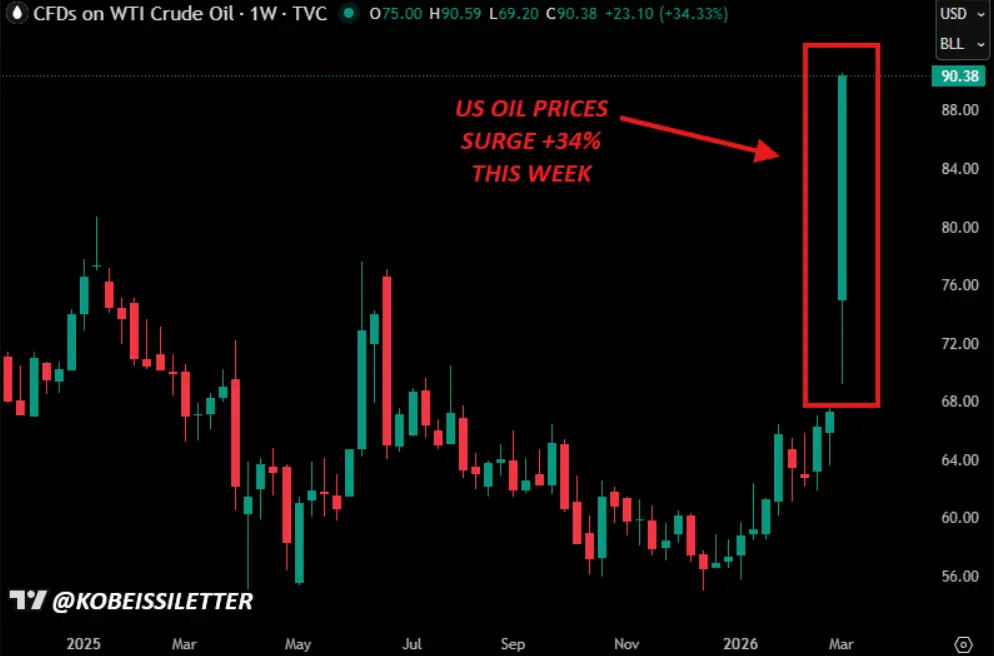 Weekly Oil Price Chart | Source: X
Interestingly, this hypothesis is not solely based on political reasoning. Signals from the financial markets also seem to support this scenario.
Recently, the crypto market has seen strong capital inflows, while global oil prices have risen significantly. U.S. oil alone is on track to record its largest weekly increase since 1982, with gains of up to 34.5% in just a few days.
From a macroeconomic perspective, rising oil prices often lead to long-term inflationary pressures. Coupled with escalating war costs, fiscal pressures could prompt stakeholders to seriously consider reaching a ceasefire.
Until now, risk assets—especially crypto—appear to serve as a hedge against geopolitical instability. But the big question is: if a ceasefire is truly maintained, will crypto lose its hedging role, or will it instead become a catalyst for a long-awaited market surge?
Uncertainty Over Ceasefire Testing Crypto’s Hedging Role
Last week’s trading proved the characteristic volatility of the crypto market.
In the first half of the week, nearly $150 billion quickly flowed into the market, sparking a strong rally. However, this enthusiasm did not last long. Capital flows slowed noticeably in the second half, risking the total market cap ending the week with only about $50 billion in gains—meaning 67% of the previous gains were wiped out.
More noteworthy is the macro picture behind these movements. The initial capital surge was largely driven by geopolitical tensions in the Middle East, as investors sought refuge in Bitcoin, reinforcing the idea that BTC is gradually becoming a safe haven asset.
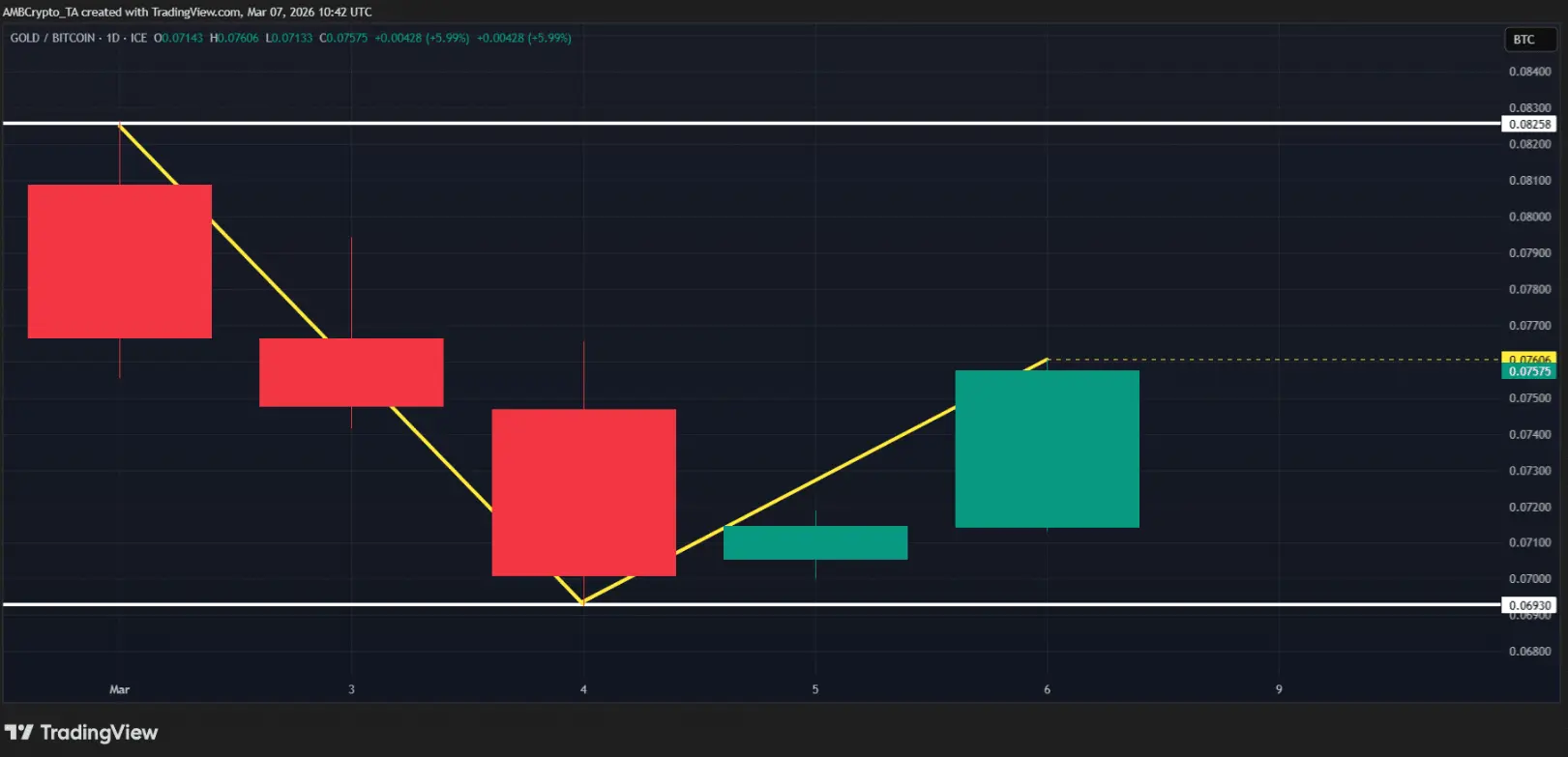 Daily XAU/BTC Chart | Source: TradingView
However, as the rally weakened, questions arose: can Bitcoin truly maintain this role? At the same time, the XAU/BTC ratio surged 6% in a single day, recovering nearly 50% of the weekly decline—a sign that capital might be shifting back into traditional assets like gold.
From a capital flow perspective, the scenario of funds leaving crypto to return to traditional markets is becoming clearer. This raises a big question: is Bitcoin surpassing $70,000 a sign of genuine hedging demand, or just a “fakeout” breakout?
Given the intense volatility this week, the second scenario seems more convincing—at least in the short term.
In this context, a ceasefire in the Middle East could serve as a key bullish catalyst, restoring investor confidence in crypto as a hedging tool.
Conversely, if tensions escalate further and oil prices continue to rise, capital is more likely to flow into gold, weakening crypto’s position and making it difficult for Bitcoin to sustain its move past $70,000.
Disclaimer: The information on this page may come from third parties and does not represent the views or opinions of Gate. The content displayed on this page is for reference only and does not constitute any financial, investment, or legal advice. Gate does not guarantee the accuracy or completeness of the information and shall not be liable for any losses arising from the use of this information. Virtual asset investments carry high risks and are subject to significant price volatility. You may lose all of your invested principal. Please fully understand the relevant risks and make prudent decisions based on your own financial situation and risk tolerance. For details, please refer to
Disclaimer.


