Interest in underground survival bunkers has spiked sharply as the 2026 U.S.-Iran conflict intensifies, according to the owner of Texas-based Atlas Survival Shelters.
Fallout Shelter Builder Says Calls Flood In as Global War Risks Rise
Ron Hubbard, founder of Atlas Survival Shelters in Sulphur Springs, Texas, said inquiries for underground shelters increased roughly tenfold after military operations involving the United States, Israel, and Iran escalated in late February and early March. Hubbard told reporters he has been “inundated with calls” from Americans seeking protection against potential fallout from the widening geopolitical crisis.
The renewed demand highlights how international conflict often sends consumers searching for disaster insurance — sometimes in the form of steel tubes buried beneath their backyard. Atlas specializes in galvanized steel and reinforced concrete bunkers designed to protect occupants from nuclear fallout, electromagnetic pulse attacks, chemical and biological threats, nearby explosions, and civil unrest.
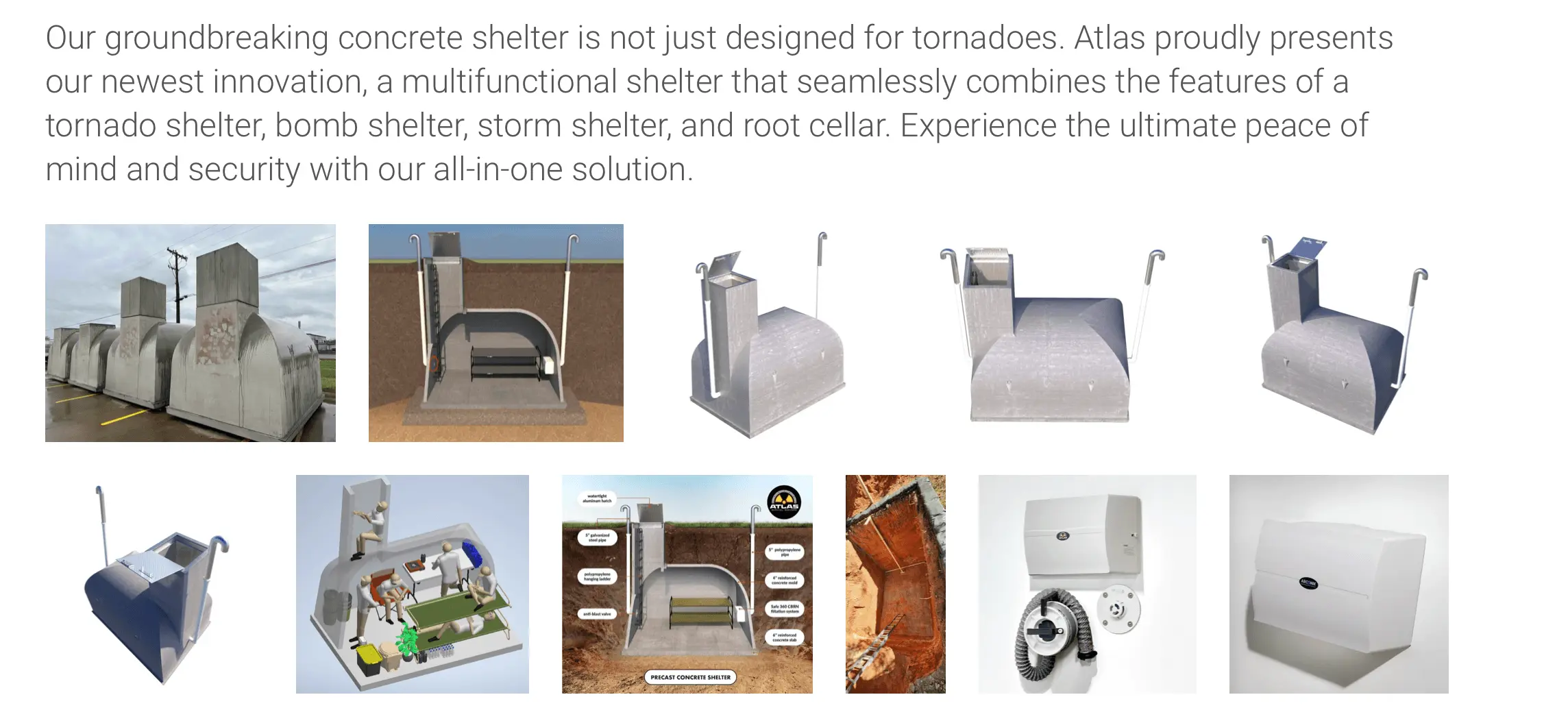 Source: Atlas Survival Shelters
Hubbard said Atlas had been averaging about $2 million in monthly sales during 2026 but now expects business could climb as high as $50 million next month if interest continues at the current pace. Whether those projections hold remains to be seen, but the phone lines, he said, have been unusually busy.
Source: Atlas Survival Shelters
Hubbard said Atlas had been averaging about $2 million in monthly sales during 2026 but now expects business could climb as high as $50 million next month if interest continues at the current pace. Whether those projections hold remains to be seen, but the phone lines, he said, have been unusually busy.
“The Iran war has hit home,” Hubbard said, noting that global crises often trigger waves of bunker shopping. Similar demand spikes followed Russia’s invasion of Ukraine in 2022 and the October 2023 Hamas attack on Israel, he added.
Atlas sells a wide range of shelters, from entry-level backyard models priced around $20,000 to $25,000 to sprawling luxury installations that can exceed $5 million. Basic units resemble fortified safe rooms designed for storms or short-term emergencies, while the high-end models aim for something closer to underground comfort.
Those luxury builds can include multiple bedrooms and bathrooms, kitchens, entertainment rooms, gun ranges, armories and even swimming pools or recording studios. Hubbard often describes the larger bunkers as underground homes capable of supporting residents for extended periods, sometimes stocked with supplies for 30 days or longer.
All Atlas shelters reportedly feature reinforced structures and nuclear, biological, and chemical filtration systems intended to maintain breathable air during extreme events. Designs typically incorporate gas-tight blast doors and angled entrances meant to limit radiation exposure from fallout.
The company also acknowledges its products have limits. Atlas states its shelters are not built to survive a direct nuclear strike or specialized military bunker-busting weapons, a distinction Hubbard frequently emphasizes when discussing the designs.
Hubbard said interest has come from wealthy buyers, technology executives and business leaders. He also claimed that two senior members of President Donald Trump’s Cabinet recently purchased shelters, though he did not name them publicly and the purchases have not been independently verified.
Past clients have included high-profile figures, Hubbard has said, including technology executives. He has previously claimed involvement in the design of an underground bunker component at a Hawaii property owned by Meta CEO Mark Zuckerberg, though details of private installations are typically confidential.
Hubbard’s End-Times Theory Echoes Predictive Historian Jiang Xueqin—But With a Biblical Spin
Like Hubbard, predictive historian Jiang Xueqin predicts the unfolding U.S.-Iran conflict as a potentially epoch-shaping event — but they arrive at that conclusion through very different lenses. Hubbard interprets global turmoil through a biblical framework rooted in Christian prophecy, while Jiang, a Chinese-Canadian historian and Yale graduate known for his “Predictive History” lectures, analyzes the same conflict through secular historical patterns and game theory.
In a March 8 interview with The Telegraph, Hubbard framed the war in explicitly religious terms, linking current events to the Book of Revelation. “Honestly, it seems like the end of times are very close,” he said. “I’m a Christian and I believe in the Bible, and I believe that there will be that great war… I believe the end of times will see the United States wiped off the map. And then there will be a winter, the rapture and seven years of tribulation.” For Hubbard and many of his clients, underground shelters represent a practical form of preparation for a world they believe may be entering a prophetic climax.
Jiang, by contrast, approaches the same geopolitical moment through a strictly secular framework. In lectures and interviews circulated online in 2024 and again in early 2026, he argues that a U.S. war with Iran would likely become a long war of attrition shaped by geography, asymmetric warfare, and economic strain. Drawing comparisons to historical conflicts such as Athens’ disastrous Sicilian Expedition, Jiang contends that prolonged military commitments and strategic overreach can accelerate the decline of global powers.
His analysis focuses on measurable factors — military supply chains, economic pressures, and shifting alliances in the Middle East — rather than religious prophecy. Jiang argues that conflicts of this scale can reshape international power structures, potentially accelerating a transition from U.S.-led global dominance to a more multipolar system.
Despite their radically different reasoning, both men ultimately describe the war as a turning point with potentially lasting consequences for the United States and the international order. One sees the moment through scripture and divine prophecy; the other through historical cycles and strategic calculation.
For now, the immediate effect is far more tangible: Americans dialing the phone and asking how quickly a bunker can be tucked beneath their homes—well, at least according to the Atlas founder’s testimony.
FAQ 🔎
- Why are bunker sales rising in the United States in 2026?
Demand has increased as geopolitical tensions from the U.S.-Iran conflict raise fears about nuclear fallout and global instability.
- How much does an underground survival bunker cost?
Basic shelters typically start around $20,000, while luxury underground complexes can exceed $5 million.
- Can survival bunkers protect against nuclear war?
Many are designed to block fallout and radiation but are not built to survive a direct nuclear blast.
- Where is Atlas Survival Shelters located?
The company operates out of Sulphur Springs, Texas, and sells survival shelters across the United States and internationally.
Disclaimer: The information on this page may come from third parties and does not represent the views or opinions of Gate. The content displayed on this page is for reference only and does not constitute any financial, investment, or legal advice. Gate does not guarantee the accuracy or completeness of the information and shall not be liable for any losses arising from the use of this information. Virtual asset investments carry high risks and are subject to significant price volatility. You may lose all of your invested principal. Please fully understand the relevant risks and make prudent decisions based on your own financial situation and risk tolerance. For details, please refer to
Disclaimer.


