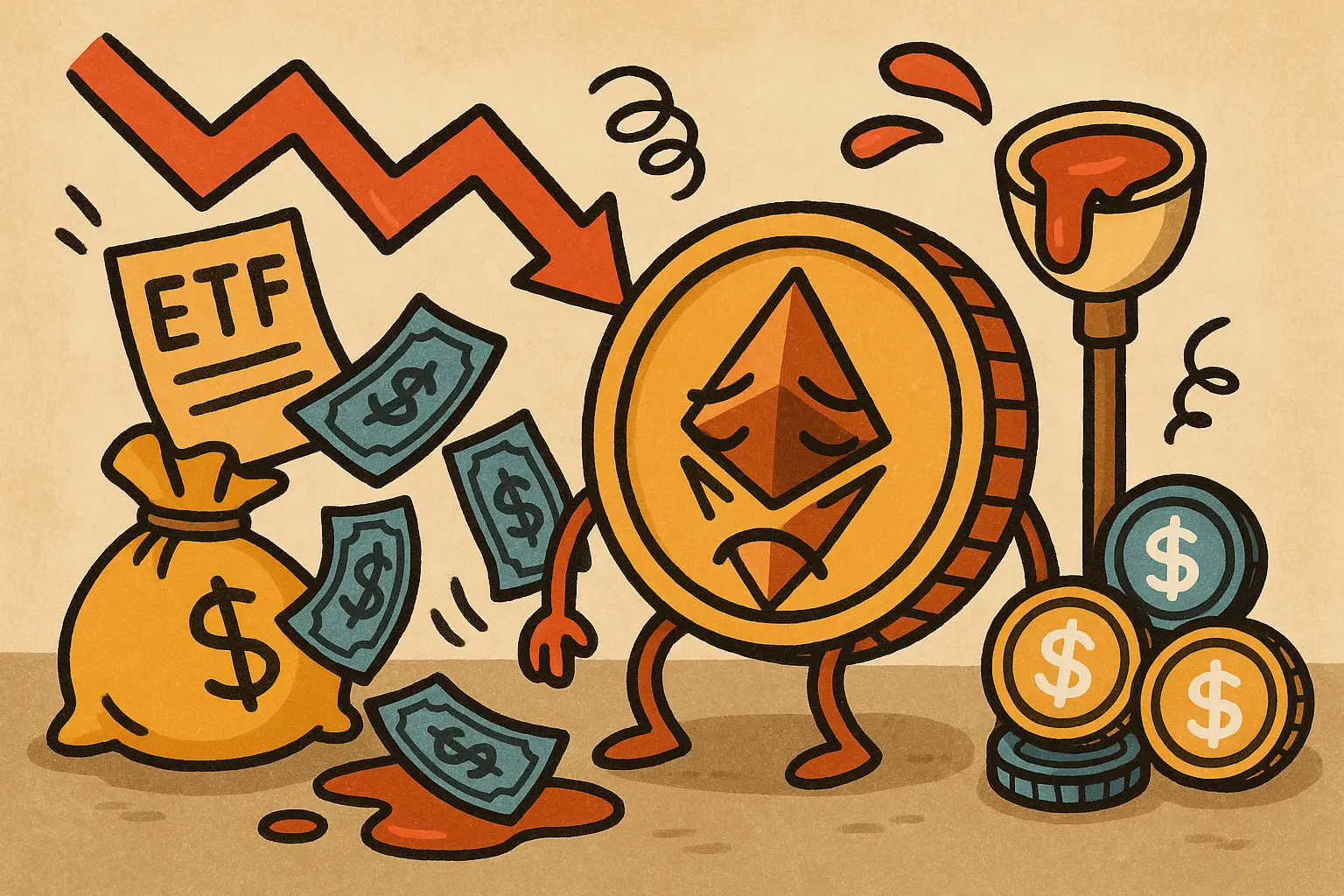
Ethereum perpetual contract funding rates fell into negative territory on Tuesday, indicating a significant increase in short-selling demand. Over the past month, this indicator has remained consistently below the neutral normal range of 6% to 12%. Although Ethereum experienced a modest 7% rebound from Monday to Tuesday, the overall derivatives market structure shows that bullish interest in leveraged positions remains lacking.
Technical Significance of Ethereum Funding Rate Turning Negative
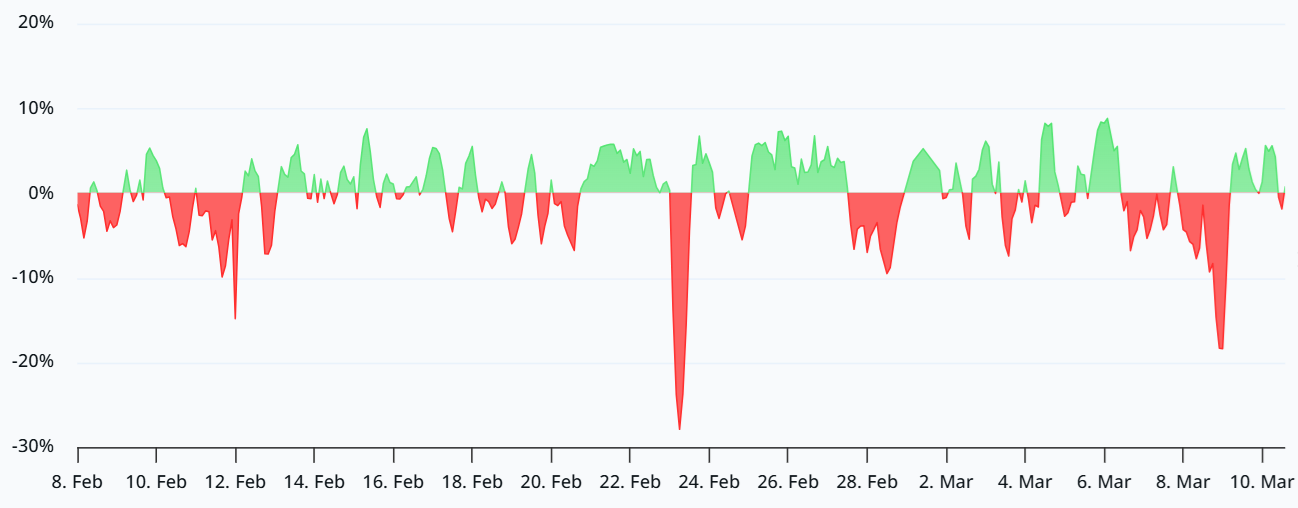
(Source: Laevitas.ch)
The Ethereum funding rate is a key indicator measuring the balance of bullish and bearish forces in the perpetual contract market. A positive funding rate means longs are willing to pay shorts to maintain their bullish positions, while a negative rate indicates the opposite—shorts pay longs—reflecting a market shift toward a bearish bias.
Over the past month, Ethereum’s funding rate has remained below the neutral normal range of 6% to 12%, suggesting that the market’s medium-term outlook on Ethereum is less than optimistic. The negative rate on Tuesday further reinforces this signal, showing increasing short-term selling pressure.
Meanwhile, the Ethereum options market offers a relatively moderate perspective. The delta skew indicator remains near the neutral range of -6% to +6%, but the premium for selling options (puts) over buying options (calls) is currently about 7%, indicating that bullish confidence is slowly recovering but has not yet reached a decisive level.
ETF Outflows and Staking Yield Competition: Dual Pressures on Institutional Demand
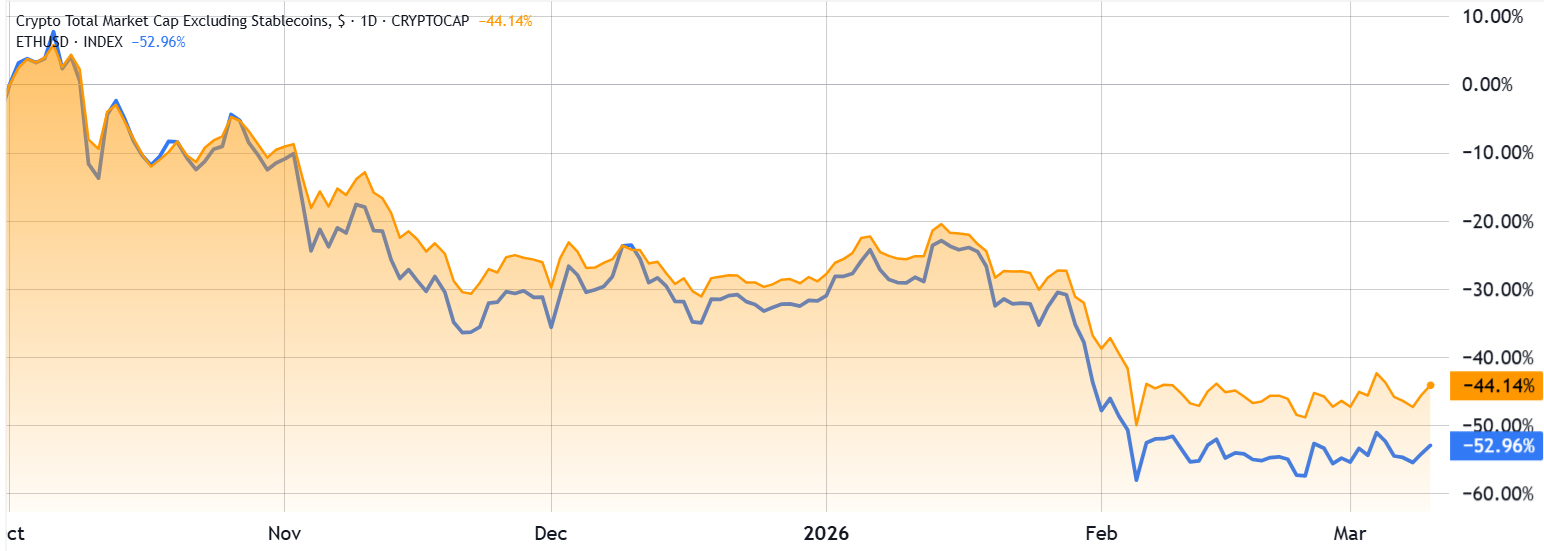
(Source: TradingView)
Ethereum ETF capital flows are the most direct measure of institutional demand. Last Wednesday, Ethereum ETFs saw inflows of $169 million, but from Thursday to Monday, there was a net outflow of $225 million, indicating that institutional capital inflow remains unstable and lacks continuity.
Another structural reason for weak institutional demand is the competitive disadvantage of staking yields:
- Native staking annual yield: approximately 2.8%
- Sky Lending (formerly MakerDAO) stablecoin yield: 3.75%
Competitive pressure: Holding Ethereum and earning staking rewards is less attractive compared to some stablecoin deposit products in terms of returns, weakening institutions’ long-term motivation to allocate to Ethereum.
The U.S. approval of ETF staking by the end of 2025 once sparked market excitement, but so far, it has not translated into sustainable capital inflows, partly due to the overall crypto market downturn at the time.
On-Chain Data and Roadmap Progress
On-chain activity data for Ethereum’s base layer has also failed to boost market confidence. Over the past month, the weekly average fee income on Ethereum’s base layer has been about $2.3 million, far below the peak of $8 million in early February this year, despite 7-day transaction volume remaining steady at around 14 million transactions. The adoption of Layer 2 rollup scaling solutions has improved overall network efficiency but has not yet driven increased demand for the native Ethereum.
On the technical front, some positive developments are expected. Ethereum co-founder Vitalik Buterin stated on Saturday that the account abstraction feature (smart accounts, developed over ten years) is expected to be officially launched “within a year,” supporting quantum-resistant wallets. The upcoming Hegota fork also brings several improvements, including enabling payments of gas fees with non-Ethereum tokens via decentralized exchanges and adding a “Universal Public Memory Pool” in privacy platforms.
Notably, Ethereum still holds a significant moat in decentralized finance (DeFi)—the total value locked (TVL) in the Ethereum DeFi ecosystem is about $56 billion, with no current competitors able to challenge this scale.
FAQs
Does a negative Ethereum funding rate mean the bears have completely taken over the market?
A negative funding rate signals increased bearish sentiment but does not mean bears have fully dominated the market. The options market remains near the neutral zone, and TVL remains stable, indicating that Ethereum’s fundamentals have not collapsed. A more accurate interpretation is that bullish confidence is weak, bears have a slight edge, but neither side has strong directional momentum.
Why does institutional demand remain weak after ETF staking approval?
The positive effect of ETF staking approval is offset by two factors: first, the timing coincided with a broader crypto market correction, leading to overall low risk appetite among institutions; second, the native staking yield of 2.8% is lower than some stablecoin yields of 3.75%, reducing institutions’ incentive to allocate to Ethereum for staking purposes.
What conditions are needed for Ethereum to break above $2,200?
Based on current derivatives and on-chain indicators, breaking and sustaining above $2,200 requires: a rise in funding rates to a positive neutral range (6-12%), continuous capital inflows into Ethereum ETFs, and a rebound in base layer fee income indicating improved on-chain activity. Technical roadmap implementations (such as account abstraction and Hegota fork) may boost demand in the medium to long term, but their short-term impact is limited.
Disclaimer: The information on this page may come from third parties and does not represent the views or opinions of Gate. The content displayed on this page is for reference only and does not constitute any financial, investment, or legal advice. Gate does not guarantee the accuracy or completeness of the information and shall not be liable for any losses arising from the use of this information. Virtual asset investments carry high risks and are subject to significant price volatility. You may lose all of your invested principal. Please fully understand the relevant risks and make prudent decisions based on your own financial situation and risk tolerance. For details, please refer to
Disclaimer.


