Author: ChainAnalysis Crypto Laboratory
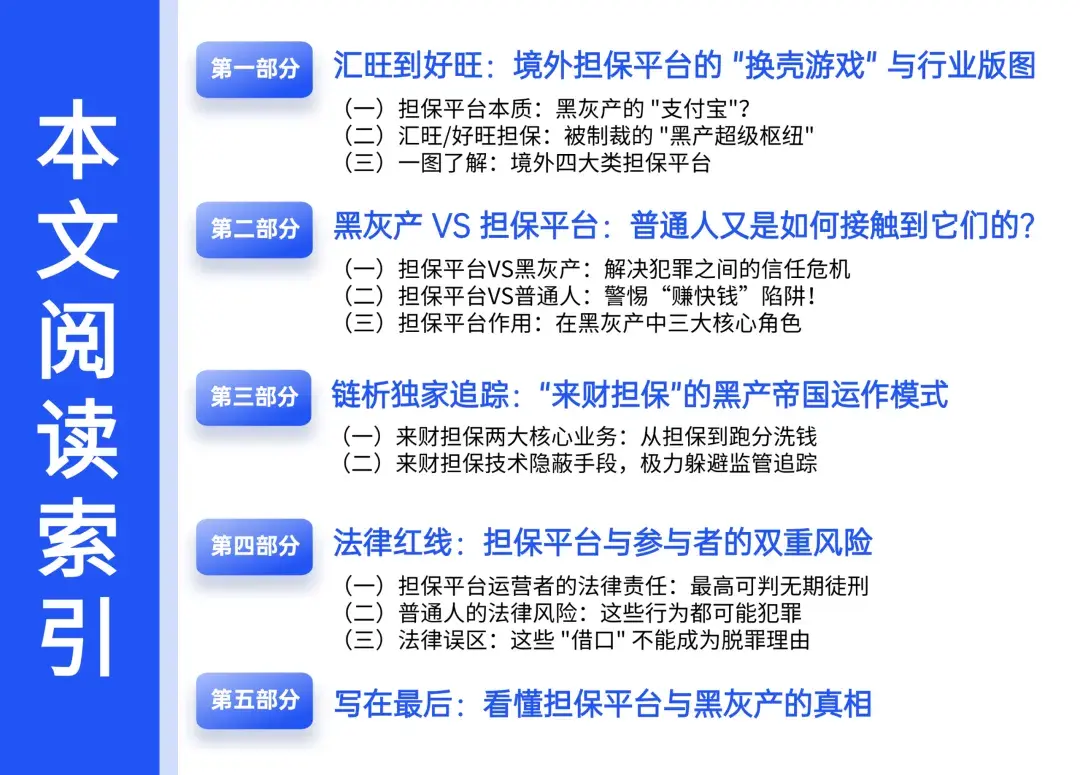
From Huiwang to Haowang: The “Shell Game” of Overseas Guarantee Platforms and Industry Landscape
(1) The Essence of Guarantee Platforms: International “Idle Fish”
In the Web3 ecosystem, guarantee is fundamentally a trust mechanism for legitimate transactions—similar to a third-party escrow when shopping on Idle Fish. The platform temporarily holds funds after the buyer pays, releases payment to the seller upon confirmation of receipt, solving trust issues between buyers and sellers. However, overseas so-called “guarantee platforms” have turned this mechanism into a cover for black and gray industry activities.
Common traits of these platforms: lacking legitimate financial licenses, operating via Telegram (commonly called Paper Plane), mainly using USDT (stablecoin) as the transaction medium—illegal tools that facilitate scams, money laundering, human trafficking, and other illegal transactions, providing fund custody and arbitration under the guise of “guarantee,” enabling criminal activities to proceed smoothly. Simply put, legitimate guarantees protect lawful transactions; these platforms protect criminal deals.
(2) Haowang/Haowang Guarantee: Sanctioned “Black Industry Super Hub”
When discussing guarantee platforms, we cannot ignore Huiwang Guarantee, known in the industry as the “Alipay for black industry.” Its development history is a black-gray industry “evolution story”:
- Around 2020: Huiwang Group in Cambodia launched Huiwang Guarantee, rapidly rising by leveraging Southeast Asia’s online scam zones.
- 2022: Due to involvement in large-scale scams and money laundering, listed for sanctions by U.S. Treasury, assets frozen, large user funds inaccessible.
- 2023: Rebranded as “Haowang Guarantee,” continuing operations via Telegram groups, attempting to evade regulatory crackdowns.
- 2024 onward: Despite frequent server and team changes, still under close monitoring by global regulators, with issues like bank runs and withdrawal difficulties.
As the industry leader, Haowang Guarantee’s business volume is staggering: over $27 billion in total transactions, serving black industry practitioners in over 100 countries and regions worldwide, with more than 80% usage in Southeast Asia scam zones.
Operational Model of Haowang Guarantee:
- Sellers (scam gangs/individual info traders) post “goods” on the platform—possibly tens of thousands of personal info records, card skimming tools, or human trafficking “channels.”
- Buyers (downstream scammers/illegal traders) transfer USDT into designated platform wallets.
- Sellers ship goods; buyers confirm “receipt” (i.e., confirm info usability, tools working).
- The platform deducts commission, then transfers remaining USDT to sellers.
- In case of disputes, the platform acts as “arbiter,” but arbitration standards favor black industry logic—e.g., whether the “information can be used” depends on whether the buyer successfully commits fraud.
Most concerning is its “anonymity”: no real-name verification required, just a Telegram account to register; all fund flows use USDT, completely outside regulatory oversight.
ChainAnalysis technical team has assisted law enforcement in tracing a scam case’s fund flow: a victim in China lost 500,000 yuan, which was cashed out via Cardano, exchanged through U商, and completed transactions through Haowang Guarantee, ultimately flowing to overseas scam gangs. The entire process took only 48 hours, with fragmented fund trails.
(3) Visual Overview: Four Major Types of Overseas Guarantee Platforms
As key hubs in black-gray industry networks, guarantee platforms have grown rapidly in recent years, with exponential increases in user and fund scales.
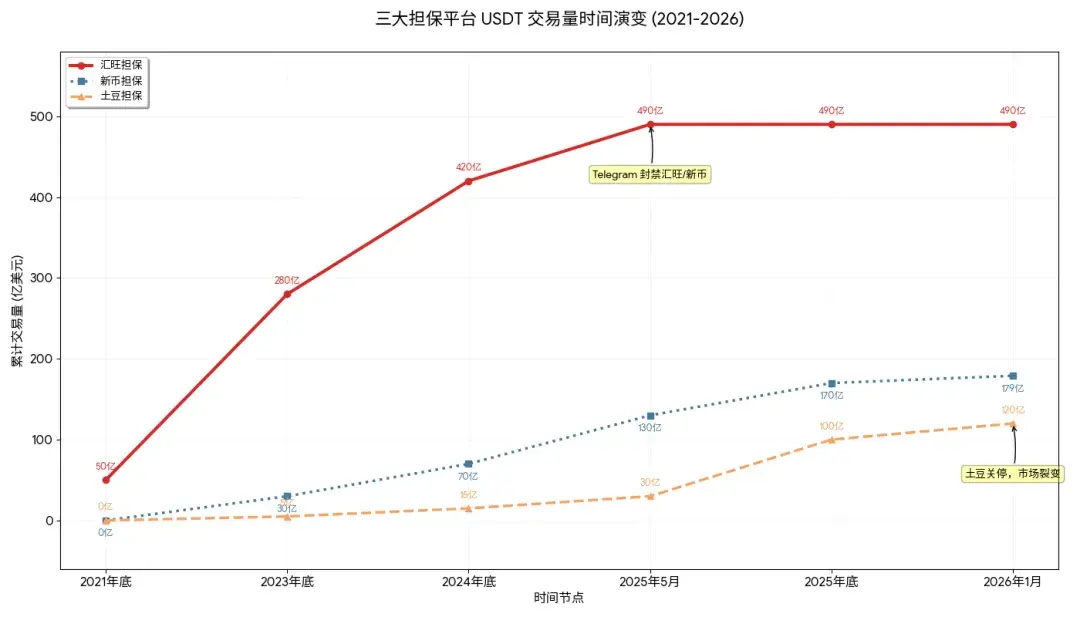
Based on on-chain data, Huiwang Guarantee, Tudou Guarantee, and Xinbi Guarantee alone handled over $78 billion USDT in transactions over the past three years. This volume surpasses the GDP of many small and medium-sized countries.
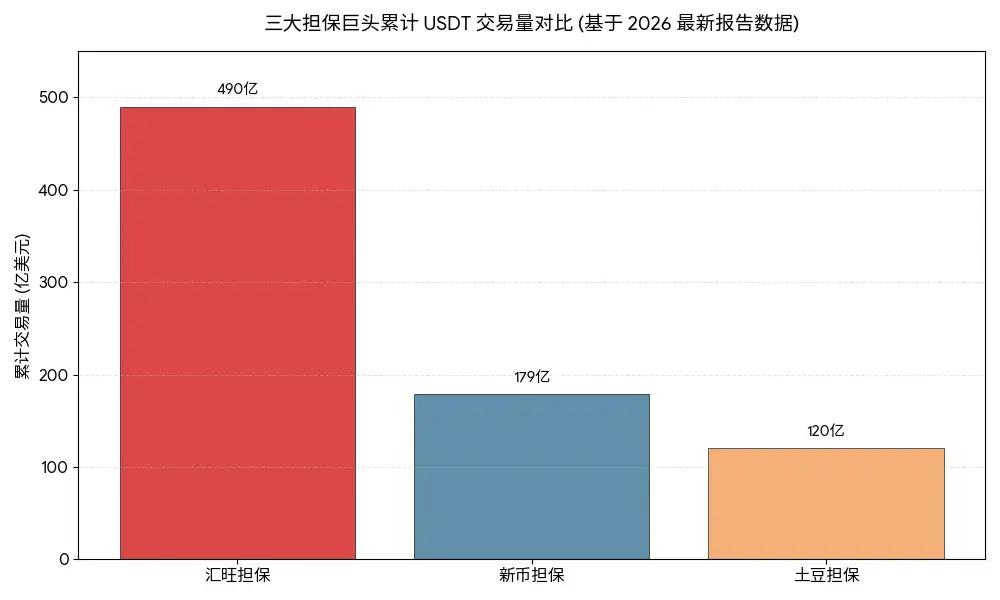
Besides these three giants, there are various specialized guarantee platforms overseas, covering different black industry scenarios. Below is a detailed comparison of four major platform categories:
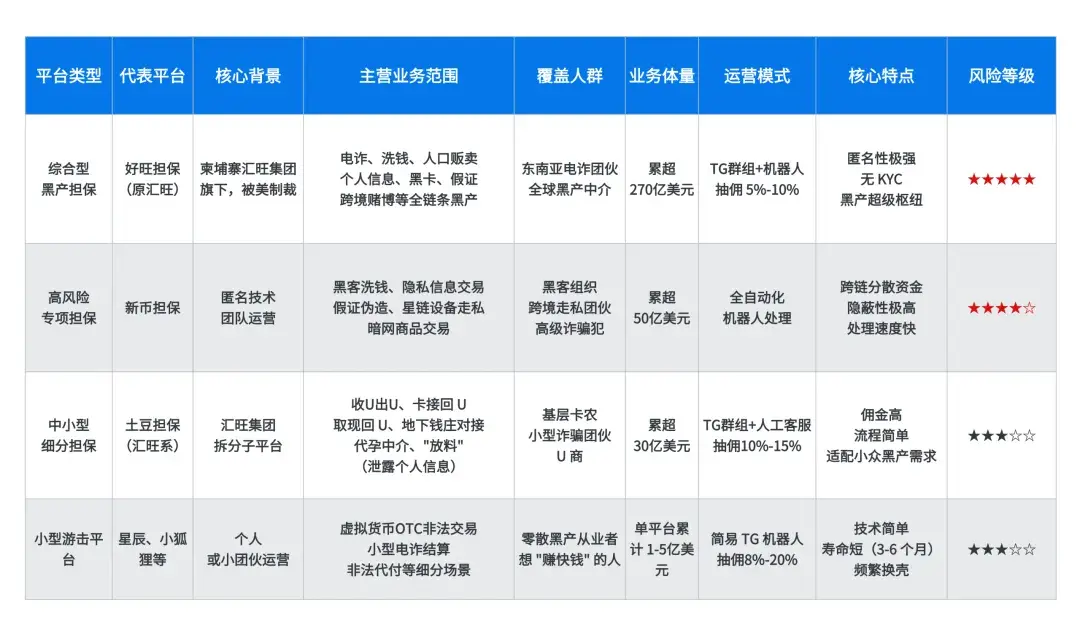
【Note】: The above data is compiled from case materials, on-chain data tracking, and industry research. Business volume refers to cumulative transaction scale; risk level is assessed based on regulatory crackdown intensity, concealment, and harm scope.
Common features of these platforms include:
❶ Using USDT as the transaction medium (USDT is pegged 1:1 to USD, stable in price, and cross-chain transfer is fast, enabling quick splitting of large funds)
❷ Avoiding formal channels, choosing Telegram as the operational platform (Telegram’s encrypted communication and group functions facilitate concealment)
❸ No substantial risk control—any illegal transaction can be guaranteed as long as the user pays a commission
Black/Gray Industry vs Guarantee Platforms: How Do Ordinary People Encounter Them?
(1) Guarantee Platforms vs Black-Gray Industry: Solving Trust Crises in Crime
Black-gray industry practitioners are essentially “mutually suspicious scammers.”
Why? Scam gangs fear their purchased personal info is fake; info traders fear delivery won’t result in payment; money laundering teams fear U商 will “black eat black”; U商 fear being eliminated after laundering. This inherent lack of trust creates space for guarantee platforms. Simply put: guarantee platforms enable scammers to trade with confidence.
Here’s a real case from our technical team’s investigation:
A scam gang wanted to buy “Four Pieces” (bank card/ID copy/phone SIM/U盾) for money laundering. The seller was a domestic “Card Farmer” intermediary. Both parties didn’t know each other, afraid of undercover agents or scams—buyers worried about paying but not receiving usable info; sellers worried about delivering info but not getting paid.
At this point, Haowang Guarantee became their “trust bridge.”
The platform ensures smooth transactions, provides anonymity, and completes the closed-loop of illegal activity. Without such a platform, many black industry transactions would be impossible—this is the fundamental reason for the platform’s irreplaceability in black-gray ecosystems.
(2) Guarantee Platforms vs Ordinary People: Beware of “Quick Money” Traps!
Many think black-gray industry is far from their lives. In reality, these guarantee platforms are infiltrating daily life through various channels, especially targeting those seeking “low-threshold quick money”:
- Social media promotion: Using keywords like “virtual currency arbitrage,” “USDT exchange profit,” “zero-threshold task” on TikTok, Kuaishou, Xiaohongshu, attracting users, then guiding them to WeChat or QQ, and further into Telegram groups.
- Friend referrals: Friends recommend “a task to earn pocket money—just transfer a small amount, get a commission,” leading many to relax vigilance and become tools for crime.
- Dark web redirects: Surfing online, users may see pop-up ads leading to Telegram groups, which may involve more serious crimes like drug trafficking or arms sales.
(3) The Role of Guarantee Platforms: Three Core Roles in Black-Gray Industry
If black-gray industry is a chain, guarantee platforms are the “core hub,” playing three key roles:
- “Fund Security Guardians”: Providing escrow for illegal transactions, solving trust issues among black industry practitioners, making fund flow “safer.”
- “Legitimization” Disguisers: Using “guarantee” to make illegal transactions appear legitimate, lowering participants’ psychological defenses and complicating regulatory enforcement.
- “Fund Trail Cutters”: Using USDT transfers, cross-chain moves, multi-address splitting, etc., to sever illegal funds from their sources, making tracing difficult.
Our technical team tracked a core wallet of a guarantee platform over six months, finding interactions with over 1,200 suspected black industry addresses involving more than $800 million. These funds flowed to overseas exchanges, anonymous wallets, and other guarantee platforms, forming a complex web that greatly hampers tracing efforts.
Exclusive ChainAnalysis Tracking: The “Laicai Guarantee” Black Industry Empire Model
As a Web3 security firm, we assisted case teams in on-chain tracking and analysis of multiple illegal guarantee platforms. Among them, “Laicai Guarantee” (name anonymized for case confidentiality) exemplifies the operational complexity and concealment typical of black industry guarantee platforms—an industry “textbook.”
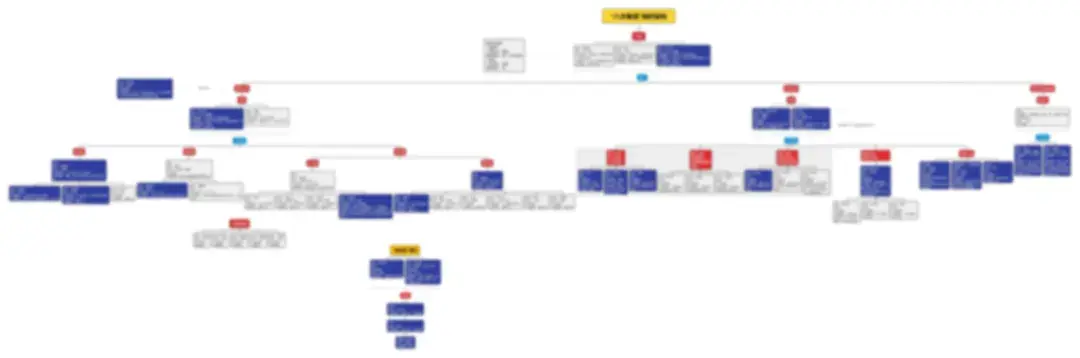
(1) Laicai Guarantee’s Two Core Businesses: From Guarantees to Money Laundering via Score Running
Our data analysis shows Laicai Guarantee is not just a single platform but a constructed black industry ecosystem centered on guarantees, covering score running, system leasing, and customer maintenance, forming a closed loop.
Core Guarantee Business 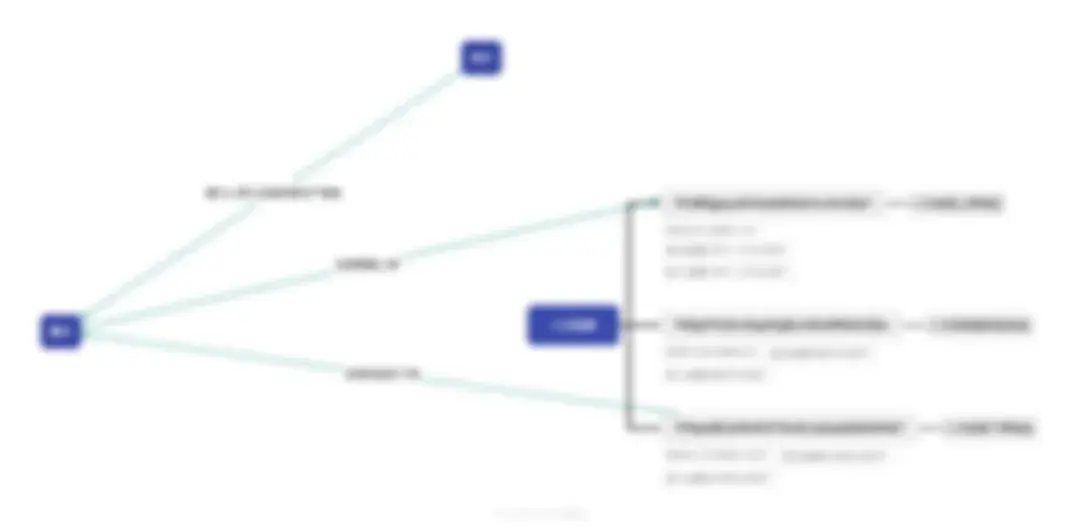
This is the foundation and most critical part, providing escrow and arbitration for black industry transactions, similar to Haowang Guarantee but more targeted—mainly serving “score running teams” and “scam gangs.” For example, scam gangs recruit score runners for laundering; both parties deposit USDT on the platform, agree on laundering rules, and after completion, the platform releases deposits with an 8% fee.
On-chain data shows Laicai Guarantee has three main virtual currency addresses for deposit, reserve, and withdrawal:
Deposit Address (TKxxxx1): From May 2024 to Feb 2026, total inflow of 96.56 million USDT, all from suspected black industry addresses, used for collecting deposits from both sides.

Reserve Address (THxxxx2): From July 2025 to Feb 2026, inflow of 12 million USDT, all from the deposit address, used to demonstrate platform strength and attract more users.

Withdrawal Address (TPxxxx3): From March 2025 to Feb 2026, inflow of 937 million USDT, mainly from score running addresses, used for refunding deposits after transactions. Funds show a pattern of “inflow and scattered outflow,” mostly small amounts, consistent with deposit refunds.
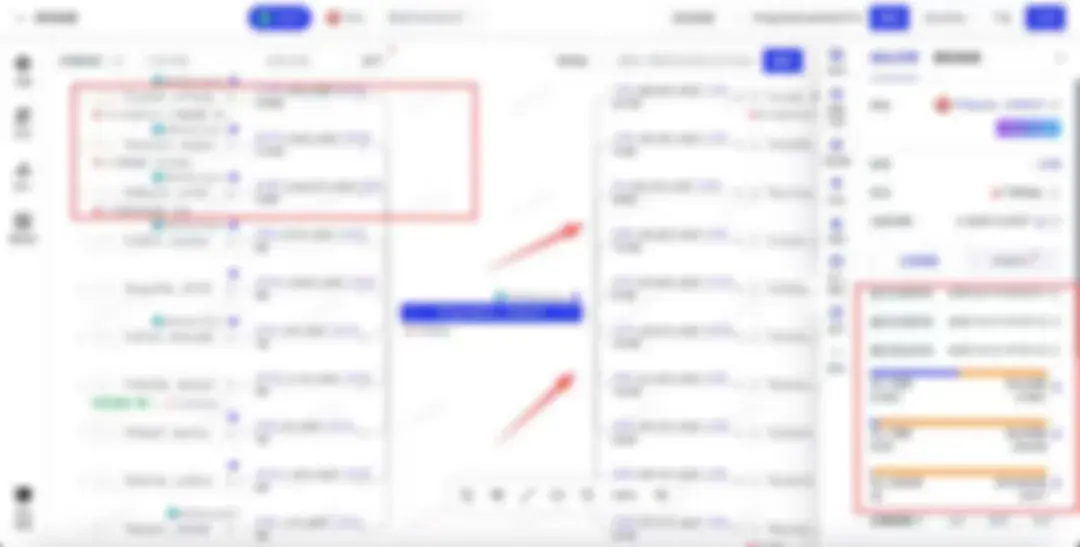
Score Running Money Laundering Business
The platform developed its own score running app. Score runners (participants) must pay a minimum deposit (about 5,000 RMB or equivalent USDT) to participate in laundering orders. After receiving illegal funds, they exchange via exchanges or coin traders into USDT, then transfer back to the platform, which takes a commission before sending funds overseas.
We tracked three core payment addresses with a total transaction volume of 933 million USDT:
Main Payment Address (TQxxxx4): From Feb 2025 to Feb 2026, transacted 715 million USDT, responsible for refunds and transfers abroad.

Main Receiving Address (TLxxxx5): From Jan 2025 to Feb 2026, transacted 674 million USDT, mainly receiving from exchanges and coin traders.
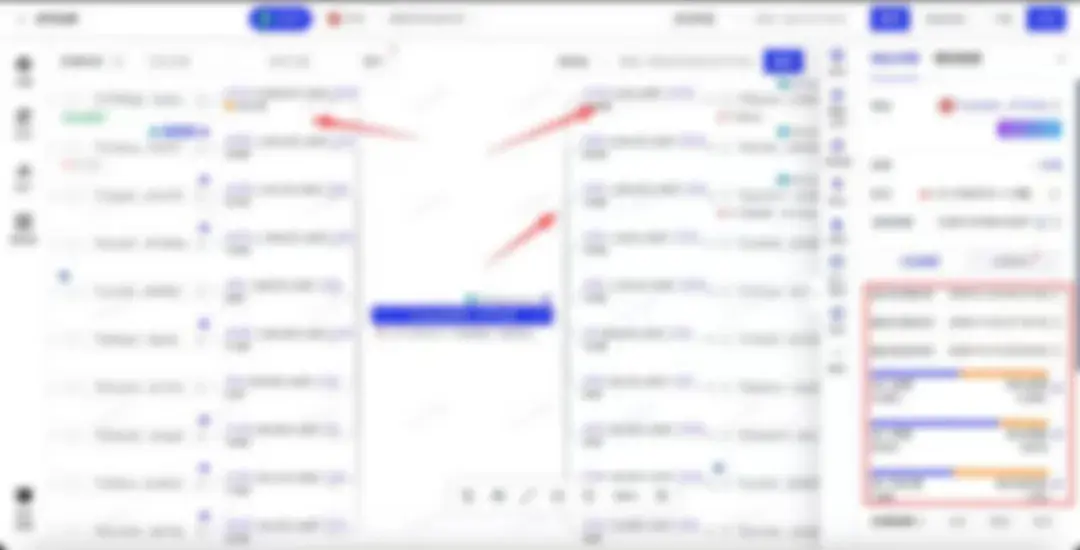
(2) Laicai Guarantee’s Technical Evasion Tactics: Avoiding Regulatory Tracking
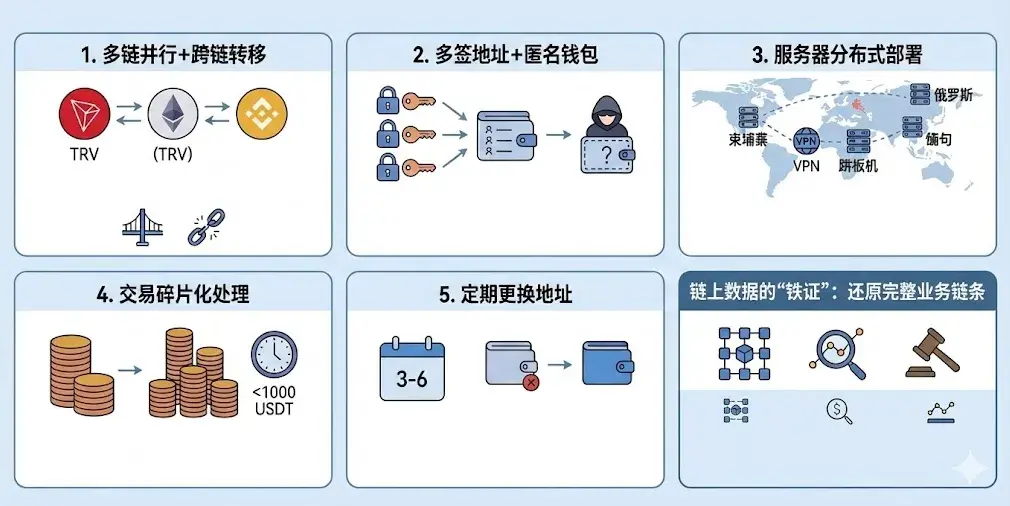
Our deep analysis reveals Laicai Guarantee employs several sophisticated concealment techniques:
- Multi-chain + cross-chain transfers: Using TRX (Tron) primarily, also Ethereum, BSC, with frequent chain switching to fragment transaction trails.
- Multi-signature addresses + anonymous wallets: Core addresses use multi-sig; funds are transferred into decentralized anonymous wallets, unlinkable to real identities.
- Distributed server deployment: Servers located in Cambodia, Myanmar, Russia, etc., using VPNs and jump servers to hide IPs; even if some are seized, others continue operation.
- Transaction fragmentation: Large sums split into small transactions under 1,000 USDT, with irregular timing to evade monitoring.
- Regular address rotation: Core addresses change every 3-6 months, making continuous tracking difficult.
Legal Red Lines: Risks for Guarantee Platforms and Participants
Beyond technical analysis, we must consider legal risks.
Many black-gray industry practitioners and “quick money” seekers hold a false sense of security—thinking “overseas platforms are unregulated” or “transferring funds isn’t criminal.” But the fact is: whether overseas or domestic, as long as Chinese citizens or interests are involved, Chinese law applies; any illegal activity involving Chinese citizens or harming China’s interests can be prosecuted. Participants, whether active or passive, will bear legal responsibility.
(1) Legal Responsibilities of Guarantee Platform Operators: Up to Life Imprisonment
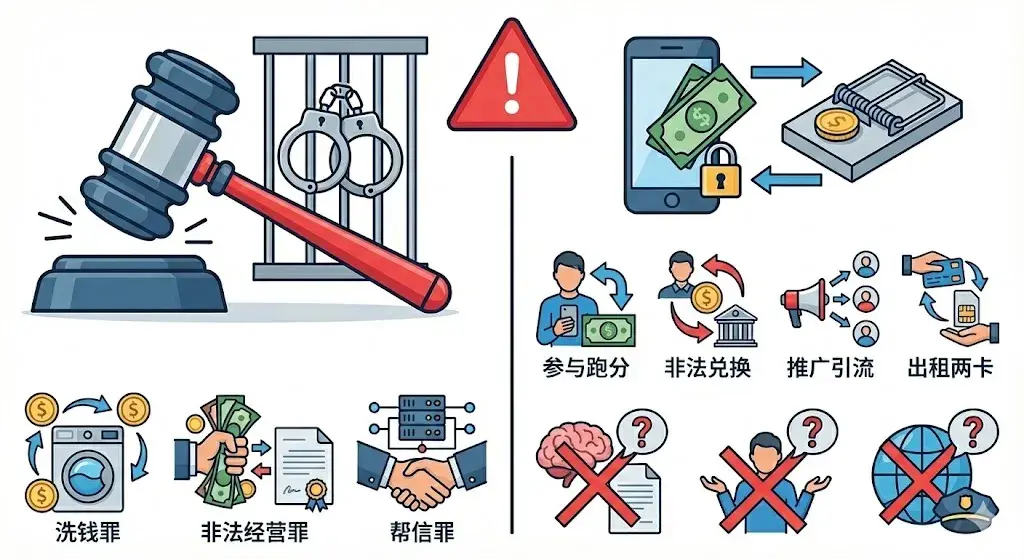
According to Chinese Criminal Law and related judicial interpretations, operators of overseas guarantee platforms may face charges such as:
❶ Money Laundering: Providing accounts, assisting in converting assets to cash or financial instruments, transferring funds via remittance or settlement, or sending funds abroad for crimes like drug trafficking, mafia, terrorism, smuggling, corruption, financial fraud—constituting money laundering. Serious cases can lead to 5-10 years imprisonment or life imprisonment.
❷ Illegal Business Operations: Operating securities, futures, insurance, or payment settlement services without approval—these are illegal. Since offshore guarantee platforms essentially conduct illegal payment settlement, serious cases can result in up to 5 years or detention, with fines exceeding the illegal gains.
❸ Helping Information Network Crime: Knowingly assisting others in committing crimes via the internet—providing access, hosting, storage, transmission, advertising, or payment—can lead to up to 3 years imprisonment or detention, plus fines.
Operators may also face charges like fraud, selling personal info, smuggling, etc., with multiple charges applied.
Note: Even if registered and operated overseas, if the business involves Chinese citizens or interests, Chinese authorities have jurisdiction. Recent extraditions of overseas black industry operators demonstrate that “the net is vast and wide.”
(2) Risks for Ordinary People: These Actions May Constitute Crimes!
Many think they’re just “making a little money” and won’t be criminally liable. But in fact, the following common behaviors can be criminal:
❶ Participating in score running and money laundering: Using score running apps, receiving illegal funds via bank cards, Alipay, WeChat, exchanging to USDT, and earning commissions. This may constitute aiding and abetting—criminally liable if the amount exceeds certain thresholds (e.g., over 200,000 yuan or illegal gains over 10,000 yuan).
❷ Acting as U商 (exchange agent): Intermediating USDT exchanges between users and the platform, earning profit from the difference. This could be illegal operation, aiding and abetting, or money laundering, especially if knowing the funds are from illegal activities.
❸ Promotion and referral: Recommending new users to guarantee platforms for commissions. This is aiding and abetting—liable under law even without direct involvement in transactions.
❹ Renting out bank or mobile accounts: Leasing accounts for receiving or registering on platforms—known as “two-card” crimes, a focus of police crackdowns.
Even if not criminal, involvement can lead to frozen bank or payment accounts, affecting daily life; cross-border flows may lead to blacklisting, affecting credit and loans.
(3) Common Misconceptions: These “Excuses” Do Not Exempt from Crime
Many arrested individuals justify themselves with reasons like “I didn’t know it was illegal,” “The platform is overseas, so it’s outside Chinese jurisdiction,” or “I’m just a small player, earning little.” But these are invalid excuses:
❶ “I didn’t know it was illegal”: Ignorance isn’t a defense. Judgments depend on the person’s knowledge, environment, and profits. Someone deeply involved in crypto and USDT arbitrage cannot claim ignorance.
❷ “The platform is overseas, I thought China couldn’t regulate”: As stated, as long as the activity harms China or involves Chinese citizens, Chinese law applies—overseas isn’t outside jurisdiction.
❸ “I’m just a minor participant, earning little”: Even accessory participants can be criminally liable; sentencing may be lighter, but immunity is not guaranteed.
Final Words: Understanding the Truth Behind Guarantee Platforms and Black-Gray Industry
Web3’s core is decentralization and transparency, but technology itself cannot distinguish legal from illegal. Industry practitioners who abide by regulations will be supported; those exploiting tech for illegal activities will be cracked down upon and abandoned.
All unlicensed overseas virtual currency guarantee platforms are essentially accomplices of black-gray industry. Your perception of “safe guarantees” is actually backing criminal acts. Participating in such activities risks crossing legal red lines. Behind the “quick money” routes of black-gray industry are unseen traps: platforms may run off with funds, funds may be frozen, and participants may become tools for crime—ultimately ending up with “no money, and jail time.”
In conclusion: While Web3 technology has enormous innovative potential, it must be exercised within a lawful and compliant framework. We hope this article helps everyone understand the true nature of certain guarantee platforms, stay away from black-gray industry, and protect your assets and freedom.


