A whale exchanged $50.43 million USDT for AAVE tokens all at once through Aave, but due to extreme slippage, they only received 324 AAVE (about $36,000), nearly losing everything. Yet all safety measures functioned normally behind the scenes.
(Background: Tragedy! Whale loses $50 million in Aave swap due to “extreme slippage”)
(Additional context: Detailed analysis of DeFi lending “liquidation mechanisms”: Risks of Compound, Maker, AAVE)
Table of Contents
Toggle
- Anatomy of a single transaction
- The brutal math of liquidity
- Where did the “overpaid” spread go?
- The three lines of defense
- Apology of $600,000
- The cost of DeFi maturity
- DeFi stands on the same historical curve
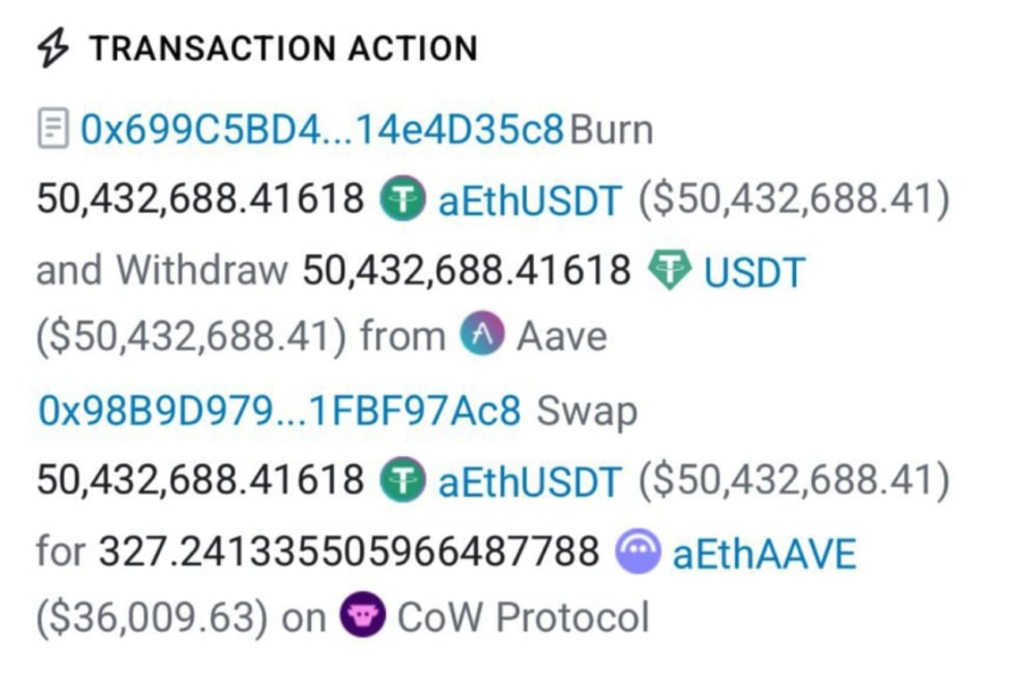
$50,432,688: This is the amount a anonymous wallet invested in a single transaction on March 12.
$36,297: This is what they actually received.
Loss ratio: 99.93%. In less than a minute, $50 million in crypto assets turned into the price of a used car.
This is not a hack, no smart contract bug, no flash loan attack, no private key theft.
All protocols involved in this transaction—Aave, CoW Protocol, Uniswap—later stated that the system “operated as designed.”
A transaction with a 99.93% loss, every component functioning normally. This is the most intriguing part of the story.
Anatomy of a single transaction
To understand why this happened, let’s break down each layer of the transaction.
This wallet (address 0x98B9D979…1FBF97Ac8) holds a large amount of aEthUSDT: an interest-bearing token automatically generated when depositing USDT into Aave’s lending protocol, representing their USDT deposit position. Holding aEthUSDT means lending USDT on Aave to earn interest.
The user’s goal was simple: swap their USDT deposit position for AAVE deposit tokens (aEthAAVE). In plain language, converting one collateral type into another.
Aave’s interface offers a “Collateral Swap” feature, allowing users to perform this operation with one click, without withdrawing funds, exchanging on an exchange, then depositing again. Sounds convenient.
The problem lies behind this “one-click” feature.
When the user clicks confirm, the transaction is routed through CoW Protocol (Aave’s integrated decentralized routing system as of late 2025). The CoW Solver takes over and executes the following steps:
Step 1: Redeem 50,432,688 aEthUSDT from Aave V3, retrieving 50,432,688 USDT.
Step 2: Swap this $50.43 million USDT in the Uniswap V3 USDT/WETH pool for 17,958 WETH.
Step 3: Swap WETH for AAVE tokens.
Step 4: Deposit the received AAVE into Aave V3, minting aEthAAVE and returning it to the user.
The entire process seems logically sound. But in the end, the user only received 327.24 aEthAAVE.
At the time, AAVE was approximately $111 per token, so 327 tokens are worth about $36,297.
$50 million down to $36,000.
The brutal math of liquidity
Many reading this news might first think: this must be a bug, a phishing attack, a smart contract vulnerability, or a flash loan exploit; but this time, it’s none of those.
AAVE tokens have a total circulating supply of about 15.3 million, with a market cap around $1.6 billion. Before the incident, daily trading volume on major DEXs was about $273 million.
Now, someone wanted to buy $50.43 million worth of AAVE in a single order.
In plain language, they aimed to purchase roughly 3% of the circulating supply in one go.
It’s like entering a stock market with a daily volume of $270 million and placing a $50 million market order. In traditional finance, such an order would be halted by risk controls. Exchanges have circuit breakers. Market makers are obliged to keep spreads reasonable.
But in DeFi, none of that exists.
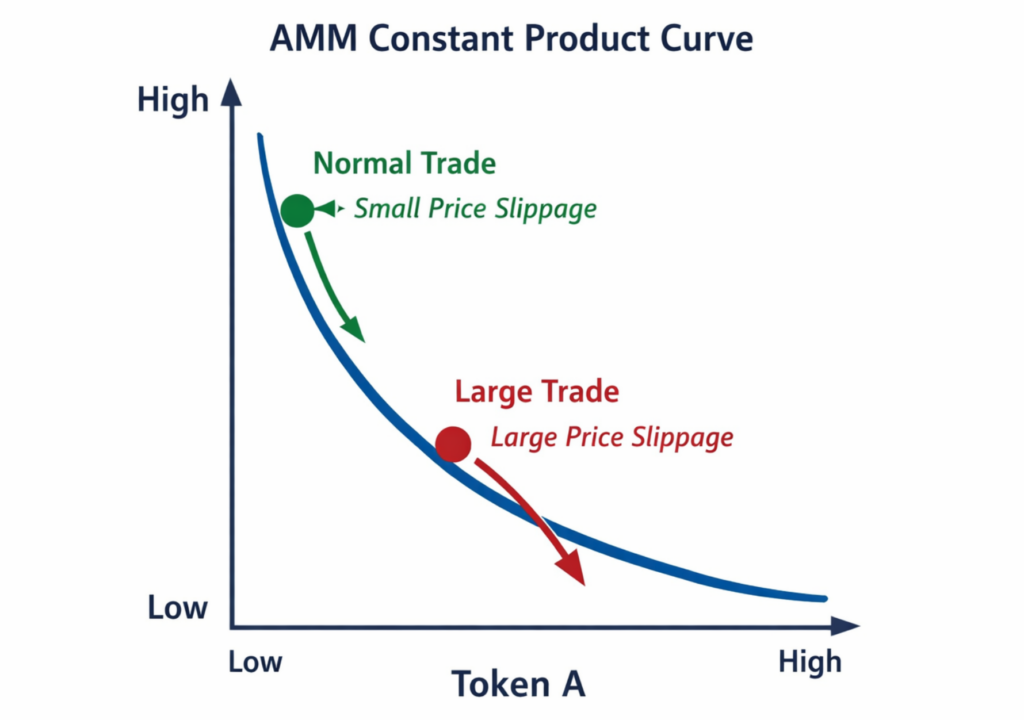
Decentralized exchanges rely on “Automated Market Makers” (AMMs). The pricing formula most common is the constant product x × y = k. This means the larger your purchase, the more dramatic the price slippage. It’s nonlinear, exponential rather than linear.
When this $50.43 million order hits the Uniswap liquidity pool, its impact far exceeds what the pool can handle. The marginal cost of each AAVE token skyrockets. By the time only a few tokens remain, the system’s calculated “per token price” could be hundreds of times the market price.
Result: $50.43 million only bought 324 AAVE.
Where did the “overpaid” spread go?
It went into the pockets of arbitrage bots.
In Ethereum’s ecosystem, there are specialized MEV (Maximal Extractable Value) bots that monitor every large transaction 24/7. When they detect someone placing a huge order in a low-liquidity pool, they execute arbitrage within milliseconds: front-run the order, push the price up, then sell after the trade completes, pocketting the difference.
This process is known as a “sandwich attack.” In this transaction, MEV bots enjoyed a feast worth nearly $50 million.
Ironically, CoW Protocol was designed precisely to protect users from MEV attacks.
The three lines of defense
What’s most unsettling about this story isn’t the amount lost, but that all safety mechanisms “worked as intended.”
First line: CoW Protocol’s MEV protection.
CoW Protocol is one of the most advanced routing systems in DeFi. Instead of directly submitting your trade to a liquidity pool, it batches multiple user orders, and professional “solvers” compete to find the optimal execution path.
In theory, this system can do three things:
-
Hide your trading intent through batch auctions, preventing MEV bots from front-running.
-
Use a unified clearing price, making the prices within the batch consistent and eliminating ordering arbitrage.
-
Match demand directly between users, bypassing on-chain liquidity pools altogether.
But for a $50 million one-way order, all three mechanisms fail. Because it’s impossible for another user to want to swap the same amount of AAVE at the same time. Batch auctions can’t change a fundamental fact: the pool simply doesn’t have enough liquidity.
CoW Swap’s statement afterward was brief: “Trades are executed according to the signed order parameters. … The system provides clear price impact warnings.”
Statement from CoW Protocol:
Earlier today, a trader attempted to swap 50M aEthUSDT for aEthAAVE via Aave’s swap interface, powered by CoW Protocol. Despite clear warnings indicating they would lose nearly all of their transaction value, and despite… https://t.co/Pav4udXUkX
— CoW DAO (@CoWSwap) March 13, 2026
Second line: Slippage warnings on Aave’s interface.
Aave founder Stani Kulechov explained a key detail afterward: when the user initiated the transaction on Aave’s interface, the system popped up an “abnormal slippage” warning. The user had to manually check a box to confirm acceptance of the risk before proceeding.
According to Kulechov, the user completed this confirmation on a mobile device.
One checkbox, $50 million decision, on a phone.
Later, an Aave engineer revealed more details: before confirmation, the system already showed that $50.43 million USDT could only be exchanged for less than 140 AAVE (before fees). In other words, the system explicitly told the user: you will lose over 99%.
Yet, the whale still saw this number and clicked “confirm.”
Third line: The user’s own judgment.
In traditional finance, if a client wanted to execute a $50 million trade on their phone with a 99% expected loss, their broker would call to confirm. Risk management would intervene. Compliance would require written authorization. The whole process might take days.
In DeFi, all that is compressed into a checkbox and a single screen tap.
No one knows who this user is. No one knows why they confirmed after seeing a 99% loss. Did they misread the number? Swipe accidentally? Tap the wrong button on a small screen? Or is there some other unknown reason? I even suspect they might be intoxicated or under the influence.
But one thing is certain: in the decentralized world, “confirmation” is irreversible. No T+1 settlement. No cancel button, no customer support line.
Once you click confirm, the transaction is permanently recorded on the blockchain.
The apology of $600,000
Within 24 hours of the incident, Aave founder Kulechov responded.
He announced that the Aave protocol would refund the approximately $600,000 in fees collected from this transaction.
Earlier today, a user attempted to buy AAVE using $50M USDT through the Aave interface.
Given the unusually large size of the single order, the Aave interface, like most trading interfaces, warned the user about extraordinary slippage and required confirmation via a checkbox.…
— Stani.eth (@StaniKulechov) March 12, 2026
Six hundred thousand dollars. Refund to someone who lost $50 million. It’s like paying for a $1 million dinner and getting a bottle of water in return.
But this is already the most Aave can do under current mechanisms.
Because Aave is a decentralized protocol, its funds are managed by a DAO. Kulechov and Aave Labs are the development teams, but legally and governance-wise, they do not own the funds. To use DAO treasury funds for compensation requires community proposals, voting, and approval.
This raises a deeper question: who is responsible in a decentralized world?
In centralized exchanges, the answer is clear. They have an obligation to protect users. If their system design causes unreasonable losses, they compensate. Regulators intervene. Lawyers send notices.
But in Aave’s case, responsibility is dispersed across at least four layers:
-
Aave Labs designed the interface, integrated CoW Swap, and provided the collateral swap feature. But they say the system gave sufficient warnings.
-
CoW Protocol executed the routing. But they say the trade was executed according to the signed parameters.
-
Uniswap’s liquidity pools provided the quotes. But AMM operation is inherently transparent and open.
-
The user clicked “confirm.” And was explicitly warned about over 99% slippage.
Each party has a point, each did “nothing wrong,” but $50 million evaporated.
The cost of DeFi maturity
This incident prompts us to revisit a fundamental question about DeFi: what is the cost of “permissionless” finance?
DeFi’s core value proposition is removing intermediaries—no banks, no brokers, no compliance officers. It’s just you, your assets, and code.
Over the past decade, this idea has attracted millions of users. As of March 2026, total value locked in DeFi approaches $97.6 billion. Just Aave alone manages over $25.7 billion, with total loans surpassing $1 trillion.
But the flip side of “removing intermediaries” is the removal of all protections they provided.
In traditional finance, large orders are protected by a set of safeguards:
-
NYSE’s circuit breakers halt trading if prices move too sharply.
-
Brokers have “suitability obligations” to confirm trades match your risk profile.
-
Banks perform KYC to identify clients and contact them if needed.
These systems may seem bureaucratic and un-Web3, but they exist because two centuries of financial history show: humans make mistakes, slip up, misread screens, and emotional reactions influence decisions.
DeFi chose a different path. It returns all judgment to the user. You decide what to buy, how much, and acceptable slippage. The system only gives a warning: a checkbox, then faithfully executes your command.
In most cases, this is efficient. But in extreme situations, it creates a paradox: the more the system “operates as designed,” the harder it becomes to recover user losses.
Because no one “did something wrong.” All losses are “voluntary” on the user’s part.
This echoes an old principle in traditional finance: “Caveat emptor”—let the buyer beware. Before modern regulation, markets operated on the assumption that buyers bore all risks. It was an era without SEC, investor protection laws, or class actions.
After the 1929 stock market crash and the 2008 financial crisis, regulations tightened, protections improved.
DeFi stands on the same historical curve
Aave manages $25.7 billion in assets, earning over $600 million in fees annually. CoW Protocol handles billions of dollars in trades. These are no longer experimental toys—they are real financial infrastructure, carrying real wealth.
But their user protection mechanisms still stop at “pop-up warning boxes.”
$50 million turned into $36,000—every step compliant, transparent, and “normal.”
In traditional finance, an unwritten rule exists: protecting clients from their own mistakes is a fundamental obligation. But in DeFi, the unwritten rule is the opposite: not making decisions for users is the core principle of decentralization.
These two worldviews will inevitably collide.
And this time, the collision cost is $50 million. But I’m not suggesting DeFi should follow traditional banking models; rather, it’s worth reflecting on human weaknesses and the control mechanisms needed.


