The artificial intelligence (AI) arms race just got another shot of rocket fuel after Nvidia dropped a cool $2 billion on AI cloud builder Nebius, signaling that the next frontier of computing won’t be fought with clever code alone—it’ll be fought with gigawatts of electricity and warehouses full of silicon.
Nvidia’s AI Bet: $2B Investment Targets Gigawatt-Scale Data Centers
Nvidia and Nebius Group announced this week that the chip giant will invest roughly $2 billion through pre-funded warrants, securing a minority stake while helping bankroll a sprawling buildout of hyperscale AI infrastructure expected to exceed 5 gigawatts of Nvidia-accelerated computing capacity by 2030.
Five gigawatts, for context, is not a cute startup number. That’s the kind of power consumption normally associated with cities, not server racks. In practical terms, the partnership aims to create massive AI “factories” capable of training large models, running inference workloads, and handling the swelling wave of agentic AI systems now flooding the tech sector.
Nebius, headquartered in Amsterdam and trading on Nasdaq under ticker NBIS, is one of the newer entrants in what analysts have begun calling the “neocloud” category—companies purpose-built for AI workloads rather than retrofitted from traditional enterprise cloud platforms.
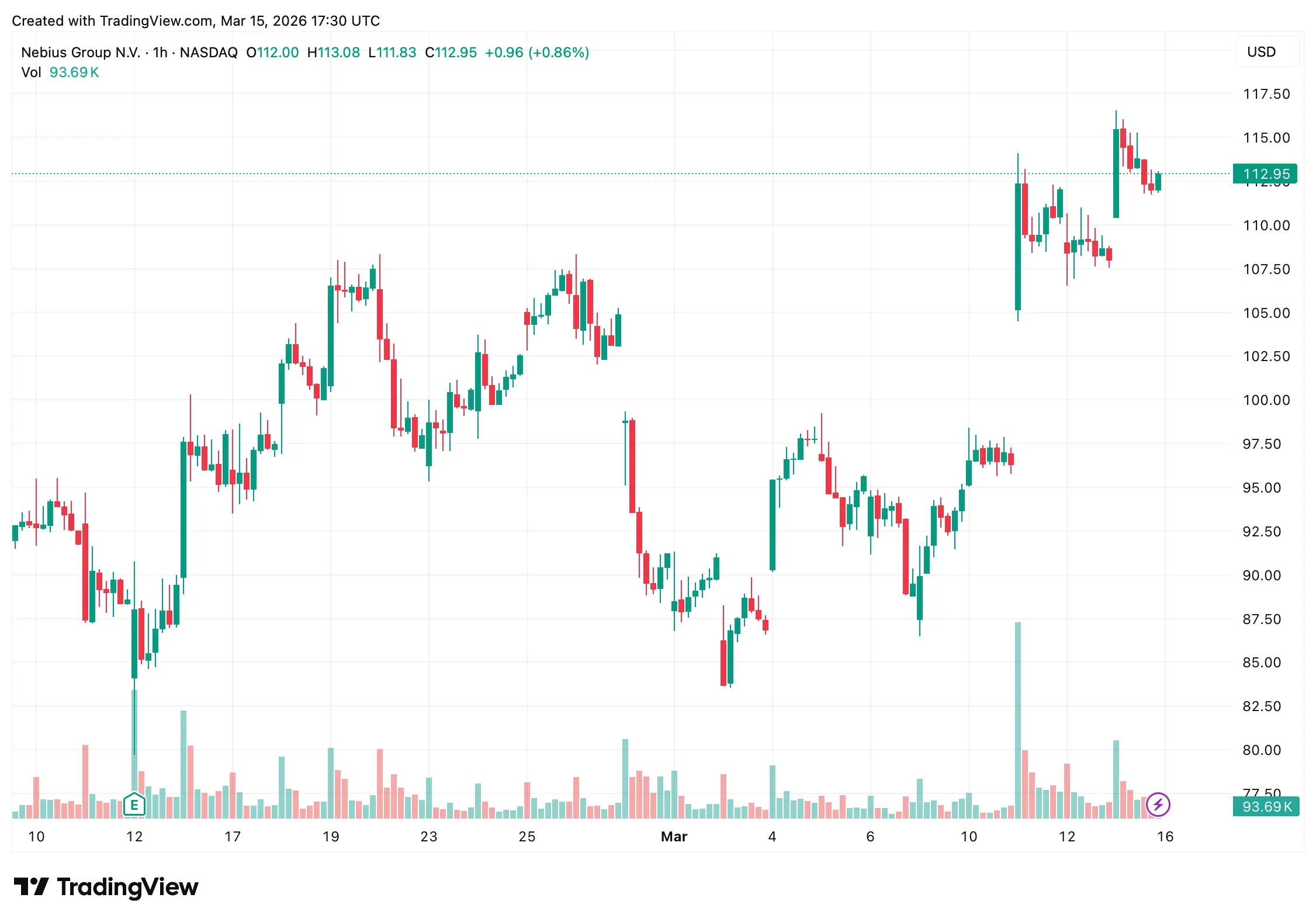 Nebius Group shares.
If the name sounds unfamiliar, its roots are not. Nebius emerged in 2024 after the Dutch parent of Russian search giant Yandex divested its Russian businesses for about $5.4 billion. The remaining international operations were reorganized into Nebius, which now runs AI infrastructure operations across the United States, Europe, and Israel.
Nebius Group shares.
If the name sounds unfamiliar, its roots are not. Nebius emerged in 2024 after the Dutch parent of Russian search giant Yandex divested its Russian businesses for about $5.4 billion. The remaining international operations were reorganized into Nebius, which now runs AI infrastructure operations across the United States, Europe, and Israel.
Since then, the company has moved with the quiet urgency of someone who knows the buffet table is about to run out of food. Nebius already operates large GPU clusters powered by Nvidia hardware—including H100 and H200 accelerators—and plans to adopt future systems such as Nvidia’s Rubin architecture, Vera CPUs and BlueField storage platforms as part of the new partnership.
In exchange, Nvidia locks in a major long-term ecosystem partner that will consume enormous quantities of its chips. Think of it as the hardware equivalent of securing a guaranteed table at the busiest restaurant in town. The companies say the collaboration spans the entire AI technology stack—from designing data centers to deploying inference infrastructure and managing fleets of GPUs.
Jensen Huang, Nvidia’s founder and CEO, framed the partnership as part of the next phase of the AI boom. “AI is at another inflection point—agentic AI, driving incredible compute demand and accelerating infrastructure buildout,” Huang said in the joint announcement. “Nebius is building an AI cloud designed for the agentic era.”
Nebius CEO Arkady Volozh, a Yandex co-founder who helped shepherd the company through its post-divestiture rebirth, pitched Nebius as a rare cloud provider built specifically for AI rather than repurposed from legacy computing services.
“Nebius has been built for AI since day one,” Volozh said. “Now with Nvidia, we are extending that throughout the stack—from gigawatt-scale AI factories to inference and software.”
And the scale they’re talking about is not hypothetical.
Just days before the investment announcement, Nebius secured approval for a 1.2-gigawatt AI data center campus in Independence, Missouri, one of the largest planned AI infrastructure sites in the United States. The project is expected to generate roughly 1,200 construction jobs and deliver an estimated $650 million in economic impact over two decades.
The Missouri project is only one piece of a larger expansion strategy that could see Nebius operating up to 16 global data-center sites by the end of 2026, with contracted power capacity approaching 3 gigawatts within the next year.
Money, unsurprisingly, is being spent at a pace that would make even Silicon Valley venture capitalists blink.
Nebius reported capital expenditures of about $2.1 billion in the fourth quarter of 2025 alone, and its projected spending for 2026 ranges between $16 billion and $20 billion as it races to build infrastructure before demand outruns supply.
Revenue, for now, remains relatively modest—roughly $530 million over the trailing twelve months—but the company says long-term contracts and backlog point to rapid scaling.
Among its major deals are a multi-year agreement with Microsoft tied to a data center project in Vineland, New Jersey, estimated between $17 billion and $19.4 billion, as well as a separate $3 billion arrangement with Meta Platforms.
Investors, clearly, liked what they saw.
Nebius shares jumped between 13% and 16% following news of the Nvidia investment, pushing the company’s market capitalization past the $24 billion mark during early trading. Analysts often describe such partnerships as a “Nvidia halo effect”—a polite way of saying that when the chipmaker shows up with a checkbook, Wall Street tends to assume something interesting is happening.
The broader message is unmistakable: artificial intelligence may be built on algorithms, but its real bottleneck is infrastructure—power, cooling, and enough advanced chips to keep the digital brains humming. And with Nvidia writing billion-dollar checks to expand the ecosystem, the race to build the world’s AI backbone is only getting louder.
FAQ 🤖
- Why did Nvidia invest $2 billion in Nebius?
Nvidia is backing Nebius to expand massive AI cloud infrastructure that will consume large volumes of its chips.
- What is Nebius and why does it matter in AI?
Nebius is a next-generation AI cloud provider built specifically for training and running large artificial intelligence systems.
- What does 5 gigawatts of AI infrastructure mean?
It represents enormous data center capacity—roughly the electricity usage of millions of homes dedicated to running AI workloads.
- Why are companies building gigawatt-scale AI data centers?
The explosion of AI models, inference services and autonomous agents requires unprecedented computing power and energy.
Disclaimer: The information on this page may come from third parties and does not represent the views or opinions of Gate. The content displayed on this page is for reference only and does not constitute any financial, investment, or legal advice. Gate does not guarantee the accuracy or completeness of the information and shall not be liable for any losses arising from the use of this information. Virtual asset investments carry high risks and are subject to significant price volatility. You may lose all of your invested principal. Please fully understand the relevant risks and make prudent decisions based on your own financial situation and risk tolerance. For details, please refer to
Disclaimer.


