Author: Wenser, Odaily Planet Daily
Editor: Hao Fangzhou
Recently, Evan Sui, CEO of Mysten Labs, shared his views on the “bear market.” He mentioned that he does not agree with the idea that “a bear market is good and continue building.” In fact, a bear market is not “great.” Framing it as beneficial for everyone ignores the real costs (such as discouraging builders and users). Many retail investors and excellent teams face cash flow issues and are forced to exit, ultimately harming the long-term development of the crypto industry.
However, data does not support this view. A report published by Lattice VC in October 2024 shows that over 80% of crypto startups that announced seed funding during the 2022 bear market are still in development. In other words, if project teams can keep their personnel and funding relatively stable, a bear market can actually be more conducive to project development and growth. The reasons may include increased focus on product development and user experience during downturns, or that bear markets help teams develop resilience and survival skills. Overall, in the crypto bear market, ambitious projects might find opportunities to survive and forge their own paths.
In light of this, we will explore this potential cycle and its related employment opportunities and project directions through a series of articles titled “Crypto Bear Market Startup Guide.” If future crypto projects emerge and grow rapidly from this environment, Odaily Planet Daily is open to collaboration with project teams.
Today, let’s first discuss one of the hottest potential startup directions beyond market predictions—the pre-market price difference of tokens and stocks.
The Real Demand for the Token-Stock Pre-Market: Platform Differentiation and Liquidity Bridges
As a bridge connecting the crypto market with traditional finance, token-stock trading platforms have attracted significant attention and participation from crypto project teams. Major global securities platforms like Nasdaq and NYSE are also entering this space, aiming to capture new markets and further activate liquidity in traditional finance.
In addition, not only are listed cryptocurrencies and concept stocks undergoing tokenization and on-chain contract transformations, but many hot concept stocks that have not yet gone public are also being embraced by both crypto and traditional markets. This has led to the emergence of several pre-market stock tokenization trading platforms.
With the upcoming US stock listings of AI companies like OpenAI, Anthropic, SpaceX (xAI), prediction market platforms like Kalshi, Polymarket, and crypto exchanges such as OKX and Kraken, the year 2026 is poised to be a “big IPO year.”
Against the backdrop of a declining crypto market with occasional rebounds and a rising stock market, the popularity of pre-market trading in stocks further supports the above view—there is strong demand for pre-market trading of hot concept stocks in both crypto and traditional finance.
This is the main reason why platforms like PreStocks, Jarsy, Tessera have emerged. Compared to traditional pre-market trading platforms like Hiive and Nasdaq Private Market, crypto pre-market trading is more flexible in trading methods, purchase limits, and entry thresholds, often with higher premiums, attracting enthusiastic participation.
However, just as the same token can have different prices across exchanges, before mechanisms like oracles are introduced into the pre-market stock trading space, we can clearly see that different platforms price the same stock differently, creating a price gap.
Based on this information, we can boldly conclude that the crypto market still lacks one or more “bridge platforms” between different pre-market trading markets.
This may be a necessary step toward advancing the tokenization of stocks and pre-market trading—creating a unified, comprehensive platform that covers both traditional finance pre-market trading and crypto pre-market trading.
Next, we will examine the feasibility and real demand for this “startup direction” using recent examples such as Kalshi and Polymarket, two leading prediction market platforms seeking $20 billion in funding, and SpaceX (xAI), valued at up to $1.25 trillion.
Comparing PreStocks, Jarsy, Tessera: Max Price Difference Over 50%, Price Variations Up to Nearly $150
Kalshi Pre-Market Price Difference: Up to $148, About 37% Difference
For Kalshi’s pre-market trading, prices on different platforms are as follows—
PreStocks platform: about $397 (compared to $369 a month ago in our article “Kalshi Trading Volume Hits New High, What’s a Reasonable Pre-Market Price?” (https://www.odaily.news/zh-CN/post/5209330)), an increase of nearly $30, or 7.6%).
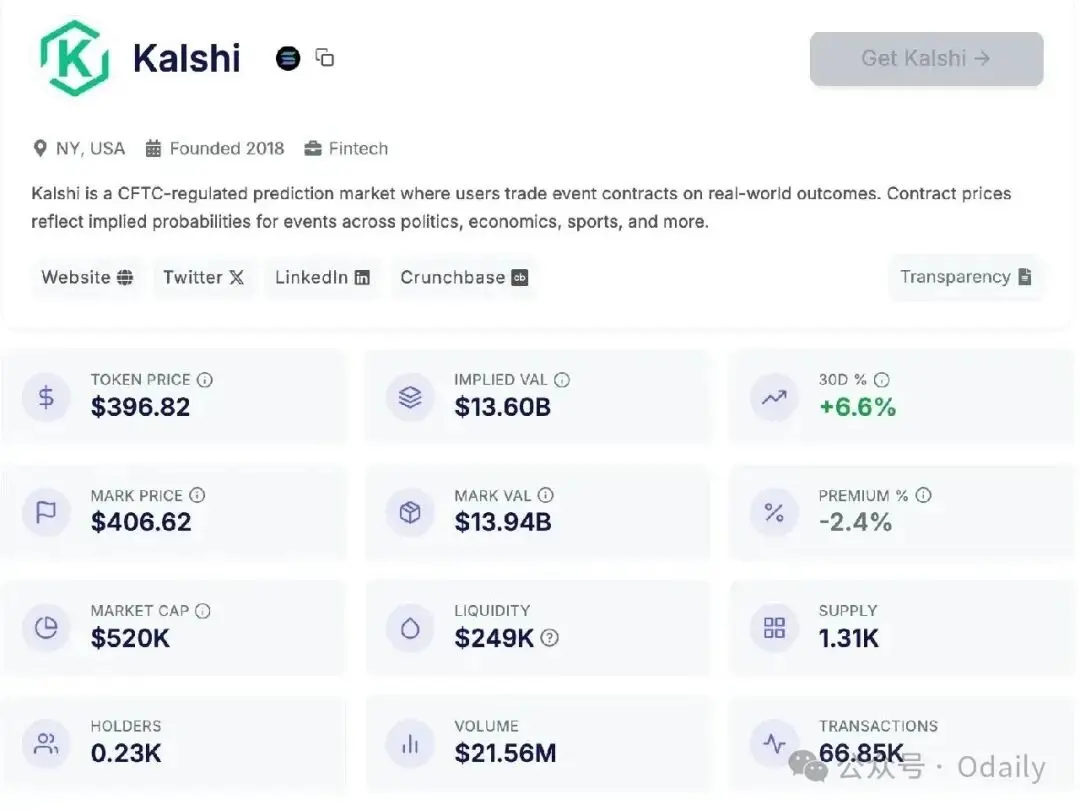
Jarsy platform: about $545 (compared to $504 a month ago in the same article, an increase of over $40, or 8.1%).

In other words, Kalshi’s pre-market stock price differs by as much as $148 between the two major platforms (Odaily Planet Daily note: considering that one platform uses order book trading and the other on-chain liquidity tokens, this comparison is abstract; specific asset transfer methods are not discussed here). If we use Hiive’s traditional pre-market price of $360 as a reference, the price gap could reach $185.
Polymarket Pre-Market Price Difference: Up to $94, Over 50% Difference
For Polymarket, prices on different platforms are—
PreStocks: about $186 (up 23% over the past 30 days).
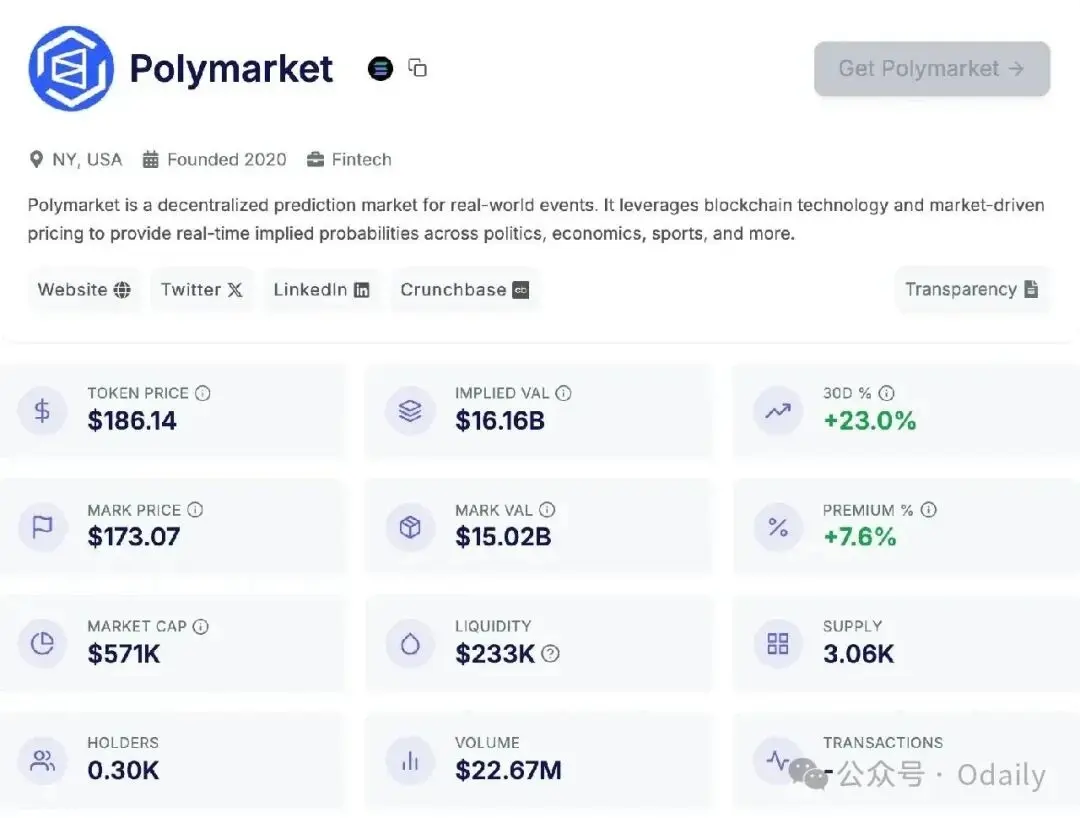
Jarsy: about $280.

The price difference for Polymarket stocks between the two platforms is approximately $94, with a rate of about 50.5%.
SpaceX (xAI) Pre-Market Price Difference: About $75, 12.7% Difference
For SpaceX (xAI), prices are—
PreStocks: about $666 (up 4.1% in 30 days).
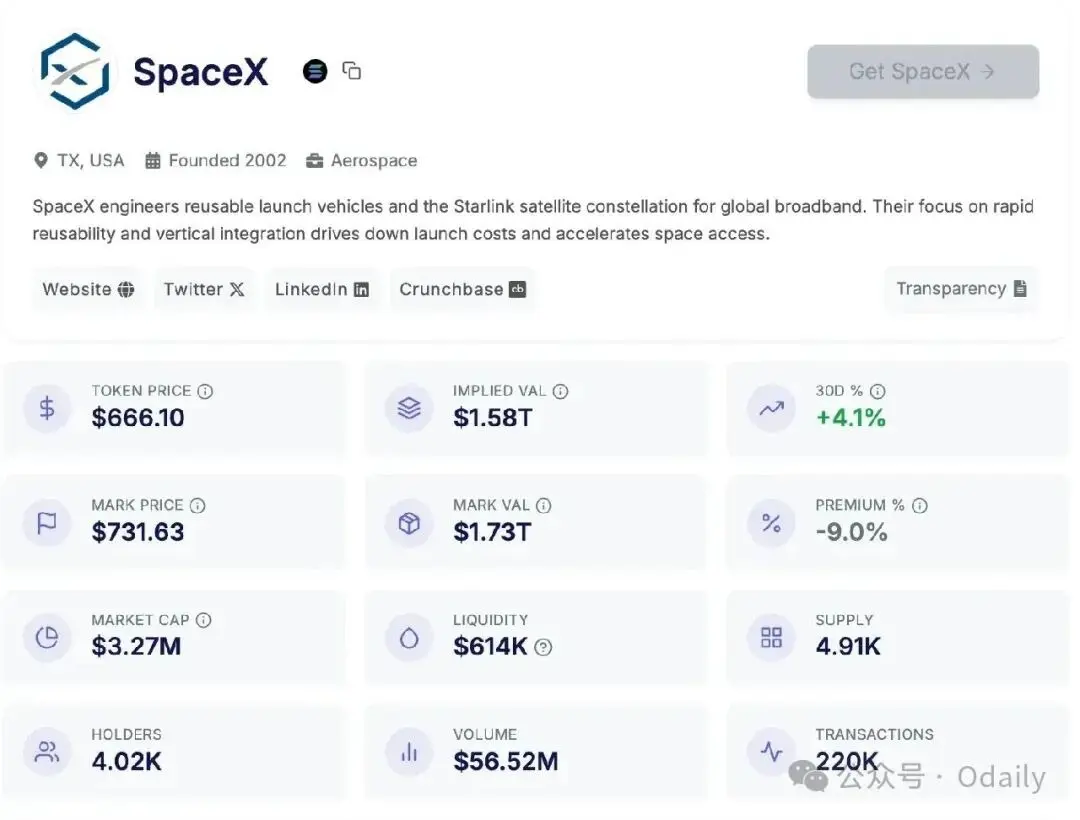
Tessera: about $591 (up 14.5% in 30 days).
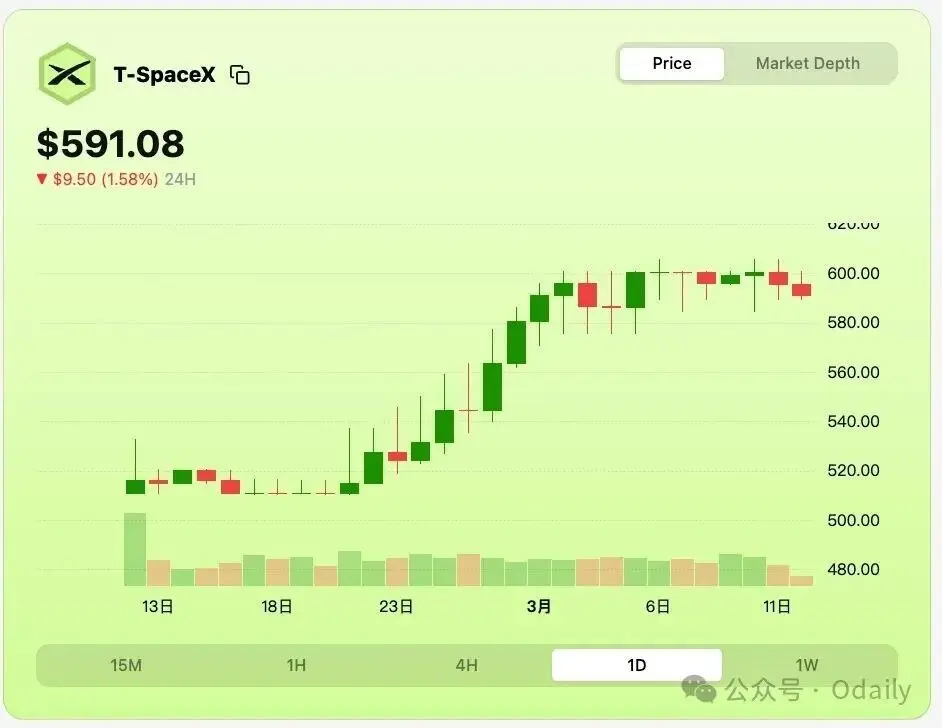
The price difference between the two platforms is roughly $75, with a rate of about 12.7%.
In summary, based on current pre-market platforms, it’s possible to build a token-stock pre-market price difference market. With enough pre-market tokens or pre-market equity capital, it could meet trading and speculative demands.
Of course, since market liquidity remains within the million-dollar range, the main business model for such a platform would likely involve transaction fees, LP fees, and profit from platform-held investment margins.


