
FTX Revival Trust Fund announced on Wednesday that it will distribute $2.2 billion to creditors and former customers on March 31, marking the fourth payout since February 2025. Eligible creditors will receive funds within 1 to 3 business days through their chosen distribution provider. After the fourth round, the total payouts to FTX creditors and former customers are expected to reach approximately $10 billion.
Details of the Fourth Payout Distribution Structure
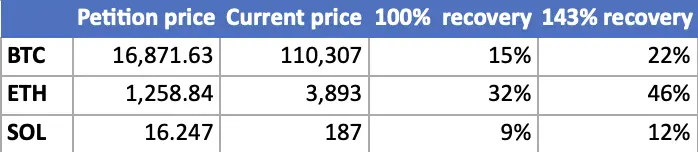 (Source: Sunil X)
According to the trust fund’s announcement, the $2.2 billion distribution will be allocated to different claim categories as follows:
Dotcom Customer Claims: 18%
U.S. Customer Claims: 5%
Unsecured General Claims: 15%
Digital Asset Loan Claims: 15%
Convenience Claims: receive 120% compensation according to the payout plan
The trust fund stated that funds will be credited to accounts within 1 to 3 business days via various distribution providers. Looking back at the previous three rounds: the first in February 2025 paid $1.2 billion, the second in May paid $5 billion, and the third in September paid $1.6 billion.
Core Contradiction Behind the Billion-Dollar Payouts: The Deadly Logic of 2022 Crypto Prices
Although FTX has recovered billions of dollars and continues to pay creditors, there is a fundamental dispute in the compensation mechanism — all payouts are calculated based on the crypto asset market value at the time legal action was initiated in 2022, not the current market value.
This calculation method results in a significant gap in actual losses:
Bitcoin: approximately $16,871 per coin at the time of the 2022 lawsuit; currently about $71,078, an increase of over 320%
Ethereum: about $1,258 per coin in 2022; currently about $2,195, up over 74%
FTX creditor and claim advocate Sunil Kavuri bluntly stated, “FTX creditors have not been fully compensated.” His comment points to this systemic flaw — creditors suffered full losses when FTX collapsed but cannot be compensated based on the later appreciation of assets.
SBF’s Appeal and Rumors of Trump’s Pardon
While payouts are ongoing, the legal situation of FTX founder Sam Bankman-Fried continues to attract attention. In 2023, he was convicted of misappropriating customer funds and sentenced to 25 years in federal prison, currently held at Terminal Island Federal Detention Center in Los Angeles.
Recently, he posted on X (formerly Twitter) via an agent, praising President Trump’s actions in Iran conflicts and his stance on digital asset regulation. Industry speculation suggests this was an attempt to pave the way for a presidential pardon. However, reports indicate Trump explicitly stated in January that he would not consider pardoning Bankman-Fried. A court document filed by his mother on Monday states he will be transferred to a new detention facility “within the next few weeks.”
Frequently Asked Questions
Why are FTX’s compensation methods causing dissatisfaction among creditors?
The core issue lies in the “frozen valuation” calculation mechanism. FTX’s payouts are based on the crypto prices at the time of the 2022 lawsuit, which was a low point for the crypto market — Bitcoin was around $16,871, and Ethereum about $1,258. While creditors can recover the nominal “loss amount,” they miss out on the substantial potential gains from asset appreciation afterward. From a real purchasing power perspective, the crypto assets they could buy in 2022 with the same funds are far more than what the current payout amounts can buy.
What potential impact could FTX’s payouts have on the crypto market?
Each large-scale payout distribution may cause short-term market effects. If creditors choose to reinvest the USD (or equivalent) received into cryptocurrencies, it could create short-term buying pressure; if they cash out and exit, it could cause selling pressure. The $2.2 billion in the fourth round is relatively small compared to the overall daily trading volume of the crypto market but still noteworthy. The market will closely watch the flow of funds.
When will the fifth round of FTX payouts occur, and will there be more in the future?
The trust fund has announced that the fifth payout is scheduled for May 29, 2026. FTX still holds some recoverable assets and ongoing legal claims, so whether there will be additional payouts depends on the progress of asset recovery. To date, the four rounds have totaled about $10 billion, but the estimated customer losses at the time of FTX’s collapse exceed this amount, indicating that the overall compensation process may continue for several more years.
Disclaimer: The information on this page may come from third parties and does not represent the views or opinions of Gate. The content displayed on this page is for reference only and does not constitute any financial, investment, or legal advice. Gate does not guarantee the accuracy or completeness of the information and shall not be liable for any losses arising from the use of this information. Virtual asset investments carry high risks and are subject to significant price volatility. You may lose all of your invested principal. Please fully understand the relevant risks and make prudent decisions based on your own financial situation and risk tolerance. For details, please refer to
Disclaimer.


