
SBI VC Trade Launches USDC Lending Service with Up to 10% Annualized Return, Promoting Digital Dollar Yield Applications Under Japan’s Stablecoin Legal Framework
Japanese financial group SBI Holdings’ cryptocurrency trading platform SBI VC Trade announced that starting March 19, 2026, it will officially launch the “USDC Lending” service, allowing users to lend USDC stablecoins to the platform and earn returns over the agreed period.
The company states that this is the first licensed domestic provider in Japan to offer a stablecoin-based lending service. The initial offering features a 12-week cycle with an annualized rate of 10%, and once normalized, it is expected to maintain an approximate annualized return of 5%. This not only introduces a new dollar asset income option to the Japanese retail market but also extends the role of stablecoins in Japan from “tradeable digital dollars” to “utilizable digital financial tools.”
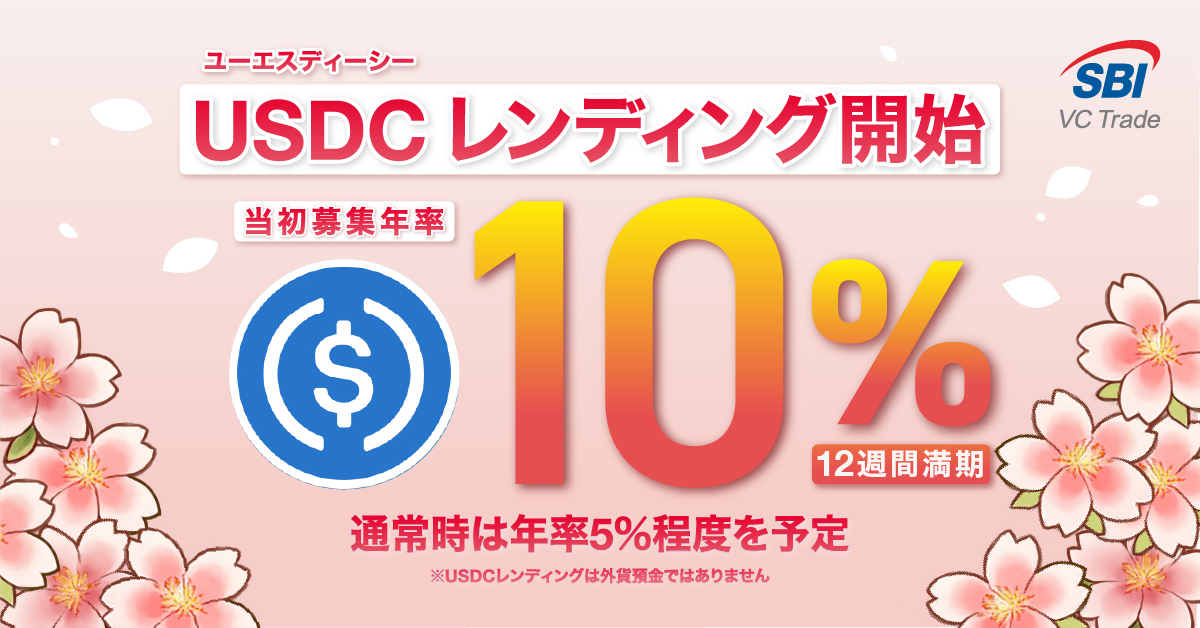
Image source: SBI VC Trade
According to SBI VC Trade’s announcement, this new service essentially functions as a consumer lending transaction, where users lend their USDC to the platform, which then returns the principal and interest in USDC upon maturity. The initial cycle lasts 12 weeks with a 10% annualized interest rate, while the regular offering plans to provide about 5% annualized returns. Each account can apply for up to 5,000 USDC per round, and early termination is generally not permitted.
The official emphasizes that this product is not a foreign currency deposit, nor is it covered by deposit insurance or typical bank-like protections. Users must bear the platform’s credit risk and price fluctuations during the holding period.
SBI clearly positions this product as: on one hand, packaging USDC into a more understandable “dollar yield tool”; on the other, attempting to extend stablecoins from mere trading media to more traditional financial applications.
The announcement also compares USDC Lending to common Japanese dollar time deposits, noting that typical dollar deposit rates range roughly from 0.01% to 4% annually, while USDC Lending, under market conditions, can potentially offer higher yields.
The Key to Japan’s Stablecoin Development: Legislation First, Then Market Opening
Looking at SBI’s new service within the broader industry context, it’s clear that the global role of stablecoins has rapidly evolved. Visa’s latest stablecoin page states that the total circulating supply of stablecoins worldwide has exceeded $272 billion, with a 12-month adjusted global transaction volume reaching $10.2 trillion. This indicates that stablecoins are no longer just a hedging tool in the crypto market but are increasingly becoming essential infrastructure for cross-border payments, on-chain settlements, and digital dollar circulation.
Earlier this year, Circle also reported that USDC’s on-chain transaction volume in Q3 2025 reached $9.6 trillion, a 680% increase year-over-year, reflecting that stablecoin applications are expanding from exchange trading to institutional finance, payment clearing, and capital markets. This is why major institutions like Visa, Circle, and other large financial entities have recently regarded stablecoins as a crucial part of the “native internet financial system.” SBI’s USDC yield service is not an isolated event but a localized microcosm of the global stablecoin shift from “crypto product” to “financial product.”
Japan’s unique development path for stablecoins has attracted market attention: instead of rapid growth followed by regulation, Japan first establishes a legal framework and then gradually opens the market. The Financial Services Agency (FSA) explains that the core principle for “digital-money type stablecoins” is that they must be linked to fiat currency value, promise redemption at face value, and be issued by banks, money transfer operators, or trust companies, with clear redemption rights and compliance with AML/CFT standards. In contrast, algorithmic stablecoins like Terra or stablecoins without fiat redemption features are classified as general crypto assets in Japan, not protected under the stablecoin-specific regulations.
Japan’s Landmark Progress: USDC Breaks the Ice
After amending the Funds Settlement Act in 2022, related regulations and implementing orders were completed in 2023, officially bringing stablecoins and their circulation intermediaries under regulation, and establishing new “Electronic Payment Instruments” and trading service provider systems. The FSA also incorporated stablecoin transfers into AML/CFT frameworks such as the Travel Rule, KYC, and suspicious transaction reporting, signaling a clear stance: stablecoins can be legally recognized, provided they are embedded within a regulated financial system.
Within this regulatory framework, a concrete milestone is SBI VC Trade obtaining the relevant license and becoming the first in Japan to introduce USDC. In March 2025, SBI VC Trade registered as an “Electronic Payment Instruments Exchange Service Provider,” making it the first licensed entity capable of handling stablecoins in Japan. Subsequently, Circle announced a partnership with SBI, officially launching USDC circulation in Japan on March 26, 2025.
This essentially resolves the “legality” issue of stablecoins in Japan, and the next phase—“adoption”—begins, transitioning from a few licensed intermediaries to broader trading platforms, payment scenarios, and corporate treasury uses.
While Japan’s stablecoin market is still in early stages compared to its traditional payment tools and banking system, its clear regulatory approach, institutional participation, and market infrastructure position it as one of the few major economies worldwide actively pursuing a legal framework for stablecoins.
- This article is reprinted with permission from “BlockCast”
- Original title: “SBI VC Trade Launches Licensed USDC Lending Service in Japan, Moving Stablecoins Toward Yield Generation”
- Original author: Anfei
Disclaimer: The information on this page may come from third parties and does not represent the views or opinions of Gate. The content displayed on this page is for reference only and does not constitute any financial, investment, or legal advice. Gate does not guarantee the accuracy or completeness of the information and shall not be liable for any losses arising from the use of this information. Virtual asset investments carry high risks and are subject to significant price volatility. You may lose all of your invested principal. Please fully understand the relevant risks and make prudent decisions based on your own financial situation and risk tolerance. For details, please refer to
Disclaimer.


