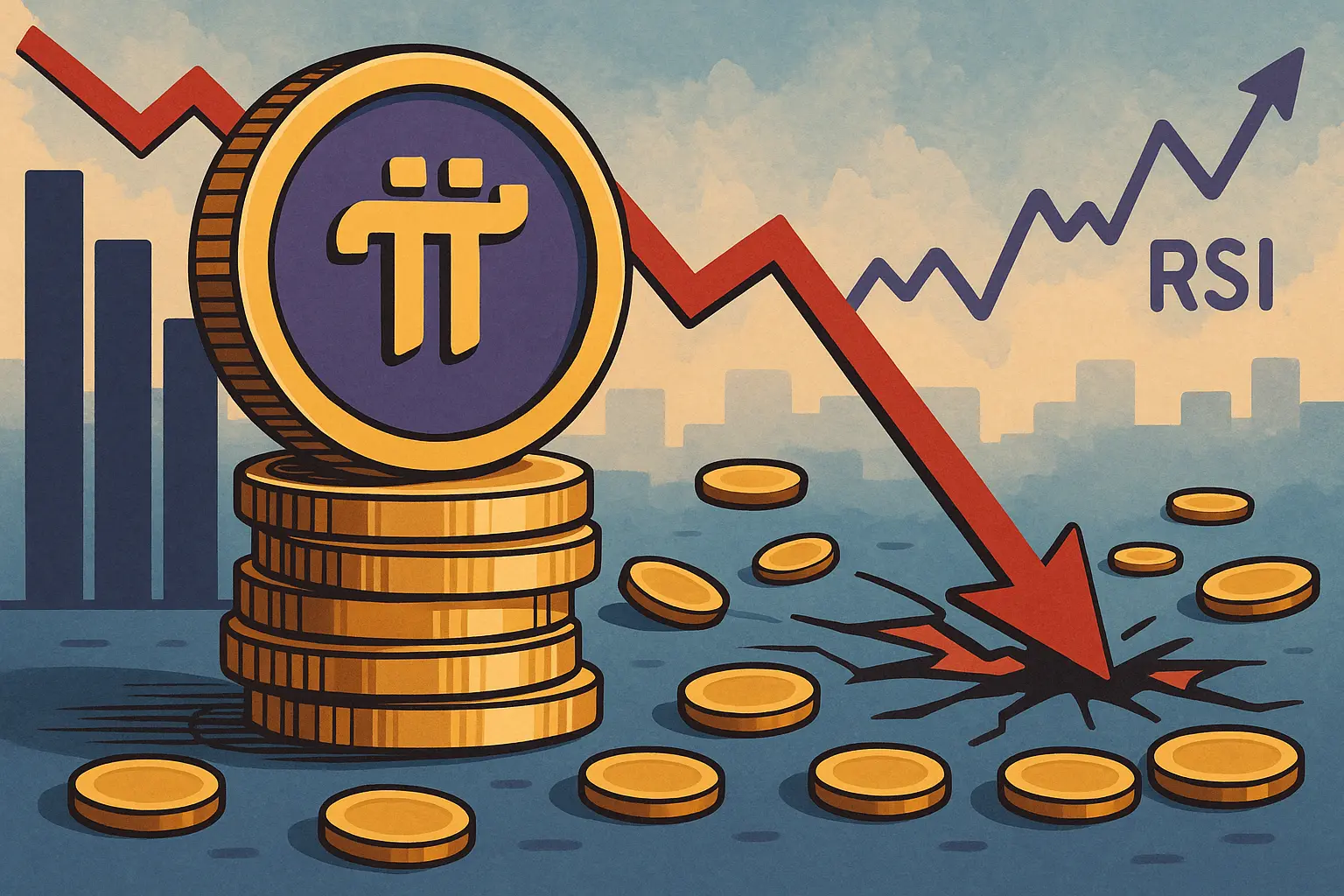
Pi Network has decreased about 6% over the past week, currently trading at $0.19. Despite catalysts that drove the March rebound—including multiple protocol updates, community enthusiasm for PiDay 2026, and listing on Kraken—the short-term upward momentum has quickly faded. Currently, PI faces two technical support signals and two downward risk signals, creating a direct confrontation between bullish and bearish forces.
Bullish Signals: RSI Approaching Oversold and Strong Community Sentiment
Signal 1: RSI Near Oversold Zone
PI’s Relative Strength Index (RSI) is currently around 31, close to the oversold threshold of 30. RSI below 30 is generally interpreted by the market as an indication that the token may be oversold, with potential for a rebound to gather momentum. The previous rally in mid-March was partly triggered under similar low RSI conditions. It’s important to note that RSI approaching oversold is a necessary condition but not sufficient—macro market sentiment and trading volume are equally critical.
Signal 2: CoinMarketCap’s Second-Highest Bullish Sentiment Ranking
According to CoinMarketCap’s community sentiment data, PI ranks second in bullish sentiment across the entire crypto market, only behind Kaspa (KAS). This suggests that despite price pressure, investor and community holding intentions remain relatively strong. Bullish sentiment often helps sustain buying support. For comparison, the community bullish sentiment for Pepe (PEPE), Shiba Inu (SHIB), and Ethereum (ETH) is lower than that of PI.
Bearish Signals: Rising Exchange Reserves and Upcoming 154 Million Token Unlocks
Exchange PI Reserves: Increased by over 2 million in the past 24 hours, now approaching 473 million; Gate holds the largest amount (~251 million), followed by Bitget (~144.6 million), while Kraken’s listing accounts for only about 1%.
Total Token Unlocks in the Next 30 Days: 154.2 million, averaging about 5.1 million per day entering the market.
Peak Unlock Period: Expected to occur from late March to early April, potentially causing concentrated selling pressure.
Rising exchange reserves are often seen as a precursor to potential selling, as large amounts of tokens transferred from user wallets to exchanges indicate increasing willingness to sell. Simultaneously, scheduled token unlocks directly increase circulating supply; if buying support does not sufficiently absorb this influx, it could exert downward pressure on PI’s spot price.
March Rebound Catalysts and Subsequent Fade
In mid-March, PI surged to $0.30, a five-month high, driven by multiple positive factors, making it one of the strongest-performing crypto assets at the time. Catalysts included protocol feature updates, large-scale community events for PiDay 2026, and Kraken’s official announcement to enable PI trading. However, this rally was short-lived, failing to break through decisively, and gradually retreated back to the current level of $0.19.
Frequently Asked Questions
Does RSI near 31 for Pi Network indicate an imminent rebound?
RSI approaching 30 and entering oversold territory has historically been associated with short-term rebounds. However, this is a probabilistic technical signal, not a guaranteed prediction. If the overall market remains under pressure (e.g., macro risk-off sentiment or simultaneous token unlock pressures), the oversold signal may be masked or delayed.
Why is increasing exchange reserve considered a bearish signal?
Large amounts of tokens moving from user wallets to exchanges typically indicate holders preparing to sell. Rising exchange reserves suggest increased potential selling supply. If buying support does not absorb this additional supply, the price may face downward pressure.
How significant is the 154 million token unlock in the next 30 days for PI’s price?
The upcoming 154 million tokens, averaging about 5.1 million daily, will enter circulation depending on holder behavior and market depth at that time. The impact depends on whether holders choose to sell immediately and whether market demand can absorb the influx. The peak unlock period (late March to early April) is a key window to watch; insufficient buying support could exert noticeable downward pressure on PI’s spot price.
Disclaimer: The information on this page may come from third parties and does not represent the views or opinions of Gate. The content displayed on this page is for reference only and does not constitute any financial, investment, or legal advice. Gate does not guarantee the accuracy or completeness of the information and shall not be liable for any losses arising from the use of this information. Virtual asset investments carry high risks and are subject to significant price volatility. You may lose all of your invested principal. Please fully understand the relevant risks and make prudent decisions based on your own financial situation and risk tolerance. For details, please refer to
Disclaimer.


