


As of June 3, 2026, Gate market data shows that Applied Optoelectronics (AAOI) surged 9% intraday, closing at $202.2, with a session high of $205.77. Trading volume reached approximately 12.6693 million shares, with a turnover of about $2.524 billion. In after-hours trading, the stock edged down 3.8%, temporarily quoted at $194.4. Year-to-date, AAOI has gained over 439%, and its 52-week rally has exceeded 1,100%.
This rally, fueled by the AI data center investment boom, has thrust the optical communications sector into the market spotlight.
Why Is AAOI Charting Its Own Course?
Over the past year, AAOI’s stock performance has far outpaced the S&P 500. By early June 2026, AAOI had climbed 459.81% year-to-date, with a 52-week gain of more than 1,157%. The driving force behind this surge isn’t short-term speculation, but rather the realization of several structural tailwinds: explosive demand for 800G and 1.6T high-speed optical modules in AI data centers, ongoing constraints in laser manufacturing capacity, and supportive US domestic manufacturing policies—all converging to boost the stock.
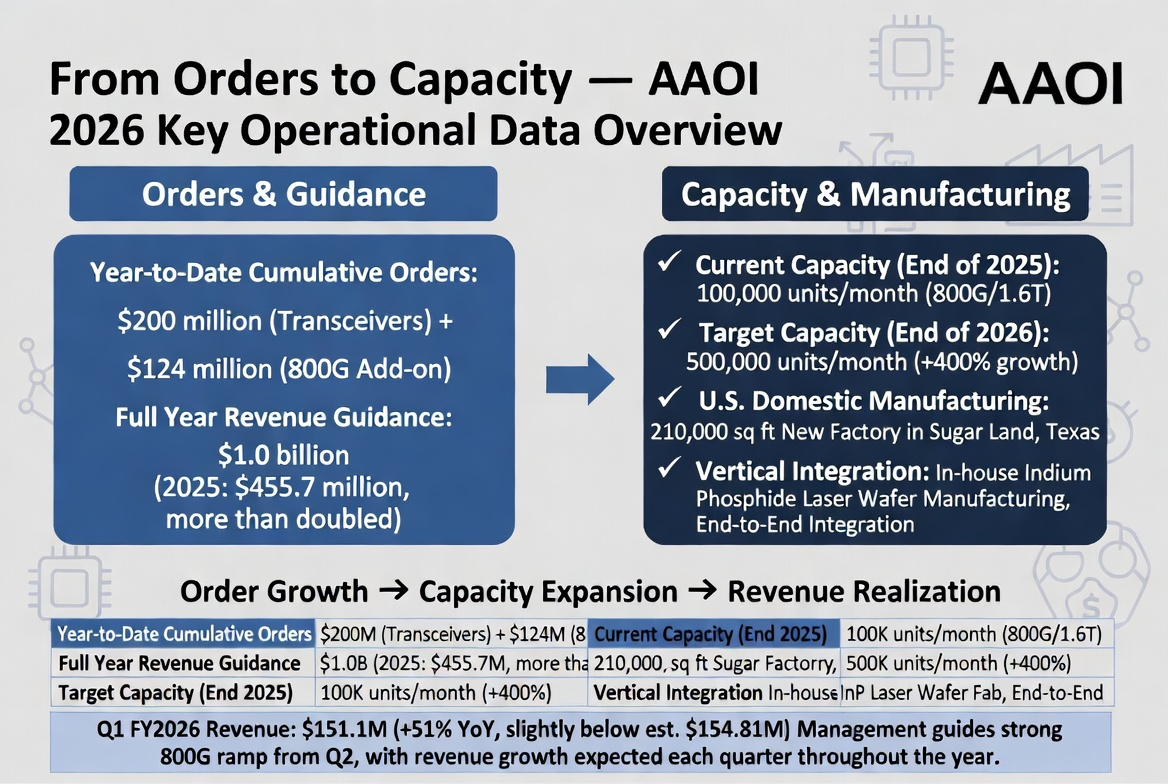
From Orders to Capacity—AAOI 2026 Key Operating Data Snapshot
On the order side, the company has disclosed substantial supporting information. In April 2026, AAOI secured a $200 million new order for optical transceivers, propelling its share price up 237% for the year. Earlier, in March and April, the company announced separate 800G orders worth over $53 million and $71 million, respectively, with a single major customer’s cumulative order totaling about $124 million. At the same time, AAOI issued full-year revenue guidance of $1 billion for 2026—if achieved, this would more than double the $455.7 million recorded in 2025.
However, institutional views remain divided. According to analyst data from April 2026, AAOI’s 12-month average target price stands at $102.3, with forecasts ranging from $54 to $190. The consensus is a "Buy," but the wide target price range reflects significant disagreement over whether AAOI can successfully convert orders into profits.
How Are AI Data Centers Reshaping High-Speed Optical Module Demand?
To understand AAOI’s growth prospects, it’s crucial to examine structural changes on the demand side. The networking architecture of AI training clusters fundamentally differs from traditional data centers. While conventional cloud networks use a leaf-spine architecture, AI training clusters adopt a fat-tree architecture, dramatically increasing the number of switches and optical modules required, along with higher speed demands for these modules.
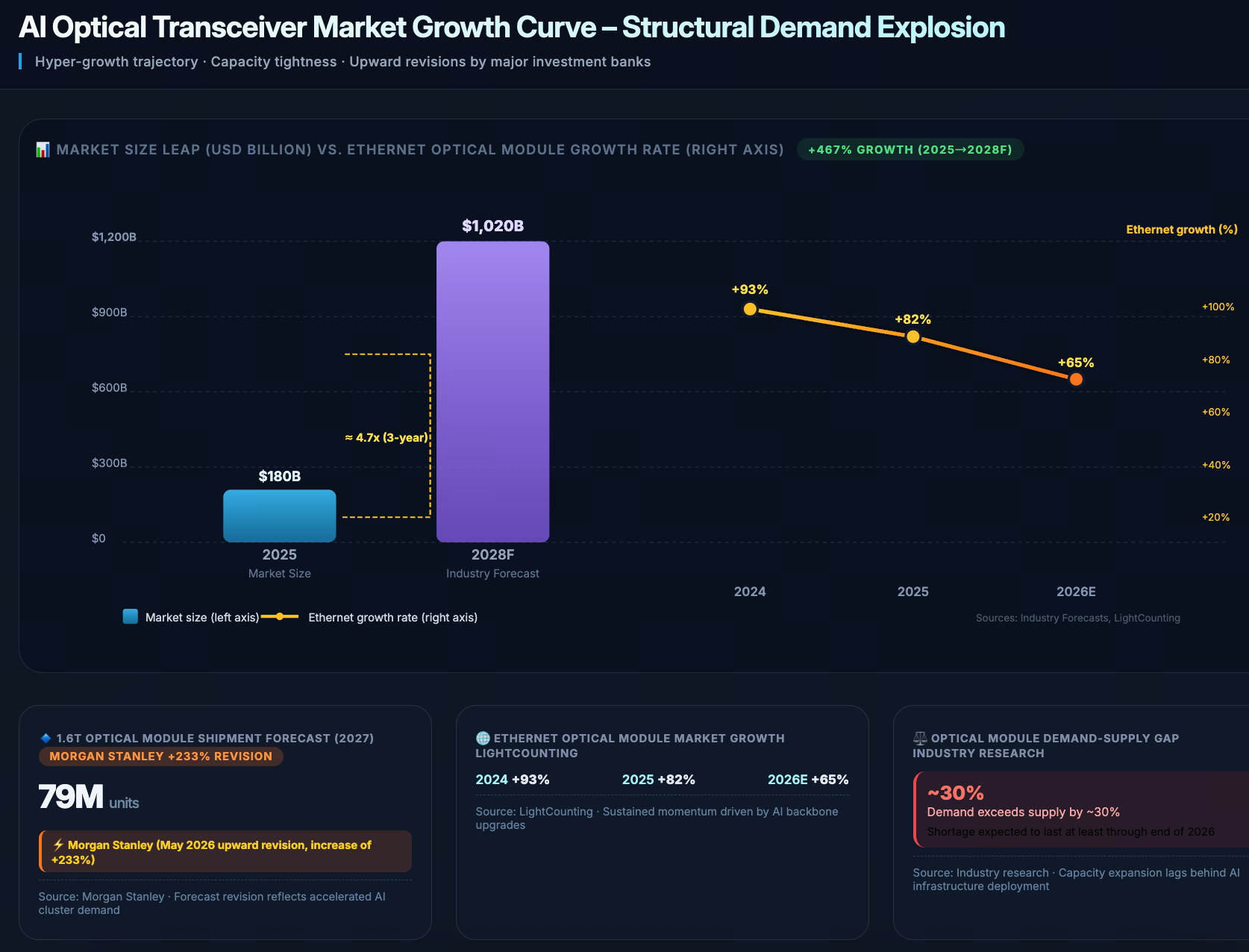
AI Optical Transceiver Market Growth Curve—Structural Demand Explosion
Specifically, 800G optical modules began scaling up in 2023 and are expected to maintain rapid growth through 2026. 1.6T modules will start shipping in 2025 and enter mass production in 2026. In May 2026, Morgan Stanley sharply raised its forecast for AI optical transceiver shipments, projecting 1.6T units in 2027 to reach 79 million—up from a previous estimate of 24 million, a 233% increase. The global AI optical transceiver market is expected to grow from $18 billion in 2025 to $102 billion in 2028, more than quadrupling in three years.
Ethernet optical module growth is equally steep: up 93% in 2024, another 82% in 2025, and LightCounting expects a 65% year-over-year increase in 2026. This explosive demand for high-speed optical modules provides a solid foundation for core suppliers like AAOI. The fundamental driver is the continuous expansion of GPU clusters—inter-chip bandwidth has become a key bottleneck for computing efficiency, elevating optical modules from mere "connectors" to the "arteries" of AI infrastructure.
Why Is Laser Manufacturing Capacity the Center of Industry Competition?
Despite soaring demand, supply is lagging behind. Manufacturing AI optical modules relies heavily on upstream indium phosphide lasers and related optical components, which are currently in global shortage. Industry research shows that optical module demand exceeds supply by about 30%, and this shortfall is expected to persist at least through the end of 2026.
The bottleneck lies in the manufacturing process for laser chips. High-end indium phosphide lasers are locked up by long-term purchase agreements. Lumentum expects EML capacity to grow by more than 50% by the end of 2026, with most capacity sold out through 2027. In this tight supply environment, vendors with vertically integrated manufacturing capabilities have a clear competitive edge.
AAOI’s differentiated advantage in this area is noteworthy. Unlike many fabless competitors, AAOI owns its indium phosphide laser wafer manufacturing—from semiconductor crystal growth and laser chip processing to final optical transceiver assembly, achieving end-to-end vertical integration. This means that when the industry faces laser component shortages, AAOI doesn’t depend on competitors’ capacity allocations and can independently expand production to meet demand.
This vertical integration is being revalued in the AI era. With Nvidia investing $2 billion each in Lumentum and Coherent to secure laser capacity, non-Nvidia cloud providers (including Google, Amazon, and Microsoft) urgently need independent suppliers not subject to competitor capacity constraints. AAOI, with 100% in-house manufacturing, occupies a unique strategic position as an "independent supplier."
What Is AAOI’s Differentiated Strategy in the Competitive Landscape?
Within the optical communications value chain, different manufacturers pursue distinct strategies. Lumentum and Coherent are expanding into higher-value optoelectronic co-packaged components and optical switches, while AAOI is taking a different path—focusing on LPO architecture in pluggable optical modules.
LPO, or Linear Pluggable Optics, eliminates the DSP (digital signal processor) chip found in traditional modules, significantly reducing power consumption. Microsoft is a major proponent of this technology. Low power consumption is critical in AI data centers—power density per cabinet keeps rising, making cooling and electricity costs operational bottlenecks. LPO’s power efficiency offers substantial commercial value for hyperscale cloud providers.
Beyond technology, capacity expansion is a core competitive factor. AAOI plans to ramp up 800G/1.6T capacity from 100,000 units per month at the end of 2025 to 500,000 units per month by the end of 2026—a 400% increase. This expansion pace will directly determine whether the company can meet its $1 billion revenue target for 2026. Additionally, AAOI is aggressively pursuing US domestic manufacturing, establishing a new 210,000-square-foot plant in Sugar Land, Texas—the largest AI data center transceiver production facility in the US.
It’s worth noting that AAOI’s Q1 2026 financial results were somewhat mixed. Revenue grew 51% year-over-year to $151.1 million, but fell short of the $154.81 million expected; data center revenue was $81.4 million, below the $91.4 million forecast; adjusted gross margin was 29.2%, less than the expected 30.4%. Despite short-term financial misses, management stated that 800G products would enter mass production in Q2, with revenue expected to grow sequentially throughout the year and accelerate as new capacity comes online.
How Are Silicon Photonics and CPO Reshaping the Technology Roadmap?
When discussing the long-term outlook for optical communications, the evolution of technology is a central issue. The industry is at a key inflection point for optical interconnects—pluggable modules are shifting from 800G to 1.6T, while silicon photonics and co-packaged optics (CPO) are rapidly moving toward commercial adoption.
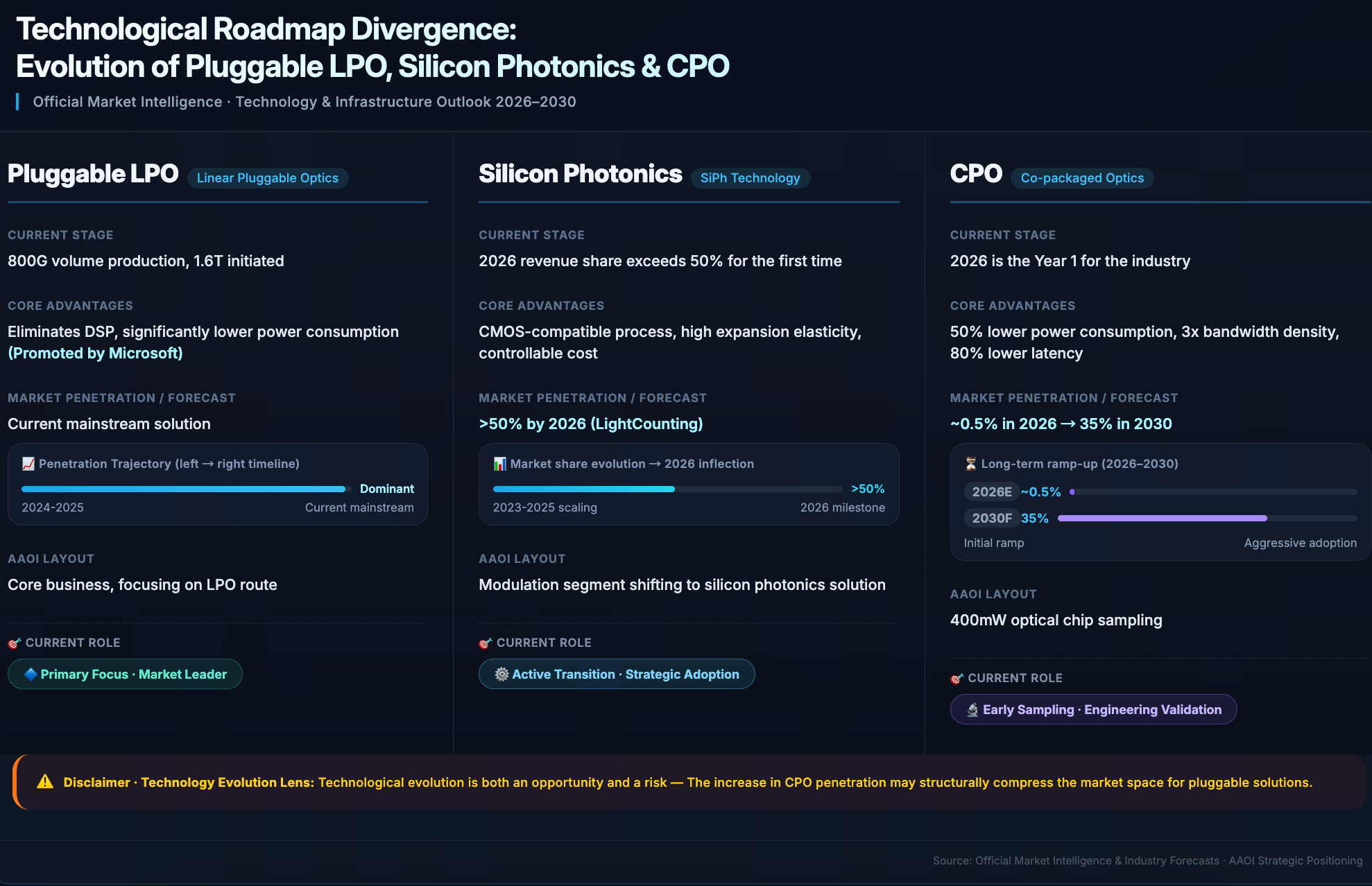
Technology Pathways—Pluggable LPO, Silicon Photonics, and CPO Evolution Map
LightCounting’s June 2026 report notes that silicon photonics-based optical module sales will surpass 50% of the total market for the first time in 2026. Silicon photonics offers compatibility with CMOS manufacturing, enabling flexible expansion and cost control. While indium phosphide lasers will remain the largest segment of the optical chip market—58% share in 2025, still 46% in 2031—the modulation function is shifting en masse to silicon photonics.
CPO integrates the optical engine directly with switch chips or GPUs, shrinking electrical interconnects from centimeters to millimeters. Compared to traditional pluggable modules, CPO reduces power consumption by 50%, triples bandwidth density, and cuts latency by 80%. According to TrendForce, CPO penetration in AI data center optical modules will be about 0.5% in 2026, but is projected to reach 35% by 2030, offering vast growth potential.
For AAOI, this technological shift presents both challenges and opportunities. The company already has a presence in CPO, with its 400-milliwatt optical chip for CPO in sample testing. Importantly, CPO requires high-power CW light sources, and very few global suppliers can deliver at scale—supply-demand imbalance is expected to last through 2027. AAOI’s vertical integration could give it a first-mover advantage in this segment.
How Do Capital Flows and Capex Validate Industry Momentum?
On a broader financial level, optical communications momentum is an extension of the AI infrastructure investment wave. The world’s top 11 cloud providers are expected to spend $735–795 billion in capital expenditures in 2026, up about 60% year-over-year. Increasingly, these funds are allocated to upgrades of 400G, 800G, and 1.6T transceivers.
In the secondary market, optical module stocks rallied across the board pre-market on June 2, 2026. AAOI and Lumentum jumped 7.39% and 8.2%, respectively, while the newly listed pure photonics ETF FOTO soared 5.29%. Multiple optical communications stocks rose in tandem, indicating that the market is systematically pricing in capacity bottlenecks for high-speed interconnects both within and between AI data centers.
Beyond North America, the spillover effect of AI computing investments into optical interconnects continues to expand, making optical communications the most closely watched AI hardware segment after GPUs. Ongoing capital expenditures and institutional allocations provide strong assurance for long-term demand in the sector.
What Uncertainties Should Be Closely Watched?
Rapid growth in this sector comes with a series of risks and uncertainties that warrant close attention.
First, execution risk. Q1 2026 data center revenue missed expectations, and Q2 guidance midpoint ($189 million) is also below the market’s $196 million estimate. The $1 billion full-year revenue target is forward-looking; achieving it depends on ramping up capacity, improving yields, and timely customer deliveries. Insiders have begun selling shares—both the Chairman and CFO sold holdings in May at $173.26 and $190.36, respectively.
Second, customer concentration risk. AAOI’s order structure shows that most revenue comes from a handful of hyperscale cloud providers. Changes in orders from a single customer could significantly impact overall performance. Profitability is also a concern—AAOI lost $0.26 per share in 2025 and remained unprofitable in Q1 2026. The market is closely watching whether AAOI can transition from scale expansion to improved profitability.
Third, technology iteration risk. The market lifespan for pluggable optical modules is uncertain. As CPO penetration rises from about 0.5% in 2026 to 35% by 2030, pluggable solutions could face structural contraction. The pace and path of technology transitions will directly affect the market position of companies like AAOI, whose core business is pluggable modules.
Fourth, valuation risk. AAOI’s current price-to-book ratio exceeds 14x, price-to-sales is over 24x, and market cap is about $16.2 billion. With valuations stretched, the market will demand strict delivery on financial metrics; any operational miss could trigger sharp price corrections.
Summary
Applied Optoelectronics operates in an optical communications sector undergoing structural expansion, driven by AI data center investments. On the demand side, the upgrade from 800G to 1.6T, the fat-tree architecture’s multiplier effect on module counts, and sustained capital spending by global cloud providers together underpin high-confidence growth for the next two to three years. On the supply side, persistent shortages of indium phosphide lasers and other core components give vertically integrated manufacturers a differentiated competitive advantage. On the technology front, silicon photonics is entering a dominant market share phase, and CPO is poised for its industry takeoff, opening new market opportunities for the value chain.
At the same time, execution risks, customer concentration, technology transition pace, and valuation safety margins cannot be ignored. The long-term outlook for optical communications depends on the interplay between demand realization and technology evolution—this is both the opportunity and the uncertainty.
FAQ
What stage is the optical communications sector currently in?
The optical communications sector is in a structural expansion phase driven by AI data center investments. 800G modules have transitioned from small to large-scale production between 2023 and 2025; 1.6T modules started shipping in 2025 and will scale up in 2026. The Ethernet optical module market grew 93% in 2024 and 82% in 2025, with 2026 growth expected to remain above 65%. Global AI optical transceiver TAM is projected to grow from $18 billion in 2025 to $102 billion in 2028, quadrupling in three years.
How are silicon photonics and CPO technologies impacting industry dynamics?
In 2026, silicon photonics will account for over 50% of optical module sales for the first time, while CPO penetration will rise from about 0.5% in 2026 to 35% by 2030. These two technology paths are driving optical interconnects from "connectors" to "core components" of AI infrastructure, while also creating structural pressure on the market space for pluggable module vendors.
What is AAOI’s order status and capacity expansion plan?
In 2026, AAOI disclosed multiple large orders, including a $200 million transceiver deal and additional 800G orders of $53 million and $71 million. The company issued full-year revenue guidance of $1 billion. On capacity, AAOI plans to ramp up 800G/1.6T production from 100,000 units per month at the end of 2025 to 500,000 units per month by the end of 2026, and has established a new 210,000-square-foot factory in Texas for US-based manufacturing.
Does the current price movement fully reflect fundamentals?
AAOI has gained over 439% year-to-date, with valuation (price-to-sales around 24x, price-to-book about 14x) at historic highs. Analyst 12-month average target price is $102.3, ranging from $54 to $190, reflecting significant differences in views on valuation and performance delivery. Profitability (still loss-making in Q1) and capacity ramp-up progress are key variables in assessing whether price aligns with fundamentals.


