



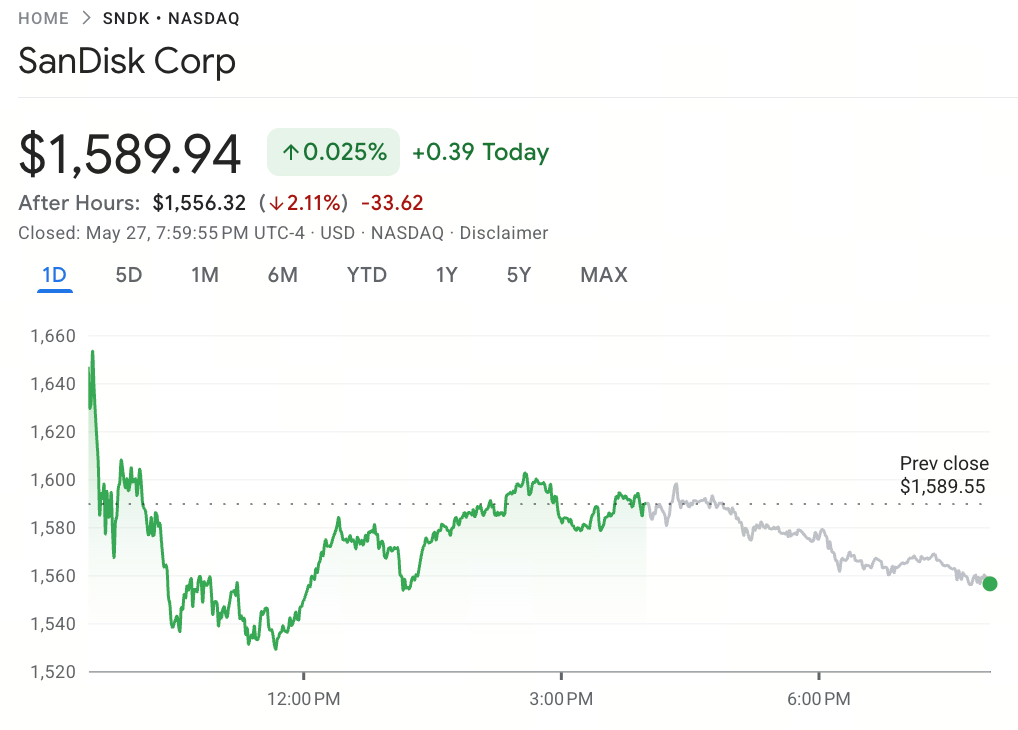
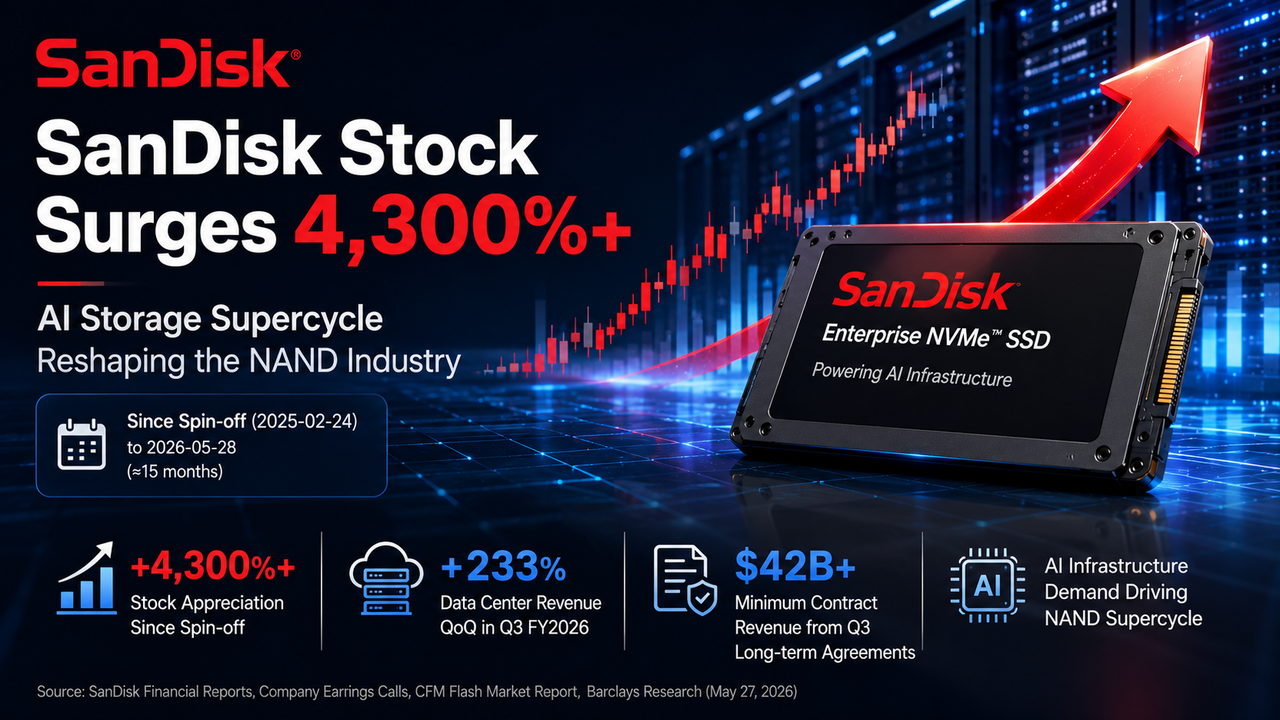
On February 21, 2025, SanDisk officially completed its spin-off from Western Digital. The company began trading independently on Nasdaq under the ticker SNDK on February 24. By May 28, 2026, marking one year and three months since its independent listing, Gate Tradfi market data shows SNDKUSDT trading at approximately $1,556.32, reflecting a cumulative gain of over 4,300% from its initial listing price.
Source: Google Finance
This year of transformation is more than just a company stepping out from the shadow of a large conglomerate. It’s a microcosm of the structural reshaping of the NAND flash industry, driven by surging demand for artificial intelligence. Is SanDisk’s success merely a cyclical price windfall, or does it signal a fundamental evolution in its business model?
The Spin-Off: An Underestimated Structural Transaction
SanDisk’s independence wasn’t a sudden move, but the result of more than two years of strategic maneuvering.
Let’s rewind to May 2022. That month, Western Digital’s largest shareholder, Elliott Management, publicly proposed spinning off the flash business. The rationale: HDD and NAND assets are valued by the market using fundamentally different logics, and their combined operations led to both being undervalued. On October 30, 2023, Western Digital’s board formally authorized management to advance the spin-off plan.
On February 21, 2025, the spin-off was legally finalized. Western Digital distributed approximately 80.1% of SanDisk’s outstanding shares to its shareholders at a 3:1 ratio (for every share of WDC stock held, shareholders received one-third of a SanDisk share), retaining about 19.9% itself. After the spin-off, Western Digital reclassified SanDisk’s historical performance as discontinued operations and stopped consolidating its financial results. Former Western Digital CEO David Goeckeler transitioned to lead SanDisk as CEO, while Western Digital focused exclusively on its HDD business.
Notably, the newly independent SanDisk retained about $3.7 billion in cash on its balance sheet and maintained its Flash Ventures joint venture structure with Kioxia. This partnership is foundational to SanDisk’s production capacity: the company shares advanced NAND manufacturing facilities in Yokkaichi and Kitakami, Japan with Kioxia, enabling access to cutting-edge process capacity without bearing the full capital expenditure burden. On January 30, 2026, both parties extended the joint venture agreement to December 31, 2034 (originally set to expire in 2029). As part of the renewal, SanDisk agreed to pay Kioxia $1.165 billion for manufacturing services and ongoing supply assurance, to be paid in installments from 2026 to 2029.
The spin-off was completed on February 21, 2025, and SanDisk began trading independently on Nasdaq on February 24, 2025. Some analysts believe the spin-off unlocked valuation potential previously suppressed by the HDD business, but the market initially underpriced this change, and SNDK’s share price remained relatively low in the early days of independent trading.
Financial Leap: From Steady Growth to Explosive Breakthrough
If SanDisk spent its first year as an independent company building market recognition, then by 2026, it delivered a financial performance that caught the market’s attention.
According to public financial reports, SanDisk posted revenue of $3.03 billion in Q2 FY2026 (ending January 2026), up 31% quarter-over-quarter, exceeding the upper end of prior guidance. GAAP net income for the quarter reached $803 million.
Growth accelerated further in Q3 FY2026 (ending April 2026). Revenue surged to $5.95 billion, up 97% quarter-over-quarter and 251% year-over-year, far exceeding management’s guidance of $4.4–$4.8 billion. Non-GAAP gross margin climbed from 51.1% in the previous quarter to 78.4%. Non-GAAP earnings per share hit $23.41, well above consensus estimates.
Performance across business segments showed marked divergence—highlighting the direction of structural change within the industry.
| Segment | Q2 FY2026 (ending Jan 2026) | Q3 FY2026 (ending Apr 2026) | Q3 QoQ Change |
|---|---|---|---|
| Data Center | ~$440 million | $1.467 billion | +233% |
| Edge Computing | ~$1.68 billion | $3.663 billion | +118% |
| Consumer | ~$907 million | $820 million | -10% |
Source: Company financials and earnings call disclosures
Data center revenue grew 233% quarter-over-quarter and about 645% year-over-year in Q3, reaching $1.467 billion. Consumer revenue declined 10%, consistent with historical seasonal trends. The data shows that AI data centers have overtaken consumer electronics as SanDisk’s primary growth engine. On the earnings call, CEO Goeckeler asserted that the strong performance in the data center segment marks SanDisk’s transformation from a consumer storage-focused company to a high-value supplier at the heart of AI infrastructure.
Industry Landscape: The NAND Market’s Supercycle and Share Battles
SanDisk’s surge isn’t an isolated case. The entire NAND flash industry is experiencing an historic upcycle.
CFM Flash Market data shows global NAND Flash market size reached $42.815 billion in Q1 2026, up 81.8% quarter-over-quarter. Enterprise SSD demand has doubled and continues to accelerate. Despite signs of weakness in consumer demand, overall supply remains tight, and NAND ASPs jumped significantly in Q1.
Global NAND Flash Market Share (Q1 2026)
| Rank | Company | Market Share |
|---|---|---|
| 1 | Samsung | 29.7% |
| 2 | SK hynix | 17.6% |
| 3 | Kioxia | 14.9% |
| 4 | SanDisk | 13.9% |
| 5 | Micron | 11.7% |
Source: CFM Flash Market
SanDisk holds fourth place with a 13.9% market share. In the data center segment, SanDisk’s growth far outpaces the industry average—Q3 data center revenue rose 233% quarter-over-quarter. TrendForce reports SanDisk’s data center segment grew over 200% quarter-over-quarter, indicating its product mix is shifting toward high-value offerings.
Samsung maintains a commanding lead at 29.7%, but SanDisk’s growth in the data center segment is well above the industry average. SanDisk’s competitive strategy isn’t about expanding overall market share, but about building differentiated advantages in the high-value enterprise SSD market. Management repeatedly emphasizes "disciplined capital spending"—preferring to sacrifice some market share rather than expand recklessly and dilute margins.
Supply-Demand Dynamics: Why NAND Shortages Will Persist Through 2027
The current surge in storage prices is fundamentally driven by the intersection of "structural AI demand" and "disciplined supply contraction."
On the demand side, AI servers require far more storage than traditional servers. SanDisk management noted on earnings calls that as inference workloads expand, technologies like KV caching and retrieval-augmented generation are increasing demand for flash storage. CEO Goeckeler also cited model scaling, higher token generation, longer and more complex model runs, and rising context requirements as AI-driven factors boosting NAND demand.
On the supply side, major NAND suppliers remain cautious about large-scale capacity expansion. Barclays’ latest report indicates that industry supply-demand imbalance may persist through 2027.
The structural gap between demand growth and capacity expansion is the industry’s core supply-demand contradiction—and the fundamental driver supporting higher NAND prices.
Multiple institutions forecast NAND shortages will continue through 2027 or longer. Consumer electronics demand is showing signs of fatigue, and mobile and PC NAND segments are under pressure. Unlike previous cycles, this supply shortage is driven by structural AI compute demand rather than cyclical consumer electronics swings. This means demand sustainability and price resilience may far exceed traditional storage cycles. However, if high prices "crowd out" consumer demand, mid-term risks could emerge on the demand side.
Contract Revolution: From Cyclical Battles to Long-Term Lock-In
If supply-demand dynamics set the "baseline" for NAND pricing, then business model innovation is SanDisk’s deeper attempt to rewrite industry rules.
According to Barclays analyst Tom O’Malley’s report dated May 27, 2026, SanDisk’s recently signed long-term supply contracts are fundamentally changing the economics of the storage industry. On the Q3 earnings call, CFO Luis Felipe Visoso revealed that SanDisk has signed five multi-year supply agreements (termed "New Business Model" or NBM), with three signed in Q3 and two so far in Q4. The three Q3 contracts guarantee approximately $42 billion in minimum contract revenue, and the five agreements collectively include over $11 billion in financial guarantees, including prepayments and instruments managed by third-party financial institutions.
Contract durations vary, with the longest extending to 2031. They are based on quarterly shipment commitments, which increase over time. Pricing mechanisms use fixed prices in the short term and introduce floating prices in the long term, allowing SanDisk to fully benefit from price increases.
Barclays upgraded SNDK from "market perform" to "overweight," raising its target price from $1,200 to $2,300, citing this contract structure as "significantly enhancing the industry’s defensive capabilities during downturns."
SanDisk isn’t limiting itself to the NAND business. In March 2026, SanDisk, along with Kioxia, Solidigm (a subsidiary of SK hynix), and Cisco, participated in Nanya Technology’s NT$78.72 billion private placement. SanDisk subscribed for 138.6 million shares, investing about NT$31 billion (roughly $960 million), for a 3.9% stake. The intention is clear—by securing DRAM capacity, SanDisk ensures stable supply of DRAM cache for SSD controllers.
SanDisk has signed five long-term supply contracts, with three Q3 contracts guaranteeing $42 billion in minimum revenue and total financial guarantees across all five exceeding $11 billion. In the Nanya Technology private placement, SanDisk invested about NT$31 billion. The long-term contract model is SanDisk management’s strategic response to the "cyclical nature of NAND." Essentially, by locking in multi-year supply relationships, SanDisk is shifting its NAND business from a "commodity" model to an "infrastructure service" model. The success of this transformation depends on whether AI demand continues to grow as expected and whether customers honor contracts during price downturns.
Risk Review: Six Major Concerns Amid High Valuation
Having laid out SanDisk’s growth story, it’s essential to examine the substantive risks it faces.
Concern 1: Can pricing power be sustained?
SanDisk’s Q3 Non-GAAP gross margin has soared to 78.4%—an extremely rare level in semiconductor manufacturing. The sustainability of high margins depends on how long the NAND supply shortage lasts. Once new capacity comes online or AI investment slows, declining prices will directly impact profitability. Analyst target prices for SNDK vary widely—from Barclays’ $2,300 to Bernstein’s $1,700 and Citi’s $2,025. The gap between the highest and lowest targets reflects fundamental market disagreements about the durability of pricing power.
Concern 2: Dynamic changes in the competitive landscape.
Samsung holds an absolute lead in the NAND market with a 29.7% share, followed by SK hynix and Kioxia. SanDisk’s technological moat in enterprise SSDs isn’t unassailable, and competitors are accelerating penetration in QLC enterprise SSDs.
Concern 3: Weak consumer demand and capacity squeeze effects.
When manufacturers prioritize capacity for high-margin data center customers, consumer electronics firms face a dilemma: accept exorbitant spot prices or halt production. Q3 consumer revenue dropped 10% quarter-over-quarter. The potential consequence: consumer demand is "crowded out" by high prices, and if data center growth slows, suppressed consumer demand shrinkage could negatively impact the industry.
Concern 4: The counterforce of HDD substitution.
The widening price gap between NAND and HDD is eroding the economic advantage of SSDs replacing HDDs in AI data centers. Some demand may shift from NAND to HDD—precisely the domain Western Digital, SanDisk’s former parent, excels in.
Concern 5: The double-edged sword of long-term contracts.
Long-term supply agreements provide revenue stability during boom times, but customers may seek to renegotiate terms during downturns. The specific terms of the $11 billion in financial guarantees across five agreements aren’t fully disclosed, and their actual binding power will be tested if the market turns.
Concern 6: Capacity autonomy constraints from the Kioxia joint venture.
About half of SanDisk’s NAND capacity comes from joint venture factories with Kioxia. Although the agreement is extended to 2034, key decisions on capacity allocation, technology roadmap, and capital spending require mutual coordination. During a super upcycle, this arrangement may limit SanDisk’s flexibility to seize market share.
All these risks are supported by public data or reports and represent structural challenges inherent to the industry. SanDisk’s core tension is between exceptional short-term profitability and an unproven long-term business model. The market has awarded SNDK valuation multiples far above traditional storage cycle stocks, but whether this is justified ultimately hinges on how long and to what extent AI storage demand continues to outpace supply expansion.
Conclusion: The Real Test for an Independent Leader Lies Ahead
Looking back at the first anniversary of its independent listing, SanDisk’s performance is undeniably impressive. From the moment it split from Western Digital, this company—once known for consumer flash products—embarked on a strategic journey to become a core supplier for AI infrastructure. Explosive growth in data center revenue, institutional innovation through long-term contracts, and management’s commitment to capital discipline form the three pillars of this transformation.
However, whether SanDisk truly deserves the crown of an "independent leader" isn’t answered by the past year’s stock chart, but by the real-world challenges of the next 12 months.
When NAND prices retreat from historic highs, when competitors ramp up enterprise SSD production, and when global AI capital spending growth shifts gears, can SanDisk’s long-term contract system, capacity structure, and technological moat withstand cyclical shocks? That’s the true measure of an "independent leader." The history of the storage industry proves time and again: you only know who’s swimming naked when the tide goes out. Whether SanDisk’s swimsuit is sturdy enough, the market will ultimately decide.


