What Role Does Pendle Play as Wall Street Yields Move On-Chain?

Markets
Updated: 05/13/2026 09:37

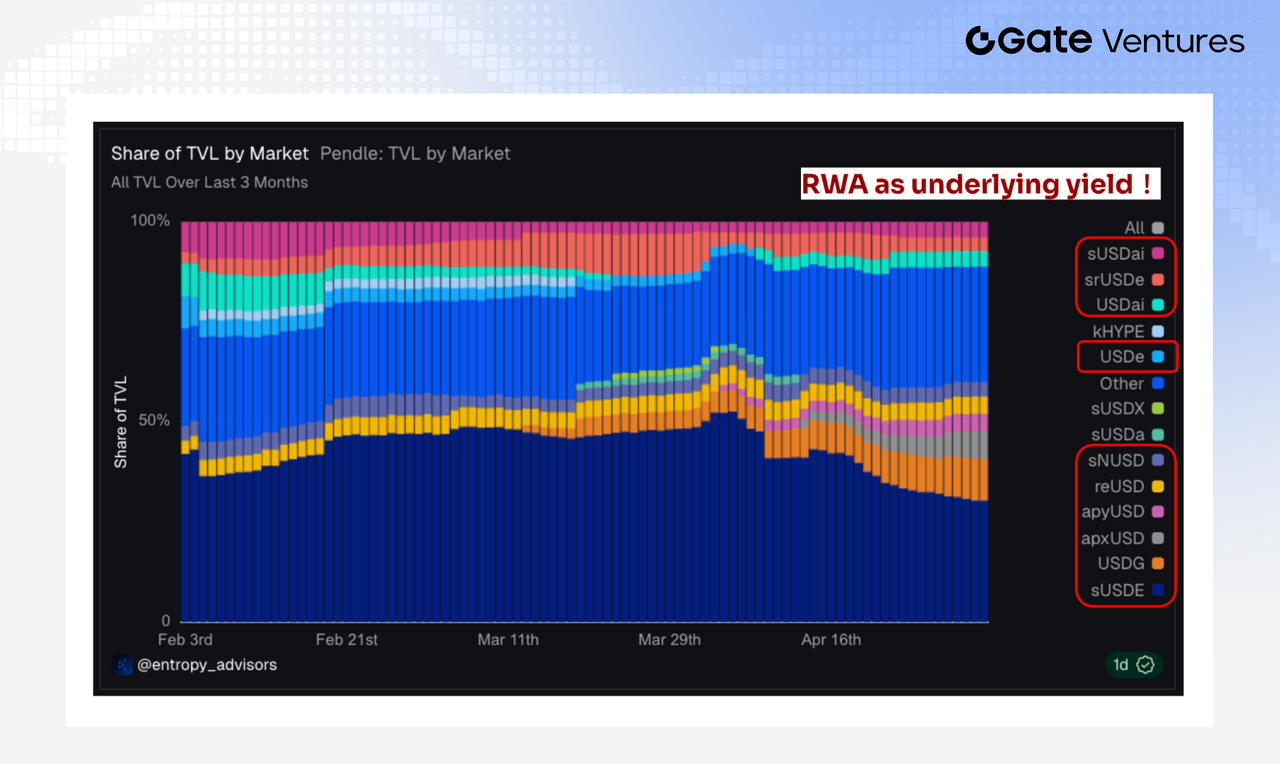
Source: Dune@entropy_advisors

Introduction

Pendle stands as a core platform for on-chain fixed-rate strategies, leveraged yield trading, and points amplification. In the previous cycle, Pendle’s widespread adoption was largely driven by points mining: users boosted their potential airdrop rewards by purchasing YT, which in turn increased demand for the protocol.

However, Pendle’s value hasn’t faded with the decline of points mining. In theory, yield trading itself caters to investors with varying risk and return preferences. Some seek to lock in fixed returns, others are willing to take on the volatility of floating yields, and some prefer to use leverage to amplify specific yield exposures.

More importantly, Pendle has recently demonstrated a clear capability to migrate underlying assets: expanding from a focus on crypto-native yields to incorporating RWA-related yield assets. This shift means Pendle is no longer just a short-term trading venue during points cycles, but is evolving into an on-chain interest rate market capable of supporting multiple types of yield assets.

Source: Pendle

The crypto market previously experienced a DeFi cycle dominated by crypto-native yields: strategies like looped lending, restaking yields, and crypto basis trades were mainstream.

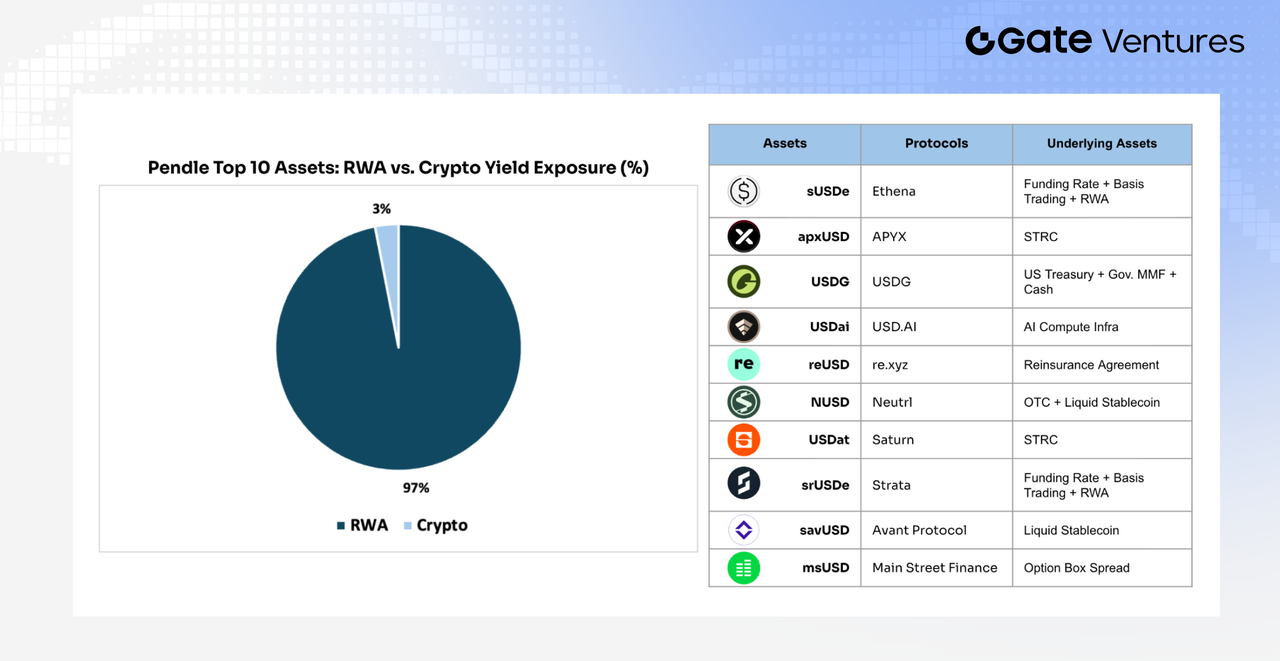
But if you look at Pendle’s Top 10 assets today, about 97% of TVL’s underlying yields now carry RWA attributes. Even major assets like USDe now include some degree of RWA exposure, such as USTB (BlackRock BUIDL tokenized US Treasury fund) and USDm (US Treasuries). At the same time, Pendle has seen a growing variety of RWA yield assets, including apxUSD / USDat backed by MicroStrategy STRC, USDai supported by AI compute infrastructure, and reUSD backed by reinsurance protocols.

Why Do These RWA Yield Assets Need Pendle?

The key reason is that they lack a distribution mechanism that can transform "floating yield products" into "fixed-rate instruments"—and the latter is what institutional capital truly needs.

For institutions, "predictability" of returns often matters more than simply chasing high APY.

Treasury managers, when allocating funds, must assess terms, cash flow arrangements, and return stability in advance. This makes it difficult for them to accept products whose yields fluctuate daily with market funding rates, even if historical returns are high.

Take sUSDe as an example. If an institution plans to allocate $10 million, it cares not just about today’s APY, but whether it can lock in a relatively clear return range over the next 3, 6, or 12 months.

This is where Pendle delivers value: it splits and prices originally floating, uncertain RWA yields into tradable, term-locked yield instruments.

Otherwise, many RWA protocols—despite their institutional-grade underlying assets—still offer products more suited to retail markets, making it difficult to attract large-scale institutional capital.

How Can We Validate Pendle’s Impact on RWA Yield Asset Distribution Efficiency and TVL Growth with Data?

Source: DeFiLlama, Etherscan

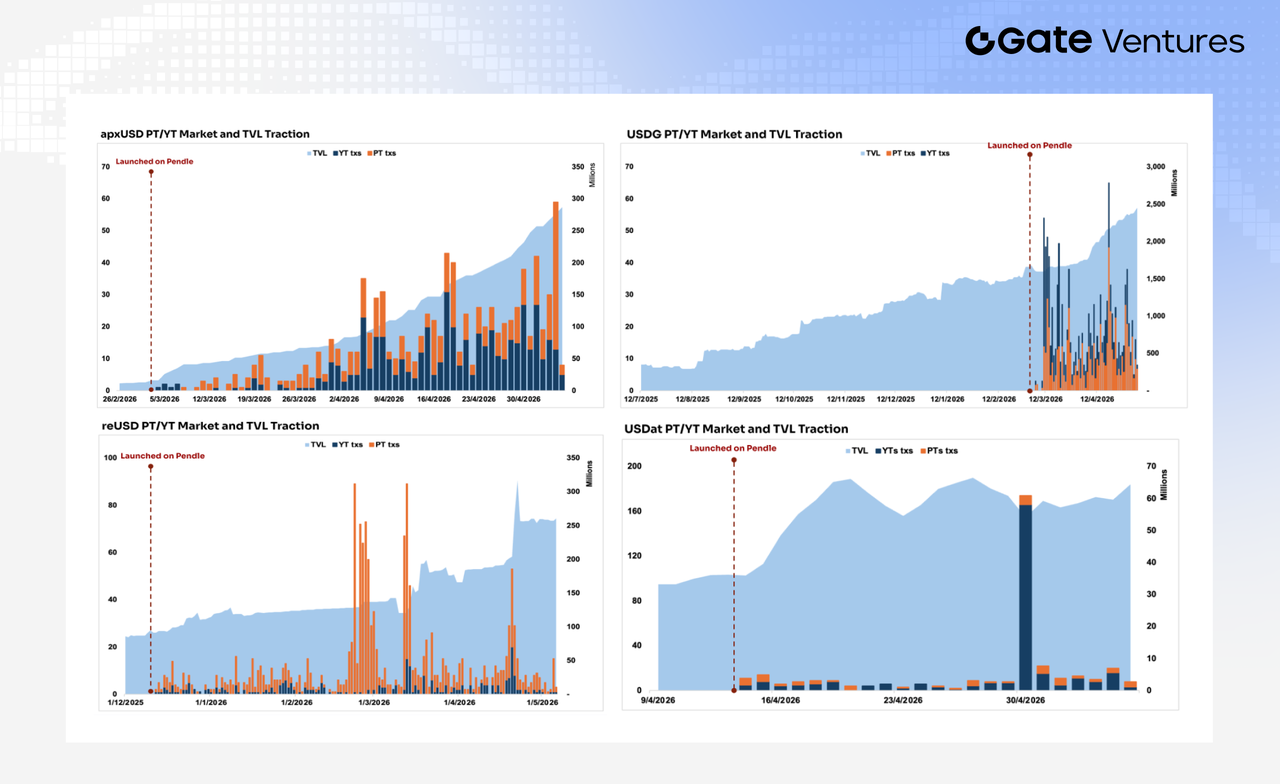
This article reviews the top 10 RWA yield markets on Pendle, with a focus on apxUSD, USDG, reUSD, and USDat. Key findings include:

Pendle as an Early Distribution and Growth Engine

Most assets recorded positive TVL growth after integrating with Pendle, and many projects chose to integrate Pendle early in their asset launch. apxUSD, USDat, and reUSD were all listed on Pendle at the initial launch of their yield assets, indicating that project teams clearly view Pendle as an important post-launch growth and distribution channel. This approach is especially effective for projects with token issuance expectations or those seeking to meet the yield trading needs of users with different risk preferences via PT / YT splits.

Looking at the data, apxUSD has seen the most significant TVL growth since integration, up +1690%; reUSD grew +185%; USDat increased +82%. While Pendle may not be the sole driver of TVL growth, the fact that multiple RWA projects chose early Pendle integration underscores its importance as a yield asset distribution channel.

USDG integrated Pendle during its mid-stage development, but still saw about +53% TVL growth post-integration. This integration was accompanied by weekly incentives for YT and LP holders, showing that Pendle can serve not only as a yield trading market but also as an effective venue for project teams to drive user adoption and incentive distribution, particularly by attracting users to stake YT for extra rewards.

PT / YT Structure Reflects Market Preferences for "Certainty vs Flexibility" in Yield Pricing

reUSD and USDG have more PT traders, reflecting the market’s perception that their underlying yields are more stable and predictable—closer to on-chain fixed income assets. reUSD’s underlying comes from reinsurance protocols, USDG’s from US Treasuries; both have relatively clear cash flow paths and low volatility, so users prefer to buy PT at a discount to lock in maturity yields, rather than betting on upside with YT.

In contrast, USDat and apxUSD attract more YT traders, both tied to STRC as their underlying. Compared to Treasuries or reinsurance yields, STRC yields are more strategy-driven and influenced by market conditions, capital flows, and strategy execution, offering greater flexibility and uncertain upside potential. Thus, users buy YT not just for base yields, but to amplify exposure to future yield increases, incentive events, or outperforming strategies.

Source: DeFiLlama, Etherscan

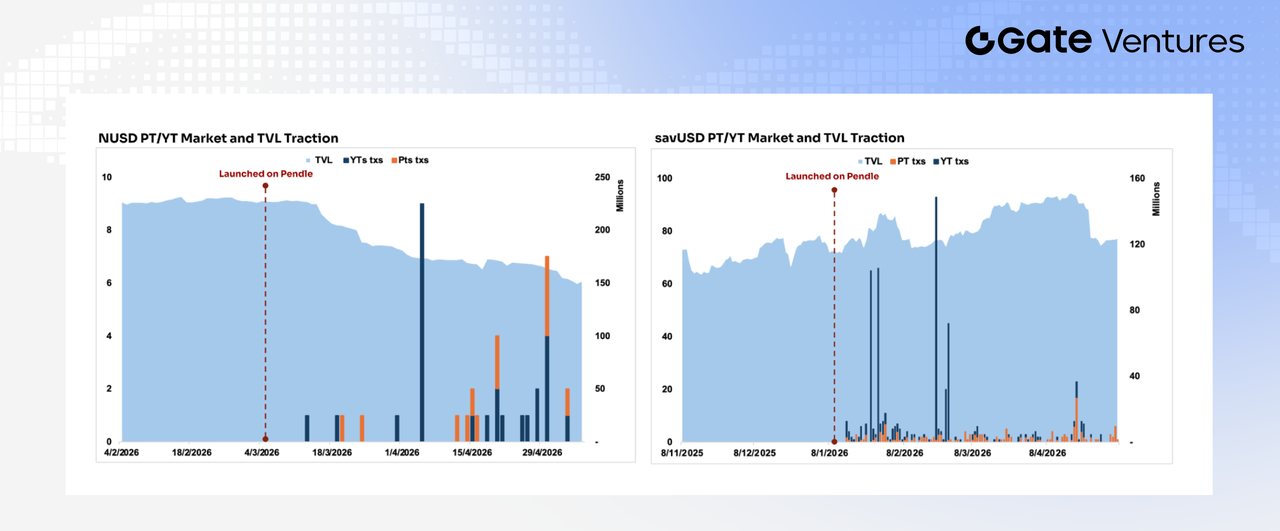
Of course, not every project integrated with Pendle creates a positive flywheel. For example, NUSD’s underlying yields come from sUSDs and OTC arbitrage, but TVL dropped about 33% after integrating Pendle, with weak PT / YT trading activity; savUSD’s underlying is a crypto asset delta-neutral strategy, and TVL grew only about 2% post-integration.

So, Pendle is best described as a yield distribution and trading channel, whose main role is to diversify yield asset trading methods—not to guarantee TVL growth. Whether a project can ultimately establish a growth flywheel depends on the attractiveness of its underlying assets, its own market outreach, capital acquisition capabilities, and whether it can effectively leverage Pendle’s PT / YT mechanism.

What Is the Market Size and Growth Potential of Pendle × RWA Sector?

Source: Pendle, DeFiLlama, SIFMA

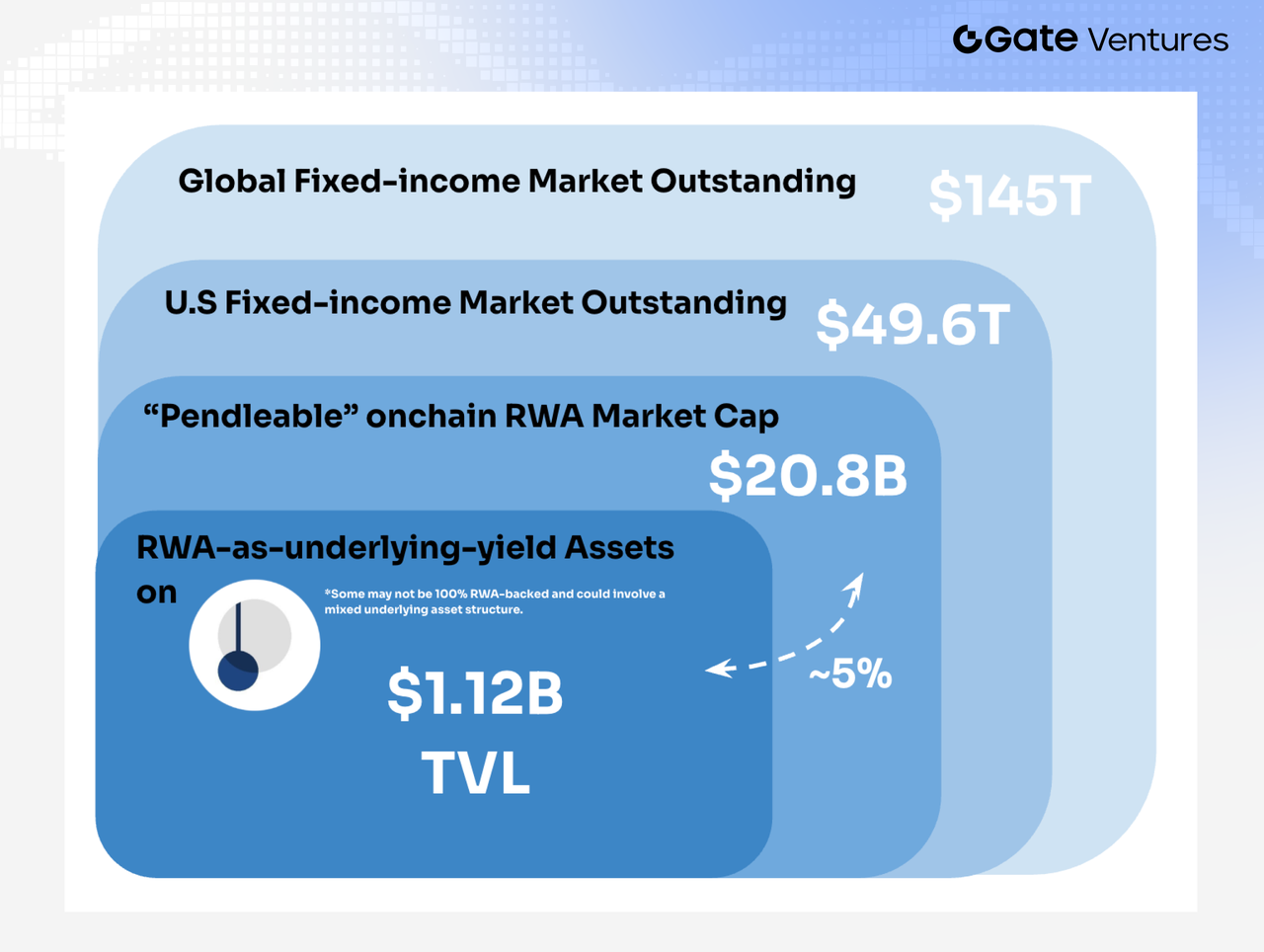
Currently, Pendle’s penetration in the RWA yield market remains in its early stages. Most RWA yield assets on Pendle are still concentrated in money market funds, bonds, and private credit—traditional fixed income products—while new yield assets like DAT dividends and AI compute lending are emerging. Overall, this segment contributes only about $1.12 billion in TVL. The total on-chain RWA market that could be "Pendle-ized" (splittable yields) is roughly $20.8 billion, meaning Pendle currently captures only about 5% of the market, with significant room for growth.

Benchmarking against traditional markets, the potential becomes even clearer. According to SIFMA, the US fixed income market’s outstanding size is about $49.6 trillion; globally, it’s about $145 trillion. By comparison, on-chain RWA is still in its infancy.(1) (2)

Of course, not all fixed income will move on-chain, but those assets that "require composability, cross-border liquidity, secondary market trading, and yield repackaging" will be first to migrate. The assets most likely to be tokenized are those facing friction in traditional systems—like high cross-border subscription barriers, long redemption cycles, and high minimum investment requirements.

In the short to medium term, Pendle will first capture highly compatible on-chain RWA yield assets, such as money market funds, short-term debt, private credit, structured yields, and new cash flow assets. In the long run, if more traditional fixed income is tokenized and yields can be distributed on-chain, Pendle could become the core secondary infrastructure for on-chain fixed income markets. The current 5% capture rate shows it’s still early, but also highlights two main growth drivers: expansion of total on-chain RWA and increased Pendle penetration into splittable yield assets.

Which Assets Are Suitable for Pendle-ization?

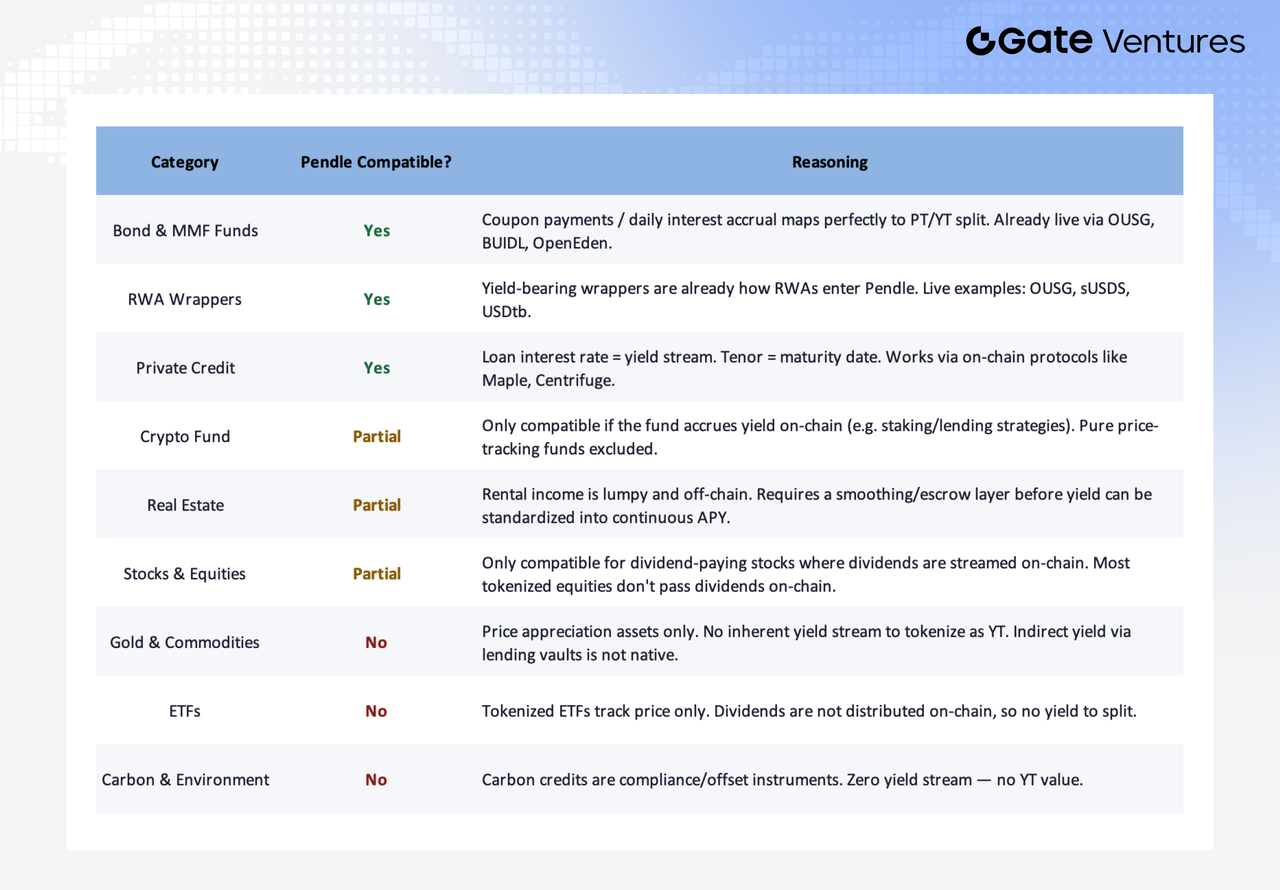
To be listed on Pendle, the fundamental requirement is that the asset must have splittable yield attributes. That is, the asset must consistently generate yield and be structurally split into principal (PT) and yield (YT). Assets without yield (like pure stablecoins) or those whose yield cannot be extracted independently cannot form Pendle’s core trading structure.

Additionally, yields need to be reasonably predictable and accumulate over time. Pendle’s pricing logic relies on expectations for future yield (implied APY), so yields must be modelable (such as staking, RWA interest rates, or mature funding/basis arbitrage)—not one-off or highly random returns. Yields should accrue continuously over time, not be distributed in discrete or event-driven bursts.

On the infrastructure side, the underlying asset should have sufficient scale and market demand to naturally create counterparties for fixed and leveraged yield trading, or else liquidity will be weak.

Given these requirements, on-chain bond assets, money market funds, and private credit yield assets are all likely future expansion directions for Pendle.

As for crypto funds, real estate, and equities, the key isn’t the asset class itself, but whether its yield can be consistently generated, quantified, and transmitted on-chain. For example, stock dividends, real estate rental income, or strategy yields from crypto funds—all are suitable for Pendle splitting into principal and yield, only if those cash flows can be stably accumulated and distributed on-chain.

The Foundation for RWA Perpetual Rate Trading: Boros

Source: Boros

Boros is Pendle’s funding rate trading market, enabling traders to convert the floating funding rate of perpetual contracts (perps) into tradable, lockable fixed rates. Simply put: Boros = on-chain perp funding rate swap market.

As more RWA assets move on-chain, perpetualization is almost inevitable. The unique mechanism of perpetual contracts is the funding rate, which anchors perp prices to spot/reference prices.

This is exactly where Pendle Boros comes in. In the future, when traders participate in RWA perps, the question isn’t just "Will asset prices rise?" but rather:

How can you prevent trading returns from being eroded by floating funding rates?

Boros allows traders to hedge or lock in funding rates, turning uncertain floating funding costs into predictable fixed rates. This gives RWA perp trading a clearer, more manageable yield structure.

Source: X@skyquake_1

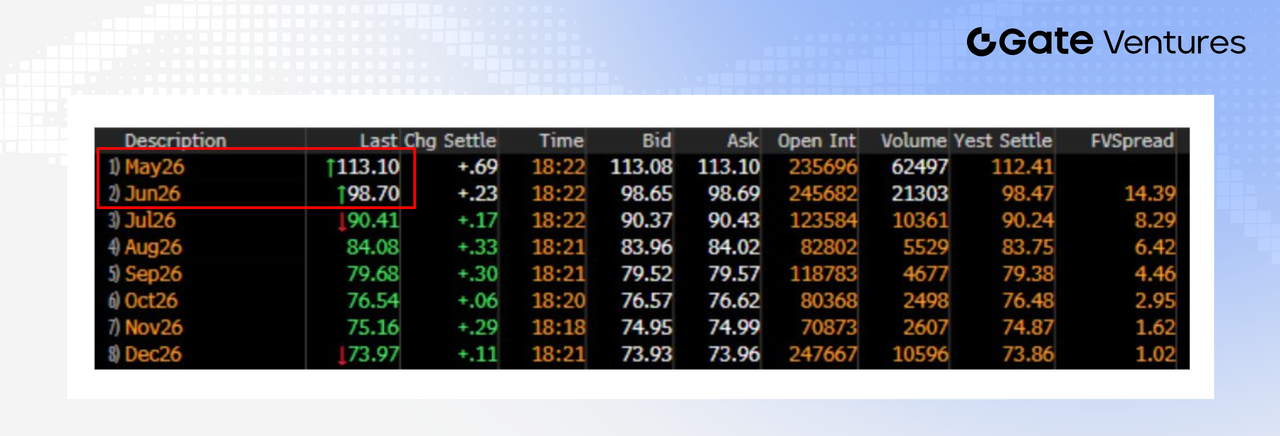
In April, the US-Iran conflict and the Hormuz Strait supply crisis caused the WTI curve to experience extreme backwardation. The spread between front-month and next-month crude prices widened rapidly, leading to rare large-scale basis trades and funding distortions in on-chain oil perps. The CL crude oil perpetual contract case perfectly illustrates why Boros is important.(3)

At first, this looked like a standard basis trade: WTI crude was at a clear spot premium, with the front-month contract priced around $113.10 and the next-month contract at about $98.70—a spread of $14.40, or roughly 12.7%.

Because trade.xyz’s oil perpetual contract oracle switches from the front-month to the next-month contract during rollovers, the perp price theoretically drops from near $113 to near $99. Traders can short the oil perp and go long CME next-month futures, waiting for the oracle repricing to close the spread.

But the real issue quickly emerged.

As more traders spotted this seemingly certain arbitrage, everyone piled in: shorting the perpetual contract.

In crypto perp markets, more shorts don’t directly compress the traditional futures market’s calendar spread. Instead, they unbalance perp market positions, pushing funding rates to extreme negative values. Short traders start paying hefty funding fees.

This is where Boros steps in.

Source: Pendle

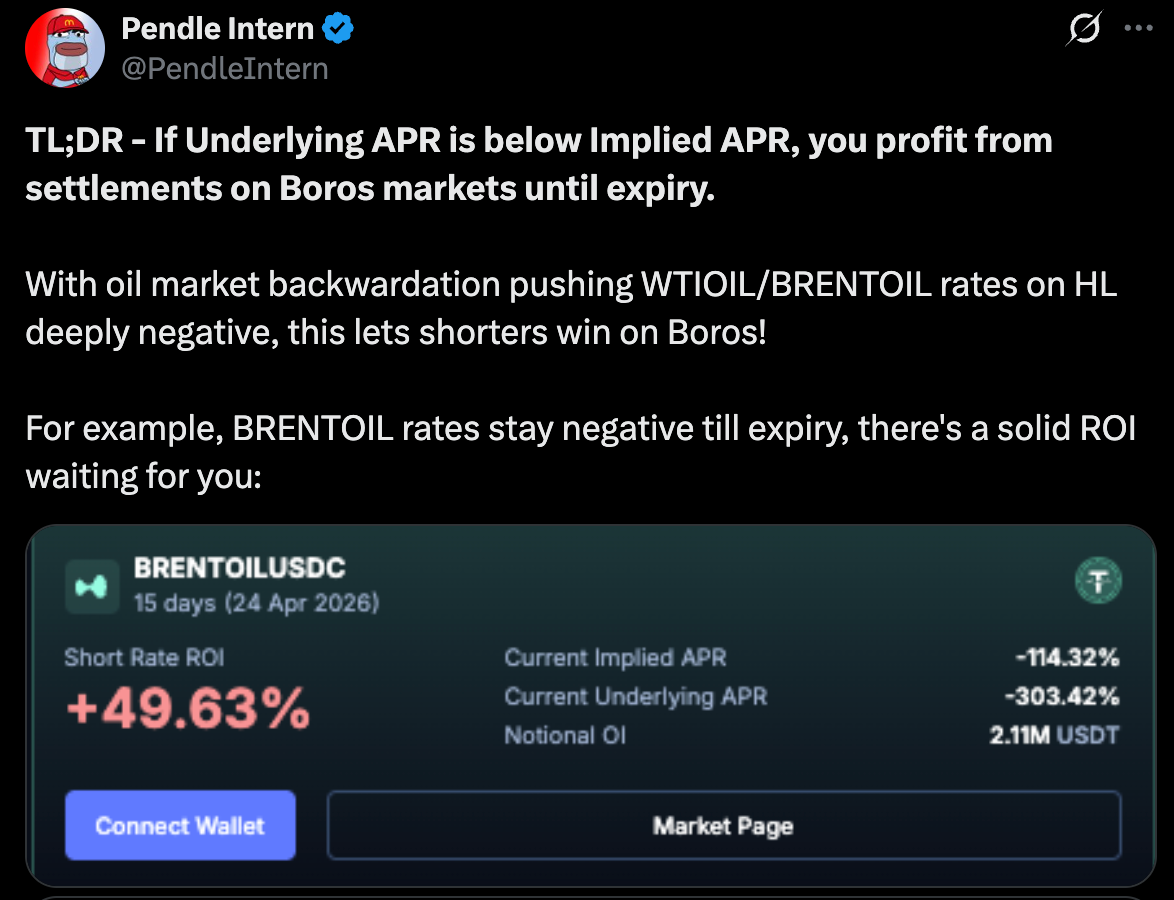
In this case, it appears to be an oil spread arbitrage, but the real profit/loss driver is funding rate.

Pendle’s team noted on Twitter that a trading group had shorted the perp and faced a breakeven funding rate cost of nearly -303%, while Boros could lock it at about -114%. Boros doesn’t just lower trading costs—it transforms a highly uncertain floating funding expense into a fixed cost that can be locked, calculated, and managed in advance.

This validates a broader trend: perpetual contracts are becoming a new venue for institutional basis trading. But for institutions to truly participate, they can’t just focus on price spreads—they must have funding rate risk management.

Boros provides on-chain perpetual contract markets with the foundational infrastructure for rate swaps, similar to traditional finance.

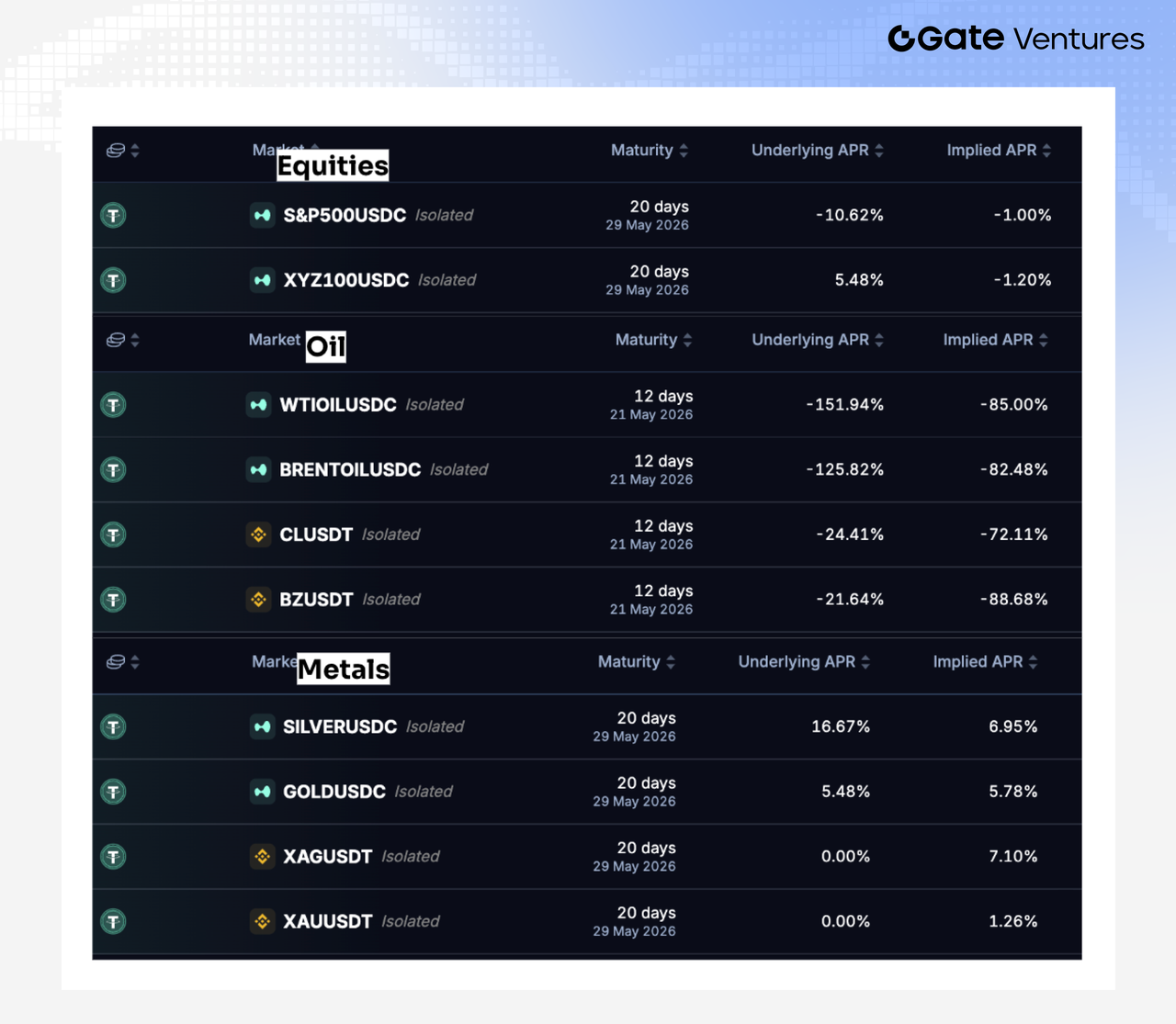
As more real-world assets—like oil, gold, forex, interest rate products, and equity indices—are perpetualized and brought on-chain, structural spreads and funding rate distortions like those in CL will become more common. Boros’s role will gradually evolve into the core rate trading layer for on-chain real-world asset derivatives markets.

What Trends Are Driving Pendle as RWA Yield Trading Infrastructure?

First: Regulatory restrictions on stablecoin yields may actually strengthen Pendle’s positioning

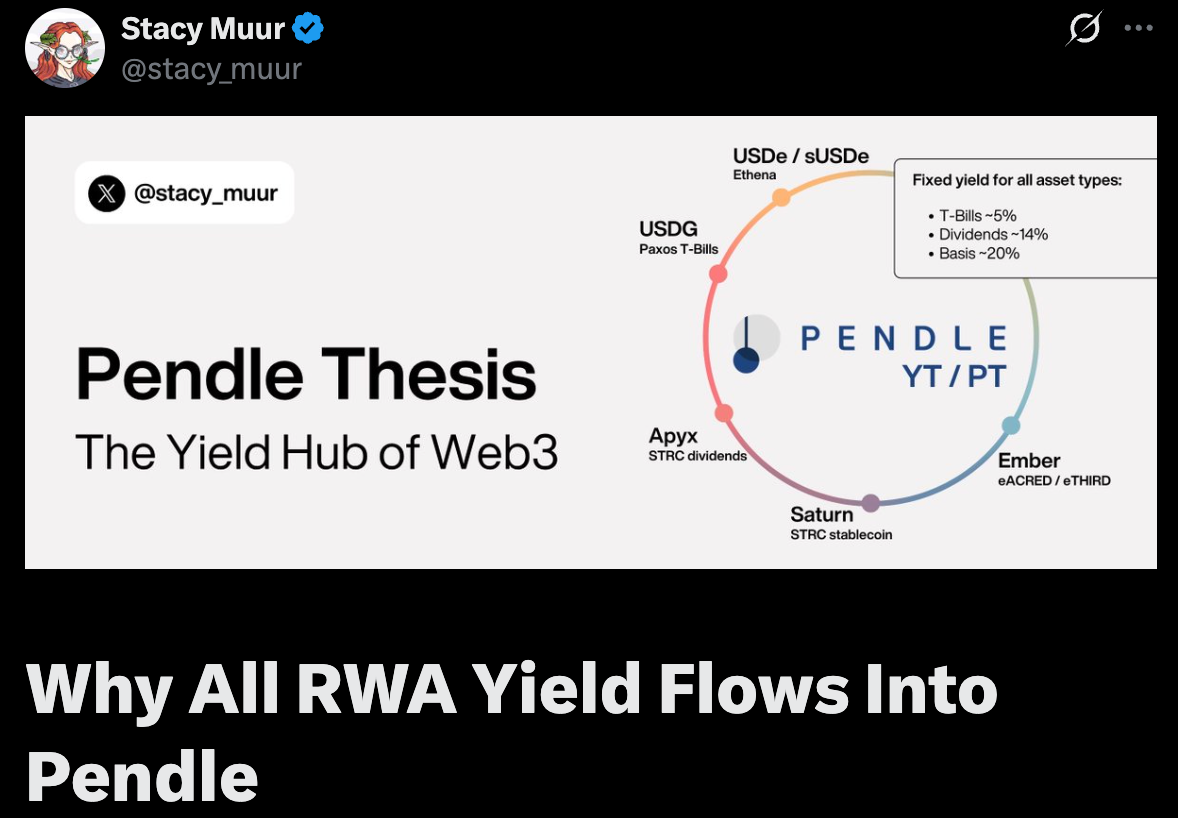
Source: X@stacy_muur

Analyst Stacy Muur points out that the GENIUS Act and CLARITY Act could make Pendle the default venue for stablecoin yield trading. The main reason: capital always flows to where yields are higher.(4)

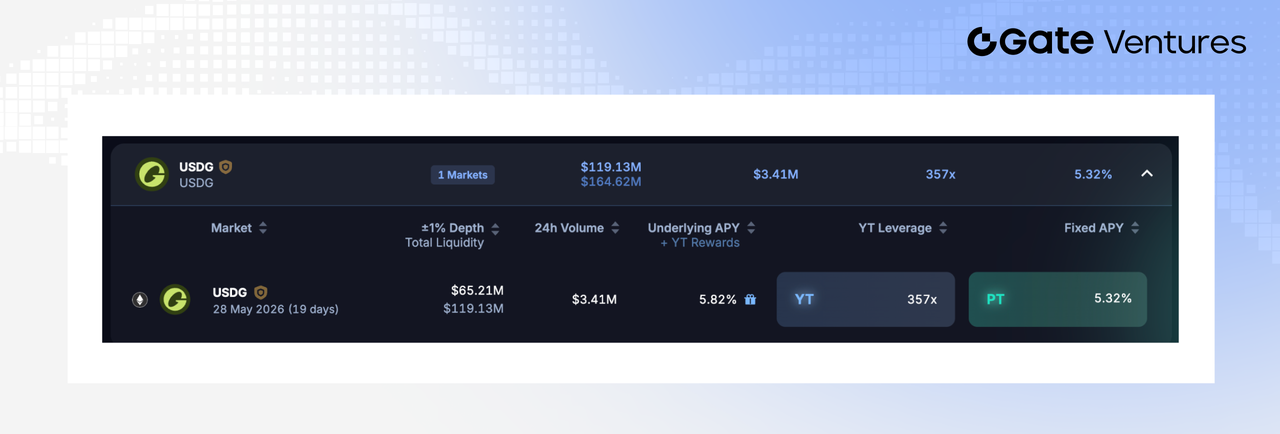
Source: Pendle

Looking at yield spreads, traditional bank savings accounts offer annualized returns as low as 0.01%, while centralized exchanges provide USDC rewards around 3.5%–4%. On Pendle, PT products like PT-USDG (a Treasury yield protocol) can deliver yields up to about 5.3%.(5)

This yield premium is a major driver for capital moving from banks and exchanges to on-chain platforms. Of course, this comes with corresponding on-chain risks: liquidity crunches, smart contract vulnerabilities, protocol risk, and market discount volatility.

Regulatory changes may further amplify this trend. The GENIUS Act prohibits stablecoin issuers from paying interest or yield to holders, but the restriction mainly targets "issuers," not exchanges or DeFi. The CLARITY Act goes further, potentially extending similar restrictions to "digital asset service providers," meaning exchanges like Coinbase and Kraken offering USDC yields could face greater regulatory pressure.

Pendle’s advantage is that it doesn’t pay interest directly from an issuer or exchange. For example, with PT-USDG, users earn fixed yields through price discovery and market discounts in a permissionless AMM, not from an institution’s promise to pay. If stablecoin issuers and centralized exchanges are restricted in offering yield products, Pendle could become one of the few on-chain venues still able to provide dollar-denominated fixed yields.

Second: A "bridging layer" is emerging between Permissioned RWA and Permissionless DeFi

Traditional RWA assets often have strong compliance requirements—KYC, whitelisting, investor qualification checks—making them difficult to enter open DeFi protocols like Pendle. But the market is developing new solutions: intermediary layers, wrappers, or synthetic stablecoins that repackage real-world asset yields into composable on-chain yield assets.

For example, yields from Treasuries, money market funds, and private credit can be wrapped into yield-bearing stablecoins or synthetic dollars, then enter Pendle to be split into PT and YT, creating a fixed and floating yield trading market.

This means Pendle doesn’t need to directly integrate every permissioned RWA product—it can serve as the secondary yield trading layer for "RWA yield wrapper assets," meeting on-chain demand for fixed income, rate trading, and yield management.

Meanwhile, Boros further expands Pendle’s long-term boundaries. Pendle founder TN Lee notes that Boros isn’t limited to funding rates; as long as reliable oracles provide rate data—whether Treasury yields, Libor, rental yields, staking returns, or any other percentage-based yield metric—they could be traded in the future. This greatly broadens Boros’s potential use cases and further opens up Pendle’s growth ceiling as on-chain rate trading infrastructure.

Third: Adoption and penetration of on-chain RWA perpetual contracts are rising

The market is moving toward a stage where "everything can be traded on-chain." Different asset classes are being tokenized and traded as perpetual contracts. Whether it’s xStocks, Ondo Finance, or other platforms exploring on-chain derivatives for stocks, ETFs, and commodities, the core trend is bringing traditional assets into on-chain trading markets.

As more RWA assets are perpetualized, funding rate becomes an unavoidable key variable. For institutional traders, the trade isn’t just about asset prices—it’s about the cost of holding positions and yield volatility driven by funding rates.

As shown in the CIL oil trading case, during periods of extreme market sentiment, geopolitical events, or weekend liquidity shortages, funding rates can swing wildly, significantly impacting trading returns.

In other words, as more stocks, commodities, and bond yields are traded as perpetual contracts on-chain, Boros could become the funding rate risk management layer behind these on-chain RWA perpetual markets.

  1. https://www.sifma.org/research/statistics/us-fixed-income-securities-statistics

  2. https://www.sifma.org/research/statistics/fact-book

  3. https://x.com/skyquake_1/status/2041496769746649234

  4. https://x.com/stacy_muur/status/2049060475837587759

  5. https://www.bankrate.com/banking/savings/average-savings-interest-rates/

The content herein does not constitute any offer, solicitation, or recommendation. You should always seek independent professional advice before making any investment decisions. Please note that Gate may restrict or prohibit the use of all or a portion of the Services from Restricted Locations. For more information, please read the User Agreement
Like the Content