As distributed energy resources continue to expand, the energy grid is shifting from a traditional centralized model toward a more open and flexible network architecture. Electric vehicles, home battery storage, solar photovoltaic systems, and smart meters are becoming essential elements of the power grid. However, given the sheer number and dispersed nature of these devices, their full potential remains untapped without a unified coordination mechanism.
OpenVPP aims to solve this challenge. Built on the Virtual Power Plant (VPP) concept, OpenVPP is an energy DePIN network that connects real-world energy devices via blockchain. It leverages smart contracts for energy data logging, device identity management, and value settlement.
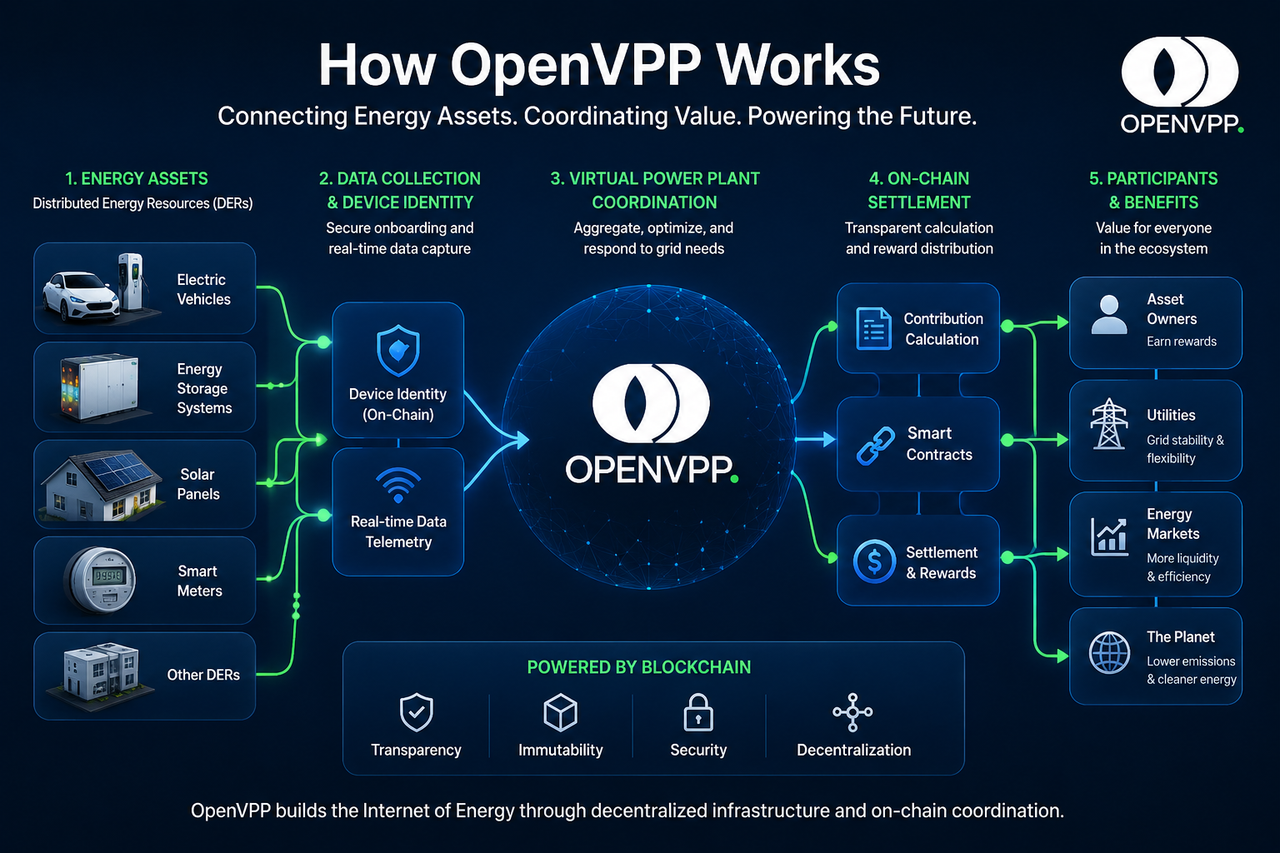
What Is the Overall Operational Logic of OpenVPP?
The core goal of OpenVPP is to organize a vast number of scattered energy devices into a unified energy network.
The operational flow can be broken down into six key stages:
- Device Network Connection
- Digital Identity Establishment
- Real-Time Data Collection
- Energy Resource Aggregation
- Energy Contribution Calculation
- On-Chain Settlement and Incentive Distribution
Unlike traditional virtual power plants, OpenVPP not only coordinates device operations but also records the flow of energy value.
The entire system can be viewed as a digital platform that manages both energy flow and value flow simultaneously.
How Do Devices Connect to the OpenVPP Network?
Device connection is the starting point of the OpenVPP process.
Users first need to connect their energy devices to the communication network supported by OpenVPP. The connection method may vary depending on the device type.
Currently, OpenVPP focuses on the following device types:
- Electric Vehicles (EVs)
- EV Charging Stations
- Home Energy Storage Batteries
- Commercial and Industrial Energy Storage Systems
- Rooftop Solar Panels
- Smart Meters
- Smart Energy Management Systems
After a device connects, the system verifies its parameters and operational capabilities, then establishes ongoing communication.
This process is similar to IoT device registration, except the objects here are energy infrastructure assets.
How Does OpenVPP Establish Digital Identities for Devices?
Digital identity is a critical component of the OpenVPP network.
Traditional energy systems rely on centralized databases to record device information, while OpenVPP establishes an on-chain identity framework.
When a device joins the network, the system creates a corresponding digital identity record containing:
- Device Type
- Device Owner
- Energy Capacity
- Geographic Region
- Historical Operational Data
- Credit Record
Digital identity allows the network to track device origins and ensures that all energy contribution records are verifiable.
This mechanism also lays the groundwork for future digitization and tokenization of energy assets.
How Does OpenVPP Collect Energy Data?
Energy data is the core foundation of the entire system.
After connection, devices continuously upload their operational status to the network.
Common data points include:
- Power Generation
- Power Consumption
- Battery State of Charge
- Storage Capacity
- Grid Response Status
- Device Online Status
This data is typically collected through smart meters, charging equipment, or energy management gateways.
OpenVPP uses this real-time information to build an energy status map, enabling a clear picture of the network's supply and demand dynamics.
Compared to traditional energy platforms, the blockchain-based recording mechanism enhances data transparency and traceability.
How Does OpenVPP Aggregate Energy Resources?
Energy resource aggregation is a core capability of any virtual power plant.
A single home battery or one EV can only provide limited capacity. But when thousands or even millions of devices are combined, they form a large-scale energy network.
OpenVPP dynamically aggregates resources based on device operational status.
For example:
- Dispatch storage when grid demand increases
- Schedule charging when electricity prices are low
- Increase storage utilization during periods of surplus renewable energy
- Coordinate demand response during peak load periods
This coordination mechanism enables a vast number of dispersed devices to work together, creating regulation capabilities comparable to those of a traditional power plant.
How Does OpenVPP Participate in Demand Response?
Demand response is a crucial application for virtual power plants.
When grid load spikes suddenly, the traditional approach is to activate backup power generation.
OpenVPP takes a different route.
The system coordinates energy devices within the network to collectively respond to demand changes, for example:
- Adjust EV charging rates
- Deploy home battery storage to discharge
- Optimize industrial equipment power consumption plans
- Shift non-critical loads
This approach reduces grid stress and improves overall energy efficiency.
Demand response capability is also a key source of value for virtual power plants participating in energy markets.
How Does OpenVPP Calculate Energy Contribution?
After coordinating energy resources, the system must determine each participant's actual contribution.
OpenVPP calculates energy value based on device-provided data.
Calculation dimensions may include:
- Power Generation Contribution
- Storage Contribution
- Grid Stability Contribution
- Demand Response Participation Level
- Online Duration
- Data Quality
Using unified rules, the system quantifies the value each device generates for network operation.
This is analogous to node contribution statistics in blockchain networks.
How Does OpenVPP Complete On-Chain Settlement?
On-chain settlement is one of the biggest differentiators between OpenVPP and traditional virtual power plants.
Traditional platforms rely on centralized databases for revenue calculation and payment management.
OpenVPP uses smart contracts to automate settlement logic.
After the system confirms a device's contribution:
- Data enters the settlement module;
- The smart contract verifies the contribution record;
- The corresponding reward is calculated;
- On-chain incentives are distributed;
- The device's reputation record is updated.
The entire process runs automatically without human intervention.
This mechanism improves transparency and reduces administrative costs compared to traditional settlement workflows.
What Role Does the OVPP Token Play in the Process?
OVPP is the core value token within the OpenVPP network.
In the complete operational flow, OVPP serves three main functions.
First, incentives: Devices participating in the energy network receive OVPP rewards based on their contributions.
Second, settlement: Certain network services and ecosystem activities are paid for or exchanged using OVPP.
Third, governance: OVPP holders can participate in protocol upgrades and community governance decisions.
Thus, OVPP is not just a digital asset — it is a critical medium linking energy activity with the on-chain economic system.
OpenVPP vs. Traditional Virtual Power Plant Processes
| Process Step |
OpenVPP |
Traditional VPP |
| Device Management |
On-Chain Identity System |
Centralized Database |
| Data Recording |
Blockchain Certification |
Platform Logging |
| Resource Aggregation |
Decentralized Coordination |
Centralized Operations |
| Incentive Method |
Token Mechanism |
Fiat Compensation |
| Settlement Process |
Automated via Smart Contracts |
Manual or Platform Settlement |
| Data Transparency |
High |
Relatively Limited |
Both handle energy coordination, but OpenVPP places greater emphasis on open networks and on-chain value exchange.
Summary
Through device connection, digital identity creation, data collection, energy aggregation, demand response coordination, and on-chain settlement, OpenVPP builds a complete decentralized virtual power plant network. Compared to traditional energy management platforms, OpenVPP not only addresses energy flow but also establishes a system for energy value flow, enabling real-world energy devices to participate in the digital economy.
As the Energy Internet and DePIN ecosystem continue to evolve, the model pioneered by OpenVPP is driving virtual power plants from simple energy management tools toward open energy infrastructure.
FAQs
How Does OpenVPP Connect Real-World Energy Devices?
OpenVPP connects distributed energy resources such as EVs, storage systems, and solar equipment through smart meters, energy management systems, charging infrastructure, and communication gateways, collecting real-time operational data.
Why Does OpenVPP Need a Digital Identity System?
A digital identity system records device attributes, operational history, and contribution data to ensure verifiability and traceability of energy activities. It also serves as a foundation for digitizing energy assets.
How Does OpenVPP Calculate Device Contribution?
OpenVPP evaluates contributions based on multiple dimensions including power generation, storage capacity, demand response participation, and online duration. The results drive subsequent incentives and settlement.
What Role Does the OVPP Token Play in Settlement?
OVPP is used for ecosystem incentives, value exchange, and governance. The system distributes OVPP rewards to participants based on device contributions and supports value transfer within the ecosystem.
What Is the Biggest Difference Between OpenVPP and Traditional VPPs?
OpenVPP uses blockchain and smart contracts to manage device identity, energy data, and value settlement, whereas traditional VPPs rely on centralized platforms. This gives OpenVPP distinct advantages in transparency, openness, and value transfer mechanisms.