Unlike stock indices, which simply track price changes, the VIX captures the market's expectations of future risk. When investors grow concerned about rising uncertainty, demand for safe-haven assets typically increases, driving up option premiums and pushing the VIX higher. As a result, the VIX has become an essential tool for monitoring market sentiment and risk appetite.
As the derivatives market has evolved, the VIX has long outgrown its role as just another market indicator. Today, futures, options, ETFs, and risk management tools built around the VIX form a complete volatility market ecosystem—with CBOE as its primary architect.
Why the VIX Matters to the Market
The VIX draws global investor attention because it offers a real-time read on how the market perceives future risk.
Traditional stock indices can only show price movements—they don't directly measure how much volatility investors expect going forward. By analyzing S&P 500 index option prices, the VIX quantifies the market's consensus on expected volatility over the next 30 days.
When uncertainty hits the financial markets, investors tend to buy more protective options to hedge their risk. That added demand pushes option premiums higher, which in turn drives up the VIX. This makes the VIX an important reference during shifts in market sentiment.
For many institutional investors, the VIX has become an indispensable barometer of market risk—on par with the attention given to some stock indices themselves.
How the VIX Measures Market Volatility
The VIX isn't calculated from stock prices. Instead, it's derived from the price data of the S&P 500 index options market.
Because option prices inherently embed the market's expectations for future volatility, CBOE uses a specific methodology to extract that information and construct the VIX. Simply put, the VIX shows what investors are willing to pay in "insurance premiums" to protect against future risk.
Generally speaking:
| VIX Level |
Market Condition |
| Below 15 |
Market sentiment is fairly stable |
| 15-25 |
Normal volatility range |
| 25-40 |
Risk sentiment is clearly elevated |
| Above 40 |
Strong fear in the market |
One key point: the VIX measures expected volatility, not market direction. Even if stocks are rallying, the VIX can stay elevated if investors see rising risks ahead.
That's why the VIX is best used as a risk indicator, not a tool for predicting which way the market will move.
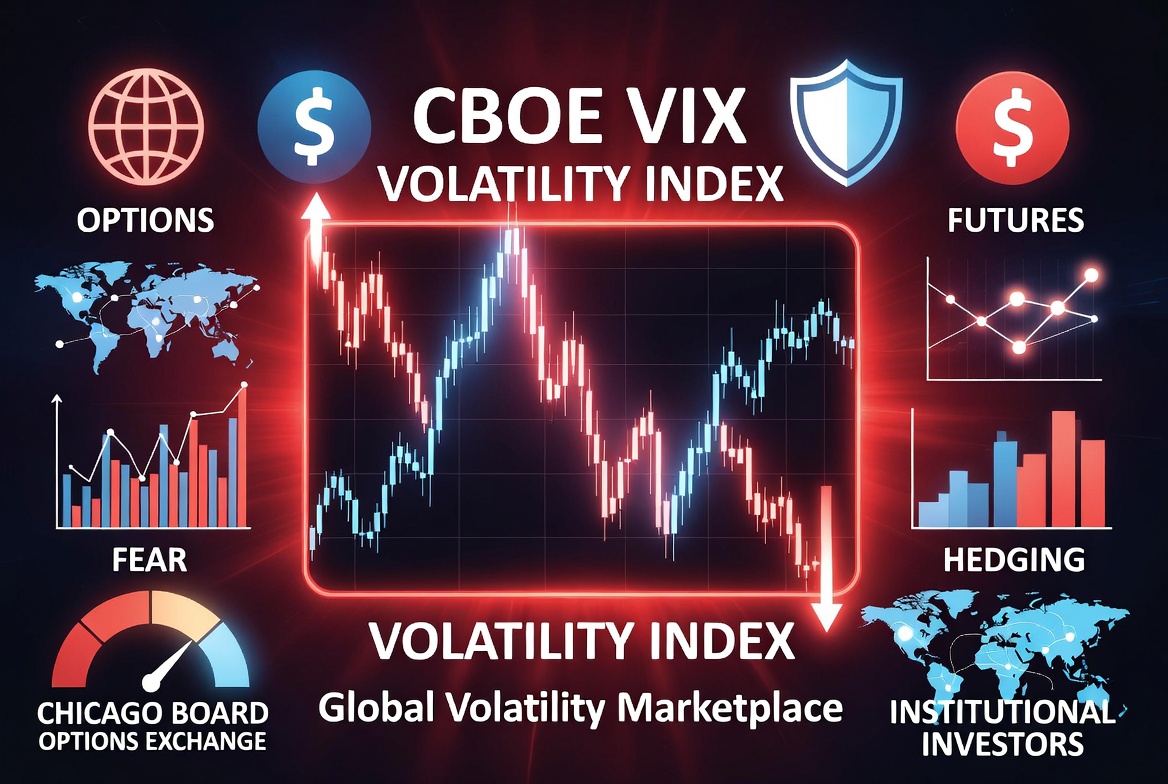
How Investors Use the VIX to Gauge Market Sentiment
One of the VIX's most common applications is helping investors read the mood of the market.
When the VIX rises steadily, it usually means the market is pricing in more risk and investors are turning more cautious. This tends to happen during times of rising economic uncertainty, heightened geopolitical tensions, or sharp financial market volatility.
On the flip side, when the VIX stays low, the market is generally in a calmer state. Investors have a higher risk appetite, and money tends to flow into risk assets like stocks.
Many fund managers and asset allocators incorporate the VIX into their risk monitoring frameworks. While the VIX can't predict the future, its trend can help investors understand how market sentiment is changing.
That's why the VIX has become one of the most important risk-monitoring tools in global capital markets.
As demand has grown, financial products built around the VIX have expanded, turning volatility into a tradable asset class.
Common VIX-linked products available in the market include:
- VIX futures
- VIX options
- Volatility ETFs
- Volatility ETNs
- Risk management strategy products
These products are mainly used for hedging, safe-haven positioning, and portfolio management.
For example, if investors are worried about sharp market volatility, they can use volatility products to hedge their risk. Because the VIX typically moves inversely to market risk sentiment, volatility products often serve as a form of portfolio insurance.
For some professional trading firms, volatility has become an independent investment asset in its own right—not just a supporting indicator.
Why Institutional Investors Focus on Volatility Management
For large institutions, managing risk is often more important than chasing returns.
Pension funds, insurance companies, sovereign wealth funds, and large asset managers control enormous amounts of capital, so they need to control the potential damage from extreme market swings.
Volatility indicators help institutional investors assess current risk levels and adjust their portfolios accordingly. When the VIX climbs, some institutions may reduce their exposure to risk assets. When volatility subsides, they may increase equity allocations.
On top of that, many quantitative models treat volatility as a core input. Changes in volatility affect not only risk levels but also asset pricing and portfolio construction.
For these reasons, volatility management has become a cornerstone of modern asset management.
Why the Volatility Ecosystem Is a Strategic Asset for CBOE
The VIX is more than just an index—it's a major competitive advantage CBOE has built over decades.
Because CBOE developed and operates the VIX, the futures, options, and other derivatives built around it are largely housed within the CBOE ecosystem. This allows the company to benefit from trading volume growth, market data revenue, and index licensing fees.
More importantly, the volatility market enjoys strong network effects. As more investors and institutions participate, liquidity improves, which in turn attracts even more participants to the ecosystem.
After decades of growth, the VIX has become one of the most recognized volatility brands globally. And the full ecosystem built around it gives CBOE a clear edge over other exchanges.
For CBOE, the volatility market isn't just a business line—it's a core source of long-term competitive strength.
How to Buy CBOE (Cboe Global Markets) Stock
CBOE is the ticker symbol for Cboe Global Markets, traded on U.S. stock exchanges. Traditionally, investors can buy CBOE shares through any brokerage account that supports U.S. stocks, gaining exposure to the global exchange industry.
Given CBOE's leading role in options and the VIX ecosystem, many market participants see it as a key player in the derivatives and financial infrastructure space.
As digital assets and traditional finance converge, new tools for trading around U.S. stock price movements have emerged. Some platforms offer CFD products linked to stock prices, letting users participate through price changes without directly owning the underlying stock.
Gate TradFi is steadily expanding its coverage of traditional financial assets. Users can monitor digital assets, U.S. stocks, ETFs, indices, and commodities—all within a unified account. In select markets, Gate also offers CFD products, giving users more options for cross-market asset allocation and price tracking.
No matter how they choose to participate, investors should fully understand the product structure, trading rules, and regulatory requirements in their jurisdiction.
Summary
The VIX is one of the most important volatility indicators in global finance. Its core function is to reflect the market's expectations for future risk and volatility. Both retail investors and large institutions use the VIX to monitor sentiment, assess risk, and shape their strategies. The ecosystem of futures, options, and volatility products built around the VIX has turned volatility into its own asset class. For CBOE, the VIX is not just an index—it's the foundation of a global volatility market ecosystem.
FAQ
What is the VIX?
The VIX is a volatility index developed by CBOE, calculated from S&P 500 index option prices to measure expected market volatility over the next 30 days.
Why is the VIX called the fear index?
When market risk increases, investors typically increase safe-haven demand, pushing up option premiums and the VIX. That's why the VIX is often seen as a gauge of market fear.
Does a rising VIX always mean stocks are falling?
Not necessarily. The VIX measures expected volatility, not market direction. However, it does tend to move inversely to the stock market in most scenarios.
Can retail investors trade the VIX?
Investors can't buy the VIX directly, but they can participate through VIX futures, VIX options, and related ETFs and similar products.
Why do institutions care about volatility management?
Volatility helps institutions assess risk levels and fine-tune asset allocation, making it a critical component of modern portfolio management.
Why is the VIX so important to CBOE?
The VIX is one of CBOE's most powerful brands. The trading products, data services, and licensing revenue built around it form a major competitive moat for the company.