Introduction
Most criticism of hedge fund returns is based on a category error. When someone tells you hedge funds “underperform the market,” they are comparing a boat to a car and complaining the boat is slow on highways. True - but that misses the entire point.
Buying the S&P, ergo, the market factor costs you 9 basis points per year. Elite hedgefunds charge close to 800-1600bps a year (2/20 + pass through fees land you in that benchmark). That’s literally 100x the cost difference.
If both products delivered the same thing, allocators would be idiots. But they are not delivering the same thing and the sophisticated institutions pouring hundreds of billions into these funds are not idiots.
What they are buying is something that cannot be replicated at any price: factor-neutral, high-Sharpe, uncorrelated returns at scale. And when you understand what that means, the cost premium starts making sense and you stop comparing a hedge fund to a vanguard index.
Understanding The Demand
The standard hedge fund critique goes like this: “Citadel’s 9.3% return while the S&P 500 is up roughly 17% this year.” For most hedge funds, it is probably a valid complaint since the median hedge fund probably is expensive beta.
However, it fundamentally misunderstands what elite hedgefunds like MLP/Citadel/P72 are selling. These funds are not trying to beat the S&P 500. That is not the mandate. Comparing a fund designed to have zero correlation to equities (actually stronger than that) against a 100% equity benchmark is like criticizing your insurance policy for not generating investment returns.
When you run a $100 billion pension fund, you already have $60 billion in equities. You are not short equity exposure - you are drowning in it. What you desperately need is something that goes up when equities goes down (or at least does not go down when equities do). You need diversification. Actually, what you REALLY want is something that goes up no matter what and performs better than cash.
That sounds REALLY good and SEEMS like a very expensive product, right? And so it is! Real diversification is extraordinarily expensive because it is extraordinarily rare!
Understanding The Competition
The S&P 500 has delivered a long-term Sharpe ratio of approximately 0.35 to 0.50. That means for every 1% of volatility you take, you earn 0.35-0.50% in expected excess return. The kind of sharpe ratios delivered by the best hedge funds in the world range between 1.5 to 2.5 or higher.
We are talking about maintaining sharpe ratios of ~2 for decades; so not only are you getting uncorrelated return streams that are free of the “cheap” stuff, you are getting them with significantly lower volatility. Drawdowns by these firms are shallow and recovery is fast.
Hedge funds are not a more expensive version of the same product. They are an entirely different product category. The “elite” hedge fund product category offers 2 premiums that are not obtainable with ETFs/market-tracking products:
- Factor neutrality
- High sharpe ratios
Factor Neutrality
To understand why factor neutrality commands such a premium, you need one formula:
r = alpha + beta * factor_returns + epsilon
r = your portfolio return
alpha = skill-based return (the intercept)
beta = your exposure to systematic factors
factor_returns = what those factors delivered
epsilon = idiosyncratic noise
The beta term represents the portion of your returns that can be reconstructed using publicly available factor portfolios. If I can replicate it, I should only pay replication prices for it. And replication is cheap: 3-9 bps for market beta, 15-30 bps for style factors.
The alpha term is what remains after I have accounted for everything replicable. By construction, it cannot be synthesized from factor exposures. That non-replicability is the entire basis for the premium.
Here is the insight most critics miss: beta is cheap because factor returns are a public good with unlimited capacity. If the market rises 10%, everyone holding market exposure captures that 10%. There is no excludability. The S&P 500’s returns are not diminished because more people own it. You can pour $10 trillion into market beta and everyone still gets the same percentage return.
Alpha is expensive because it is zero-sum with hard capacity constraints. Every dollar of alpha captured is a dollar of alpha lost by a counterparty. The inefficiencies that generate alpha exist in finite quantity, and they shrink as capital exploits them. A strategy that generates 2.0 Sharpe at $100 million may generate 0.8 Sharpe at $10 billion because the very act of trading at scale moves prices and arbitrages away the opportunity. This is why elite funds close to new capital. They are not being exclusive for status, they are protecting the scarcity that justifies their fees.
Factor neutrality (beta ≈ 0 across all systematic exposures) is the only configuration where the return stream is genuinely non-replicable. That is what justifies the premium. Not the returns themselves, but the fact that you cannot manufacture those returns any other way.
High Sharpe Ratios
Compounding effects of very high sharpe ratios show up over time. Two portfolios with the same 7% expected return but different volatilities (16% vs 10%) will have dramatically different outcomes over 20 years. The lower volatility portfolio has half the probability of loss and much better downside protection.
If you are an institutional endowment with spending commitments, that reliability is worth paying for.
Also, most people understand volatility as “how bumpy the ride feels.” That is true but incomplete. Volatility mathematically reduces your compound returns even when expected returns are identical.
Here is the formula that governs long-term wealth creation:
Geometric Return ≈ Arithmetic Return - (Volatility²/2)
This is called volatility drag, and is arithmetic reality that tells you how a high volatility portfolio will drastically underperform a low volatility portfolio in the long run.
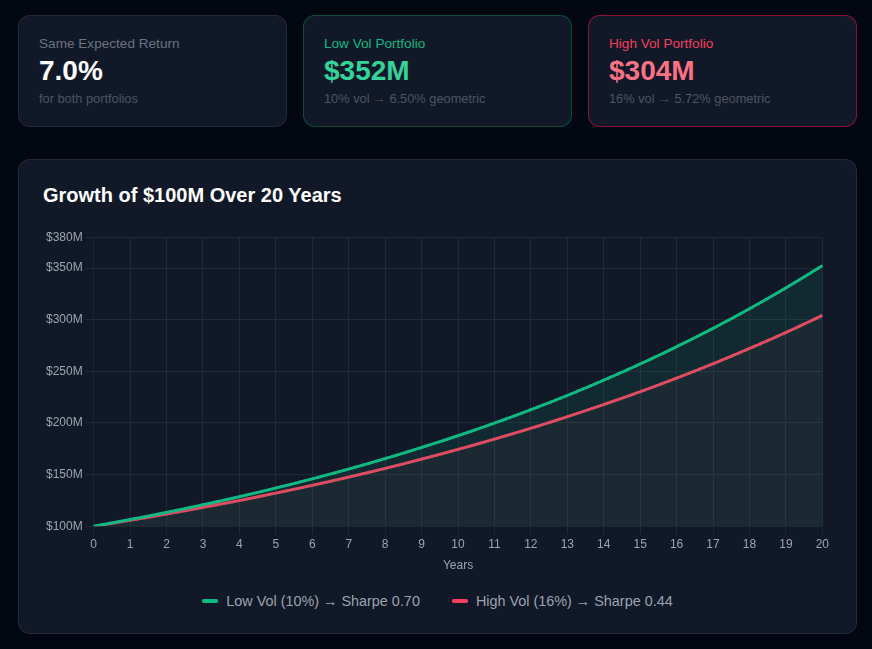
The low-volatility portfolio delivers $48 million more, a 16% improvement in terminal wealth, despite having the same “expected return.” This is not a risk preference, just mathematical fact that volatility destroys wealth over time.
Think Like An Allocator
Want to understand why allocators rationally pay ~100x more for factor-neutral funds? It comes down to some portfolio math.
Consider a toy institutional portfolio: 60% equities, 40% bonds. This gives you roughly 5% expected return, 10% volatility, and a Sharpe ratio of 0.5. Respectable, but not exceptional. And heavily exposed to equity risk.
Now add 20% to factor-neutral hedge funds with a 10% expected return, 5% volatility and a Sharpe of 2.0 and zero correlation to both stocks and bonds. Your new allocation: 48% equities, 32% bonds, 20% hedge funds.
You get higher expected return (6%) AND lower volatility (8%). Your Sharpe ratio improves by 50% (~0.75).
This is ONE uncorrelated hedge fund, if you can find 2? 3? Now you are starting to see how valuable a bunch of extremely high performing hedge funds that are uncorrelated to each other can be!
This is why allocators compete for access to elite funds. It is not because they failed to notice VTI is cheaper. It is because they understand some basic portfolio-level arithmetic. The comparison is not about fees. It is about what those fees buy you in terms of portfolio efficiency.
Finding Investments Like An Allocator
Let’s say you want to find and evaluate funds that are as close as possible to an elite hedge fund. You don’t have access to Citadel/Millennium/Point72 but you have a lot of time on your hands. Could you sift through many funds and determine if they have “elite” hedge fund worthy status?
Here are some things you want to look for:
Calculate factor exposure reports over time. Not just current exposures, but rolling exposures over years. A truly factor-neutral fund shows near-zero loadings on market, sector, and style factors consistently. If you see 0.3 beta to the market that “comes and goes,” that is factor timing - which may or may not add value, but is definitely not the product you want to be paying for.
Verify factor neutrality through stress periods. Any fund can show low correlation during calm markets. The test is crisis periods: 2008, 2020, March 2020, 2022. If their drawdowns coincided with market drawdowns, they were not factor-neutral. They are secretly loading up on beta.
Search for high sharpes for extended periods. You can have a very high sharpe in a short period out of sheer luck, but having very high sharpes for an extended period of time greatly reduces the probability that it is sheer luck. The sharpe after all, is a scaled t-stat (statistical significance) of returns.
Accept that you cannot replicate this with factor ETFs. Factor ETFs give you exposure to value, momentum, size, etc. for 15-50 basis points. That is not the same product. Factor ETFs are correlated with factors. Factor-neutral funds are not. The correlation structure is the entire point. You will need to look for actively managed funds or “alpha-generation” products.
Recognizing The Scarcity
When you do the above, you will likely come to the conclusion that the grand total of the number of products that meet all the criteria above is… 0! (But if you do find any, don’t tell me about that, don’t post about it - quietly invest in them and be happy you found a real gem! Congratulations!)
In all seriousness, you may be able to find such investments with those criteria, but they are almost certainly not going to be able to handle any kind of capacity required by institutional allocators. Being able to invest anything less than $100mn is uninteresting to a sovereign wealth fund with a ~trillion dollars in capital.
Then, you will likely (correctly) conclude that only a handful of firms have demonstrated Sharpe ratios above 2, at scale above $50 billion, for periods spanning multiple market cycles. This is extraordinarily difficult. The combination of factor neutrality, scale, and longevity is rare. That scarcity justifies the premium for those who can access it.
Conclusion
The 50-100x cost premium for elite factor-neutral hedge funds is justified by portfolio math that critics ignore. Allocators are not naive. Perhaps the only real scandal here is that too many funds charge elite fees while delivering expensive beta you could buy for 15 basis points.
(P.S: When funds report returns NET OF COSTS, they already include pass-through fees, so there is nothing left to deduct).
Disclaimer:
- This article is reprinted from [systematicls]. All copyrights belong to the original author [systematicls]. If there are objections to this reprint, please contact the Gate Learn team, and they will handle it promptly.
- Liability Disclaimer: The views and opinions expressed in this article are solely those of the author and do not constitute any investment advice.
- Translations of the article into other languages are done by the Gate Learn team. Unless mentioned, copying, distributing, or plagiarizing the translated articles is prohibited.







