Gate AI Product Positioning and Core Capabilities
From a positioning perspective, Gate AI is not a traditional automated signal tool; rather, it is an intelligent system built around market information, data analysis, and trading assistance. Its core logic is to use AI to reduce the cost for users to acquire information and understand the market.
In traditional trading processes, users often need to simultaneously monitor:
-
Market movements
-
News updates
-
Project developments
-
On-chain data
-
Market sentiment
Gate AI's goal is to integrate these fragmented sources of information and present them to users in a more intuitive way.
In terms of capability structure, Gate AI typically focuses on several core areas:
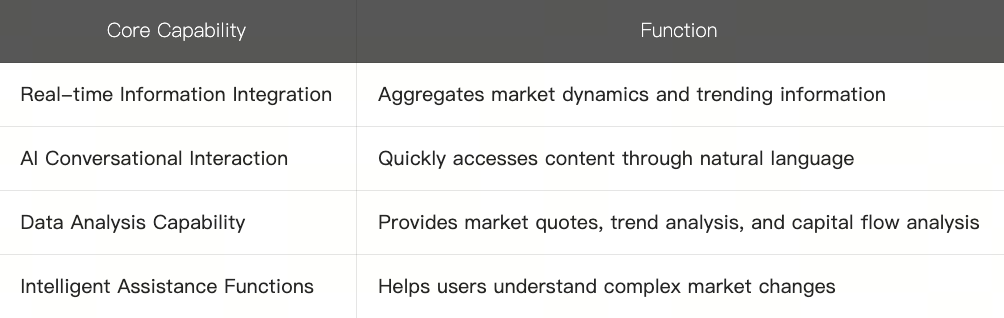
The focus of this model is not to replace users, but to help them improve decision-making efficiency.
In the crypto market, a key characteristic is that market changes often occur much faster than humans can process. Especially during periods of high volatility, large amounts of information can appear simultaneously in a very short time, such as:
-
Breaking news
-
Whale transfers
-
On-chain capital movements
-
Changes in community sentiment
-
Macroeconomic policy news
For regular users, it's difficult to filter and analyze all this information quickly. The value of AI lies in its ability to handle such high-density information environments.
Gate AI plays three main roles in this process:
Integrates information originally scattered across different channels, reducing users' search costs.
Content interpreter
Not only provides data, but further analyzes key points and potential impacts. Compared to traditional news platforms that only display data, AI systems focus more on understanding and analyzing market information. In addition to tracking price changes, the system also monitors market sentiment, trending narratives, capital flows, and the development of risk events.
For example, when a sector rises rapidly, AI not only displays the price changes but can also analyze whether market sentiment is heating up, whether capital is flowing into related tracks, and whether the narrative is becoming a market focus.
At the same time, when risk events occur in the market, the system can continuously track related discussions and market reactions, helping users quickly determine whether risks might further spread.
AI's role in financial markets is no longer just providing information; it is gradually becoming a decision support tool that helps users build market understanding. Unlike traditional news platforms that stack up news and data, AI emphasizes analyzing the logic behind market changes.
For instance, when a hot sector rises, AI not only shows price changes but also analyzes whether there is capital rotation, current market risk appetite, and whether similar trends have occurred historically. The system also observes correlations between relevant assets, helping users quickly understand structural changes in the market.
The core of this model is that AI doesn't just display the market—it attempts to understand it and assists users in forming judgments more efficiently.
Smart strategies, data insights, and user experience
One of the major changes AI brings to trading platforms is that user experience is shifting from function-driven to cognition-driven. In the past, platform competition focused on trading depth, fees, number of listed tokens, and product variety. But as the market matures, users increasingly care about whether a platform can help them understand the market more efficiently.
As a result, smart strategies and data insights are gradually becoming new core capabilities. Compared to simply providing trading functions, AI emphasizes helping users build market judgment through data analysis. For example, the system can help users identify market trends, observe capital flows, analyze asset correlations, and spot abnormal volatility to generate strategy references.
Meanwhile, AI is also changing how information is presented. The system can provide more personalized content and analysis highlights based on different user behaviors and preferences. For example, high-frequency traders focus more on real-time volatility and order flow changes; long-term investors care about macro trends and asset allocation; novice users need more market explanations and risk alerts. This shift means that trading platforms are gradually evolving from traditional tool platforms to intelligent interactive platforms emphasizing engagement and understanding.
AI application scenarios in crypto asset allocation
AI's applications in the crypto market aren't limited to market analysis—it's gradually entering asset allocation and risk management.
Due to characteristics such as:
Traditional static allocation methods often struggle to adapt to market changes in time. Therefore, AI is now used for dynamic asset management.
Common application scenarios include:
Market sentiment monitoring
Uses NLP (Natural Language Processing) to analyze social media, news, and community discussions to assess changes in market risk appetite.
Dynamic position adjustment
AI dynamically optimizes asset allocation based on market volatility, capital flows, and trend changes.
Risk alert system
When the market experiences abnormal volatility, liquidity drops, or on-chain risk events occur, the system can issue early warnings.
Smart strategy recommendation
Another important application of AI in investing is smart strategy recommendation. The system combines users' risk preferences, market environment, and asset characteristics to generate different types of strategy references, helping users quickly establish investment directions suited to their needs.
For example, for users with lower risk tolerance, the system may prefer stable allocation suggestions; when trends are clear, it may generate trend-focused strategy references. Additionally, when the market enters specific stages, AI can provide yield-enhancing strategies to help users optimize asset efficiency.
As model capabilities continue to improve, AI's role may further expand in the future. Beyond offering strategy suggestions, the system could enter automated asset rebalancing, multi-market linkage analysis, and integration of on-chain/off-chain data for more complex applications. In the long term, AI may even develop autonomous learning-based strategy optimization systems that allow investment models to continuously adjust logic based on market changes and further enhance dynamic decision-making capabilities.