Information Pressure and Efficiency Bottlenecks in the Crypto Market
Compared to traditional financial markets, the crypto market features higher-frequency information updates and price volatility. The market operates year-round without breaks, requiring traders to continuously track changes to maintain real-time decision-making.
In this environment, market participants typically need to monitor:
- Price trends and changes in trading volume
- Capital inflows and outflows
- On-chain transfers and large address activity
- Market sentiment and news events
- Price differences across various exchanges
When this information is dispersed, manual processing is not only inefficient but can also lead to delayed judgment. With the emergence of AI, multi-source data can be integrated and analyzed simultaneously, enhancing overall information processing efficiency and helping the market reflect new information more quickly.
How AI Reshapes Market Efficiency
The core value of AI lies in changing the speed and quality of information → decision → execution transmission in the market, thereby impacting overall market efficiency:
- Improve information processing speed
AI can analyze multiple data sources simultaneously and quickly identify potential trading signals, enabling market information to be absorbed and reflected faster.
Shorten trading response time
Through automated execution mechanisms, trading shifts from manual order placement to system-based real-time responses, reducing delays and making prices more closely reflect actual market conditions.
Strengthen strategy consistency and discipline
AI makes decisions based on data and models, reducing emotional interference and making trading behavior more systematic and stable.
Accelerate the price discovery process
As more trades are driven by algorithms, arbitrage opportunities in the market may shrink, price adjustment speeds increase, and the overall market moves toward greater efficiency.
Gate for AI: Practical Applications of Intelligent Trading
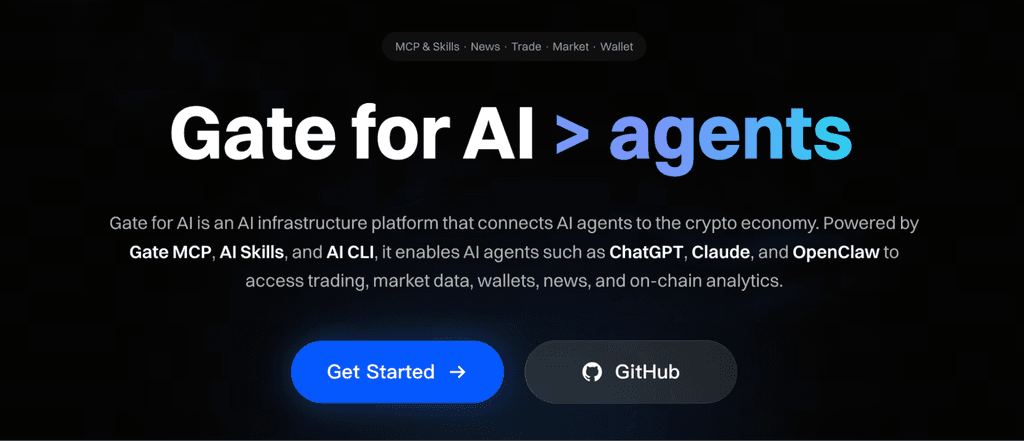
As AI gradually integrates into trading workflows, trading platforms are also beginning to incorporate relevant technologies to build a more complete intelligent trading environment. Gate’s Gate for AI is an example of integrating market analysis, strategy generation, and trade execution within a single system.
Through modular design, processes that previously required multiple tools are unified into one, making the trading workflow more coherent and reducing the time gap between analysis and execution.
Its core systems include:
- Market data monitoring system
- Strategy generation and optimization system
- Automated trade execution system
- Risk control and capital management system
This integration shifts the trading workflow from fragmented operations to systematic functioning, further improving execution efficiency.
Operational Logic of AI Trading Systems
In practice, AI trading systems usually form a continuous decision-making cycle, making market responses more dynamic and timely:
- Real-time monitoring of market dynamics
The system continuously tracks data such as prices, trading volume, and market volatility, using algorithms to identify potential opportunities.
- Establishing data-driven strategies
Trading strategies are generated based on analysis results and adjusted using historical data and risk parameters.
- Automatic execution of trading instructions
When market conditions meet strategy requirements, the system automatically places orders, reducing human delay.
- Continuous optimization and adjustment of strategies
As the market evolves, the system dynamically adjusts strategy parameters to maintain overall performance stability.
This cycle mechanism turns trading from a single decision into a dynamic process of continuous optimization.
Automated Strategies and Improved Decision Efficiency
Compared to traditional trading methods, AI can automatically generate and adjust trading strategies based on vast amounts of historical and real-time data, making the decision process more efficient and systematic. Its applications mainly focus on automating strategy generation and execution. The system dynamically creates trading strategies based on market trends and adjusts position allocations according to risk preferences; as market volatility changes, trading frequency adapts to different market rhythms. Meanwhile, the system continuously tracks strategy performance and optimizes related parameters, switching to more suitable strategy combinations when market conditions change.
With this mechanism, trading decisions gradually shift from relying on human judgment to being model-driven, making the entire process more consistent and efficient while further enhancing resource allocation efficiency in the market.
Risk Management: Stability Beyond Efficiency
While trading efficiency improves, risk control remains an indispensable component of automated systems. Because market volatility can expand rapidly in a short time frame, automated trading systems without risk management may actually amplify losses.
Therefore, AI trading systems typically incorporate multilayered risk control mechanisms such as:
- Smart stop-loss and take-profit
- Market abnormal volatility alerts
- Dynamic position and risk exposure management
- Reduced trading frequency in highly volatile environments
- Multilayered fund security and verification mechanisms
These mechanisms not only protect capital security but also ensure that systems can operate continuously in different market environments.
Future Trends: From Auxiliary Tools to Market Participants
As AI technology continues to evolve, future trading systems will integrate more data sources for more comprehensive market analysis—including on-chain capital flows, cross-market asset changes, community sentiment, macroeconomic data, and more.
Future development will focus on higher-level integration and autonomous capabilities. As data sources expand, trading systems will possess broader data integration abilities for more thorough market analysis; improvements in modeling capabilities will also enable more accurate trend predictions. On this basis, strategy execution will move further toward automation—AI can proactively adjust risk parameters and position allocations according to market changes, making decision processes increasingly dynamic.
At the same time, trading systems will move toward greater personalization by offering differentiated strategies tailored to users’ risk preferences and goals. Driven by these changes, AI’s role will shift from an auxiliary analysis tool to an important participant directly involved in market operations.
Market Efficiency Improvement and Intensified Competition
The introduction of AI has continuously improved efficiency in information processing, trade execution, and strategy optimization within the crypto market. However, this improvement also means that competition becomes fiercer—trading opportunities may be absorbed faster. In such an environment, trading will gradually shift from being human-led to human-machine collaboration or even further toward machine-led operations. While greater efficiency brings a more mature trading structure, it also raises skill requirements for participants.