Author: Arthur Hayes, founder of BitMEX; compiled by Jinse Finance
It’s time for me to transform into a “keyboard meteorologist” again. Concepts like La Niña and El Niño are flooding into my vocabulary. Predicting the wind direction for a snowstorm is just as important as forecasting snowfall amounts, as it directly relates to where I should go skiing. I use my limited weather knowledge to express opinions on when autumn will end and winter will begin in Hokkaido, Japan. I also discuss with other local skiing enthusiasts about my dream of an early start to the powder snow season. However, the app I check most frequently on my phone is not my favorite cryptocurrency chart app, but the snow condition forecast app.
As the data points continued to arrive, I had to decide when to head to the slopes with incomplete information. Sometimes, you can't predict the weather until the day before you put on your skis. A few snow seasons ago, I arrived in mid-December and found the entire mountain covered in dust. One lift line was open, yet it had to serve thousands of skiing enthusiasts. To ski on a thinly snow-covered, beginner to intermediate flat trail, people waited in line for several hours. The next day, heavy snow fell, and I enjoyed an epic powder run at my favorite ski resort, surrounded by forest clearings.
Bitcoin is the free market barometer for the liquidity of fiat currencies globally. Its trading is based on expectations of future fiat currency supply. Sometimes reality aligns with expectations, and sometimes it does not. Money is politics. The ever-changing political rhetoric can influence the market's expectations of future fiat currency supply. Our imperfect leaders sometimes call for the issuance of more and cheaper currency to support the voters they back; at other times, to combat inflation and prevent the public from suffering a heavy blow that threatens their chances of re-election or continuation of their rule, they also call for the issuance of more and cheaper currency. Just like in science, it is wise to maintain an open mind in trading rather than being stubborn.
After the disastrous defeat on April 2, 2025, during the American Liberation Day, I called for “only up, no down!” I believe that President Trump and his Treasury Secretary Mnuchin have learned their lesson and will no longer try to change the global financial and trade system too quickly. To regain support, they will print money to distribute benefits to their supporters, who hold significant financial assets such as real estate, stocks, and cryptocurrencies. On April 9, Trump announced a suspension of tariffs, which seemed like the beginning of another Great Depression but turned into the best buying opportunity of the year. Bitcoin surged by 21%, and some altcoins (mainly Ethereum) also rose, while Bitcoin's market share fell from 63% to 59%.
However, the implied liquidity expectations for Bitcoin in US dollars have deteriorated recently. The price of Bitcoin has fallen 25% since reaching its historical high at the beginning of October, with many altcoins experiencing even steeper declines than the capitalists in the New York City mayoral election. What exactly has changed all of this? The statements from the Trump administration have not altered. Trump continues to criticize the Federal Reserve for maintaining excessively high interest rates. He and his aides continue to discuss stimulating the real estate market through various means. Most importantly, Trump has compromised with China at every critical moment, hesitating to reverse the trade and financial imbalances between the two major economies because the resulting economic and political pain is simply unbearable for politicians who must face voters every two to four years. Also unchanged is the contraction of dollar liquidity, and the market's current focus on this is even greater than that on politicians' statements.
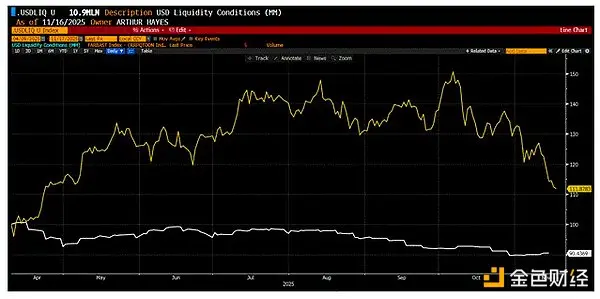
My US dollar liquidity index (in white) has fallen by 10% since April 9, 2025, while Bitcoin (in gold) has risen by 12%. This discrepancy is partly due to the Trump administration's positive liquidity rhetoric. Part of the reason is that retail investors view the inflow of funds into Bitcoin ETFs and the mNAV premium of DAT as evidence that institutional investors want to hold Bitcoin.
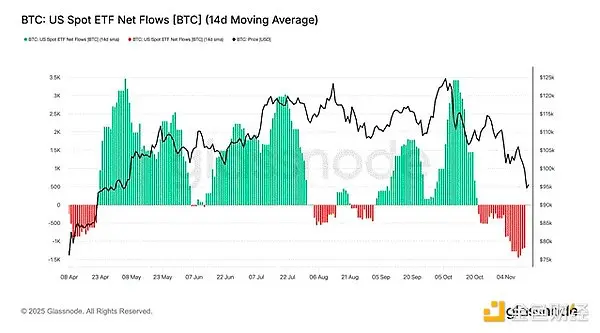
Institutional investors are flocking to Bitcoin ETFs, at least that's what the official sources say. As you can see, the net inflow of funds from April to October has provided continuous demand for Bitcoin, even as dollar liquidity has declined. I must add a point of clarification regarding this chart. The largest ETF by assets under management (BlackRock's IBIT US) has its largest holder using the ETF for basis trading; they are not bullish on Bitcoin. They are shorting Bitcoin futures contracts listed on the Chicago Mercantile Exchange (CME), rather than buying the ETF, to profit from the spread between the two. This approach is capital efficient, as their brokers typically allow them to use the ETF as collateral for their short futures positions.

The above are the five largest holders of IBIT US. They are all large hedge funds or investment banks focused on proprietary trading, such as Goldman Sachs.
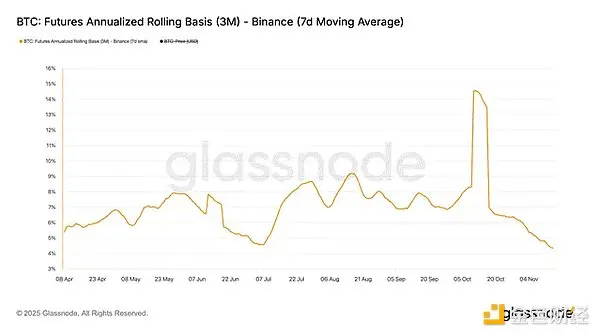
The above figure shows the annualized basis obtained by these funds through buying IBIT US and selling CME futures contracts. Although the figure displays data from Binance exchange, the CME's annualized basis is generally the same. When the basis is significantly higher than the federal funds rate, hedge funds flock in, causing a continuous large net inflow of ETF funds. This creates an illusion for those who do not understand the market microstructure that institutional investors have a strong interest in Bitcoin, when in fact they do not care about Bitcoin at all; they are merely participating to gain some extra yield above the federal funds rate. When the basis declines, they quickly liquidate their positions. Recently, with the decline in the basis, the ETF market has experienced massive net outflows. Now, retail investors believe that these institutional investors do not like Bitcoin, forming a negative feedback loop that prompts them to sell off, further lowering the basis, ultimately leading to more institutional investors selling their ETFs.
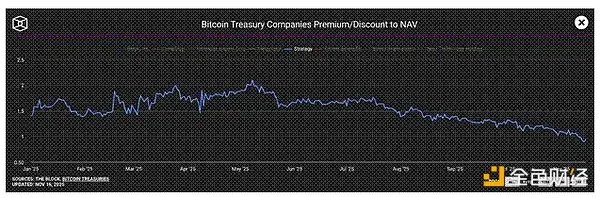
Digital Asset Holdings (DAT) provides institutional investors with another way to gain exposure to Bitcoin. Strategy (ticker: MSTR US) is the DAT that holds the most Bitcoin. When its stock trading price is significantly higher than its Bitcoin holdings (referred to as mNAV), the company can acquire Bitcoin at a lower cost through issuing shares and other financing methods. As the premium turns into a discount, the pace at which Strategy acquires Bitcoin also decreases.
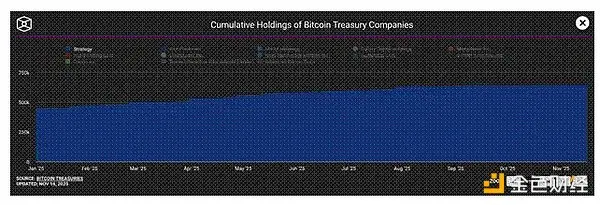
This is a cumulative position graph, not the rate of change graph for that variable, but you can intuitively see that as the mNAV premium of the strategy disappears, the speed of position growth slows down.
Despite the continued decline in dollar liquidity since April 9, the inflow of funds into Bitcoin ETFs and the purchases of DAT have driven up the price of Bitcoin. However, this situation has ended. The current basis is insufficient to sustain institutional investors' continued purchases of ETFs, and since the trading prices of most DATs are below their minimum net asset value, investors are now also shying away from these Bitcoin derivative securities. Without these inflows to mask the lack of liquidity, Bitcoin is bound to fall to reflect current short-term concerns about the decline in dollar liquidity or the growth rate not meeting the commitments made by politicians.
Let's see the real skills of Besant.
Now is the time for Trump and Besant to show their true abilities. Either they have the capability to make the Treasury superior to the Federal Reserve, create another real estate bubble, issue more stimulus checks, and so on; or they are just a bunch of weak and incompetent liars. More complicated is the fact that Democrats have discovered (which is not surprising) that developing campaign strategies around various narratives of “affordability” is the key to victory. Whether the opposition can deliver on these promises, such as free bus passes, a large number of rent-controlled apartments, and government-operated grocery stores, is not important. What matters is that the public wants their voices to be heard, and at least hopes that someone can self-deceive into thinking that those in power are looking out for them. The public does not want to be deceived by Trump and his “Make America Great Again” (MAGA) social media army, mistakenly believing that the inflation they see and hear every day is fake news. They want their voices to be heard like they were when Trump listened to them in 2016 and 2020, when he told them he would take on China, drive out people of color, and their high-paying jobs would magically reappear.
For those looking at the long-term future, the short-term slowdown in the issuance of fiat currency is irrelevant. If Republicans lack the ability to print money, the stock and bond markets will crash, which will bring those in both parties who are skeptical about monetary policy back to the cult of printing money. Trump is a shrewd politician, similar to former President Biden—Biden also faced strong opposition from the public due to inflation caused by the COVID-19 stimulus plans—he will publicly change his stance and criticize the Federal Reserve for causing inflation that affects middle-class voters. But don’t worry, Trump won’t forget those wealthy asset holders who fund his campaign. Besant will be tasked with printing money in ways that the public cannot understand.
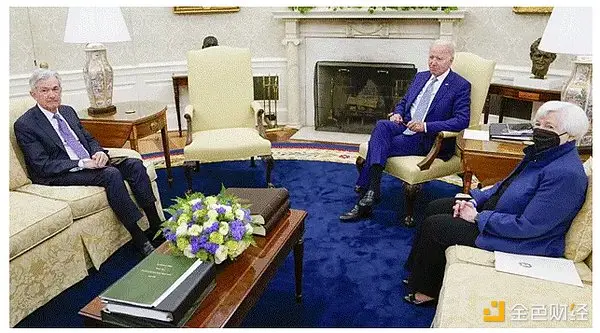
Do you remember this photo from 2022? Our favorite Federal Reserve Chairman Powell is being lectured by then-President Biden and Treasury Secretary Yellen. Biden explained to his supporters that Powell would curb inflation. Then, because he needed to increase the financial assets of the rich who put him in office, he instructed Yellen to rescind all of Powell's interest rate hikes and balance sheet reduction measures at all costs. Yellen issued more short-term Treasury bonds than long-term bonds or notes, pulling $2.5 trillion from the Fed's reverse repo program from Q3 2022 to Q1 2025, which boosted the prices of stocks, real estate, gold, and cryptocurrencies. For the average voter, and some of you readers, what I just wrote sounds like a foreign language, and that is precisely the point. The inflation you are feeling directly stems from a politician who once vowed to address the affordability issue for the public. Besant must also perform similar magic. I am 100% certain he will bring about similar results. He is one of the most knowledgeable experts in the operation of currency markets and foreign exchange trading in history.
Preparation Work
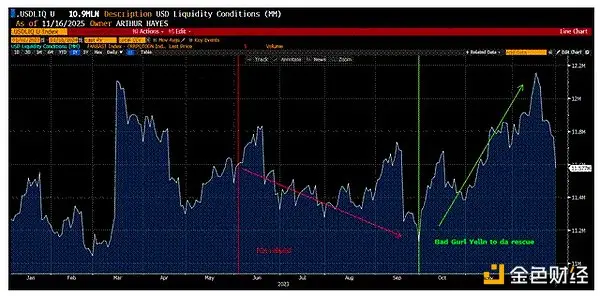
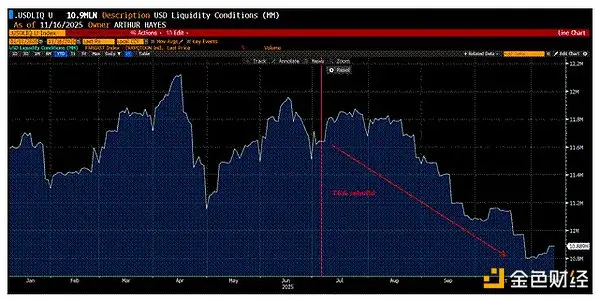
The market landscape in the second half of 2023 and the second half of 2025 is astonishingly similar. The debt ceiling showdown ends in the midsummer (June 3, 2023, and July 4, 2025), forcing the Treasury to rebuild the General Account (TGA), resulting in a decline in system liquidity.
2023:
2025:
Yellen has satisfied her boss. Can Bessent find his positioning and get the market adjusted so that the Republican Party can mobilize voters holding financial assets for the 2026 midterm elections?
Whenever politicians seriously listen to the voices of the majority of the public suffering from inflation, they tend to talk a lot about restraining those central bank governors and treasury officials who are keen on printing money. To dissuade them from tightening credit, the market presents a dilemma. As investors realize that printing money is taboo in the short term, stock and bond prices quickly fall. Politicians can either print money to save the highly leveraged fiat currency financial system that supports the overall economy but leads to accelerated inflation again, or they can allow credit tightening, which would destroy wealthy asset holders and cause massive unemployment, as over-leveraged companies are forced to cut production and jobs. Typically, the latter option is politically easier to accept, as the unemployment and financial distress reminiscent of the 1930s always lead to electoral losses, but inflation is an invisible killer, while using printed money to subsidize the poor can obscure this fact.
Just as I am confident in snowmobiling in Hokkaido, I am 100% sure that Trump and Besant want their Republican team to stay in power, so they will find ways to appear tough on inflation while also printing money to maintain a Keynesian fractional reserve system, thus continuing the deception of the US and global economy. On the mountain, arriving early can sometimes let you slide on the muddy snow. In the financial markets, before we return to a situation of 'only rising and not falling', to put it simply, the market must first decline before it can welcome a true 'eagle soaring high'.
The music videos they are shooting now are different from before.
Reasons to Watch the Market
The counterargument to my proposed theory of “negative dollar liquidity” is that as the U.S. government resumes operations after the shutdown, government financial assistance (TGA) will decrease by $100 billion to $150 billion, thereby reaching the target of $850 billion in the short term, which will increase system liquidity. Furthermore, the Federal Reserve will stop reducing its balance sheet starting December 1 and will soon restore balance sheet expansion through quantitative easing.
At the beginning of the government shutdown, I was optimistic about risk assets. However, after delving into the data, I found that according to my index, approximately $1 trillion in liquidity has evaporated since July. While the addition of $150 billion is certainly welcome, what will happen next?
Despite several Federal Reserve officials suggesting that restarting quantitative easing is crucial for rebuilding bank reserves and ensuring the normal functioning of the money market, this is merely talk. We can only be sure they are serious when the Wall Street Journal's Federal Reserve insider Nick Timiraos announces that the restart of quantitative easing has been approved. But we have not reached that point yet. Meanwhile, the standing repurchase facility will be passively used to print hundreds of billions of dollars to ensure that the money market can cope with the massive issuance of government bonds.
In theory, the Bessenet can reduce the scale of TGA to zero. However, since the Treasury must roll over hundreds of billions of dollars in national debt every week, a large cash buffer must be maintained to handle emergencies. They cannot bear the risk of defaulting on maturing debt; once a default occurs, the remaining $850 billion cannot be immediately injected into the financial market.
The privatization of government-sponsored mortgage agencies Fannie Mae and Freddie Mac is certain to happen, but it will not be completed in the next few weeks. Banks will also fulfill their “responsibilities” by providing loans to companies that manufacture bombs, nuclear reactors, semiconductors, etc., but similarly, these loans will be completed over a longer period, and this credit will not immediately flow into the dollar money market.
Being bullish is correct; over time, the printing press will inevitably roar. But first, the market must give back the gains made since April in order to better align with the liquidity fundamentals. Lastly, before I discuss the positions in Maelstrom, I do not agree with the notion of a four-year cycle. Bitcoin and certain altcoins will only reach new historical highs after the market crashes to a certain extent, prompting an acceleration in the printing speed.
Maelstrom Position
During the weekend, I increased my holdings in USD stable assets to respond to the expected decline in cryptocurrency prices. I believe that the only cryptocurrency that can escape the dilemma of insufficient USD liquidity in the short term is Zcash (code ZEC). With the involvement of artificial intelligence, large tech companies, and governments, privacy in most areas of the internet has disappeared. Zcash and other privacy cryptocurrencies that utilize zero-knowledge proof encryption technology are humanity's only hope to combat this new reality. For this reason, Balaji and others believe that the core concept of privacy will continue to drive the development of the cryptocurrency market for many years to come.
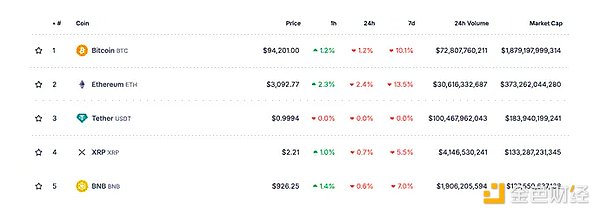
As followers of Satoshi Nakamoto, we should feel outraged: the third, fourth, and fifth largest cryptocurrencies by market capitalization are actually dollar derivatives, useless tokens on a blockchain with no real function, and a centralized computer owned by Zhao Changpeng (CZ). If 15 years later, these cryptocurrencies turn out to be the largest by market capitalization after Bitcoin and Ethereum, what are we even doing? I am not targeting Paolo, Garlinghouse, or Zhao Changpeng personally; they are all masters at creating value for token holders. Founders, please take note. But Zcash or similar privacy cryptocurrencies should only rank behind Ethereum in market capitalization. I believe the grassroots cryptocurrency community is gradually realizing that by giving these tokens such high market value, we are secretly supporting something that is contrary to a decentralized future. In a decentralized future, we, the flesh-and-blood humans, should still maintain our autonomy when facing oppressive technology, government, and AI giants. Therefore, while we wait for Bessent to resume the money printing pace, the price of Zcash or other privacy-focused cryptocurrencies will rise in the long term.
Maelstrom is still very strong, and if I have to buy at a high position like I did earlier this year, then let's buy. I accept failure calmly because I have enough fiat currency at hand to go all out for victory and ensure success every time. If a similar opportunity arises in April 2025, having enough liquidity will determine your profits and losses for this cycle more than blindly chasing sporadic trades (which will inevitably lead to losses).
The price of Bitcoin has plummeted from $125,000 to just over $90,000, while the S&P 500 index and Nasdaq 100 index are hovering near historical highs, making me realize that a credit crisis is brewing. My dollar liquidity index has also been continuously declining since July, confirming my view. If my judgment is correct, a 10% to 20% correction in the stock market, combined with the 10-year U.S. Treasury yield nearing 5%, would be enough to prompt the Federal Reserve, the Treasury, or other U.S. government agencies to urgently launch some sort of money-printing plan. During this weak period, it's entirely possible for the price of Bitcoin to drop to between $80,000 and $85,000. If the broader risk markets collapse and the Federal Reserve and Treasury accelerate money printing, then by the end of the year, the price of Bitcoin could soar to $200,000 or $250,000.
I still believe that the Chinese economy will experience inflation again. But it will only press the start button when the United States truly accelerates the issuance of dollars. The dragon is about to awaken and will pour Moutai into the flames of the 2026 cryptocurrency bull market.
Before I leave for the beautiful Argentina to dance gracefully, there is one last thing to say about China: Beijing is angry about the U.S. 'stealing' a Chinese citizen's Bitcoin through fraud, isn't that ridiculous? Clearly, China sees Bitcoin as a valuable asset that should be held and preserved by the Chinese government or its people, not the U.S. government. If both the U.S. and China believe Bitcoin is valuable, why are you not optimistic about Bitcoin's long-term prospects?


