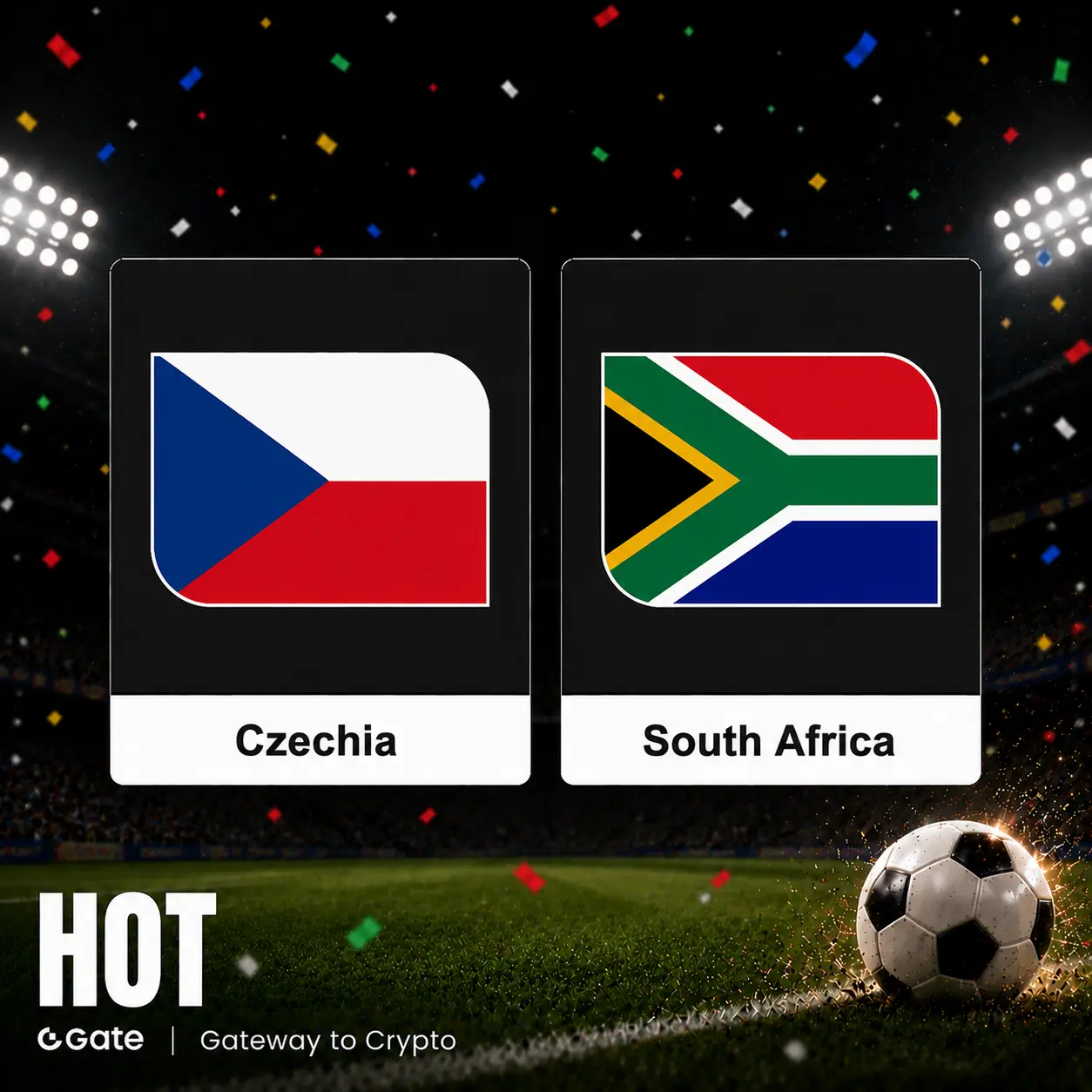
Does a 52% win-rate expectation accurately reflect the true course of the match? Behind the probability distribution of the three possible outcomes, what key variables are market funds pricing in?
How big is the gap in world ranking and squad strength between the two teams?
One of the core reasons the prediction market gives Czechia a 52% win rate is the gap in “paper strength” between Czechia and South Africa.
As of April 2026, Czechia is ranked 41st in the world, while South Africa is 60th. The 19-place difference reflects, to a certain extent, the divide between overall competitiveness in European football and African football. Czechia returned to the World Cup after 20 years, squeezing through via the European qualification playoffs. South Africa, meanwhile, finished a 16-year “World Cup drought” by edging out Nigeria by one point in the African qualifying playoffs.
In terms of squad composition, Czechia’s player setup is more experienced in major international tournaments. The forward core, Hložek (Patrik Schick), made 24 appearances and scored 11 goals this season for Bundesliga side Bayer Leverkusen, while the midfield enforcer Souček (Tomáš Souček) is a regular starter for English Premier League club West Ham United. By contrast, South Africa’s lineup is mainly made up of players from the domestic league: players from Mamelodi Sundowns and Orlando Pirates contribute the vast majority of their internationals, and the only player playing in one of Europe’s “top five” leagues is the English Premier League forward Foster (Lyle Foster) of Burnley.
Ahead of the match, Czech head coach Kubeck conceded in a press conference that the team’s competitiveness has dropped sharply compared with the “golden generation” era in 2006. Today, most of the players in the squad play in their domestic league, making it impossible to field a starting XI at the level of Europe’s top five leagues. Even so, Czechia’s overall squad depth and experience still surpass South Africa.
How did the opening-match performance shape market expectations for both teams?
The result of the opening match often significantly influences the probability pricing in prediction markets in the short term. Czechia lost 1-2 to South Korea after a reverse, while South Africa was completely outplayed and lost 0-2 to the host Mexico. Although both teams earned no points, the match content differed markedly.
In the match against South Korea, Czechia scored first and at one point took the initiative, but the eventual comeback exposed the team’s lack of ability to control the tempo after taking the lead. Still, Czechia’s attack had bright spots—scoring two goals via headers (one of them was ruled out for offside). Their height advantage is a key weapon for Czechia, and against South Africa, whose physique is at a disadvantage, aerial bombardment and set-piece combinations will be the most direct routes to breaking the deadlock.
South Africa’s opening-match performance was worse. Not only did they lose 0-2, but two midfield mainstays such as Fomba Swani were sent off after receiving red cards one after another. Under World Cup rules, a red card results in a suspension, meaning South Africa faces serious personnel shortages in midfield. Head coach Hugo Broos also admitted that the team’s rhythm in the opening match did not keep up, revealing multiple defensive mistakes and several unforced passing errors.
Judging by the opening performances, Czechia’s loss was more a matter of regret over details, while South Africa’s loss exposed structural flaws. This difference is directly reflected in the prediction market’s probability distribution—Czechia’s win rate is above 50%, while South Africa’s win rate is less than one-quarter.
How does squad completeness and the absence of key players affect the win probability?
The suspensions from red cards for two South African midfield players are one of the most decisive variables in this match. Midfield is the hub of both offense and defense transitions, and the absence of the two starters will force South Africa into passive adjustments in formation and tactics. Some analyses suggest South Africa in a must-win match may be pushed to retreat into a low defensive system with five defenders. Counter-attack football is South Africa’s strength, but the absence of the midfield core will directly weaken their ability to turn possession into attack and reduce the points of initiation for counter-attacks.
By contrast, Czechia has no major personnel losses. Core players like Schick, Souček, Coufal (Vladimír Coufal), and Krejci (Ladislav Krejci) are all available. The attacker Hložek (Adam Hložek) has also fully recovered, giving Czechia more attacking options.
The imbalance in squad completeness is one of the important reasons the market gives Czechia a higher win rate. In the World Cup group stage elimination format, the absence of any one key player can be amplified into a decisive factor. South Africa’s “double red card” loss in midfield has already been reflected in the prediction market’s pricing.
What reference value can the head-to-head record provide?
Czechia and South Africa have only met once in an official match—at the 1997 FIFA Confederations Cup, when the two teams drew 2-2. Back then, Czechia took the lead twice through Šmicer (Vladimír Šmicer), and South Africa equalized twice.
That match from 29 years ago offers limited reference value for today’s showdown. The squads, tactical systems, and overall strength of both teams have undergone fundamental changes. The only thing that can be confirmed is that there is no psychological dominance between the two sides on a big-match stage. With a lack of historical head-to-head data, the uncertainty of this match increases instead.
For prediction markets, the absence of head-to-head history means pricing relies more on immediate factors such as current form, squad strength, and tactical fit, rather than the influence of historical inertia.
How does the situation for group advancement affect each team’s game strategy?
The group advancement situation in Group A is key background for understanding the strategic significance of this match. After the first round, Mexico and South Korea each have 3 points, while Czechia and South Africa are both on 0. For two teams with zero points, the loser of this match will basically be out of contention for the knockout stage—two straight defeats mean that even if they take all 3 points in the last round, it will still be difficult to break into the best third-placed teams based on total points.
This urgency of “win or go home” will deeply affect both teams’ tactical choices. Czechia needs a win to keep their advancement hopes alive, and South Africa has no way out either. But with midfield reduced, South Africa may be forced to strengthen their defense, which could trap them in a dilemma of “wanting to attack but can’t, wanting to defend but can’t.”
It’s also worth noting that this match is being played in Atlanta, while in their respective opening matches, both teams played in different cities in Mexico. Both Czechia and South Africa need to cross long distances and adapt to altitude changes. Fitness recovery and adaptation ability may also become invisible factors affecting the match flow.
What pricing logic does the prediction market’s probability distribution reveal?
The probability distribution provided by the Gate prediction market—Czechia win 52%, draw 27%, South Africa win 22%—reflects the market funds’ combined pricing of multiple variables.
Czechia’s 52% win rate is slightly higher than the implied probability embedded in Czechia’s win odds in traditional bookmakers (about 50% to 55%). This indicates that participants in the prediction market assess Czechia relatively positively, likely based on the following logics: South Africa’s structural disadvantage caused by midfield losses, Czechia’s height and set-piece advantages, and the attacking threat Czechia showed in the opening match.
The 27% draw probability is significantly higher than the draw probability in general football matches (usually around 25%). This relatively high draw pricing may reflect the market’s concern about scenarios such as: even if Czechia has the edge, their ability to break through may be limited, and after South Africa compresses their defense, the match could be dragged into a stalemate. Both teams lost in the first round, and with a context in which neither side dares to rush forward easily, the possibility of a draw increases.
South Africa’s 22% win rate is the least favored outcome by the market. This probability is not only lower than Czechia’s win rate, but also significantly below how traditional bookmakers price South Africa’s chances of winning. With three factors stacking—suspension due to red cards, a collapse in the opening match, and the overall strength gap—the market treats a South Africa upset win as a low-probability event.
Frequently Asked Questions (FAQ)
Q: How are the probability data from the Gate prediction market formed?
The market price is jointly determined by the participants’ buying and selling actions. When more funds buy the “Czechia wins” contract, the contract price rises, and the corresponding probability increases accordingly. After Gate integrates with Polymarket, users can use USDT directly within the Gate App to participate in prediction trading. Market price is essentially the collective wisdom’s probability judgment of the event outcome.
Q: Does a 52% win rate mean Czechia will definitely win?
No. 52% only means that the market participants believe the chance of Czechia winning is slightly higher than half. A prediction market provides a probability assessment, not a certain prediction. South Africa’s 22% win probability and the draw’s 27% probability likewise indicate that a considerable portion of market funds believe the match may go other ways.
Q: How much will the red-card suspensions for two South African players affect the match?
Significantly. Midfield is the core area for attack-defense transitions; the absence of two midfield starters will directly weaken South Africa’s ability to control possession, launch counter-attacks, and cover defensively. South Africa’s head coach may be forced to adjust the formation, which will create knock-on effects for the team’s overall tactical execution.
Q: Where exactly does Czechia’s height advantage show up?
Czechia has a clear height advantage in set pieces and aerial duels. Players like Souček and Schick have strong abilities when contesting headers. Against South Africa’s defensive line, which is relatively shorter, Czechia’s corners, free kicks, and wide crosses will become important scoring methods.
Q: What does this match mean for both teams’ prospects of advancing from the group?
The team that loses will basically be out of the knockout race. Two straight losses mean that even if they win in the last round, their total points will only be 3, making it hard to gain an edge in cross-comparisons among third-placed teams. Therefore, this isn’t just a three-point battle—it’s a life-or-death match for both teams in this World Cup.