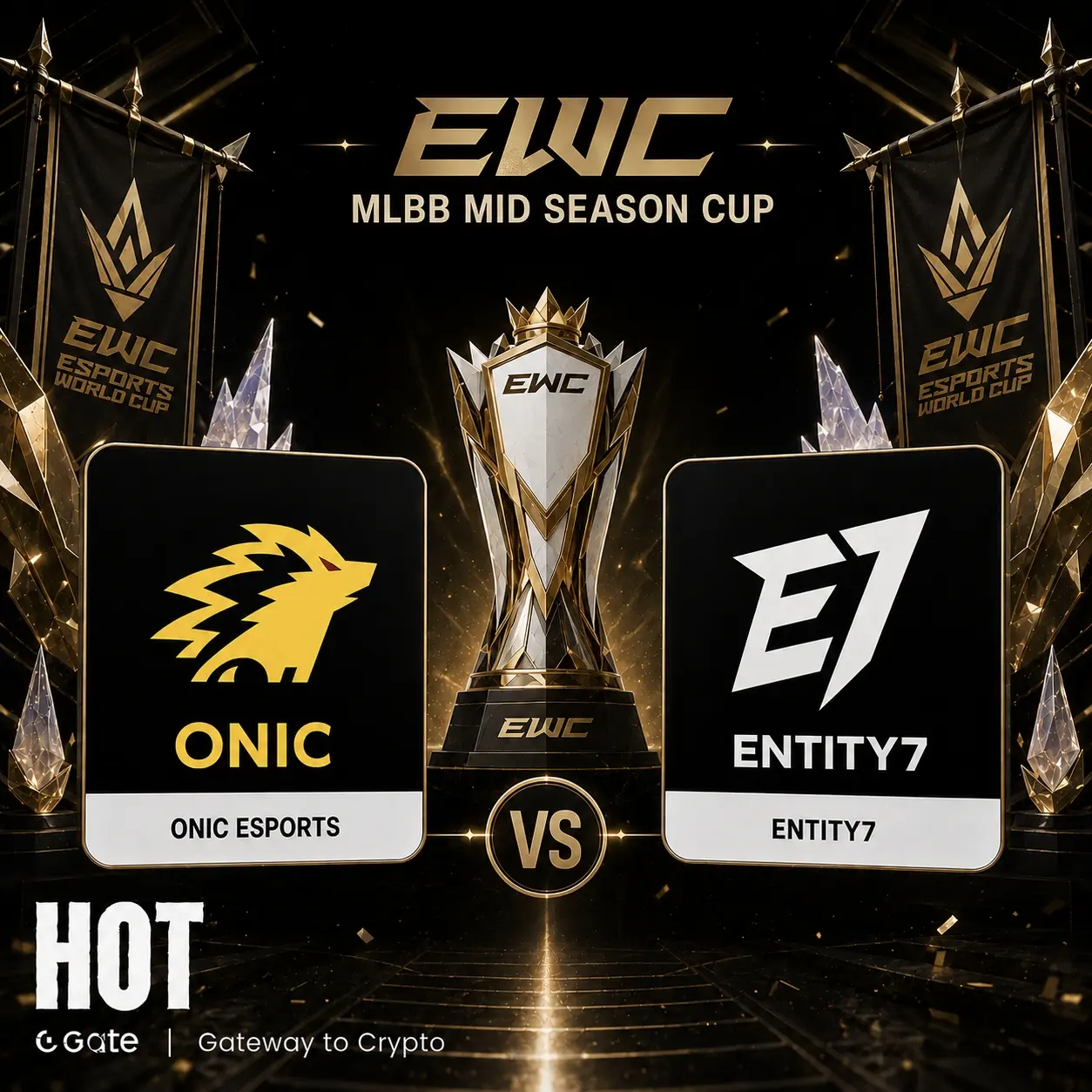
A near-12x gap in win rate is not common in esports tournament predictions. What kind of market consensus does this stark odds structure reflect? How large is the actual performance gap between the two teams? And how should prediction market data be interpreted rationally?
The 2026 summer esports season is already underway, with major events such as EWC, LPL, and LCK continuing one after another. Popular esports titles including LoL, Dota 2, Counter-Strike, and Valorant are all getting underway in succession. Gate has launched the limited-time “电竞巅峰交易季” campaign, predicting esports matchups worldwide and sharing in a prize pool of 200,000 USDT.
What position does MLBB MSC 2026 hold within the EWC ecosystem
MLBB is one of the most influential mobile MOBA games worldwide. As of now, the game’s global monthly active users have surpassed 110 million, and total registered users exceed 1.5 billion. In 2026, MLBB esports events are expected to cover more than 70 countries and regions worldwide, with global viewership time exceeding 600 million hours.
As one of EWC’s core events, MLBB MSC 2026 has a total prize pool of up to $3.5 million. The tournament features 16 top teams from around the world, split into Groups A and B for the group stage. The group stage uses a double-elimination format, with all matches played as Bo3 (best of three). The top four teams in each group advance to the knockout stage. The knockout stage begins on July 29, and the Grand Final is scheduled for August 1 in a Bo7 format to decide the champion.
Group B, where ONIC is placed, is essentially a “group of death.” Other teams in the same group include Selangor Red Giants, Team Liquid, Aurora Gaming, and other strong squads from different regions. The importance of the first match in the group stage is self-evident—winning sends the team directly into the winners-bracket semifinals, while losing drops them into the losers bracket, making advancement prospects extremely unfavorable.
How big is the performance gap between ONIC and Entity7
ONIC Esports is a traditional powerhouse in the Indonesian MLBB scene. In MPL Indonesia Season 17, ONIC finished as runner-up, securing their spot in MSC 2026. In terms of roster composition, ONIC has four players who have won international event championships: Kairi, Sanz, and Kiboy previously lifted the MSC 2023 championship trophy together, while Kelra is the winner of the M6 World Championship. Kairi plays as the Jungler, Kiboy is the Roamer, Sanz anchors the Midlane, and Kelra handles the Gold lane.
International tournament experience is a key metric for measuring a team’s ceiling. ONIC is not only the champion of MSC 2023, but they have also repeatedly represented Indonesia at world-class events. In MLBB’s global power rankings, ONIC is listed as Tier A, alongside teams such as Selangor Red Giants and Team Spirit.
By contrast, Entity7 represents the AMER region (the Americas)—a region still in the growth stage within MLBB’s global map. In earlier power rankings, Entity7 was categorized as Tier D, in the same tier as teams such as Sunset Ravens and True Rippers. In pre-tournament predictions, professional esports media were direct: the South American region where Entity7 plays is a “fledgling scene,” and external expectations for its competitiveness on a top-stage like MSC are not high.
From player résumés, regional strength, and international experience, a systemic performance gap exists between ONIC and Entity7. This gap is not due to only one or two positions having individual advantages; it is a comprehensive lead spanning tactical systems, tournament mindset, and team synergy.
How the 93% vs. 10% win-rate data is interpreted by the market
Based on Gate prediction market data, ONIC’s win probability is 93%, while Entity7’s is 10%. Fundamentally, this data reflects the collective judgment of market participants—meaning that large numbers of traders express strong confidence in ONIC’s victory by putting up capital.
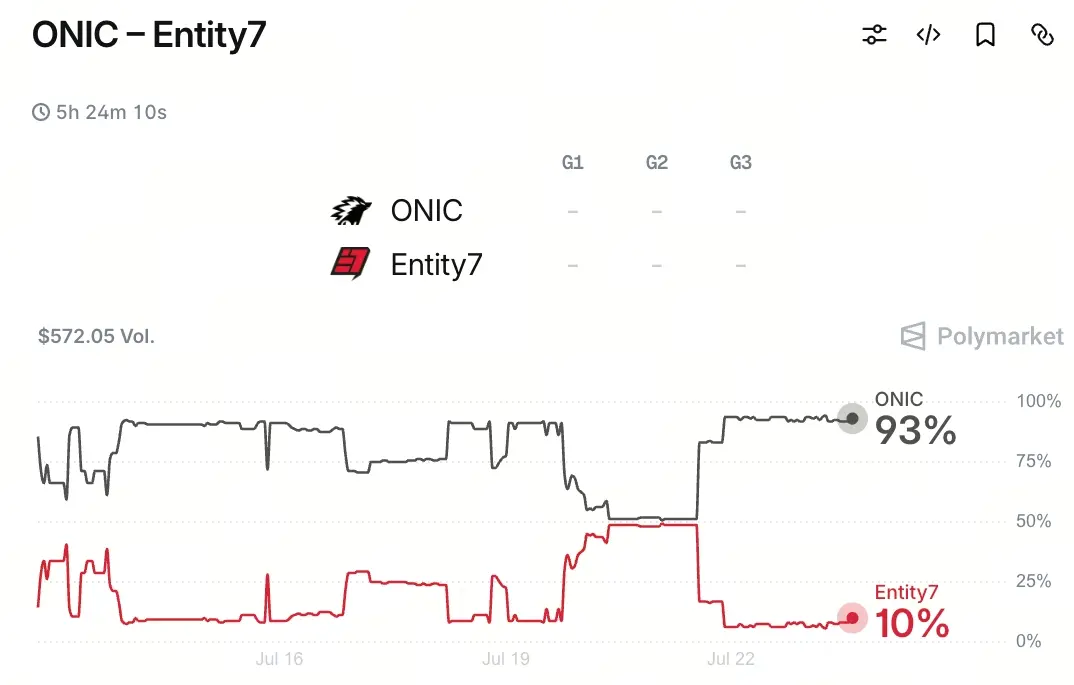
A 93% implied probability means the market believes there is virtually no suspense in this match. From the prediction market pricing logic, this win rate includes ONIC’s absolute advantages in player strength, past performance, and regional strength, and it also reflects the objective lack of validation for Entity7 at international events. By using capital to “vote,” the market turns the quantifiable gap between the two teams into a probability figure close to an extreme value.
But 93% is not equal to 100%. The core value of a prediction market lies precisely in how it “prices uncertainty” in a market-based way—even in a match that appears lopsided in strength, Entity7 still has a theoretical chance of an upset with a 10% win rate. Under the Bo3 format, randomness in individual games, players’ form on the day, and the strategic battle in the BP (Ban/Pick) phase can all become variables that change the course of the match. Prediction market win-rate data is not a “prophecy” of the outcome; it is the market’s pricing of the information set at specific points in time.
How prediction markets are reshaping how people participate in esports events
Prediction markets are becoming an important intersection between the crypto industry and the esports industry. Through platforms such as Gate Polymarket, users can use USDT to place prediction trades on the outcomes of esports events and the eventual champion.
The key innovation in this mechanism is that it turns “watching,” a passive behavior, into “participation,” an active decision. Successful predictions do not rely on luck; they are based on systematic analysis of team performance, player condition, historical data, head-to-head records, and tournament momentum.
Gate’s expansion in the prediction market space has already shown early results. During the just-concluded World Cup, Gate prediction markets recorded more than 500k total participants, and cumulative trading volume exceeded $528 million. The trading volume on July 19 for a single day even surpassed Polymarket’s first place across all channels. As the first centralized trading platform to integrate Polymarket, Gate has become an important entry point for users to engage with prediction markets.
Currently, Gate’s ongoing “esports trading season” campaign covers multiple major tournaments including EWC, LPL, and LCK, with a total prize pool of 200,000 USDT. Users can not only share rewards through prediction trades, but also use the platform’s “smart money” feature to track the positions and judgments of high-win-rate traders. Prediction markets are evolving from a niche crypto application scenario into an important component of mainstream esports culture.
Where will the intersection of crypto assets and the esports industry go
The combination of esports and crypto assets is not accidental. Both share highly similar user profiles—young, digital-native, and sensitive to emerging technologies. Prediction markets are only the starting point of this intersection.
From a more macro perspective, MLBB’s three-time appearance at EWC, global monthly active users surpassing 110 million, and a total esports event prize pool of $3.5 million in 2026—these figures jointly point to a trend: esports is upgrading from “entertainment content” into a “tradable asset category.” And the price-discovery function provided by prediction markets offers infrastructure-level support for this trend.
When a match’s win probability can be priced by the market, and when users’ esports knowledge can directly convert into trading returns, the commercial model of the esports industry is being redefined. Gate prediction market data during the World Cup already proved that prediction demand for sports and esports events is real and strong. As more events are brought into the prediction market system, there is still enormous room for growth in this track.
How to view the relationship between prediction market data and match results
Prediction market data is “reference,” not a “conclusion.” A 93% win rate reflects the market’s comprehensive pricing of information before the match, but it cannot eliminate uncertainty within the match itself.
For ordinary viewers, prediction markets offer a quantifiable lens for watching—you can clearly see the market’s sentiment toward a particular match. For investors and traders, a prediction market is a decision tool that requires continuous tracking and dynamic adjustment. Changes in player form, sudden pre-match news, and the BP-phase strategic battle can all cause real-time fluctuations in win-rate data.
More importantly, the value of prediction markets is not only about “getting the result right,” but also their price-discovery function as an information-aggregation mechanism. When large numbers of participants express their judgments with real money, the resulting win-rate data itself becomes valuable information—it reflects the market’s collective assessment of the relative strengths of all sides in the event.
FAQ
Q: How are Gate prediction market win-rate data derived?
A: Gate prediction market win-rate data comes from the collective trading behavior of market participants. Users express their judgments by buying or selling shares of a given outcome; the market price then fluctuates, and the final probability reflects the market’s overall expectation of the event result. This mechanism is fundamentally different from traditional betting odds—it has no house edge and is determined entirely by market supply and demand.
Q: Does a 93% win rate mean ONIC is guaranteed to win?
A: No. 93% is the market’s pre-match pricing of ONIC’s probability of winning, not a guarantee of the match result. In the Bo3 format, variables such as randomness in individual games, players’ form on the day, and BP strategies can all affect the final outcome. A 10% win rate is low, but it is not zero.
Q: How can I participate in Gate’s esports prediction market?
A: Users can enter Gate Polymarket from the Alpha board in the Gate App via the homepage, and use USDT in their accounts to participate in prediction trades for popular esports events. At the moment, Gate is running the “电竞巅峰交易季” campaign; after signing up, users can participate in new-user benefits, weekly trading tasks, and prediction trade leaderboards.
Q: What is the total prize pool for MLBB MSC 2026?
A: The total prize pool for MLBB at EWC 2026 is $3.5 million. As an important part of EWC, MSC is one of the most heavyweight MLBB international events in the first half of the year.