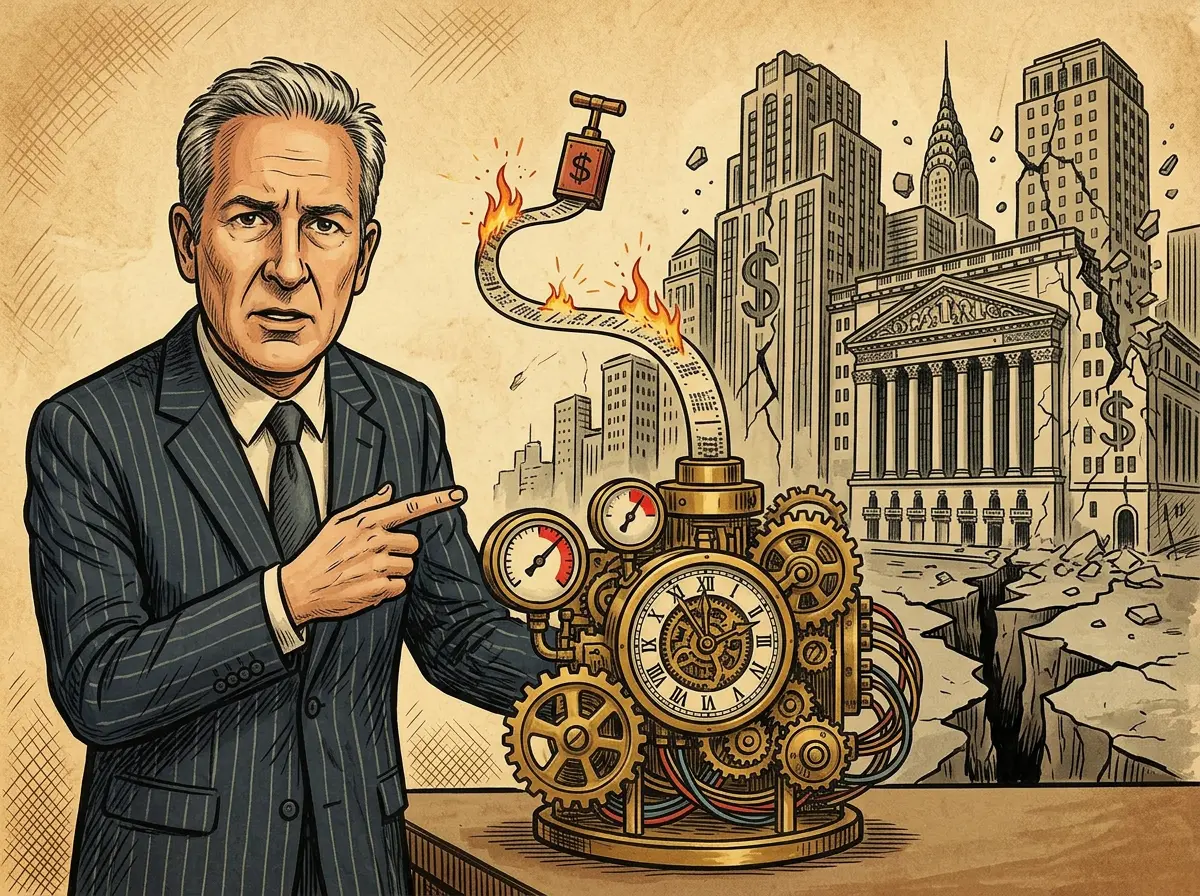
Peter Schiff, an economist known for long-term bearish views on the U.S. economy, said on June 3 in an interview with TheStreet that today’s U.S. stock market is more like a “time bomb,” with the market pricing equities “according to hopes rather than reality,” while ignoring structural risks such as U.S. Treasury debt nearing $39 trillion. Schiff explained that many of his warnings over the past several years have been gradually validated, and the only thing that hasn’t happened yet is the “ultimate crash.”
Confirming market data
S&P 500 index: Up about 80% cumulatively over the past five years
Nasdaq index: Up about 96% cumulatively over the past five years
Shiller P/E: Has broken above 40, one of the highest levels since 1999
U.S. Treasury debt: Nearly $39 trillion, continuing to rise
Gold’s gain over the past 12 months: Cumulatively up more than 35% (including the recent pullback)
Schiff’s reasons for recommending gold: central bank accumulation and de-dollarization
In the interview, Schiff said that the main driver behind gold’s rise is overseas central banks continuing to add to their gold reserves, and that this is the result of de-dollarization accelerating. He further pointed out that gold does not depend on corporate earnings, issuer repayment ability, or central banks printing more money, and thus differs structurally from stocks, bonds, and fiat currency. JPMorgan CEO Jamie Dimon also said that in the current environment, gold prices could “very well” rise to $10,000 per ounce.
Other institutions’ assessments: Solomon and Shiller P/E levels
Goldman Sachs CEO David Solomon said the odds of a 10-20% pullback in U.S. stocks over the next 12 to 24 months are “higher.” The Shiller P/E (CAPE ratio) currently exceeds 40, a benchmark used to gauge long-term market valuation; this level is similar to the 1999 dot-com bubble period. In a rapid Q&A during the interview, Schiff was asked whether the U.S. economy is “resilient” or whether a “recession is being delayed,” and his answer was: “A recession—maybe a depression.” This is Schiff’s personal view of the current situation, not an official data definition.
FAQ
What exactly does Peter Schiff mean by the “ultimate crash”?
In the interview, Schiff said that many of his warnings have been validated over the years—“the only thing that hasn’t happened is the final crash—the ultimate crash.” He said this is the ultimate result of various economic imbalances that have built up over the long term, but he did not provide a specific time prediction in the interview.
Why is attention on the Shiller P/E (CAPE ratio) breaking above 40?
The Shiller P/E (CAPE ratio) uses a cyclically adjusted price-to-earnings ratio based on average earnings over the past 10 years, adjusted for inflation, and is widely used to measure long-term equity market valuation. Currently, levels above 40 are among the highest since the 1999 internet bubble, and historically, such high valuation levels are typically followed by significant pullbacks.
What exactly did Goldman CEO David Solomon say?
According to reports, Solomon said that in his assessment, the odds of a 10-20% pullback in U.S. stocks over the next 12 to 24 months are “higher.” This is Solomon’s personal publicly stated view, not an official investment recommendation from Goldman.


